
Following Hurricane Melissa
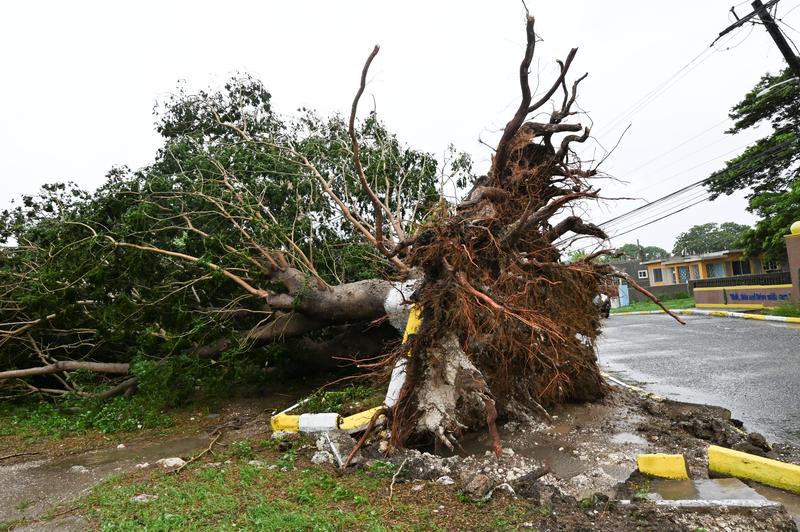
( RICARDO MAKYN/AFP via / Getty Images )
Title: Following Hurricane Melissa
[MUSIC]
Brian: Brian Lehrer on WNYC. As you've no doubt been hearing, if you follow the news at all, Melissa, one of the strongest hurricanes ever recorded, struck Jamaica yesterday with 185 miles per hour winds, causing landslides, knocking down trees and power lines, and more. The storm is now crossing Cuba, thankfully with less intensity, although still a slow-moving Category 3 storm, more than 100 mile-an-hour winds in Cuba.
Melissa has caused flooding in Haiti as well and the Dominican Republic, and will continue to bring heavy rains to other parts of the Caribbean on its way to Bermuda and on out to sea. Officials are still struggling to assess the damage done so far, but we're joined now by Arlan Fuller, the director of Emergency Preparedness and Response for Project HOPE, a global health and disaster response organization. Arlan, thank you for taking some time from what must be a very busy day for you right now. Welcome to WNYC.
Arlan: Thanks, Brian. Appreciate you having me on.
Brian: Listeners, we want to invite you to help us report this story. What have you heard from friends or family in Jamaica or anywhere else in the region that's being affected? 212-433-WNYC. Call or text. Have you been able to contact them even since the storm? What do you know about preparations or the results of this monstrous storm? Call or text us with anything you can say to help us report the story, or if you have questions for Arlan Fuller from Project HOPE, 212-433-WNYC, 433-9692. Arlan, I see your Project HOPE website says you've mobilized a response team to move in and assess the needs in Jamaica. Have you already gotten any reports?
Arlan: Yes. Thanks, Brian. We do have our response coordinator in Kingston at the moment, talking to officials, local partners, and it's basically getting as much information as possible. I think part of the challenge with the sun that's come up now and everyone's kind of getting an understanding on how strong that impact of the storm was, we're still having issues in terms of getting any sort of communication to the west side of the island. Reports back have been sparse, but what we're hearing is that the true scale of the disaster is really catastrophic.
We're hearing back stories after stories of people who've lost homes, hospitals, one by one, reporting in basically saying that they've significantly received damage, or if they're basically not even in communication at all at this time. Just family after family of even those, as our team has been trying to reach loved ones on the west side, just learning that for many of them, all they have left is the shirts on their backs. It is definitely a larger concern. As the hours go by this morning, we'll have a better understanding on really where all the need is and how we can actually try to address that.
Brian: Let's take a phone call. Here's Tiffany in Bergen County. You're on WNYC, Tiffany. Thank you for calling in.
Tiffany: Hi. Thanks for having me. We are Jamaican, and so my grandparents are there. They're in their 80s. They live close to Montego Bay, but near Falmouth, which is where actually many cruise ships go. We have a feed, and that we have a camera that we can see here in the US, but we lost the feed the day before at about 11:30 PM when the wind started. Unfortunately, I've been calling, our other family members been calling, we've heard nothing since. Again, they're right where it hit close to Montego Bay.
Brian: That's really frightening. Arlan, do you have any advice or suggestions for Tiffany on how she can get in touch indirectly with her grandparents or go through official channels to find out about the particular neighborhood that her grandparents are in, or anything like that?
Arlan: Brian, what I would recommend is certainly the ways in which we've tried to do wellness checks on family members or friends. If you can't get any direct contact with the individuals that you're looking for, to try to find someone outside of the affected area or somewhere nearby, the best person that you can actually make contact with and see if you can have that individual go directly to find the people that you're worried most about.
I think, as of right now, calling the civil authorities or anything on the larger scale, I'm sure they're being inundated with all of those similar calls. The effectiveness of being able to try to do that through those sorts of channels may be a little bit more difficult. I would recommend definitely having, at best as possible, trying to find someone who can go in and physically check on them as quickly as you can.
Brian: Tiffany,-
Tiffany: Thank you.
Brian: -I hope that's helpful. Thank you very much. As we continue with Arlan Fuller, director of Emergency Preparedness and Response for Project HOPE, a global health and disaster response organization, talking about Hurricane Melissa in Jamaica and elsewhere in the Caribbean, and you, if you want to help us report this story or ask a question, as our first caller did, 212-433-WNYC, 433-9692. Let's take another call. Here's Spencer in Manhattan. Spencer, you're on WNYC. Hi.
Spencer: Hi. Thank you for having me. As a Jamaican who got displaced during the hurricane and came up to New York, I'm devastated by what's happened down on the island. I'm still waiting to hear from half of my family and so many friends who have been disconnected from this devastating hurricane. The damage is actually unbelievable. I've received videos from friends and family who I have connected with.
At this point, I think the only thing we can do is pray that everyone who hasn't already outreached is going to do so. If you're looking for a place to donate, there's the American Friends of Jamaica that does incredible work on the island and will immediately send aid to the people who need it the most, as well as the Food For The Poor, which is a Christian organization on the island that does a lot of things as well. Just so devastated and praying for my island and my people.
Brian: Thank you. Before you go, and Arlan, I'm sure you're going to say people can donate to Project HOPE as well, but Spencer, did you hear anything from your family members about how they were preparing for the storm or how effectively they felt that local officials were helping them prepare for the storm?
Spencer: Sure, absolutely. I really appreciate that question. At the end of the day, this storm sat as a storm I've never seen for days, building in the warm waters of the Caribbean, right south of Jamaica. Really, I've been in Jamaica for dozens of hurricanes, near misses, a couple landfall, but this one seemed to have a vendetta of some kind. It really built and went right across the island, not quite as we were expecting it to, crossing the western side of the island instead of the eastern side, which was originally forecast.
My people all took it very seriously. Houses were boarded up. I'm involved with the Yacht Club in Montego Bay. Everybody took their boats off the dock, and what we do with those is ram them into the mangroves and tie them down as many times as we can, and most of those are okay. Roofs went. There's not much you can do about a roof flying off of your house. Boarded-up doors, sandbags in front of doors to keep the floodwaters out, things like that. The storm surge on the south coast seems to have been much worse than the storm surge on the north coast, but it's still unfolding.
Brian: Thank you for filling us in to that degree. I hope everybody who you know down there is safe. Spencer, thank you for your call. Arlan, what can people do to help? What's the most effective way to help, and is there anything that should be avoided?
Arlan: With the last caller, I do agree that trying to find the right organizations that can provide support and direct that support as effectively as possible is the right way to go. Whether that's Project HOPE or any other organization, if you're Jamaican or have Jamaican ties, and there's organizations that you've supported in the past, I'm certain that every organization is putting down everything that they're doing to make a big impact and try to help those in need. The amount of needs for a Category 5 is going to really exceed everything that really can be brought to the fore. Providing as much support to those organizations so they can direct those services in the most effective manners possible is the way to go.
I'd say, in sort of the old-fashioned traditional way of putting together care packages and putting them in the mail and sending them down and pre-selecting things and making those sort of in-kind donations is really not as effective as what you can do for actually a straight donation to an organization. There's just too much involved in terms of coordinating and managing all of the things that could be donated, and it just creates a lot of inefficiency where organizations, if they were just to get direct support, can focus right on providing as much support to those people in need as of in the immediate sense. That would be the recommendation I would provide to anyone listening.
Brian: Listener texts, "I'm a student at Howard University in DC. I've been reaching out to my family in St. Catherine and Clarendon, and I haven't heard any response since yesterday. I see a lot of videos online. The water decimated so many parts of St. Elizabeth. I can't access the camera feed either. Just keep praying." Here's one regarding Cuba. Listener writes, "I've heard no word from my in-laws or friends in Santiago de Cuba, the first stop the hurricane made after it left Jamaica. It's 22 hours since they've showed as being online on WhatsApp or Facebook. I had hoped to hear from them by now, so I'm getting concerned."
Then a little description. "Things were already difficult in Cuba with the electricity and the water. I'm assuming they have no power and no water now, but I don't know what else has happened to them. There are high mountains in Santiago, and flash flooding is a real danger. Losing the roofs and becoming vulnerable to debris and water is a real danger." There's that from a listener. Arlan, what about the US government role? So much international aid has been cut, but President Trump has indicated the US would provide emergency assistance after this storm. What can you tell us that will be similar or different to previous US responses to other hurricanes in the Caribbean?
Arlan: We're on the watch to really get an understanding on how the US government's going to respond here. The president did make a commitment for a humanitarian response as it relates to Hurricane Melissa. That's extremely encouraging that that would be the case. Obviously, in the last several months, we have been watching a real change in plans in the way in which humanitarian action and US government support on international funding is really taking a massive strategic shift.
This is actually the first time in which we can see this plan in action. We've been in close contact. I was in communication with the State Department already. I think at this point in time, it's still to be determined as to what these change of plans may be and how that's going to affect things in real term. I can also hopefully be encouraged that with all the changes that we were seeing as it related to FEMA and all of the domestic disaster response directions that were going to be taken and the worries that FEMA was not going to be able to come in as strong as they could for the next domestic response, we did see a rather robust response in Texas.
It had its own challenges and problems in its own right, but it was something in which, even with all the talk, there was a rather robust response in Texas. Now, whether or not that will be the same case in future domestic responses, we don't know. At least I'm remotely encouraged that in a response here for Hurricane Melissa, that there is going to be a strong US level of support, but that still is to be determined.
Brian: We will have to leave it here for now [inaudible 00:14:10] Arlan Fuller, director of Emergency Preparedness and Response for Project HOPE. Good luck with all your efforts. Our thoughts obviously are with everyone affected by this devastating storm. Of course, we'll have reports throughout the day on our newscasts, a lot on all things considered this afternoon, starting at 4:00. Arlan, thank you for joining us this morning.
Arlan: Great. Thanks, Brian.
Copyright © 2025 New York Public Radio. All rights reserved. Visit our website terms of use at www.wnyc.org for further information.
New York Public Radio transcripts are created on a rush deadline, often by contractors. This text may not be in its final form and may be updated or revised in the future. Accuracy and availability may vary. The authoritative record of New York Public Radio’s programming is the audio record.
