Brian: Brian Lehrer on WNYC. We're going to end the drive with a little bit of fun each of the next few days with a short-form series about how to find your personal style. We will bring you wisdom from a few well-dressed people, if you want to call them that, who think seriously about clothes and who understand the history and meaning behind the clothes we choose and why we wear what we wear.
We're starting close to home. Our colleague James Ramsey, digital producer and author of the early edition newsletter for the WNYC and Gothamist newsroom, joins me today because he recently admitted to a long-running aspiration. Hey, James.
James: Hi, Brian. I don't know if I qualify as well-dressed, but I admire those who are, so I'm qualified enough to talk on the topic.
Brian: What was that long-running aspiration?
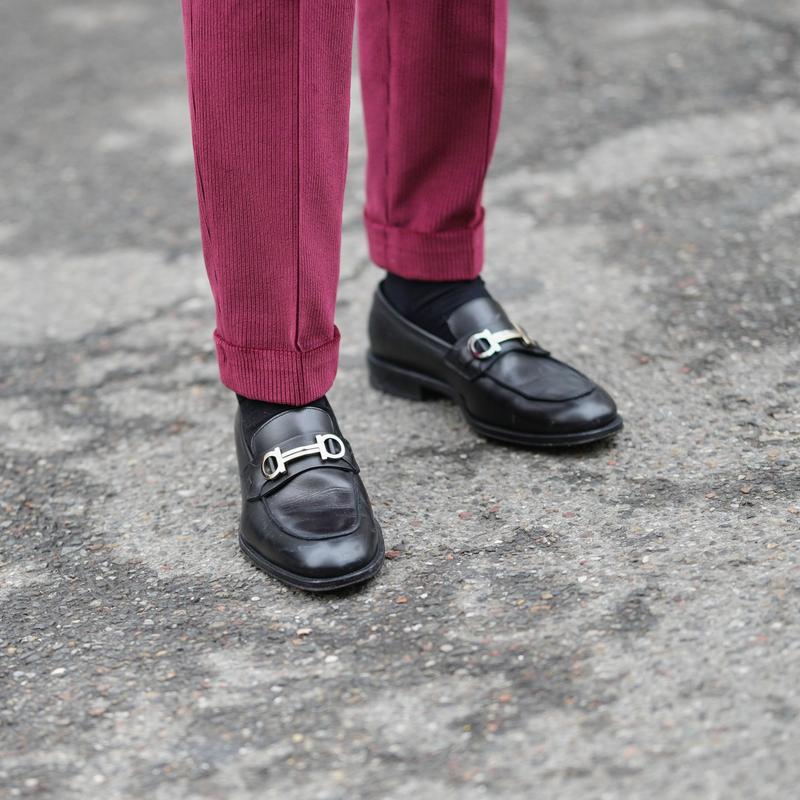
James: The long-running aspiration has been to be the kind of person who wears dress shoes to work.
Brian: [laughs] Why?
James: I haven't quite gotten there, but I haven't given up on it either.
Brian: I aspire to be the kind of person who wears running shoes to work. Why dress shoes?
James: Why dress shoes? Because I think of it as a very adult and dignified aspirational way of carrying yourself. For me, this goes back-- I moved here at the age of 21. A lot of people move to New York City right after college, and it marks, really, the real start of your adult life. For context, I moved around as a kid, but I was coming from San Diego, California, which is a beautiful place, and the people are lovely. People with graduate degrees all dress like they're on their way to a swimming lesson. I had it in my head that I was going to come to New York, and I was going to have a little more of a dressed-up, like I said, dignified way of carrying myself.
Brian: Now, listeners, we don't have too much time for calls in this segment, but we have a little. Is there a piece of clothing that you associate with the next version of yourself? 212-433-WNYC. You're hearing James's story about what dress shoes meant to him when he first started adulting 15 years ago. What about for you? Is there a piece of clothing that you have ever associated with the next version of yourself and done it, gone there, started wearing whatever that is, or one that you have in mind right now, but you haven't pulled the trigger yet? Say it out loud.
Maybe it'll give you that impetus to take that next step. 212-433-WNYC, 212-433-9692. Call right up. You'll get right on because we only have a few minutes. Again, is there a piece of clothing that you associate with the next version of yourself from any time in your life or that you have in mind right now and might yet even really do? 212-433-WNYC, 433-9692. Maybe you just want to call and identify with James as a hard soul kind of person with some shoe style to impart. You describe a proper dress shoe as timeless, even modest. Talk about how the timelessness and modesty interact there.
James: I think the dress shoe for me is a little different than simply dressing up. It's not quite the same thing as being fancy or being flamboyant, which, if you are fancy and flamboyant, power to you. I think that's very cool. The dress shoe, it's like when you see those old pictures of people going to Yankee games in the '30s, and they're all dressed up. It's been going on for generations. Even for me, it's like Proustian reverie of my dad walking in, coming home from work at the end of the day, and hearing the clunk, clunk, clunk of his loafers on the floor.
I think people have been doing this for forever. Why do I need to just wear tennis shoes to the office every day? What makes me special? The timelessness in that sense it's emotional kind of way. It's also literally the fact that these things, the ideas, you break them in, you wear them in, and you keep them forever.
I wrote about this for gothamist.com and for the people that I spoke to for the story. Almost everybody mentioned, "Oh, these are my favorite shoes. I beat the heck out of them, and after six years, I brought them back to the cobbler, and they resold them." I also think that is an extremely New York City thing. Having a cobbler, having a guy that fixes up your shoes after you beat them up, I wish I was that. I want that so bad.
Brian: I guess I can't do that with my running shoes. By the way, this is why I love James Ramsey. Here we are talking about shoes, and he uses the phrase "Proustian reverie" with respect to shoes. Andrew on Staten Island, you're on WNYC. Hi, Andrew. You have a story?
Andrew: Hi. Yes, I totally do. I just want to say first, I listen to you all the time, so-
Brian: Thank you.
Andrew: -thanks for doing what you do. I've been trying to get into leather jackets. I'm riding motorcycles more, so I thought it'd be fitting to look like Marlon Brando. I think it's similar to the shoe thing because you break in your jacket, and it's like your jacket, and it has that patina and that look to it.
Brian: I'm going to leave it there to get a couple of more people on, but good story. I see that you're finding the impediment is that leather jackets turn out to be very expensive. David in Edison, you're up next. David, you're on WNYC. Hi.
David: Hey. I started working for myself almost two years ago. When I started my business, I went down and bought a new blazer, and it's still hanging in my closet, yet to be worn. I find that my days working for myself from home are more defined by the days where I wear hard pants versus soft pants, a hard waistband and a belt versus something with elastic, like sweatpants.
Brian: Why is the blazer still hanging there?
David: I thought it was who I wanted to be, but every time I go to dress myself up for something professional, it doesn't quite seem right, and that happens sometimes.
Brian: David, thank you very much. Vanessa in Brooklyn, you're on WNYC. Hi, Vanessa.
Vanessa: Hi. How are you? All the best with your family health issues, I want to say.
Brian: Thank you very much.
Vanessa: Ever since I was a hippie back in the '60s, I started wearing long skirts and petticoats. I found some petticoats with tons of ruffles that made me look like a maid servant from 1900. I wore petticoats for years, and now I'm still doing it. I actually have a cashmere petticoat thing that I put under my straight skirts to stay warm. The other thing that I do is hats with hat pins. Who does that?
Brian: Who does that?
Vanessa: I have a collection of hat pins, and without a hat pin, the hat is going to blow off your head. I have a lot of hair that I-
Brian: Especially this week.
Vanessa: -tie up with a bun, and I put the pin through the hat and through the hair, and it stays on my head, and people are amazed, what [crosstalk].
Brian: Vanessa, thank you very much. James, 30 seconds for a final word. Any other wisdom you want to impart?
James: I think what I'm hearing and part of this is certainly for me when I really think about it. It's a lot about confidence. Being a New Yorker is about being confident. Part of the shoe thing in particular, what I'm so hung up on is like, "Man, if I was the kind of person who could break in a pair of leather dress shoes, I could seize the world. The world would be my oyster." That's why, through all the trial and error, I keep aspiring to this.
Brian: James Ramsey, digital producer and author of WNYC's Morning Edition newsletter. His piece in Gothamist is called, New York City Used to be a Hard-Sold Shoe Town. Could I be Part of a Revival? James, thanks a lot.
James: Thank you, Brian.
Brian: That was fun. More personal style talk at this time tomorrow. Coming up after the news, All Of It with Alison Stewart. Among her guest, documentarian Morgan Neville talks about Man on the Run, his new film about Paul McCartney's career in the decade after the Beatles broke up. That'll be fun. More with Alison after the latest news here on WNYC.
Copyright © 2026 New York Public Radio. All rights reserved. Visit our website terms of use at www.wnyc.org for further information.
New York Public Radio transcripts are created on a rush deadline, often by contractors. This text may not be in its final form and may be updated or revised in the future. Accuracy and availability may vary. The authoritative record of New York Public Radio’s programming is the audio record.