
Feeding Senior Neighbors
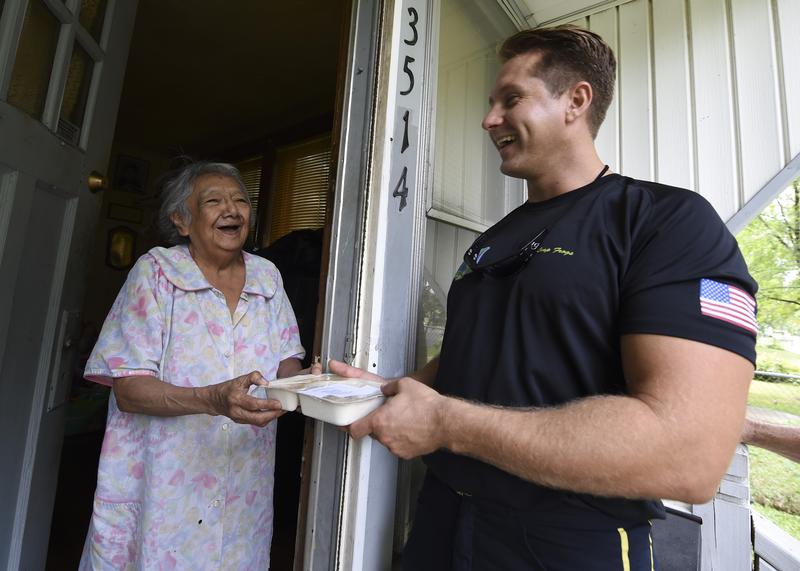
( MC2 Pyoung K. Yi/U.S. Navy / U.S. Navy )
Amina: It's The Brian Lehrer Show on WNYC. I'm Amina Srna, a producer for The Brian Lehrer Show, filling in for Brian today. Thanksgiving, just one week away, is also the busiest time of year for many organizations who provide food assistance to New Yorkers. This year, some of the year-end report findings are pretty stark. The Poverty Tracker report, released by the charitable organization Robin Hood and Columbia University, finds that over 40% of New York City families can't afford their weekly food costs.
Citymeals on Wheels, which says it's the nation's largest operation to deliver meals to homebound seniors, says that here in the city, 1 in 10 New Yorkers over the age of 60 already lack reliable access to affordable and nutritious food, and that half of meal recipients surveyed by Citymeals rely on SNAP. With us now to talk about one segment of New Yorkers who rely on food assistance programs this holiday season is Beth Shapiro, CEO of Citymeals on Wheels. Citymeals is the nation's largest operation to deliver meals to homebound seniors. Beth, welcome back to WNYC.
Beth: Amina, thank you for having me.
Amina: As we say, Citymeals delivers 2 million meals annually, 700,000 of which will be just this holiday season alone. Can you tell us a bit about the people that you serve? What ages are they, and where do they live?
Beth: Citymeals is feeding homebound older New Yorkers across all five boroughs. From 60 years old on, the average age of our meal recipient is 87, and I am honored, proud, and sometimes shocked to say we are feeding over 500 people who are 100 years old or older in this city.
Amina: Grocery shopping can be a schlep, even for younger and able-bodied people. Could you describe the unique challenges that older folks who often have mobility challenges might experience when they're trying to go grocery shopping? Milk and all the rest of the groceries are really heavy.
Beth: I think older adults in general often struggle with carrying groceries, and the people that Citymeals is focused on are identified as being too frail to shop or cook for themselves. They are not able, on a regular basis, to get to a grocery store to carry their groceries home with them. We're making sure meals, as well as some of our smaller programs, are bringing pantry items and fresh produce to their doors, as well.
Amina: Listeners, we might have some time for a few of your calls. Does anyone out there receive food assistance from Citymeals on Wheels, or anyone you know who does? What would you like listeners to know about what you're dealing with? Give us a call or text at 212-433-WNYC. That's 212-433-9692. If anyone listening has a senior neighbor or a friend that you're a little worried about, they might need some help getting or affording food, give us a call, and we'll see if our guest, Beth Shapiro, from Citymeals on Wheels, can help. 212-433-9692. Beth, more than half of the seniors surveyed who rely on Citymeals survive on very low incomes. Can you tell us about their economic situations, generally?
Beth: Sure. Actually, about 65% of those we're serving are surviving on $15,000 a year or less here in New York City. They are making difficult decisions about rent, in the summer, air conditioning, paying for medicines, as well as food. I think we all know that that $15,000 does not go far, and grocery costs have gone up 33% in the last decade. They're stretching their dollars further and further, and we want to make sure at least one meal a day is coming to the door to help.
Amina: Citymeals has also spoken against the federal government's recent decision to end the USDA's annual household food security report. For listeners who aren't familiar, can you explain that report for us, and why the government has ended it, and really what it means for Citymeals?
Beth: The USDA report looks at hunger across the whole country. They look for areas of higher insecurity. Actually, the South Bronx is known to have the highest insecurity than almost any other area in the country. It is that report that then enables the federal, state, and city governments to direct services to the areas that need it most. Without that report, we're going blind. The good news for Citymeals and for New York's older adults, Citymeals did a research almost two years ago now, specifically looking at hunger among older New Yorkers. We have data, but the rest of the population from cradle to grave is lacking or will be lacking information.
Amina: Let's go to a call. Gregory in Harlem, you're on WNYC. Hi, Gregory. Gregory, can you hear me? Oh, we'll go back to Gregory to see if we can get him. Beth, the federal government shutdown that started on October 1st paused the issuance of some SNAP benefits, but New York State used its funds to issue full November SNAP benefits to residents. Still, as we heard from listeners when we were covering that story, the uncertainty was stressful for the people that we heard from. How many Citymeals recipients also rely on SNAP, and what was that moment like for them?
Beth: About 30% of older adults who receive home-delivered meals also rely on SNAP benefits. There was a delay in getting the SNAP funds, and the anxiety and fear around that, it continues, actually, because we are facing a two-month reprieve, and then who knows what is coming. Even though it looks now that SNAP has been made whole through next fall, it already wasn't enough when you see the increases in food costs, and I think the fear and anxiety, coupled with actuality, is a lot for people to deal with.
Amina: A listener texts, "What are the requirements to receive Citymeals on Wheels?"
Beth: 60 and older have a limited ability to shop or cook for themselves. Home-delivered meals are not needs-based. They're not financially driven. As I said, we know 65% of our meal recipients are surviving on $15,000 a year or less. People can call 311 or look at citymeals.org to get information about receiving meals for themselves, family, neighbors, friends.
Amina: I think we have Gregory back. Hi, Gregory. You're on WNYC.
Gregory: Thank you. Thank you so much for taking my call. I just wanted to say thank you to not only the people who run the Meals on Wheels, because the people here in my building receive, and they're all seniors. I am too. I'm 79 years old and a member and a constituent of the local food bank here, where we serve seniors every afternoon. We have been aware that ever since that FRAC meeting in 2019 in Washington, and we're very concerned about food insecurity because, as I'm sure you know, that the Farm Bill still hasn't been done yet.
Food insecurity has been around for quite a long time, longer than it's become popular in the news. I just want to thank you for the service you provide for especially seniors like myself, and everyone of the services, City Harvest and Food Bank for the City of New York, who provide meals for seniors and other people. The lines were just incredible the past couple of weeks for the pantry over there. Thank you. I'm sorry.
Amina: Gregory, thank you for your call. Beth, I see you nodding your head.
Beth: I'm nodding, and I appreciate the mention of our colleagues at other nonprofits. The Farm Bill, Gregory's knowledge about the state of hunger are a bit actually inspiring to me, and the recognition that it's nonprofits that we come together when people are in need to solve problems. The call is really to the government to get together and recognize hunger as a real issue across this country. It should not be. We live in a country of great wealth and great overflow of food.
Amina: Citymeals has a goal to end elder hunger in New York City by 2040. As we transition to a new mayoral administration for the next four years, do you want to weigh in a bit on what you would like to see from the Mamdani administration to help your organization's goals?
Beth: Sure. I'll start with an invitation to come up to our distribution center in the Bronx or join me on a meal delivery and get a firsthand look at what hunger among older adults looks like in New York City. We set the goal to end hunger for older New Yorkers by 2040, knowing that we cannot achieve it alone. This is something we need to do with our partners. It's something that government, city, state, and federal level need to take a look at historical lack of funding for services aimed at older adults. That's what I would say to the new administration. Take a look and help us help you to feed New York citizens who have built this city for us.
Amina: We have another caller, James in Hell's Kitchen. Hi, you're on WNYC.
James: Hey there, thanks for taking my call. Beth, I love Citymeals. You guys all do really great work. My next-door neighbors actually get meals from you all because they can't leave their fifth-floor apartment here in Hell's Kitchen. I know they really appreciate the daily interaction from the staff and volunteers of Citymeals. I wanted to know what do you guys need support-wise? As I just heard, the need is continuing to rise, and with the holidays starting next week.
Amina: James, thank you so much for your call. As we noted at the top of the segment, this is the busiest time of year, probably for your organization. How would you respond to James' question?
Beth: I would first say it is a busy time. It is also the time of year that we were founded, when our founders recognized hunger and older adults going actually up to four days without food because the home-delivered meal program by the city was a Monday through Friday program. The first need is, of course, funding and donations. We guarantee that all donations from the general public, 100%, go to meal preparation and delivery. We also need volunteers for the holidays and beyond. Every day of the year, we rely on tens of thousands of New Yorkers to donate their time to help us deliver meals, pack meals, even write greeting cards to older adults so that they know people are thinking about them, that their neighbors do care.
Amina: We have some feedback or maybe a critique from a listener. Here's Lisa in West New York, New Jersey. Hi, Lisa. What would you like to say?
Lisa: Hi. I understand that people, it's from their heart, they're giving from their heart, but they may not know that there are two Meals on Wheels. One is the fundraiser, and the other is the one that prepares the food. I'm in West New York, New Jersey, and we have thousands of seniors in this community and in my building. Unfortunately, the kitchen is not the same. If you go to Bergen County, it's a different story. In Hudson County, especially West New York, where there are thousands of seniors, we're not getting good food. In fact, the commissioner will confirm many people are throwing it out.
Amina: Lisa, let me get a response to you from Beth Shapiro, CEO of Citymeals on Wheels. Beth, what would you like to say?
Beth: Lisa, I'm sorry you're not satisfied. Actually, Citymeals serves the 5 boroughs of New York City. There are 5,000 independently operated Meals on Wheels programs across the country. Here in the city, many of our partners work with 30 or so partners who are preparing and delivering meals. I would continue to voice your concern, Lisa, and recognize that each program is operated differently, but all meet the government requirements of nutritional standards for older Americans.
Amina: Back to Citymeals on Wheels. A listener asks, "Do we need a car for delivery?"
Beth: For volunteers? Absolutely not. In some areas, actually on Thanksgiving, we do still need volunteers with cars to help, but there are many areas across the city where it's Meals on Heels, not necessarily Meals on Wheels. So we can take walking and driving folks.
Amina: Did you mention to listeners where they can sign up?
Beth: Go to citymeals.org. You can click to donate. There's a click for volunteering and a click for more information if you know someone who needs meals.
Amina: Beth Shapiro is the CEO of Citymeals on Wheels. Beth, thanks so much for coming on the show.
Beth: Thank you for having me.
Amina: That's The Brian Lehrer Show for today. The Brian Lehrer Show's producers are Lisa Allison, Mary Croke, me, Amina Srna, Carl Boisrond, and Esperanza Rosenbaum. Our interns are Amanda DeJesus and Miranda Santos. Megan Ryan is the head of Live Radio. Juliana Fonda and Milton Ruiz are at the audio controls. I'm Amina Srna, and this is The Brian Lehrer Show on WMIC. Stay tuned for All Of It.
Copyright © 2025 New York Public Radio. All rights reserved. Visit our website terms of use at www.wnyc.org for further information.
New York Public Radio transcripts are created on a rush deadline, often by contractors. This text may not be in its final form and may be updated or revised in the future. Accuracy and availability may vary. The authoritative record of New York Public Radio’s programming is the audio record.
