
Eugene Robinson's 'Personal History of America'
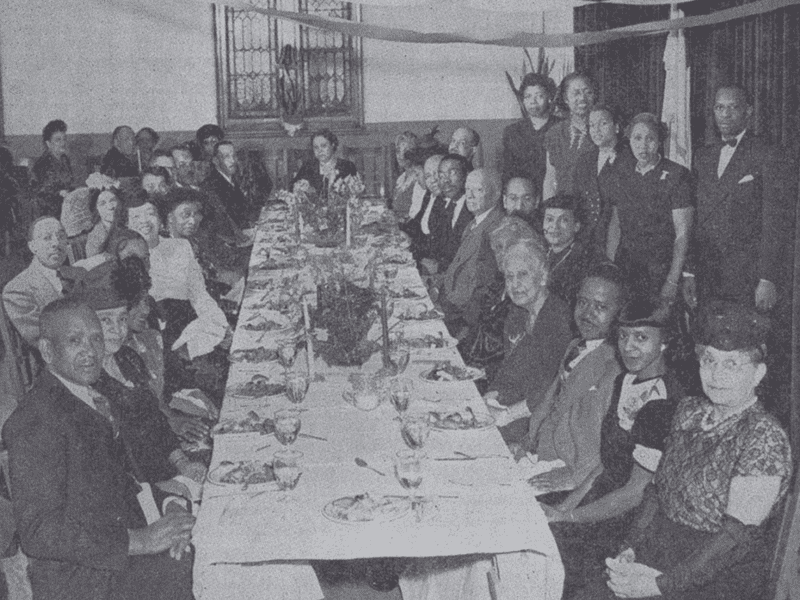
( Carter G. Woodson Home National Historic Site / National Park Service )
[music]
Kousha Navidar: It's the Brian Lehrer Show on WNYC. Welcome back, everybody. I'm Kousha Navidar filling in for Brian today. This week marks the beginning of Black History Month, and this year the annual commemoration of Black heritage and resilience celebrates its 100th anniversary. It in the years after Reconstruction, Carter G. Woodson established the precursor to Black History Month in 1926. He wrote that year, "If a race has no history, it has no worthwhile tradition. It becomes a negligible factor in the thought of the world, and it stands in danger of being exterminated. Let truth destroy the dividing prejudices of nationality and teach universal love without distinction of race, merit or rank. A hundred years later, that quote is being challenged by the Trump administration. It has, in its second term, taken down references of Black history at national parks. Juneteenth is no longer a free admission day at national parks, and last month it removed an exhibit on slavery in Philadelphia. This is all according to ABC News. Still, the celebrations go on. Scholars, civil rights activists and artists are putting together events around the country to commemorate the centennial. In honor of Black History Month, we'll now take a closer look at one family's story as it intersects with America's ongoing struggle with structural racism, what's been accomplished and what still needs to be done.
Joining us now right in the studio, I'm very excited to welcome Eugene Robinson, a Pulitzer Prize winning journalist, former columnist and associate editor of The Washington Post, and political analyst. He's the author of the new book Freedom Lost, Freedom Won: A Personal History of America. Eugene. Welcome back to WNYC.
Eugene Robinson: Thanks so much, Kousha, and happy Black History Month.
Kousha Navidar: Happy Black History Month. Happy Black History Month century. Second century, I guess now, right?
Eugene Robinson: Second century. That's right.
Kousha Navidar: As we commemorate the 100th anniversary of Black History Month, I'm wondering, listeners, if anyone wants to share some of their personal family history. Has anyone out there listening right now been able to trace back their family history and discover something about your ancestors, especially as they relate to historical events? Slavery, Reconstruction, the Great Migration. What did you find out and how? Give us a call now at 212-433-WNYC. That's 212-433-9692. You can also text us at that number.
Eugene, we'll get into your book and your family history, but you write about how growing up it never occurred to you to go looking for that history because it was already all around you. Can you tell us a bit about where you grew up? It wasn't far from where you've been able to trace your family history back to, right?
Eugene Robinson: Right. I grew up in Orangeburg, South Carolina. It's about 70 miles inland, a little northwest of Charleston, so between Charleston and Columbia. Orangeburg is home to two historically Black colleges, Claflin University and South Carolina State University. Claflin was the HBCU in South Carolina, founded in 1869. My mother was the head librarian at Claflin University for her entire career for 30 years, and my dad taught there for a while.
Orangeburg, my Orangeburg growing up was like a Black college town in a way, except one that was surrounded by Jim Crow, because I was born in 1954, so I was growing up at the height of the Civil Rights movement.
I grew up in a house that had been built by my great grandfather on my mother's side. His name was Major John Hammond Fordham, and he was a formidable person who had been a Reconstruction era success story. He had become a lawyer. He had been a Republican Party politico of a high rank. He was high ranking in the South Carolina Republican Party. He corresponded with Theodore Roosevelt, and he went to all the political conventions of his era and Republican inaugurations, everything.
He built this house, and he was a pack rat. I, literally, was surrounded by my family's-
Kousha Navidar: Stacks and stacks of your history.
Eugene Robinson: -history, the walls, the floor. There was furniture and there were documents. There were his speeches, his letters. There were bank records, there were mortgage documents. There was just papers all tucked under beds, and he had a safe that he had his most important papers. That's where he kept his most important papers. It was always there.
It was me and my sister and our parents and my grandmother and my great aunt who had lived in the house since they were-- one was a teen, one was in her early 20s when the house was built. There was not a steady stream, but an ocean of family lore that-
Kousha Navidar: You were swimming in.
Eugene Robinson: -that I swam in every day. It was just all there. I figured I would try to do something with that at some point because I knew that I had an unusually long documented history for most African American families because Major Fordham's father, my greatest great grandfather, had been enslaved and had managed to become free before the Civil War, so he was among the accounted for, as opposed to most African Americans of that era. Those who were enslaved were not-- they weren't in the census. They were hard to find.
Kousha Navidar: I want to tease that out a little bit because you write about how the most revolutionary new resource for you has been DNA testing. What made you want to send in the testing? What did it reveal?
Eugene Robinson: What made me want to do it? The book starts with that great, great grandfather, Henry Fordham, who was sold to a plantation owner in Charleston in 1829, sold again to Charleston businessman in 1848, and bought his own freedom in 1851 and sort of was the patriarch of the family. I don't know anything about where Henry Fordham originally came from.
He was described in the earliest document I could find, the document of the 1829 sale, as a boy named Harry. That's all I know of him. He was sold among a group of four African Americans who were being sold to this plantation owner, but it's unclear from the document whether they were related in some way. I think they weren't related to each other. I had tried to go back further and to see if there's anything I could find out about his life before that, who he was, who this boy named Harry was, and dead ends, blind alleys, nothing. DNA is there, and it's improving. It tells you something, but it didn't tell me anything that surprising.
What it told me was that the lion's share of my genes are from the African continent, mostly from West Africa, from what is now Nigeria and what is now Mali. I'm not sure I'm remembering the percentages right, but roughly 80% of my genes are from the African continent, and 20-25% are from Europe. Again, that makes sense. Most African Americans have that mix. Most African Americans are a mix of the enslaved and the enslaver, in a way.
Kousha Navidar: How did you find out more about Harry, then?
Eugene Robinson: About?
Kousha Navidar: About Harry? About the boy Harry?
Eugene Robinson: I knew what the family had told me, and then I went to Charleston, which is where he lived. I went to the South Carolina Historical Society, not once, but many, many, many times, just looking for any shred of paper I could find about him. Of course, I looked through the house. I live in the Virginia suburbs, outside of Washington, and I would fly down to Charleston. I would take an empty suitcase, and I'd go to our house, which my sister and I still own, I would fill the suitcase with paper, and I would bring it back. I would try to tease out this narrative in these connections.
Fortunately, there's a lot more that's available online. I came across some amazing stories. I knew that he had been free before the Civil War, that he had one son, and he and his wife and his one son, John Hammond Fordham, had lived in Charleston through the Civil War. I knew that that was rough, and that was really rough for the small, free African American population in Charleston because they came under heightened scrutiny and heightened-- A lot of their freedom was essentially curtailed. There were free African Americans who were just summarily clapped back into slavery, and many left the state.
In a database of documents from an obscure post-war commission that I stumbled across, I plugged in Henry Fordham's name, and I got a hit. You remember the movie Glory with Denzel Washington?
Kousha Navidar: I do.
Eugene Robinson: It's about the attack in which Denzel Washington dies, spoiler alert, is at Fort Wagner, which is one of the two forts that form pincers and guard the entrance to Charleston Harbor. The Union really wanted to take these two forts, Fort Wagner and Fort Moultrie, and did not succeed. The attack on Fort Wagner failed, and most of the Black soldiers from the Massachusetts 54th who spearheaded the attack were killed, but some survived and were taken prisoner back to Charleston by the Confederate army and just tossed into a hole. tossed into a dungeon.
I found through these obscure documents that my great, great grandfather was a leader of an ad hoc committee of free African Americans that formed to bring medical supplies and bring food to those imprisoned Black northern soldiers and try to keep them going, keep them alive for the duration of the war.
Kousha Navidar: What a thing to discover.
Eugene Robinson: It's one of those magical moments.
Kousha Navidar: How did it feel for you when you found that?
Eugene Robinson: It's moment after moment like that. I learned that probably there's nothing in this new set of documents, but check it out, because you never know what you're going to find.
Kousha Navidar: How did it feel when you stumbled onto that after your 100th visit there?
Eugene Robinson: Exactly. It was amazing. It was similar to the feeling of pinning down when he became free. Henry Fordham had- my great great grandfather had-- while he was enslaved by this plantation owner, Richard Fordham, he had been set to work at a Blacksmith's forge, and he had become a very skilled blacksmith.
I knew that his freedom had taken place sometime between 1848, which is when he was sold from Richard Fordham to another man named Otis Mills, and sometime between then and 1860, because his name showed up in an 1860 Charleston City census as a free person of color. I knew it was in there, but that's 12 years. I couldn't pin it down. I couldn't pin it. Couldn't. Sure enough, in the South Carolina Historical Society I'm in there and I'm tearing out what hair I have left.
Kousha Navidar: You and me both. I know [unintelligible 00:15:43]
Eugene Robinson: A very helpful librarian said, "Look for him in the Free Negro book." This was a listing of free African Americans that was compiled annually based on who had paid the capitation tax that was required. To be a free Black person in Charleston, you had to pay $2.75 a year. It was really an exercise in data collection. They wanted to know who these free Black people were and where they were, because there was a lot of paranoia about free Black people, that freedom of movement and everything. Sure enough, I started consulting the annual volumes, and there I found him.
Kousha Navidar: There you found it.
Eugene Robinson: 1851.
Kousha Navidar: What a discovery. Listeners, if you're just joining us, it's the Brian Lehrer Show on WNYC. My guest is Pulitzer Prize winning journalist and longtime Washington Post columnist Eugene Robinson. We're talking about his new book, Freedom Lost, Freedom Won: A Personal History of America, and we're taking your calls about your family's personal history as we're celebrating Black History Month and the 100th anniversary of the start of what has become Black History Month. Let's go to some callers. Let's go to Maria in Greenwich Village. Hey, Maria, welcome to the show.
Maria: Hi. Thank you so much for taking my call. I called in to Brian a couple of times before, and I'm happy to do it again.
Kousha Navidar: Nice.
Maria: I work at NYU in the Office of Community and Culture, but I'm a historian and a sociologist, so this has always been a passion of mine to understand my family's history as it relates to really critical moments in American history. I could pull on any of the branches of my family tree, but I'd like to focus on my great grandfather who raised me. I could tell a lot of American history through his own life experiences.
His name was A.G. Robinson, and it's the letter A and the letter G, which is something that was common in the South. Due to illiteracy, a lot of women and parents wanted to have agency in how they named their children, and they wanted to be able to spell it. There are many people that just had letters for names. His name was the letter A and the letter G. He was born in Winona, Mississippi, in 1920. He was the son and the grandson of sharecroppers, and I've been able to trace his lineage on up through the 1700s of folks that were enslaved and all their names and all the children that they had.
He was part Cherokee and Choctaw and also European and West African. I've also done the ancestry and found census papers, certificates and all these things. I was really curious about how some of these big moments, like slavery, Reconstruction, Jim Crow, the Great Migration, the World War, how they impacted my family. During my doctoral studies at NYU, I took a class with Bryan Stevenson called Narrative Strategies for Racial justice, where we went to Montgomery, Alabama, and went to all the legacy sites.
One of the legacy memorial sites has these fixtures hanging from the ceiling, basically, that shows all the victims of lynching in every county throughout the United States. If you haven't gotten a chance to go, this is amazing.
I went to Montgomery County, Mississippi, which is where my nonna was. I was curious about, was lynching a reason why he moved from Mississippi to Chicago in the '40s? I was very curious. I saw in 1937, in Winona County, there were two men that were lynched. He would have been 17 years old. This is something that I was so curious about. Their names were Roosevelt Townes and Robert McDaniels. It was very similar to Emmett Till's story. A white woman accused them of something. They were strapped to a tree, and they were killed. They were paraded around the city and around the county. I'm like, "This had to impact my family."
I had these questions. Unfortunately, my great grandfather passed away before I could ask him a specific question, but he did raise me, and he told me a lot of stories, but this is one that he never told. Similar to survivors of the Holocaust, there were so many decades in which they didn't share these stories because of how traumatic it was. When I took this class, I understood that we had to reframe African Americans as a part of the Great Migration, as refugees.
Kousha Navidar: Maria, you know what you mentioned that really struck with me is how the pieces of our personal family history are echoes of the larger context in which those families lived, and thinking about the movement for your family to Chicago, what the basis of that was. Thank you so much for sharing about A.G. Robinson. We really appreciate your call. Let's go to another caller. Boom in Lakewood, New Jersey. Hi, Boom. Welcome to the show.
Boom: Hi, good morning. I have a unique lineage. My grandmother, Dorothy May Walker Jefferson is a descendant of Thomas Jefferson and Sally Hemings.
Kousha Navidar: Oh, interesting.
Boom: My cousin who is a doctor in New York City did family research on it, and that all came back out. On my other side, my Richardson side of my grandfather Lee, we have a thing where our family belongs to the Haliwa-Saponi tribe, which is basically Eastern Virginia to North Carolina. We had the Great Migration in which those people who were basically on a census, they weren't put down as Cherokee, they were actually put down as mulatto during that time frame, like your guest was speaking about having the 20%, 30%, 40% Caucasian.
It turns out in my lineage on that side is, we have Benjamin Richardson who was a general from England who actually had-- They weren't exactly slaves. He had the Native Americans which were entrenched first to do the free labor and then the Africans were brought over, but he actually fathered numerous families of children through this.
What's interesting is when the families in the 1920s and '30s left Carolina, they came up to Harlem and then to Freehold New Jersey, Lakewood and Trenton. Majority stayed in Trenton, but actually some went back down South recently.
The whole thing was we have irony here because of the fact that today's standards, you always hear that Black people don't stick together, and are not united. During the migration, you had to be united. My family did exactly what many other families did. According to my grandfather Lee, he took in his brother in law, he took in other relatives. People were basically living the way comedians crack jokes on Mexicans crowding up. That's how they had to live. They worked chicken farms together until they got public jobs like working in the school system and things like that, but they all helped each other-
Kousha Navidar: Boom, let me pause you there. Thank you so much for sharing that, that idea of sticking together during pieces of challenge. I think it echoes for probably a lot of families. Eugene, I'm going to turn it back to you because I saw you nodding your head during some of those callers' comments and so much of your family history is a story of being part of progress. How did hearing those callers resonate with you?
Eugene Robinson: There's a lot to unpack on the question of progress. What really impelled me to actually sit down and do the book, was that going through all this material, I saw this cycle of when African Americans would fight and scrape individually, collectively, to win a greater measure of the freedom and opportunity that's promised by America, and then it would be taken back, or most of it would be taken back, and then they would fight again and again.
The big example, of course, is Reconstruction and then Jim Crow, but I saw other cycles, both before and after when this took place. One would argue, I would argue, for example, that it is not a coincidence that the election of the first African American president is followed immediately by the rise of Donald Trump and MAGA, Make America Great Again, go back to the past. That gave me a framework for thinking about the book.
The other thing I was nodding at, especially with the first caller, is the idea of the African American story is woven into American story in an absolute-- It's more than an indelible way. It's a totally necessary way. There is no American history without African American history. We do have to have Black History Month. We shouldn't have to have it because this is essential, necessary American history, without which you cannot understand this country. African Americans were there in every episode.
Every huge cataclysmic event that happened in or to this country has Black people involved. I saw that in my family, the Civil War, Jim Crow, the white on Black riots, World War I, I have a great uncle who went to the Western front, that I write about, to fight in World War I, World War II, the Depression, and of course, the Civil Rights movement and moving forward.
While the African American experience is necessarily distinctive and different because we were the only ones who were enslaved. In fact, Black people could be slaves and white people couldn't, so that division was enforced. That's different, but the more I looked at my family's progress, the more I saw that in many ways, the African American story is simply the archetypal American story. What were they looking for all along? They wanted their chance at the American dream. They wanted freedom and opportunity. That's all they wanted from the very beginning, and they had to fight for it in a different way.
The final thing that I was nodding along with, when we were talking about the Great Migration, I've been mostly talking about my mother's side of the family, but I also write about my father's side of the family. His is a Great Migration story. Born in rural Georgia, his family moved north to the Detroit area, actually settled in Ann Arbor. He and all of my uncles, at various times, worked at the Henry Ford's gigantic River Rouge auto plant.
He's different in that he made the Great Migration in both directions because he moved back South to South Carolina for love, because he had met my mother and they decided that mostly because of her, they wanted to live there.
Kousha Navidar: The reason to move.
Eugene Robinson: He did it both ways.
Kousha Navidar: Eugene Robinson is a Pulitzer Prize-winning journalist, former columnist and associate editor of The Washington Post and political analyst. His new book is titled Freedom Lost, Freedom Won: A Personal History of America. Eugene, thanks for the days you spent deep in the records to show this history of your family and also the history of our country. It's such a pleasure to hear you share your story with us today.
Eugene Robinson: It's great. Thank you so much for the interest. Thanks to the callers for their great contributions. This was a gratifying project to have worked on, and so it's a joy to share it with you and your listeners. Thank you.
Kousha Navidar: Stay tuned for more.
Copyright © 2026 New York Public Radio. All rights reserved. Visit our website terms of use at www.wnyc.org for further information.
New York Public Radio transcripts are created on a rush deadline, often by contractors. This text may not be in its final form and may be updated or revised in the future. Accuracy and availability may vary. The authoritative record of New York Public Radio’s programming is the audio record.
