Eric Adams: Crypto Entrepreneur?
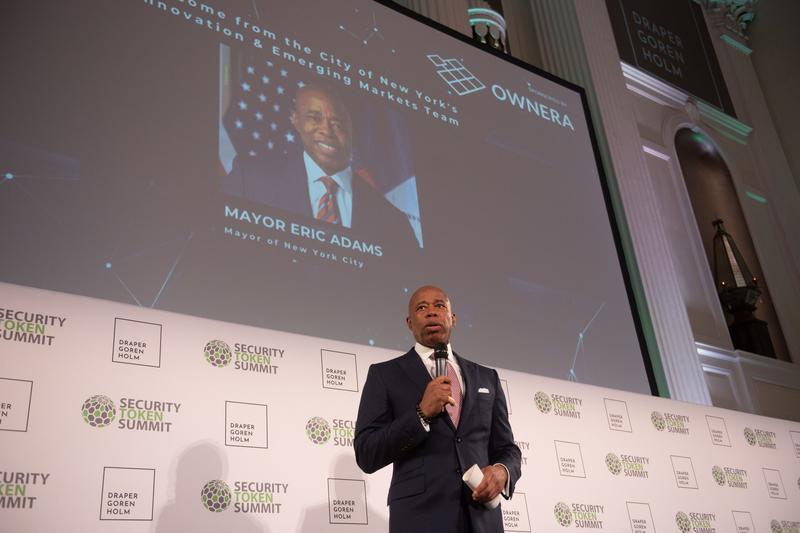
( Michael Appleton / Mayoral Photo Office )
[music]
Brigid Bergin: It's The Brian Lehrer Show on WNYC. I'm Brigid Bergin, filling in for Brian today. In retrospect, maybe this wasn't the most unpredictable career pivot, but former New York City Mayor Eric Adams is now a cryptocurrency entrepreneur. He's helped launch a new crypto token, one he claimed would somehow fight antisemitism and anti-Americanism. Unfortunately for Adams, this new token collapsed almost immediately, prompting scam accusations and scrutiny of both the project and the man behind it. What exactly happened here? Well, we're going to ask Leo Schwartz, senior writer at Fortune, who's been reporting this story. Leo, welcome to WNYC. I can't wait to talk about this.
Leo Schwartz: Thanks so much for having me.
Brigid Bergin: Listeners, we want to hear from you, too. Have you followed Eric Adams' career since he left office or paid attention to his interest in crypto? What was your reaction when you heard about this new token? Have you bought any crypto tokens yourself? What's your experience in this market? Is this rug pull, as I think they were calling it? Something that you saw coming when you saw how this was rolled out. The number 212-433-9692. You can call or text that number. We are talking Mayor Adams in his new cryptocurrency. Leo, I think when some people hear crypto token, their eyes glaze over. Tell us exactly what a crypto token is.
Leo Schwartz: A crypto token can be something popular like Bitcoin, which was the first major cryptocurrency. It can also be this class of cryptocurrencies called meme coins, which are often based around a joke. There's a famous one called Dogecoin, which is based on a famous dog. Then of course, there's something like the New York City token, which maybe purports to have some underlying utility, like raising money to combat anti-Semitism, but in reality, what they usually are, are a way for riskier investors to make money in a quick way, and for someone like Eric Adams or another project to be able to market off a popular concept.
Brigid Bergin: As we have talked about, this specific pitch coming from Adams as he was hawking what is-- and I don't even know if I'm supposed to say it like this, but it's $NYC token, or would we just say NYC token? How would you say that?
Leo Schwartz: Just NYC token. The dollar sign is the ticker symbol.
Brigid Bergin: Got you. Okay. See, I'm revealing all I'm learning about cryptocurrency. I'm sure I'm going to walk away feeling I don't know what about this conversation. How directly do we know that the former mayor was involved in promoting it and the startup of this particular coin?
Leo Schwartz: I've been hearing rumblings that Eric Adams was planning to launch his own token for months. He's flirted with the crypto industry his entire time in office. He famously took his first few paychecks in bitcoin. Then, last year, he actually hosted a crypto summit at Gracie Mansion. He launched an office focused on blockchain. There were always these rumblings that he was going to plan his own cryptocurrency launch. He teased that in his last days in office, saying that his next act would involve using cryptocurrency to combat anti-Semitism. No one really knew what that meant until we got a mysterious press release on Monday that he was going to be hosting a press conference in Times Square. It was there that he announced this New York City token. Again, fairly vague on details.
He said that the proceeds would be used to combat anti-Semitism and anti-Americanism and teach the youth about blockchain technology. When it actually launched Monday night, that's when this, I'll say, alleged rug pull happened.
Brigid Bergin: We have to get to that quick. Just to be clear, did he indicate if this new token were to be a huge success, where this money would be going, or organizations that might be benefiting, or any clear indication of how, in fact, it would be combating anti-Semitism or anti-Americanism? Any of the pitch?
Leo Schwartz: At this press conference, which probably lasted around 15 minutes, there were certainly numerous questions from reporters on how it would work, both who was actually behind the token launch besides Eric Adams himself, as well as how the funds would be used. Every time he got one of these questions, he would direct reporters to a website. When we went and checked it later, none of the buttons actually worked, and there was no details there.
Brigid Bergin: Wow.
Leo Schwartz: Again, eventually that evening is when he created this new website and the token's launch, which quickly collapsed.
Brigid Bergin: Talk more about that. The token launches Monday afternoon. How much value did it have when it launched, where did it peak, and then what happened?
Leo Schwartz: I don't want to go too into the technical details, although they're pretty interesting. Essentially, what happened is the token's market cap, or basically what the overall value of the token would be, went all the way up to $600 million, even though there was likely only a few thousand traders. What happened in the back end, and we know this from reviewing the blockchain data, as well as talking with a blockchain analytics firm called Bubblemaps, the team behind the token launch was actually withdrawing, essentially, the dollars that were being used to buy the token, as much as $2.5 million. When that happened, it increased the volatility of the token, causing that market cap to crash all the way below $100 million. The price of the token itself cratered. Then, meanwhile, it seems like the developers behind the token were able to pocket around $1 million in proceeds themselves.
Brigid Bergin: That sounds just essentially like a scam. Is it the developers who benefited? How do we know who benefited and where that seemingly missing money is now?
Leo Schwartz: This is the difficult part with crypto is, it's always sort of difficult to find out what happened. This isn't the first so-called meme coin launch that has gone awry. There was the Hawk Tuah Girl, a famous meme figure from the Internet who had one a while back. There was also the Argentine president who had a much larger-scale disastrous meme coin launch.
When these things go south, it's never really clear who exactly pockets the money. I think now we're still trying to report out and figure out who besides Adams was involved with it. Again, when speaking with this analytics firm to try and find a charitable explanation for what might have happened, there are some arguments for why liquidity might have been removed on the back end from the token. Even Nick, who's the founder of this analytics firm, says it has all the markings of what's called a rug pull, which is basically when a token launches and the team behind it takes away all the money, and the investors are left without their proverbial shirts.
Brigid Bergin: As you said, in the immediate aftermath of this crash, I was seeing tweets or X messages with memes of a rug being pulled. What were the red flags in this case that some of your reporting you uncovered?
Leo Schwartz: I think the first red flag, of course, is the fact that it's coming from Eric Adams. Not to put an indictment on him himself, but I don't think this is someone who necessarily has too much of a background in crypto. If you're looking for an investment in a team that's building something with a lot of utility, that might not be the first place to look. I think that was backed up by the fact that every time he talked about the purpose of the token, it was incredibly vague. There was no real idea of how the funds would be used, even what initiatives it would go to besides this broader idea of combating anti-Americanism and anti-Semitism.
Then, of course, on the day of the launch, the website didn't work. The initial website didn't work. Then, when it did, there was this incredibly shady behavior behind the scenes within the first hour of the launch. Another fun detail: I was actually chatting with Nick, who heads this blockchain analytics firm before this. He said that 80% of the buyers of the token actually did so before Adams announced the launch of the token, meaning it was likely done by insiders, even they lost money. Over 60% of traders lost money. Even if the people who bought it might have thought they had some sort of inside track, it didn't really work out for them.
Brigid Bergin: And doesn't bode well for the next cryptocurrency, I guess, the mayor tries to be the face of. One of the things in your reporting that was just very amusing was, apparently, there was another scam connected to this NYC token because there's another former mayoral candidate, not a well-known one, I should note, claiming to have originally come up with this idea for an NYC token, saying, essentially, that Adams has stolen his idea. Can you tell us a little bit about that?
Leo Schwartz: Yes. Andy Cohen, who previously ran for mayor, had said that he'd actually approached the Adams team six months ago with the idea for a New York City token, and he had trademarked it and was planning to issue a cease and desist. We've heard that other people have also approached the Adams team about it. One person in Adams's orbit is this man named Brock Pierce, a former Mighty Ducks child star who then went on to become a crypto billionaire for his work with the stablecoin company Tether. He had worked closely with Adams the past year on his crypto initiatives, and I think had floated the idea of a token as well.
I do just want to note that the New York City token team, Adams and his spokesperson have since come out and said, "There was no money taken away from investors. We deny all these reports." Again, the evidence behind the scenes seems to indicate that there's still this missing million dollars belonging to the developers of the project.
Brigid Bergin: Just something that I noted as a politics reporter in my day job. The spokesperson who sent you the statement that you shared, Todd Shapiro, was the same spokesperson who was representing Adams' mayoral campaign. Just, probably, maintaining that relationship. Let's sneak in one caller. We have Paul in Brooklyn. Paul, you're on WNYC.
Paul: Oh, hello. My comment is, how do you value any of these cryptocurrencies? Warren Buffett said that they have no intrinsic value, and if you use common sense, they don't. A stock, you have earnings behind it, bond, there's interest. In these things, how do you know even what they're worth? They come out of thin air. Anyone can, as you can see, do a token or another crypto, and they just have no value behind them. That's why you see these wild fluctuations in price, and a lot of them collapse. That's my comment. I'm really surprised that people don't have common sense about this. Tell me how you know what a bitcoin is worth. You don't.
Brigid Bergin: Paul, thank you so much for that. Leo, you are deep in the world of crypto. Are there best practices to be mindful of, or is Paul right? Is this kind of all smoke and mirrors?
Leo Schwartz: Well, I'll caveat with saying this is very much not investment advice, but I will make the argument that the crypto industry makes, which is that for the larger cryptocurrencies like Bitcoin, while they may not have cash flow like a typical company that you're investing in, they certainly have, again, this idea of utility. Bitcoin is used as a store of value or a hedge against inflation or government oversight by many investors. Now there are a huge amount of traditional financial firms rushing into it and giving it credence, so I think there's an argument that they could be used the same way that people invest in gold. For these smaller-cap, more meme-focused tokens, like the New York City token, I think it's hard to make an argument where their value could fairly be derived.
Brigid Bergin: In our last 30 seconds, Leo, does this feel like an outlier or pretty representative of where crypto is right now?
Leo Schwartz: It's interesting because you have this very sharp divide, where on one hand, Congress right now is debating a major bill that would grant a lot of legitimacy to the crypto industry by creating supervisory guardrails, and a lot of Wall Street is exploring crypto. On the other hand, there's always going to be this scammier, shadier element. I don't think crypto can escape that.
Brigid Bergin: [chuckles]
[music]
Brigid Bergin: My guest has been Leo Schwartz, senior writer at Fortune. Leo, thanks so much for coming on the show.
Leo Schwartz: Thanks so much for having me.
Brigid Bergin: We're going to have to leave it there. I'm Brigid Bergin. This is it for The Brian Lehrer Show today. Stay tuned for All Of It.
[music]
Copyright © 2026 New York Public Radio. All rights reserved. Visit our website terms of use at www.wnyc.org for further information.
New York Public Radio transcripts are created on a rush deadline, often by contractors. This text may not be in its final form and may be updated or revised in the future. Accuracy and availability may vary. The authoritative record of New York Public Radio’s programming is the audio record.