
Election Day: Exit Polls and the Mayoral Candidates
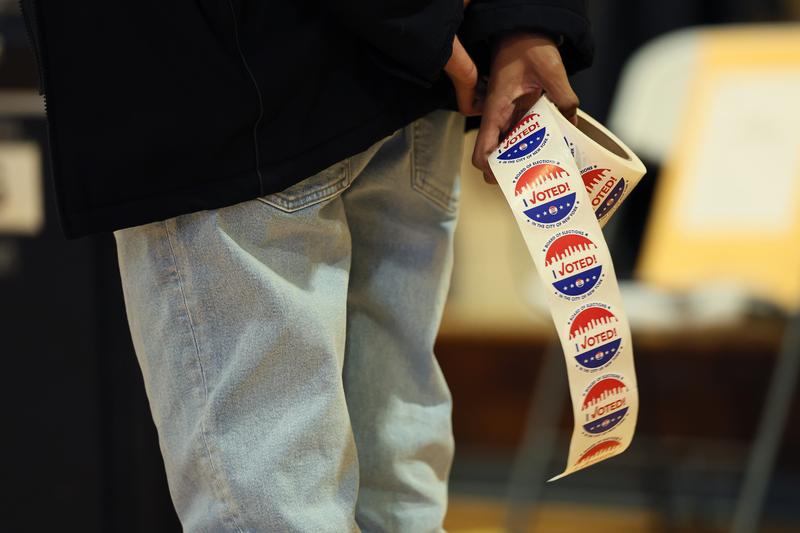
( Michael M. Santiago / Getty Images )
[MUSIC]
Brian Lehrer: It's The Brian Lehrer Show on WNYC. Good morning, everyone. Yes, here we are, Election Day 2025, finally, right? Turnout in New York City is headed for the record books. The early voting turnout, as I'm sure you've been hearing, was the biggest for any non-presidential election year in the city. It's been very high in New Jersey, too, though it hasn't gotten as much press, but more than a million votes have already been cast in the governor's race and other New Jersey elections. By my back-of-the-envelope calculations, that's about the same rate of voting as in the city.
As the show goes on, we'll open the phones for late deciders in our informal, unofficial, thoroughly unscientific Brian Lehrer Show exit poll for anyone who has made up your mind on any candidate or any ballot question in the last two weeks. Now, since the timing of our first guests is a little bit shaky because they are the three candidates for mayor, and it depends when they can actually get here after voting and stuff, you can start calling in right now.
I can't say exactly when we'll take you, but it might be soon. Call in at 212-433-WNYC, if you're one of those folks who has decided on any candidate or any ballot question just in the last two weeks, so we get a sense maybe of where things are trending. 212-433-WNYC. Call or text, 212-433-9692. Also, Brigid Bergin is here to discuss the New York City voting. Nancy Solomon on New Jersey, and we'll be checking in with some of our reporters out at polling places on both sides of the Hudson.
We'll also talk later in the show about the race for governor and some other things in Virginia, which is being seen as a bellwether for what might happen in the midterm elections next year. A little bit of a bellwether. What's happening here, too, is going to be seen that way. As I said, we'll have very brief appearances by all three candidates for mayor. We invited all three to come on for just a few minutes each for a final Election Day pitch. I think we have Zohran Mamdani coming on first in just a few minutes. First, we're going to welcome Brigid. Good morning, Brigid. Happy Election Day.
Brigid Bergin: Happy Election Day, Brian.
Brian Lehrer: Let's start here today. You covered early voting all last week, the nine days from the Saturday to the following Sunday. Your first article after the first weekend highlighted the big turnout by older voters. By the end on Sunday, you were focusing on the strong turnout by younger voters. Can you describe the curve that you saw?
Brigid Bergin: Sure, so I have to start by giving a shout-out to my colleague, Joe Hong. He is a data reporter. He is my partner in doing this work, and I'm so grateful for how much time he has spent working with me on this. We have been interested in these early voting numbers since the primary, and did similar reporting during the primary. We were really struck because we saw this record high turnout of young voters from the very beginning of early voting during the primary.
We were curious. Are we going to see that same turnout of younger voters, who were clearly an important part of Mamdani's base and what helped him win that Democratic nomination? Would we see them turn out again in such high numbers during the general election? After the first weekend, we got some of that data. We looked at it, and we were struck because there had been this shift.
Those younger voters were turning out in lower numbers compared to the boomers and Gen X voters. That, to us, seemed both more similar to what you tend to see in a general election, when you consider the general election, that older voters turn out in higher numbers, typically in an election. Because this has been such a historically different election here in New York City, it was something that we wanted to keep tabs on.
After the first weekend, as you noted, we found that those older voters turned out in higher numbers. We checked again two days later, after four days of early voting, and we saw a similar trend, that those older voters were still turning out in a higher rate than some of the younger voters, but there was a sign that the younger voters were awakening. We saw that on about the fourth day of early voting, so that's Tuesday. We kept tabs on it. We would have done another story on Friday, but we had that terrible rainstorm on Thursday, as you remember, Brian.
We saw overall early voting turnout just completely take a nosedive because it was actually dangerous to be outside. We held off, and we decided we would wait until the end of early voting. I will note that on that Friday, Halloween, incidentally, when the Board of Elections was handing out "I Voted Early Halloween" stickers, which several of the election democracy nerds who I adore were also eager to get their hands on, several people mentioned that they were waiting to vote for the Halloween-themed "I Voted" sticker.
There was a huge uptick in younger voters. Younger voters on Halloween on that Friday made up more than a quarter of all of the early voters for that day. When I say "younger," I am talking specifically voters 25 to 34 made up 26% of the vote on that day. You add in voters 18 to 24, and we are above 30%. I really do think the Halloween sticker had something to do with it.
Brian Lehrer: I think there's a model there for future elections. The sticker, "I Voted Early. Now, Give Me Candy."
Brigid Bergin: [laughs] There you go. Throughout the weekend, we saw huge numbers of early voting turnout ultimately. I believe Sunday had the highest single day of early voting turnout of any day of early voting since we've had it back in 2019. By the end of all those nine days, the younger voters had eclipsed those older voters, which is really an interesting shift, and something that political scientists that I talked to said could bode well for Mamdani. I spoke to the Cuomo campaign. They talked me through the numbers from their perspective as well.
They said, "Don't be so sure about that," because they have done a lot of work to reach out to different parts of the city, particularly in Hasidic and Orthodox communities. They have tried to turn out younger voters there. When you see potentially higher turnout in, say, the borough of Brooklyn, to assume that that is all support for someone for Mamdani may be an incorrect interpretation of those numbers, something we won't find out until, obviously, tomorrow or later tonight. They still seemed relatively optimistic that they were persuading voters. One thing that was particularly interesting, and just probably jumping ahead of your question, Brian, is where we saw some of this turnout. The City Council--
Brian Lehrer: You know what? Let me ask you to hold that thought because we do have the first of the three candidates who's checking in now. All their schedules have been a little bit in flux this morning. We're actually hoping to go back to back to back right at the top of the show, but I get it. It's Election Day. They're out voting. They're out canvassing. Brigid, don't go anywhere. Do not go to Disney World today. This is not the day for it. Hang around, because between the candidates or after the candidates, depending on when they all actually show up, we'll be talking a lot and take calls together, okay?
Brigid Bergin: Sounds great.
Brian Lehrer: All right. As I've been saying, we do have very brief appearances coming with all three candidates for mayor. We invited all three to come on for just a few minutes each for a final Election Day pitch. We'll begin with the Democratic nominee, Zohran Mamdani. Mr. Mamdani, thanks for a few minutes on Election Day. Welcome back to WNYC.
Zohran Mamdani: Thank you so much, Brian. It's always a pleasure to be back.
Brian Lehrer: Now, I've got three similar Election Day questions for each of you. In your case, you also just made news by voting this morning and announcing that you voted yes on the three housing-related ballot questions. You did not declare on those until just those couple of hours ago. Mr. Cuomo had announced he would vote yes. Mr. Sliwa had announced he would vote no. Why did you vote yes, and why on all three?
Zohran Mamdani: I voted yes because we are facing an unprecedented housing crisis. We have to acknowledge the urgent need to build more housing and deliver immediate relief to New Yorkers across the five boroughs, all while making sure that new developments are creating stable, high-quality union jobs. I also want to take a moment to acknowledge that the City Council members who've opposed these measures are advocating for their communities, which is their job. Their opposition comes from a deep investment in the well-being of those very communities. That's an investment that I share, and I look forward to working with them to deliver housing across the city.
Brian Lehrer: One listener points out that you would have qualified for the call-in we're having today for listeners who only decided in the last two weeks, how they're going to vote on any ballot question or race. Why did you withhold that until now? Democrats were divided, as you just indicated, so were you trying to avoid alienating potential voters on one side or another?
Zohran Mamdani: No, I wanted to be intentional about the decision that I made. I wanted to be honest about the fact that I was looking to have conversations with those in organized labor, with those who specialize in housing production, with those who have strong feelings on this issue. Before I actually came to a conclusion that I shared in public, I reached my decision. As soon as I reached it, I shared it.
Brian Lehrer: All right. Now, to the three questions that I've got for each of you. Roughly, the same questions in each case. Here's a scenario that I'll ask all three of you. I'm undecided between voting for you or staying home, says a New Yorker. I know I don't like the other guys, but I'm not sure about you for some of the reasons your opponents have been arguing. Give me a positive argument to vote for you rather than stay home and say, "The heck with all you politicians."
Zohran Mamdani: First, I would tell that voter that I understand. Because for many New Yorkers, their experience of politics has been one of despair and diminishing faith, cycle after cycle. I'm running with a vision to make the most expensive city in the United States of America, one that's affordable for each and every person that calls it home, and to do so by freezing the rent for more than two million rent-stabilized tenants, by making the slowest buses in the country fast and free, and by delivering universal child care.
All of this because I believe in the dignity of every single person who calls this place home. This is the agenda that I've been running on. It's an agenda that has come up against opposition, whether billionaires who donated to Donald Trump's campaign, and now find themselves at home in Andrew Cuomo's, whether corporations were making money hand over fist, or whether bad landlords who have enjoyed a time of impunity. This opposition is not because I won't deliver on my agenda and my promises, but precisely because they know that I will.
Brian Lehrer: Now, question two, this is more mostly a policy show, as you know. I'm asking each of you to tell any undecided listeners. What is the one signature policy proposal of yours that you would like late deciders to have in their minds when they walk into their polling places?
Zohran Mamdani: Universal child care. Today, it costs a family on average, $22,500 a year to pay for child care for one child. That is more money than it would cost to send that child 18 years later to CUNY. What we see is that this is a broadly popular proposal. Almost three-quarters of New Yorkers are in support of it. They are in support of it because they know that right now, we're facing the costs of not having that kind of affordable child care in the city. In 2022 alone, the state lost $23 billion from families who had to skip shifts to take care of kids or left the state altogether because of how expensive it is to raise that family. Our proposal is to deliver universal child care for children from the ages of six weeks to five years, and to do so to make it easier to raise a family in the place that we call home.
Brian Lehrer: Last question. If you win, if most of the polls are right, you will not have gotten a majority of the vote, or maybe you'll get a very slim majority. How will you start to reach out to those other voters who've been convinced to fear you, to show you'll try to be the mayor of all the people and take their interests seriously?
Zohran Mamdani: I am running to be the mayor of all eight and a half million people who call the city home, not just the many who will vote for me or those who will vote for other candidates or those who will not vote at all, frankly. I'm looking to be that mayor because I love this city, and I love everyone who calls it home. I'm looking to lead our city into an era where we could take on the twin crises of the moments, the authoritarian crisis that we're seeing from Washington, DC, and the affordability crisis that we're seeing right here in New York City. I know New Yorkers may not agree with me on every issue.
In the words of Ed Koch, "If you agree with me on 9 out of 12 issues, vote for me. If you agree with me on 12 out of 12 issues, see a psychiatrist." Yet, what New Yorkers will always know is that I am telling the truth to them about who it is that I'm fighting for and who it is that I'm looking to serve. The other choice in this race is Donald Trump's handpicked candidate in Andrew Cuomo. I know that he's coming on this show. I think that he should explain to New Yorkers if and why he accepts having the endorsements of Donald Trump, Elon Musk, and Stephen Miller, the architects of the crisis that so many New Yorkers are struggling to survive in this moment.
Brian Lehrer: Zohran Mamdani, candidate for mayor, you might have heard. Thank you very much for giving us a few minutes on Election Day. We really appreciate it.
Zohran Mamdani: It's a real pleasure. Thank you so much, Brian.
Brian Lehrer: We do have Curtis Sliwa, who I think we're going to have on in just a few seconds here, and Andrew Cuomo a few minutes after that, as we did invite all three of the mayoral hopefuls to make brief Election Day appearances here, then we'll continue with our senior politics reporter, Brigid Bergin. We'll start taking your calls in a little bit. It's going to be an informal, unofficial, thoroughly unscientific Brian Lehrer Show exit poll for Election Day, for those of you who made up your minds in any race, New York mayor, New Jersey governor, whatever race, or on any ballot question.
You just heard the last-minute announcement from Zohran Mamdani. He announced his ballot question on housing, the three ballot questions on housing, how he would vote until just this morning when he did cast his ballot. We're going to do that for you and on any other candidates on either side of the river or anywhere else, for that matter. 212-433-WNYC, 212-433-9692. We do have the Republican candidate, Curtis Sliwa, on the line with us for a few minutes now. Curtis, we always appreciate that you come on with us. Welcome back to WNYC.
Curtis Sliwa: Oh, appreciate it. Thanks for your participation in that debate with Katie and Errol. That second debate was fair and square to all the debaters on that stage, Brian.
Brian Lehrer: Thank you very much for that. Now, as I told Mr. Mamdani, I've got three questions for each of you. Here's a scenario I'm asking all three of you. I'm undecided between voting for you or staying home, says a New Yorker. I know I don't like the other guys, but I'm not sure about you for some of the reasons your opponents have been arguing. Give me a positive argument to vote for you rather than stay home and say, "The heck with all you politicians."
Curtis Sliwa: Well, number one, I would urge everybody to vote even if they're not voting for me, Brian. We've had an unprecedented turnout in the early elections and, now, for Election Day itself. We may actually reach that number that we had when John Lindsay was elected in 1969, when he had a run on the Labor Party of Alex Rose and David Dubinsky. Look, I'm the law-and-order candidate. Zohran Mamdani and Andrew Cuomo share many of the same values. Andrew Cuomo is from a different age. He's dystopian. He's got a cloud over his head. I'm the happy warrior. I can deal with everybody. Young, middle-aged, old. I would suggest you vote for me, but please, whatever you do, vote, vote, vote.
Brian Lehrer: All right, second question is a policy question. This is mostly a policy show, so I'm asking you, each of you, to tell undecided listeners, what is the one signature policy proposal of yours that you would like late deciders to have in their minds when they walk into their polling places?
Curtis Sliwa: Well, clearly, based on what Zohran Mamdani told the press this morning, when he voted with his wife, that he was now voting yes on the City of Yes. That means Andrew Cuomo and Zohran Mamdani are helping developers and realtors. I'm standing with the people. I'm the only candidate against the City of Yes. I'm suggesting, even if you don't vote for me, you vote no on 2, 3, and 4. By the way, people said, "How can you work with a democratically-controlled City Council?" Brian, I and Adrienne Adams and the Democrats and the City Council are aligned on this vote, no on the City of Yes initiative on the back of the ballot.
Brian Lehrer: That's the policy to keep in mind. No on the affordable housing ballot questions or fast-tracking those development proposals, that kind of thing. All right, last question. President Trump last night endorsed Cuomo, not you, the Republican nominee. The polls show you have almost a zero chance of winning. Polls are often wrong. We know that, but not that wrong. At the same time, you quit your job as a talk show host at WABC. You say it's because they disrespected you by urging you to drop out. If you lose, what will you do next to earn a living? What will you say to President Trump and many conservatives who held their noses and voted for Cuomo and would be angry at you for helping Mamdani win?
Curtis Sliwa: They could be angry at me, but I am the Republican candidate. The time to have challenged me would have been in the primary. Nobody stepped up. I'm the major party candidate. Look, Andrew Cuomo is dystopian. What he says and how he says it, Brian, makes me want to take a hot shower afterwards. His image of New York City is negative. In fact, he's already said, if he loses, he's going to flee in fear and fright and join his billionaire friends.
He is the candidate of the billionaires, the influencers, and the insiders. I am not. I don't have billionaires supporting me. Zohran Mamdani have some billionaires supporting him. I am the populist Republican candidate representing working-class people whose voices are not heard. I have a right to run. They tried to bribe me to drop out. I have to travel with armed security, I and my wife, because of threats against our life.
That's not democracy. Democracy, Brian, is one person, one vote, the way it should be. If I should lose, I will stay. I will improve. I will not move. If Zohran Mamdani or Andrew Cuomo becomes the mayor, well, I will be the opposition there every time they step out of line. In terms of my income, I haven't needed much to live on to begin with. I and my wife, we love our life. We take care of our animals.
Remember, Brian, unlike the others, I have an independent line that people can vote for me on. Protect animals, no kill shelters, and put animal abusers in jail. That's the first ever in American electoral politics. If you can't vote for me as a Republican, vote for me because I will protect the animals, along with my wife and so many others out there who are listening to your program now who are animal rescuers. It doesn't have to do with party affiliation.
Brian Lehrer: Curtis Sliwa, thanks again for a few minutes this morning. I know our listeners appreciate it.
Curtis Sliwa: Anytime, Brian.
Brian Lehrer: Now, we've heard briefly from Mr. Mamdani and Mr. Sliwa. Andrew Cuomo, we're told, is currently voting and taking a few questions from reporters at his polling site. He should be here in a few minutes. We'll take a break. Brigid will come back on, and we'll start taking some of your phone calls if you have decided on any candidate or any ballot question in the last two weeks. 212-433-WNYC, call or text, 212-433-9692. Stay with us on this Election Day.
[MUSIC]
Brian Lehrer: Brian Lehrer on WNYC. Again, we've heard briefly now from Mr. Mamdani and Mr. Sliwa. Andrew Cuomo currently voting, we are told, or maybe he's done voting already and taking questions from reporters at his polling site, and then he will join us for a few minutes, too. In the meantime, let's bring our WNYC senior political reporter, Brigid Bergin, back on. We'll start taking calls in our informal, unofficial, thoroughly unscientific Election Day exit poll for those of you who've decided on any candidate or any ballot question just in the last two weeks. 212-433-WNYC, 433-9692, call or text. Brigid, any thoughts on the two candidates we heard some from so far for their brief Election Day appearances? Just anything that struck you?
Brigid Bergin: Yes, I was really impressed, actually, with both of the candidates when it came to the signature policy proposal they want voters to go into the booth with. On the one hand, for Assemblymember Mamdani saying universal child care, which of his three signature proposals that he's talked about throughout the campaign, is the one that has the most momentum. It is the one that Governor Kathy Hochul has come out and said that she supports. It's the one that business leaders across the city have talked about.
I think that there is a real signal across New York that people from a variety of sectors, all the sectors that would need to be involved to actually make that happen, are stepping up and trying to move that policy forward. I think it was a very smart thing for him to signal to voters. It's also something that is incredibly popular with voters because, as he mentioned, it is an incredible cost burden on so many New Yorkers up and down the income spectrum.
Similarly, I thought it was really smart of Curtis Sliwa to note that he is the only candidate who opposes those housing ballot measures. It distinguishes him from the field. There are a lot of people who have mixed feelings about them, people who do think there needs to be more affordable housing in the city, but who also really do not like the way these ballot measures were conceived. I think any way that he can stand apart from these candidates in a way that voters, who are trying to make up their minds, who are a little bit on the fence, can identify with, I think, is helpful. I thought it was very smart of both of them to identify those policies.
Brian Lehrer: Let's take our first late-deciding voter, and it's Lawrence in Brooklyn, who's calling specifically because he was a late decider on the ballot questions. Lawrence, you're on WNYC. Hey there.
Lawrence: Hey. Hi. Yes, yes, I'd love to hear what Ms. Bergin thinks about this. I voted yes on the three giving mayoral authority over a number of decisions about upcoming development in New York. I had misgivings. I told your screener, I see a parallel to what's happening in the MAGA world. We're handing this power, I hope, to the candidate I chose to win. I want Zohran Mamdani to have this power.
I don't know who's coming after him. The power to say yes is the power to say no, too. I looked at the MAGA world, where we see this unprecedented handing over of the power of the two legislative bodies to the executive branch. I'm wondering. I don't know if anyone in that world has the same misgivings I do about what they're setting up for the future. Struck me as a weird situation. Like I said, I want Mamdani to have this power. I don't know who comes after him.
Brian Lehrer: Lawrence, thank you for sharing your ambivalence. He did land on yes, Brigid. I think he speaks probably for a lot of voters, certainly for a lot of Mamdani voters who may have been against these things when Eric Adams' brainchild and City Council was saying, "Hey, this is power grab by Adams against us." A certain kind of Democrat would have been easily against that. There are other progressives, Brad Lander, Antonio Reynoso, the Brooklyn Borough president, and others who were for it. There's the dilemma. Now, for very late deciders, the fact that Mamdani came out yes this morning on those three ballot questions, probably scrambling their brains even further, at least for some people.
Brigid Bergin: I have been out at early voting sites throughout early voting. One of the issues that has been a challenge for voters is making their decision on those ballot questions. They may have had a clear decision on who they were going to vote for, for mayor, but trying to really understand the impact of those questions and what exactly was happening there. I think people widely recognized that the city does have a housing crisis.
The question of, "Is this the best way to solve it? Are there any other ways to address it," I think, is something that a lot of people are thinking about. To that caller's point, to Lawrence's point, this does take power that sits with the City Council, a really important bit of their authority, and shift it to the mayor and the borough president. The mayor is already a very strong mayor in New York City. To give that office more power, that is a consequential move. As Lawrence noted, this is a change to the city charter. It is not going to just affect who is elected this year, but will elect whoever serves in that office going forward until the charter is changed again.
It's something that people, I think, need to think through and depending on who they find more persuasive, whether it's someone like a city comptroller, Brad Lander, who has obviously been on the ground developing affordable housing, who says, "This is what we need to do to be able to solve our housing crisis," or if it's the many members of the City Council who would say, "This is how we advocate for our constituents. This is taking away a key part of our authority." That is where voters are going to have to make up their minds.
Brian Lehrer: Here's a late decider for mayor, he says. Anthony in Manhattan, you're on WNYC, Anthony. Hi.
Anthony: Hey, Brian. How are you? Great job in the debate last week. I know we're voting for mayor this week, but it's clear who the king of New York is. That's you.
[laughter]
Brian Lehrer: No kings. I'm coming out as no kings.
[laughter]
Brian Lehrer: Certainly, in my case, nobody would want that.
Anthony: I know.
Brian Lehrer: Thank you. Go ahead.
Anthony: Yes. Look, I have a lot of experience in politics and grew up in New York and moved back last year, and been really just torn about making the choice. Obviously, Zohran's extremely inspiring. I realized I was leaning more towards Cuomo because of his experience. For example, there was a Halloween parade on Friday, then there was the marathon on Sunday.
Just seeing the throngs of people and just managing the city is a very complex role, but then I realized that Cuomo's appeal was to my fear as a voter, to my fear of Trump, to my fear of the city. I realized that that's not a place for me to vote from. I voted for Zohran, made my decision yesterday, on Sunday, when I voted early, and to vote for a more hopeful image of the city, especially with just the attacks on minorities and overall representation.
I think having a mayor from a different generation, from a person of color, will really help improve the conversation we're having as a nation. I do have a lot of reservations about how he's going to govern, and I'm encouraged that he's being more inclusive of expertise beyond the DSA role. I just hope that if he ends up leading that he ends up bringing the most qualified people in all the roles, from communications to all the bigger appointees.
Brian Lehrer: I hear you. Close call for you. Hope versus fear is what you're saying in a close call, right? You use those words--
Anthony: Yes, pretty much. That's exactly what it was. I think that Cuomo has really doubled down on the fear the last couple of weeks, and that's just been really ugly and disappointing.
Brian Lehrer: Anthony, thank you for your call. Joining us now briefly is WNYC reporter Brittany Kriegstein, who has been out at some polling sites in Brooklyn all morning. Hey, Brittany.
Brittany Kriegstein: Hey, Brian. How are you?
Brian Lehrer: Good. I hear you're currently somewhere in Central Brooklyn. Where are you exactly, and what's the scene like there right now?
Brittany Kriegstein: I am. I am where I started the day, actually, so I did a bit of a loop. I'm back at Brooklyn Borough Hall in Downtown Brooklyn, and it's busy. There are people streaming in, but I'll tell you, Brian, there were people streaming in at 6:00 AM when they opened the doors. It's been a pretty lively scene here all day.
Brian Lehrer: What have you been hearing from voters this morning?
Brittany Kriegstein: Well, a really diverse array of opinions, as always, but the one through line that I think is really important to mention is that a lot of people have been telling me just how important they feel this election is. For some people, I think that comes from a place of passion. They have hope about affordability and some of the new proposals that Mamdani is putting forward.
Then for others, there's a lot of fear. Fear about Donald Trump and his influence in the city, what they feel is an erosion of democracy, things like that, I'm hearing from people. Everyone is just really passionate about exercising their right to vote. There's been a really diverse, like I said, array of who people are voting for. Quite a few Mamdani. Some people are voting for Cuomo. I spoke to one very ardent Sliwa voter, a very fervent supporter there, who said that she can't imagine anybody else being a better candidate. It's always very interesting on Election Day.
Brian Lehrer: On bringing up aversion to Trump as one of the things that people have been mentioning to you there, have you gotten a sense of-- and, obviously, this is totally unscientific, at least as unscientific as the call-in we're having, but whether the people you spoke to were being triggered to vote for Cuomo because they're afraid that Trump will come down even harder on New York if Mamdani is the mayor, or trigger to vote for Mamdani because they think he's going to do more to stand up to Trump?
Brittany Kriegstein: I think more of the second option there. I think people are worried about that endorsement from Trump on social media that they heard yesterday in terms of Cuomo. They feel like there's some kind of link there, and they're worried. I think they look to Cuomo, though, as somebody with a lot of experience to potentially stand up to Trump. There's those two different routes, but I think for the most part, that fear of Trump was from voters who were really looking towards Mamdani here.
Brian Lehrer: All right, WNYC reporter Brittany Kriegstein, who's been out at some polling sites in Brooklyn all morning. I know we'll be hearing from you through the day on the newscasts. Thanks for giving us a few minutes.
Brittany Kriegstein: Thanks so much, Brian.
Brian Lehrer: Back to Brigid Bergin. She mentioned the Trump endorsement. Some of our listeners may not even know that that happened because it was last night, Monday night, going into Election Day, where Trump more officially endorsed Cuomo. I think he's been indicating for a while, "Oh, I'd rather have a bad Democrat than what he calls a communist."
Even Cuomo had been responding to that already by saying, "No, Mamdani is not a communist, but he is a socialist," and then trying to walk that line between being happy in a way that Trump was supporting him, but not wanting to be put in the position of looking like Trump's candidate. Obviously, very blue New York, but then last night, it was a little more official from Trump. Is it clear to you what exactly changed, or what Trump did, or why he did it?
Brigid Bergin: Well, I think we have seen, as you mentioned, Trump signaling throughout the general election, his strong opposition to Zohran Mamdani, as you said, labeling him a communist, which he is not, a Democratic socialist. We've seen the Cuomo campaign make this strategic decision that, in order to have a path to victory, they need to broaden their appeal to voters beyond just Democrats.
He has made very direct and explicit appeals to Republican voters. He has been in parts of the city that tend to vote more conservatively, even though there are maybe more Democrats registered there. They tend to be places where Republicans are successful. He's appeared on right-wing talk radio. He has stood by, as people have said, things about Mamdani's candidacy that I think other Democrats would have called out.
I think that the culmination of that has brought us to this point where Trump has made it very clear that he would prefer Andrew Cuomo to win this New York City mayor's race over what polls continue to show is Zohran Mamdani as the Democratic nominee's lead in this race. There has been previous reporting from The New York Times that there had been a call between Cuomo and Trump.
Cuomo has consistently and ardently denied that. Has anything happened since then? I don't know the answer to that. You can ask him when you talk to him. [chuckles] I do think that that endorsement is part of-- For some voters in the city, it may be what it takes to get them to go from voting for Sliwa, or potentially staying home and voting for Cuomo. I was out in Staten Island on that very rainy Thursday, talking to voters at one of the most conservative spots in Staten Island on the South Shore, an early voting site in Annandale.
I talked to a lot of voters. Many of whom described themselves as people who always vote for the Republican candidate. Several of them said that they were voting for Cuomo in part because they did not believe that Sliwa could win. Some of them repeating to me messages that we have heard from either the Cuomo campaign or from some of the super PACs that have supported him, labeling Mamdani a communist and calling Cuomo the lesser of two evils.
At the same time, some of the voters there who I spoke to just were going to stick with Sliwa no matter what. One man I met told me a whole story about how, when he was a teenager coming home from his first job at Macy's, guardian angels protected him on the subway. He felt this deep loyalty to Sliwa and was going to vote for him, and then finished the whole story off by telling me he didn't think he could win, but he couldn't help but not vote his conscience.
I think there are voters across the city who are wrestling with that, and particularly Republican voters who the Cuomo campaign has made an appeal to, who are trying to decide, do they stick with their party, or do they vote for this person who they know of as a Democrat? Now that Trump has weighed in, I think it gives them more leeway to say, "Well, the head of our party is saying to cast our vote for this person, so I'm going to the polls."
Brian Lehrer: Here's a text from a listener who writes, "Don't you understand? Trump wants Mamdani, so he can use him as an excuse to send his goons into the city." That's what that listener writes. Whether it's for that or because Trump might want Mamdani to use as a foil in the midterm elections against Democrats in swing districts for Congress all over the country, I guess it's possible that Trump is playing some kind of three-dimensional chess by endorsing Cuomo because he thinks there'll be such a backlash in New York City. It'll help Mamdani, and then that helps him with his party in the midterms. Who knows?
Brigid Bergin: [chuckles] It could be. I think it's also important to remember, Trump still-- he may be in Washington, DC. He may be in Florida at Mar-a-Lago, but his roots are so deep here in New York City. He comes from the New York City real estate world. I think there is a business interest in his mind. I was actually out yesterday with Cuomo, who was talking to some seniors in Brownsville. He was telling this story, trying to make his closing pitch to them about why he was the person who would stand up to Trump. He told a story, which I hadn't heard before, but he was telling these seniors that during COVID that the president at the time, President Trump, had threatened to quarantine New York.
He obviously pushed back. He said, "No, you can't do that." The President said, "Yes, this is what we're going to do." The governor said, "He responded by saying he would shut down Wall Street." Without being able to fact-check that in real time, what I thought was so interesting and the way that story resonated with the voters there, it was just this sign of how these two New York characters would go after each other in the ways that they understood would speak to them.
Brian Lehrer: All right, Brigid, stand by for a few, because now we have Andrew Cuomo on the line. Again, listeners, if you're just joining us, we invited all three mayoral candidates to come on here on election morning for very brief appearances. We've had Zohran Mamdani. We've had Curtis Sliwa. Joining us now, once again for a few minutes on Election Day, is Andrew Cuomo. Mr. Cuomo, thanks very much for this. Welcome back to WNYC.
Andrew Cuomo: Thank you, Brian. Thank you for having me.
Brian Lehrer: I've got three questions for each of you. Here's a scenario I'm asking all three of you. It goes like this. I'm undecided between voting for you or staying home, says a New Yorker. I know I don't like the other guys, but I'm not sure about you for some of the reasons your opponents have been arguing. Give me a positive argument to vote for you rather than stay home and say, "The heck with all you politicians."
Andrew Cuomo: Okay, good question. First, I'm no kid, and this is the most important election of my lifetime. It's not between two people or two parties. It's between two philosophies. Whether New York pursues an extreme socialist agenda, or we build a brighter New York. I have been governor, HUD secretary, attorney general. I know how to make government work to make change in people's lives. These are not just political promises I make, and then get into government, and figure out that I can't get anything done. I know how to make change. Kennedy Airport, LaGuardia Airport, Second Avenue Subway, highest minimum wage, first date to pass marriage equality. I can actually get the job done. No promises, no rhetoric, just performance.
Brian Lehrer: To get the job done, and so my second question goes to what that job is. This is mostly a policy show, as you well know. I'm asking each of you to tell any undecided listeners, what is the one signature policy proposal of yours that you would like late deciders to have in their minds when they walk into their polling places? Signature policy proposal.
Andrew Cuomo: Okay. It's a policy show, but the mayor's office is primarily a performance office. Mayor is about delivery and making things happen. Number one for me would be public safety. Hire 5,000 police officers, get back to full force. Commissioner Tisch supports that. Put 1,500 people in the subways. Let New Yorkers know they are safe. Bring crime down, not just some categories, but all of it. Safety is the foundation, Brian.
Brian Lehrer: Last question. If you win, you will not have gotten a majority of the vote, or maybe you'll get a very slim majority. Same for Mr. Mamdani. Same for you. I asked him a version of this question that applies to him. In your case, many Mamdani voters will be furious that you came from behind by stoking what they will see as Islamophobia with the recent ads and appearances on conservative media. How will you start to reach out to those voters in what might be a very divided and, in some cases, resentful electorate or fearful of you as you take office?
Andrew Cuomo: I think you have it upside down, Brian. I've been talking to New Yorkers, obviously, for days. Plus, the polls don't follow what you say. It's the exact opposite. I am all about unifying. I was governor for 11 years. I defended the Muslims when Trump proposed the travel ban for Muslims post-COVID, when the Asians were being harassed because of the so-called China flu. I was there. Anti-Semitism, I was there. That's the strongest hate crime in the United States. We are the diversity capital.
You have to work full-time to unify. That's what I've always done. Mamdani has been divisive. He'd been divisive with the Jewish community, divisive with the Italian American community, giving the proverbial finger to the Christopher Columbus statue. He called the NYPD racists, posed with a person who proposed the death penalty for LGBTQ people. That's the divisiveness in his campaign that he has waged. I've had nothing to do with that. I have always represented all New Yorkers as governor, attorney general, 100%.
Brian Lehrer: With respect, you're making a case for your record versus his, but I'm asking you how you would reach out your references to his religion and country of birth. He came here at seven, and multiple times recently to 9/11, have struck Muslims and others as playing to racism and Islamophobia. We get callers like that. I'm just telling you the perception and asking if you would reach out to those New Yorkers in any particular ways in addition to just denying that you were offensive.
Andrew Cuomo: Yes. Well, I would obviously reach out to everyone. I understand, in a campaign, a lot of people make a lot of charges, but the Muslim community is a very important community to New York City. I would work with them. I met with them. I said I want them to be a big part of the administration, appoint them to senior positions in the administration, and that has always been my history. That's what New York is all about. I think that's just a matter of effort, Brian. I don't think there's any obstacle there. They just want to know that they're represented and they're included.
Brian Lehrer: Andrew Cuomo, thank you very much for a few minutes on Election Day. We really appreciate it. I know our listeners do.
Andrew Cuomo: Thank you, Brian, for having me.
Brian Lehrer: Brian Lehrer on WNYC. We've now heard from Mamdani and Sliwa and Cuomo. We'll take a break. We'll continue with Brigid Bergin and more of your calls in our informal, unofficial, thoroughly unscientific Election Day exit poll for you, if you've made up your mind in the last two weeks on any candidate or any ballot question. 212-433-WNYC, 433-9692, call or text.
[MUSIC]
Brian Lehrer: Brian Lehrer on WNYC. Now, we've heard from all three mayoral candidates here on election morning. Our senior political reporter, Brigid Bergin, is back with us. Brigid, anything you want to add to your analysis, now that we've heard from the third of the three candidates, or I've got a lot of other questions for you?
Brigid Bergin: [chuckles] Well, I think just in summary, you had a caller right before Andrew Cuomo, who boiled the election down to hope versus fear. I think we heard some of that in Andrew Cuomo's closing argument, his closing pitch to voters. His signature policy proposal that he wants voters to go to the voting booth with is related to public safety, hiring 5,000 more police officers, and adding 1,500 to the subway. That is very much speaking to a New York as he describes that he believes is in crisis. I think a lot of voters will have to decide, is that the New York they think they live in?
Brian Lehrer: You were talking before about the massive early voting turnout, the biggest since early voting started in 2019, except for the presidential election years. Has there been any exit polling yet on what drove people's decisions, affordability plans, experience, Trump, Israel and Gaza one way or another, if any of those things or anything else are breaking out, if there's any way to tell in the more than 700,000 people who voted early?
Brigid Bergin: Yes, I haven't seen exit polling yet. I think if there has been, we'll likely see some of it later in the day. Again, I love listening to voters who call into this show, and I love going out and talking to voters. It is not scientific, but it does give you some really instructive sense of how people are thinking about the election. What are the issues that have really resonated with them? I spoke to a voter on Sunday who was voting in East Flatbush, who reminded me very much of that caller, I think Anthony, who said he had made his mind and talked us through that arc of leaning towards Cuomo for his experience, but landing on Mamdani for his optimism.
The voter who I spoke to described how he wanted to see a mayor deliver on the kind of proposals that Mamdani had proposed to address what he felt was a real affordability crisis in the city. Then he said to me something that was really striking. He said, "Even if he can't deliver it, I want him to at least try." I said to the voter, "Well, does that mean you'll be satisfied with Mamdani if he were to be elected and cannot deliver what he's promised?"
He said, "Absolutely not. I want him to do even more." I think in that, you start to get a sense of winning the election may be the easy part for any of these candidates. Actually, doing what they have said they want to do will be where the real challenge is. Putting together the team that allows them to deliver what they've said they wanted to deliver will be a challenge. As we all know, the federal government and President Trump hanging over whoever wins will be one of the biggest challenges for whoever wins this office.
Brian Lehrer: Let's hear from another late decider. Travis in Washington Heights, you're on WNYC. Hi, Travis.
Travis: Yes, thanks so much. Yes, I need to go vote later today. I'm leaning Cuomo, but what I'm really lamenting is the fact that we don't have ranked-choice voting in these general elections. If we just imagine how different things would be, I'd love to be able to rank. I'd say maybe Cuomo first, Mamdani second. To me, the existential threat is a Curtis Sliwa mayoralty, [laughs] I guess. Now, there may be many Sliwa voters. I'm sure there's a great many that would love to vote for Sliwa first. Presumably, they would rank Cuomo second.
I know this is all academic, but 2029 is not that far away. Can we please get to a place where we have ranked-choice voting in general elections? What we're likely to have here, I think you mentioned this before, is that Mamdani may well win today with less than 40% than 50% of the vote. There's going to be a perception that he's not acceptable to the majority of voters. The reality is that I'd rank him second behind Cuomo, but I can't do that. I just think that this asymmetry we have where we don't have ranked-choice voting is really hampering us in this general election.
Brian Lehrer: I'll ask Brigid about the prospect for ranked-choice voting in the future in the general. You did say you have yet to decide between Cuomo and Mamdani, and you haven't voted yet? Are you still actually undecided? If so, what's going to tip you?
Travis: Well, I may even decide not to vote the mayor's race and leave it up to my fellow New Yorkers. I'd say that, with Mamdani, I think he's made a lot of promises that he's not going to be able to keep. With Cuomo, I have reservations in terms of his-- I don't know. I think he has high negatives, if I'm not mistaken. Boy, I've never experienced this before where I just have a really hard time making my mind.
Brian Lehrer: Thank you for calling in with that. A very late decider, Brigid. On his proposal for the future, it's certainly likely that if Mamdani wins or if Cuomo wins, they're not going to have 50% of the vote. A majority of people will have voted against them, or they would have a very, very slim majority of the vote. Travis isn't the only one who's saying, "Look, that ranked-choice voting thing really worked in the primary, and it would be really relevant right now." Should we have it in the future? Are politicians or others who would be in charge of bringing that about also thinking about that?
Brigid Bergin: It is definitely an active conversation in policy circles, Brian. I had the opportunity to moderate an event back early in October at The New York Historical. It brought together Lauren Miller Karalunas from the Brennan Center, Scott Kendall, who's a lawyer up in Alaska, and Professor Rick Pildes from NYU Law School. The whole conversation was essentially about, how do we conduct our elections?
Looking at models that exist elsewhere, in Alaska, they do use a version of ranked-choice voting, but it is used in the general election. One of the points that Scott Kendall made was it was because of that ranked-choice system that exists in Alaska that they were able to elect Lisa Murkowski, who is a more moderate Republican who is in the US Senate. If she had gone through a primary where what they were arguing tends to pull people to the extremes that she would not have been as successful.
Professor Pildes made the point that, really, the optimal use or the way to try and bring our politics more to a central place would be if we were to use something like ranked-choice voting during our general election. Now, the reason we have it here in New York City during our primary is often because the primary and special elections traditionally have been where a lot of the big decisions have been made.
I do think that there is some interest among folks who want to see-- we know that just in this past Charter Revision Commission, there was a conversation about open primaries. How would that have changed our general election if that had happened, and potentially using ranked-choice voting in other ways? We don't have it yet. I do think the conversation is something that is going on among some policymakers. Who knows what we will see down the line?
Brian Lehrer: This is WNYC FM HD and AM New York, WNJT-FM 88.1 Trenton, WNJP 88.5 Sussex, WNJY 89.3 Netcong, and WNJO 90.3 Toms River. We are New York and New Jersey Public Radio. We've been on the New York side so far. In a little bit, we're going to flip to the New Jersey side, bring on Nancy Solomon, take last-minute deciders in the New Jersey governor's race or any other race in New Jersey. Stay tuned for that, New Jersey voters, New Jersey listeners. Right now, I want to bring on WNYC senior reporter Arun Venugopal, who I understand is somewhere in Southeast Queens. Hey, Arun.
Arun Venugopal: Hi, Brian.
Brian Lehrer: We heard from our colleague, Brittany Kriegstein, earlier, who's been moving around Brooklyn at polling places today. Where have you been so far?
Arun Venugopal: Right now, I'm standing outside of PS 36, which is in St. Albans in Southeast Queens. I'm standing across the street from the True Deliverance Church. Lots of churches, lots of storefront churches, and Jamaican restaurants, and a lot of West Indian residents in this area. I would say from the two or three polling sites I've been to, voting has been fairly brisk. One site was a little quiet. For the most part, people are turning up. This is after what I'm told by polling workers were a fairly heavy early election season, I guess, prior to this.
Brian Lehrer: St. Albans, area rich with engaged Black voters who swung heavily for Eric Adams in 2021, fairly strong support for Cuomo. I don't know what the total numbers were in the primary. What are you hearing from voters there now? Who are most voters today telling you about who they're supporting, as thoroughly unscientific as we know that sample would be?
Arun Venugopal: Yes, I know. You're talking about really a couple of dozen people over the course of these two or three sides I've been to. I would say it's kind of split. Definitely hearing from Mamdani supporters, as well as some Cuomo supporters. There are certain sites. You can go to polling sites where people are triumphant about their vote. They're very excited to shout it out loud.
This is not an area of the city where, at least, I haven't encountered that. People are quiet about their choices. They're low-key. A lot of people don't want to even reveal it. The people I've spoken to who are Cuomo supporters, and there are a fair number of them, I think they lean into his experience. A few of them they said in part because he has been endorsed by President Trump. Now, I'm not sure if that indicates their allegiance to President Trump or not, but definitely a couple of people I spoke to, both of them immigrants, who said-- In one case, a woman by the name of Lorna Brooks.
She's about 70. She's a home health aide worker. When she told me that she was voting for Andrew Cuomo, I asked her, "Well, did the endorsement from Trump help for you?" She goes, "Yes, it did. It motivated me." She feels like that conversation, that line of access, that channel, if you will, is going to make a difference in regard to the city's well-being. I heard similar things from an Ecuadorian immigrant, Pablo Carpio. He's in his 30s.
He talked about his concerns about immigrant well-being and safety. He said, "I think that Andrew Cuomo, he's in talks. He's got the support of the President, so that's going to make a difference for our city." It's interesting, the people who do weigh in that way, what they say. Lots of people will talk about SNAP as well. Nobody really, Brian, is talking about things that we might have heard a couple of years ago, like immigrants, the border security, or policing, public safety. It's very few people talking about that.
Everybody is talking about-- or I should say more like 70%, 80% of the people are talking about the cost of living, inflation, the price of food, price of gas, their rent, all these things. Who they think can deliver on those promises, it really depends. You're here really split. Nobody is talking about Sliwa. Nobody mentioned Sliwa. The only person who mentioned Sliwa was somebody who said-- He's the only person I met who didn't vote for any of these candidates.
Stephen Epps, he's an 80-year-old guy, Vietnam vet, and he's like, "I didn't vote for any of these guys. I wrote myself in." Maybe the Epps candidacy will grow. Basically, he's the only man who mentioned Sliwa, just to say that he had no interest in voting for him. Really, it's split between Mamdani and Cuomo, and it really largely had to do with these issues and who they think can deliver on these issues.
Brian Lehrer: Let me ask you one more thing, Arun. When we've been taking calls from late-deciding voters over the last hour and a little, the biggest thing that's come up is actually not the mayoral candidates but the housing ballot questions. I'm curious if that's come up in any of your interviews with voters out there, something that they feel strongly about one way or the other.
Arun Venugopal: No. I was thinking it might as well because there's been so much talk and discussion, debate about that at least. I would say citywide, people are trying to make sense of that, but nobody really has gone there. It's really been about this and the issues I discussed when it comes to bread-and-butter issues.
Brian Lehrer: WNYC's Arun Venugopal in St. Albans. I know I'll be hearing you through the day on the newscasts. Thanks a lot for joining us.
Arun Venugopal: Thanks, Brian.
Brian Lehrer: Brigid, I'm going to take one more late decider and then I want one more thought from you before we go to the news, and then flip it to covering the New Jersey races. Our late decider is again going to be on the housing ballot questions, and it's Lauren in Brooklyn. Lauren, you're on WNYC. Thank you for calling in. Happy Election Day.
Lauren: Hi. Thank you. Yes, I was a late decider on the three housing proposals. I voted yes because I am confident in a Zohran victory. I would vote no if I wasn't confident in a Zohran victory. I don't like this concentration of power in the hands of the executive. I'd prefer more power be with the community boards and with the city council, but I want Zohran to be able to use all of the levers that he can to fast-track affordable housing. Under those conditions, I am saying please vote yes on those because we need housing now, and we can worry about the issues with too much power in the executive hands later.
Brian Lehrer: Another ambivalent caller earlier said he also wants Zohran Mamdani to have that power that these ballot proposals would give the mayor because he thinks he would use that power well, but expressed concern about it going to the office, because you don't know who comes after Mamdani. Did that occur to you at all?
Lauren: Absolutely. That's what I'm saying, right? In the abstract, I would not have voted yes for these. As a materialist who weighs the issue of affordable housing as a higher issue than the hands in the executive of a potentially bad actor, I'm going to prioritize the people and the issues that we're seeing right now. I'm going to prioritize getting housing now.
Brian Lehrer: Lauren, thank you very much for your call. Brigid, the last thing I want to ask you about, which we haven't mentioned today, is question number six among the ballot proposals. Mamdani, when he announced this morning, and he repeated it here, said he voted yes on numbers one through five. I take it that that would mean no on number six, which is to move mayoral elections to presidential election years. Why do you think, from his point of view, as someone who might be running for reelection in the next cycle, he might not have wanted that?
Brigid Bergin: Credit to some of my colleagues out there-- Hello? Brian, are you there?
Brian Lehrer: Yes, go ahead. Sorry, we didn't have you for a second. We have you.
Brigid Bergin: No problem. Credit to some of my colleagues who've been out there with Mamdani. At the poll site where he voted, I saw a tweet of someone who asked him about that, and I think he attributed it to a column he read in a newsletter called New York Groove. It's a journalist-run and owned newsletter opposing it.
Some of the argument that was made there is similar to the argument that Errol Louis made in his column for New York Magazine, essentially that the local issues would get drowned out by some of the national coverage, that these are very important decisions that we're making and deserve to have voters' full attention. We need to get people to turn out in these elections, but that it's important that the people who are turning out understand the issues that they're voting on, that there would be a lot to ask voters to try and go to the polls with, in their minds, to have president, federal offices, state offices, local offices, ballot questions all in one election.
Brian Lehrer: Yes. I guess that's the dilemma, right? One could certainly argue that this record turnout for a mayoral election that we seem to be experiencing makes a case for keeping it separate from the presidential election years, because there was enough room in the media and voters' media diets to really process this race. I guess on the other side, turnout in last year's presidential will probably still exceed this year's turnout. Moving it to a presidential election year would involve more voters having their say. I guess the question is, would they be as informed?
Brigid Bergin: Right.
Brian Lehrer: There's the question for people as they decide on ballot question six. All right. WNYC's Brigid Bergin, I know you've got a lot of other things to do today. Good luck covering Election Day. You're going to be on with us tonight. I'll talk to you about eight o'clock this evening, as we do live election night coverage.
Brigid Bergin: Looking forward to it. Thanks, Brian.
Copyright © 2025 New York Public Radio. All rights reserved. Visit our website terms of use at www.wnyc.org for further information.
New York Public Radio transcripts are created on a rush deadline, often by contractors. This text may not be in its final form and may be updated or revised in the future. Accuracy and availability may vary. The authoritative record of New York Public Radio’s programming is the audio record.
