
Earth Day from Space
[music]
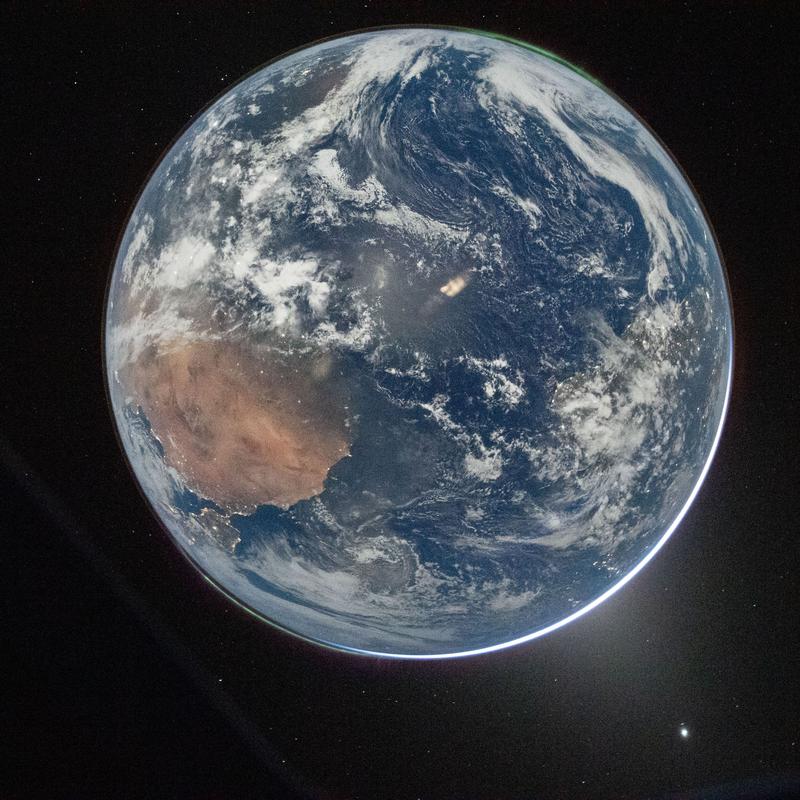
Brian Lehrer: Brian Lehrer on WNYC. Earlier this month, NASA's Artemis II mission gave us a stunning new image of our planet. Did you see it? In some ways, it was a familiar image because it recreated the iconic Blue Marble photograph from the 1972 Apollo 17 mission. That image was one of the first clear shots of the planet fully lit from way out there. Along with NASA's 1968 photo Earthrise, the images from space became powerful symbols for the environmental movement, according to NASA itself.
Here on Earth Day, we remember this year's image from the Artemis II mission is titled "Hello, World," and it looks different in comparison to the original. As has been noted with concern online, Hello World looks a bit dingier. Viewers have noted the colors seem muddier, leading many to speculate that it was because of climate change. Well, in terms of the color difference, it's likely due to 50 years of technological advancements in photography, others say. NASA is one of the global leaders in studying Earth's changing climate. It turns out that vantage point can tell us a lot.
On this Earth Day, we're joined again by Jackie Faherty, astrophysicist and science educator at the American Museum of Natural History, with an astrophysicist's view of Earth Day. Jackie, so good to have you again. Welcome back to WNYC.
Jackie Faherty: Hi, Brian. I love coming on your show.
Brian Lehrer: I'll remind listeners we had you on just earlier this month to tell us about the mission of Artemis II, but we didn't talk about Hello World or the other images from that mission so much. Just to recap, can you describe Hello World and what your reaction was to seeing it?
Jackie Faherty: Yes. Hello World was an image that Commander Reid Wiseman sent back, and NASA uploaded. The Hello World, like, "Look, Earth from here" perspective. I think it's a beautiful image. I know there's this comparison happening with the Apollo images, but there's just a lot of lighting and camera differences between the Apollo image, Blue Marble, and Hello World.
What I think the Hello World image does is there's this thing called the overview effect that astronauts will say they experience when they're in space, and they can see the Earth from above. It's like a cognitive shift that happens when you're displaced that far from your home world and you can see the planet in all its glory, the thin blue line of the atmosphere, a borderless planet. Many astronauts have said that they've felt this when they're there.
To me, the Hello World image was also many people were reacting in a way that I think invokes the overview effect, where you're reacting to the idea of seeing your planet just whole like that, like the whole disc is just right there in front of you. You can see weather, you can see ocean, you can see land. I think it implies we have this beautiful relationship with our planet, and we should preserve it. That's how people, I think, were seeing this image. That's how I saw it.
Brian Lehrer: Well, can you explain why? I guess you just started to do that, but I want to know more about why Blue Marble, the 1970s image from space of the Earth, looks so much brighter and bluer than Hello World, which was just taken by the astronauts on Artemis II. Because if I think of my iPhone, for example, my current generation of iPhone takes much clearer pictures, less muddy than my old one. What gives?
Jackie Faherty: This, to me, has way more to do with a camera expert and also the work that they did on the photo. We all know that you can change the lighting in photos. It's more of a treated photo, I think, the Blue Marble image. I don't actually think you're-- Brian, honestly, there's lots of images from space of Earth that we can look at and compare. I'm not telling you that you can't. Like, climate change is definitely happening in images, but we don't have to get too wrapped up in the Hello World versus Blue Marble images. I just don't want to get too tied down on what's probably just camera tech.
Brian Lehrer: Listeners, we can take comments or questions for Jackie Faherty on the Earth as seen from space, how it might move you when you look at any photo from any year from space of the Earth. Maybe even somebody's listening, who's ever been an astronaut who's had that experience. That's a needle in a haystack, but you never know. 212-433-WNYC, 212-433-9692. Or have studied as scientists, perhaps, what we can learn about the Earth from the vantage point, not just the visual vantage point, but also some experimental and scientific observations that are done from up there from space. 212-433-WNYC, for astrophysicist Jackie Faherty. 212-433-9692. You can call, or you can text.
What about for you, who's involved in astrophysics from that standpoint, from sort of an Earth Day standpoint? What do you think you or people have actually gone up might learn about the Earth, or might have a different emotional relationship to the Earth after they come back, compared to people who have never done it?
Jackie Faherty: I'm not an astronaut, but I study worlds beyond ours. I'm one of these people. Actually, I study atmospheres of worlds beyond our own, out of our solar system. The one thing that comes up time and time again, that we are working our hardest as astronomers to discover a world that even just has an atmosphere, Brian. We're just trying to find another atmosphere around another kind of rocky world. The thing that I am brought back to time and time again as a researcher is how really unique our planet is right now for us, for us, for humans to be existing on it, to get the right amount of oxygen, the right amount of nitrogen on our atmosphere. Everything in our atmosphere is precious for us.
This idea of save the planet, people need to finish that sentence. It's save the planet for humans. Like, the Earth's going to be fine. It'll just spit us off. These planets that we find outside of our solar system, they run the gamut. There is nothing that we've found that we can exist on yet. We need what we have here. As an astrophysicist, I really reflect on this a lot, preserving the world that we are so fragile to belong to, because we're not going anywhere else anytime soon.
Brian Lehrer: Yes. Well, some critics-- No, let me not ask that question. Let me ask this question because it so relates to what you just said. According to the Hayden Planetarium's Worlds Beyond Earth show, our planet can become, like nearby planets, Venus or Mars, if its climate is pushed to its extremes. You know this because you're involved with that. The show explores how our planet sits in what you call a Goldilocks zone. Not too hot, not too cold. This balance can be broken, much like it was on our neighbors, Venus and Mars. Can you give us some of the broad strokes as to how those planets can provide lessons?
Jackie Faherty: Yes. Our solar system is definitely a lesson in planetary evolution, and also just very slight differences. You go in a totally different direction. Our solar system is broken up into an inner part and an outer part, and the inner part of the rocky worlds, which is Mercury, Venus, Earth, and Mars. Then there's the outer part. In our inner part, we've got Venus, us, and Mars. We're all in this area that is considered the habitable zone around the sun. Habitable zone is just defined by having liquid water bubble on the surface. That's basically the astronomer's definition.
Venus is a little bit closer. Mars is a little bit further away. We're in the ideal spot at some level for liquid water to bubble, be fine on our surface, and have our climate just doing well for us. Venus, Brian, probably was habitable maybe a couple billion years ago. We're a four and a half billion-year-old solar system. Venus probably had a great run of a temperate climate. Something happened on Venus.
Now, astronomers debate about what happened on Venus. It could have been; it has a runaway greenhouse effect. Its atmosphere is crazy, it's toxic, it's a soup. We would die for sure. Venus is a dangerous place. We do not want to go the way of Venus. What happened to Venus might not be the same reason. Like, climate change could cause a Venus-type atmosphere. We don't know if what happened to Venus is the same thing that is happening here. Like, we don't know what the ancient Venus really looked like. We're kind of guessing.
Mars is a little bit different. Mars is a smaller planet. I think we're safe from going the way of Mars. What's really wrong with Mars is it's just a little bit of a smaller planet. It's got a thin atmosphere, and so it can't really hold on to its atmosphere the way we can hold on to ours. The real comparative planet that you do not want to become is Venus. This space show that we have, Worlds Beyond Earth, is an attempt to give people that full perspective on the planets in our solar system and really demonstrate for you, like guys, we got to be grateful for this right now. We are in the ideal world for us right now.
The Earth is what we-- it's all we've got. We can't look at Venus and be like, "Well, there's another world there. Maybe we could terraform it or something." Instead, you need to look at the Earth and think, "Protect this thing. This is what's working for us."
Brian Lehrer: Nathan in Coeur d'Alene, Idaho, has a take on why the Blue Marble photo of the Earth from space in the 1970s and the Hello World one from Artemis just now look as different as they do. Nathan, you're on WNYC. Hello.
Nathan: Good morning, Brian. Thank you for taking my call. As I recognized this when I was watching the activity, it occurred to me that they were taking a picture from the opposite side of the Earth. The sun was behind the Earth, and what was illuminating it at that point in time was the reflection of the sunlight off the moon onto the Earth. That's why it may not have been as clear as people had expected in that particular photograph. However, the continuous photographs thereafter are absolutely magnificent. I just wanted to call and make that clarification. I love your show. Thank you.
Brian Lehrer: Thank you for listening from Idaho. Terri in West New York, New Jersey, has something that she wants to ask about the Hello World image. Hi, Terry.
Terri: Hi. Thank you so much for taking my call. Having seen the Hello World and the Earthrising, I was a child then, and it was magnificent. I noticed on these images, if you looked at the circle like a face of a clock, I think it was like the seven to eight o'clock region, it was all like beige-ish brown. Was that because that was like the desert area of the world, or is there a different reason it looked like that?
Brian Lehrer: Do you know what she's referring to, Jackie?
Jackie Faherty: If you're talking about the Hello World image, I think Africa is centered in the Hello World image. I'd have to check it. I'm assuming she's not talking about-- there's a little bit of a smudge to the right, which I think is more from the integrity window. If you're talking about what's on Earth, I'd just double-check what part of the Earth it's actually pointing at.
Brian Lehrer: Terri, thank you very much for your call. Here's a great text. Listener writes, "The blue dot photo seemed to have a great effect on consciousness and preservation for our planet in our environment when it was released decades ago. Do you think that any new photography of our planet can inspire similar conservation efforts in our 2026 political climate?" Great question.
Jackie Faherty: Yes. I think they're referring to the pale blue dot image that was taken by Cassini when it was on its way to Saturn. That image, Carl Sagan has a very famous pale blue dot speech about which everybody should listen to. I think it's just inspiring. The words are inspiring. The image is inspiring. That image, even though it's a little grainy and we're just this pale blue dot in it, like it's just a speck, I think, does continue to get people inspired.
Frankly, Brian, we do try and do this here at the Hayden Planetarium. Everybody can't go to space and get this feeling. You can look at the images, but there is this, like, when you rise up off the surface, like the astronauts get to do, and you get to see it, that, I think, is something special. People can come here to the planetarium. We have some evening programs. You just have to check when we're doing them. I try and lift people off from Earth and show you that perspective. If more people could get that sense of serenity and peace when you can see your world, I do think it-- Maybe I'm being too kumbaya, but maybe we would be a better place.
Brian Lehrer: Because from that vantage point, we're all kind of neighbors and in this together, right?
Jackie Faherty: It's borderless. Yes, it's borderless.
Brian Lehrer: Last question. NASA's science division, I see, is facing a near 50% funding cut in the White House budget proposal for the second year in a row, according to Scientific American. Can you tell us the role NASA has had in tracking climate change?
Jackie Faherty: Oh, my goodness, yes. NASA is so important in this. This is definitely something people should be paying attention to. NASA has a number of programs that are monitoring the planet. There are thousands of satellites, Brian, that are in orbit around the Earth, and there's a fraction of them that are weather satellites. They're Earth observation or remote sensing satellites. These are run by NASA, or they're run by NASA organizations. They're weather satellites. They are really vital in continually monitoring the state of the planet. These programs require funding to both keep up the satellites and also to keep up the analysis of the data.
If people can just be very aware of this, and if this is important to you, NASA's budget isn't just sending astronauts into space; it's also looking down on the planet and monitoring the change that we see. I would just implore people to look up their local representatives to see if they can help with these various NASA budget cuts that are happening, because there's a lot of science cuts happening, but the ones that are impacting climate change are extremely large right now.
Brian Lehrer: Jackie Faherty, astrophysicist and science educator at the American Museum of Natural History. Thanks so much for coming on. Despite everything we've talked about with you and the previous guest this hour, Happy Earth Day.
Jackie Faherty: Happy Earth Day, Brian.
Copyright © 2026 New York Public Radio. All rights reserved. Visit our website terms of use at www.wnyc.org for further information.
New York Public Radio transcripts are created on a rush deadline, often by contractors. This text may not be in its final form and may be updated or revised in the future. Accuracy and availability may vary. The authoritative record of New York Public Radio’s programming is the audio record.