
Democratic Socialists' Take on the Mayor's Budget
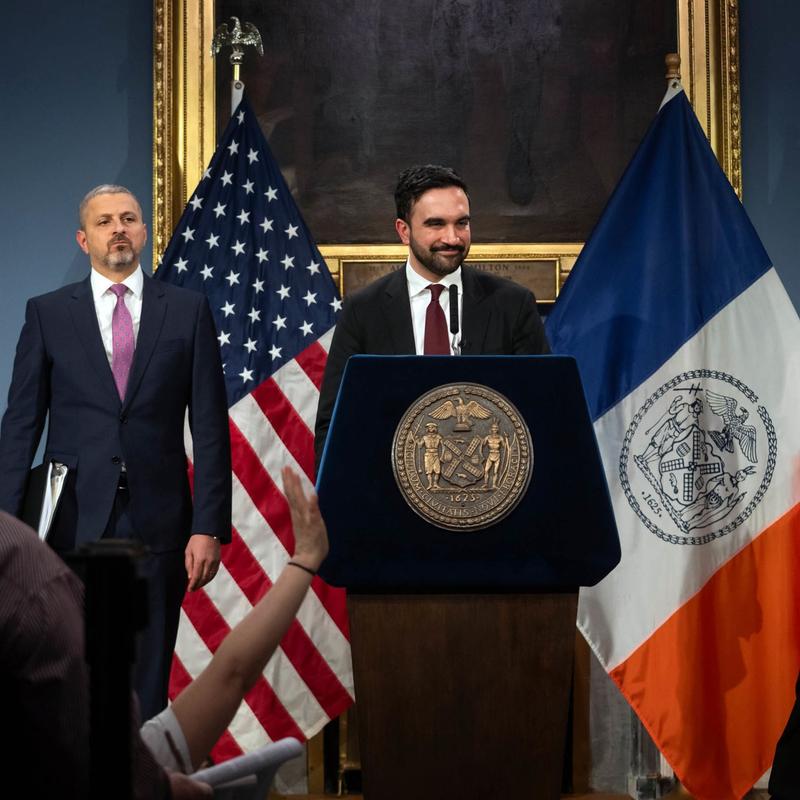
Title: Democratic Socialists Take on the Mayor's Budget
[music]
Brian Lehrer: Brian Lehrer on WNYC. How is Mayor Mamdani doing according to the group that he belongs to and did a lot to help him get elected, the Democratic Socialists of America New York chapter. How's he doing with these storms and the safety of homeless people on the streets? He did announce a resumption of homeless encampment sweeps last week, though he says they'll be more humane than under Mayor Adams.
How does his big budget blueprint released last week look to the New York City DSA leaders after the mayor said this from the podium in his inaugural? "Do the rich have everybody else over a barrel? Because--" No, that's the wrong clip. He said, "I was elected as a democratic socialist, and I will govern as a democratic socialist." One thing to note, this preliminary budget does not include a Department of Community Safety, a core campaign proposal, and you probably know, it does include two tax hike options to help close the $5 billion budget gap that the mayor inherited.
Of course, he's just been in office for two months. He didn't cause this. He inherited it. His preferred choice is to raise taxes on the wealthy, as you know, and wealthy corporations, but he's got a property tax hike plan B. Now, apart from the tax increases, Mamdani required every government agency to appoint chief savings officers tasked with eliminating waste and inefficiencies. Makes me wonder, can there be a democratic socialist version of DOGE?
There's also some lines in his budget that critics have compared to austerity measures implemented by previous administrations. Public libraries are facing a $30 million cut. CityFHEPS, the rental assistance program that helps low-income households get out and stay out of the shelter system, remains underfunded compared to the demand and eligibility. Let's get a DSA report card. With me now are Grace Mausser and Gustavo Gordillo, co-chairs of the New York City chapter of the Democratic Socialists of America. Grace and Gustavo, thanks for coming on with us today. Hope you are warm and dry and otherwise safe in the storm.
Grace Mausser: Hi. Yes. Thanks for having us.
Gustavo Gordillo: Thanks for inviting us to the show.
Brian Lehrer: Grace, I asked the sanitation commissioner last week, "Is there a Democratic and Republican way to pick up the garbage?" Because there's that old Mayor La Guardia clip, "There's no Democratic or Republican way to pick up the garbage." Is there a democratic socialist approach to a snow emergency?
Grace Mausser: Well, I think the word you might be looking for is sewer socialism, which of course was popularized in the early part of the 20th century. To us, providing basic services, showing that the government, a well-funded government, can and should be serving the people in a timely and efficient manner is socialism. It's about the government serving the people and the people having a say in how the government reacts and responds and makes our lives better and makes our city more affordable. To me, yes, there is a socialist way to clean the snow and pick up the garbage. I think we're starting to see what that could look like.
Brian Lehrer: Does the mayor, Gustavo, bear any responsibility for being too, what's the word? Too reluctant in the name of compassion to homeless people, to get people off the streets during the previous storm and the very, very cold weather that led to about 18 deaths, or did it lead to 18 deaths in the conservative press, the New York Post and elsewhere, you would think it all came from that. Can you make a case that it didn't?
Gustavo Gordillo: I think we saw that a number of those deaths were due to overdoses. They were not necessarily all attributable to the cold. I think that the mayor has posed that this new approach to contacting homeless residents, connecting them to services is a pretty dramatic departure from what was in place under the Adams' mayoralty. The fact is we're only about 50 days into the Mamdani administration, and the movement and the mayor alike are trying to undo 50 years of neoliberal governance that's disinvested in public services and constrained the city to put profits over-- for the 1% above everything else.
I think we're early into the administration, but we've seen a number of successes already, like a major step toward universal childcare on day eight. He's recently announced that he's appointing a supermajority to the Rent Guidelines Board. They're going to be able to ensure a rent freeze for rent-stabilized tenants in New York City for the duration of the administration. We're facing a challenge in coming into governance, but we knew that, and I think that the mayor has pretty dramatic accomplishments already 50 days in.
Brian Lehrer: On day five of his administration, Mayor Mamdani paused homeless encampment sweeps, calling the Adams' policy a failure. Then after the deaths in the cold, he came on the show and elsewhere and said, "None of the people who died in the cold were in encampments," so he needed to separate the one policy from the result, but then last week, as you know, after that prolonged cold snap, he reversed course.
The new policy puts the Department of Homeless Services in charge instead of the NYPD. It requires seven consecutive days of daily outreach before any sweeps happen, but advocates, some of them are calling it a broken promise. The mayor says it's a fundamentally different approach. Which is it, according to you, the leaders of the New York City Democratic Socialists of America? Are you disappointed that he reversed course and will engage in some homeless encampment sweeps?
Grace Mausser: Of course, [crosstalk]--
Gustavo Gordillo: I think--
Grace Mausser: Oh, sorry. Go ahead, Gustavo.
Gustavo Gordillo: I think that ideally by having DHS lead the process rather than the New York Police Department, he is going to create an opportunity to build enough trust and offer enough placements; connecting people with care, services, and resources. I think that under the Adams administration, there was no goal really for connecting homeless people with services. I think that in 2024, actually only three homeless people were brought from encampments to temporary shelter, but in the past seven weeks, the current administration has made 1,600 connections to shelter or long-term housing. I do think that this is an improvement on what we saw during the Adams administration.
Brian Lehrer: Grace, how do you understand the fact that in the budget there is no Department of Community Safety, no money for creating the Department of Community Safety, which was supposed to be a lead agency on this, side by side with or as an alternative to the NYPD for this kind of thing as well as some other things. There is no proposal in the budget for a Department of Community Safety, which was such a core campaign proposal. What do you make of that?
Grace Mausser: The headline of the budget should really be that the mayor is imploring the governor and the state legislature to tax the rich. Most of the budget is built on the idea that there needs to be more revenue from the wealthiest in the state to pay what they owe to make the city and state affordable. The cuts that were presented, the potential taxes that were presented, are alternatives that Zohran is putting forward if revenue is not raised. Those alternatives are the only two levers that the city has in place because of binds that the state has put the city in over the course of the last 50 years. [crosstalk]
Brian Lehrer: Right, and we'll get to-- Let me jump in for a second. Because we'll get to the property tax alternative if the state does not pass the income and corporate tax increases, but the ultimate budget number for what the city would spend, I believe, is the same whichever tax route he feels they have to take. Do you understand why there's no Department of Community Safety in there?
Grace Mausser: I don't have full insight into all of the administrative decisions, but I do know that there's some discussion about how we create a department versus an office. As you may know, departments are part of the city charter. They have to go through a charter process, whereas a mayoral office can be created more quickly, but of course, has less staying power.
I think with just 50 days in and still staffing up, there is a lot of discussion on how do we create a Department of Community Safety that isn't just a flash in the pan, something that exists for eight years of a Mamdani administration, but something that truly becomes an integral part of the fabric of New York City governance. I'm not sure that we can settle all that within two months. I remain optimistic that it will happen within the next year or two.
Brian Lehrer: Here's a tax the rich question from Rebecca in the Rockaways. Rebecca, you're on WNYC. Hello.
Rebecca: Hi, good morning. My question was, why can't New York City tax its own billionaires? Like does the state have to do that? Can we do that ourselves? If so, why not?
Brian Lehrer: Thank you. Yes, the state has to do it. Gustavo, do you want to elaborate on that at all? Because that is where the politics rest for the income tax hike on people earning a million dollars a year or more or on the wealthiest corporations. Doesn't seem like the city can do it on its own.
Gustavo Gordillo: That's right. After the '70s fiscal crisis, there were a number of fiscal constraints imposed on New York City and on the mayor. Something we run into when we're canvassing and talking to voters is that there is a misconception that the mayor has more power than he actually does. In this case, it's the governor and the state, the state legislature, that must pass taxes on the rich. The only power that the mayor does have, together with the city council, is to increase property taxes.
That is why we have a campaign to force Hochul to tax the rich. Because right now, the New York State is about to face a $12 billion tax cut coming from Trump's One Big Beautiful Bill Act. Millionaires and corporations in New York are going to be paying fewer taxes than ever because of the Trump tax cuts. The question for the governor is whether she's going to collaborate with Trump, and in effect, codify these cuts into law, or is she going to pass taxes on millionaires and corporations so that they pay what they owe?
Brian Lehrer: What's your take on the 9% property tax increase as a plan B? You're okay with that, Gustavo?
Gustavo Gordillo: No one is okay with raising taxes on working-class homeowners. That's why the mayor has said that his top goal is to raise taxes on the rich, and that's what we're fighting to build power to do. We are organizing thousands of people to travel up to Albany this Wednesday. Hope to see some listeners there. We're also building a mass movement here in New York.
That's how we got a huge childcare deal announced on day eight of the administration. It's because we built a historic movement during the campaign that led to a million people voting for Zohran Mamdani for mayor on an agenda of taxing the rich to build an affordable New York City. That's how we're going to force Kathy Hochul to tax the rich.
Brian Lehrer: Lydia in Chelsea, you're on WNYC with the two leaders of the New York City chapter of the Democratic Socialists of America. Hi, Lydia.
Lydia: Hi. Hi. Thanks for taking my call. I'm calling to ask, and let me say, if you guys are report card graders, I think you're easy graders. Why is Mayor Mamdani supporting the privatization of public housing in the Fulton and Elliott Chelsea projects? Why is he allowing 70% of the public land to be taken for market-rate housing? Why has his administration kept people from the Adams administration in housing who are in support of privatization of public housing? Thank you.
Brian Lehrer: Thank you, Lydia. Grace, you want to take that?
Grace Mausser: Sure. I'll be honest that I don't know the ins and outs of the Chelsea project that she's referring to specifically, but broadly, I will say that we know Zohran is committed to building 200,000 units of affordable housing and wants that development to be fast-tracked. I would say one thing that is overlooked in the housing discussion frequently, at least until Zohran came on the scene and helped popularize it, is freezing the rent and expanding tenant protections for people who are already in place.
We have to stop the bleed of working-class New Yorkers from leaving the city in addition to building more affordable housing. While I can't speak to the specifics, unfortunately, of what the caller is discussing, I know that he's committed to this. He's building a team of people within HPD, under the deputy mayor for Housing who are committed to this. Some of this will just take time.
We're New Yorkers, we're not patient people, but we do have to help the mayor and take ownership over what is happening in the city and give him time to build a team that is aligned with him and then help with the grassroots supports and the movement of people who have demanded an affordable New York, to create the housing system we need, the taxation system we need, and just the public services that are fully funded by fair taxes that we deserve.
Brian Lehrer: Another listener who I think would want you to be more pure than they're experiencing you, writes, "Really disappointed to hear you responding to thoughtful questioning about deaths of New Yorkers with facts about how great Mamdani is. This is typical party hack stuff. The problem is the shelter system not providing what people actually need and people having to be corralled into space that's limiting, restrictive, and not all that humane."
To that caller's point, Grace or Gustavo, either of you could take it. The mayor-- We know that there isn't enough permanent housing to actually get everybody off the street, who should be gotten off the street or at least have the opportunity to get off the street for good. CityFHEPS, those vouchers are supposed to be part of that solution, the rental assistance program that helps low-income New Yorkers exit the shelter system and stay out.
City council passed expansions in 2023, but the Mamdani budget doesn't fund them. We have a reaction, for example, from Win, the city's largest family shelter provider. They say full implementation could actually save the city $635 million over five years. Grace or Gustavo, why is Mayor Mamdani walking away from full funding of those CityFHEPS housing vouchers? How is that consistent with DSA principles?
Grace Mausser: We need to fund more of our services. I know we sound like a broken record here, but that really is the problem. We have to tax the rich to fund the services we deserve. I fully agree with the write-in listener that what we need are better shelters, clear pathways to permanent homes, and all of that costs money. I think the left for too long has just-- hoped that when we get someone slightly aligned with us into office, we can snap our fingers and everything will be different, but we know that isn't true.
That is why DSA has built a robust campaign around taxing the rich. That's why Mayor Mamdani is demanding the same thing. Because we know that to actually change these systems and build sustainable, long-term, permanent solutions over time, we need an increase in funding, we need an increase in revenue. That's exactly what we're demanding. This kind of either-or mentality, if he has to fund CityFHEPS right away or he's a total failure, he has to do this thing and sacrifice that thing.
It's a limited mindset. We have to expand what is possible. That means expanding the revenue that the state sees. It means pulling more from the robust economy that all workers in the state and city have created so that we can fund the services we need, so that we can fully fund CityFHEPS, so that the mayor does not have to do any cuts, so that we can create permanent housing and better shelters. I deeply understand the frustration of the listener, and I really think the answer is that we have to tax the wealthiest New Yorkers to make these services possible.
Brian Lehrer: In light of Governor Hochul's opposition to that, are either of you disappointed that the mayor has now endorsed the governor for re-election and declined to endorse her more progressive challenger, Deputy Mayor Delgado, or that the mayor declined to endorse Chi Ossé, who's now a DSA member who wanted a primary, Hakeem Jeffries?
Gustavo Gordillo: I will say that I don't think that Governor Hochul has earned the mayor's endorsement. I think that if she wants to live up to the promise of the affordability agenda, she has to commit to raising taxes on millionaires and corporations, but what we've seen is that-- the mayor is one of the most popular politicians in the country right now, likely the most popular politician in New York.
As the governor has moved her agenda closer to the affordability agenda that the mayor ran on, she's become more popular herself, but taxing the rich is among the most popular policies in this state. 73% of Democrats support taxing the rich all over the state, not just in New York City. Taxing the rich is more popular than Hochul herself, just as the mayor is more popular.
I think if she wants this partnership that she's developed with the mayor to be effective, she has to protect the affordability agenda. The only way to really make it work in the long run is if we have sustainable funding. I think she cannot just take this partnership for granted, that it will be able to continue if she's becoming an obstacle to implementing the affordability agenda that a million New Yorkers are relying on.
Brian Lehrer: You're okay with Mamdani, now that he's actually in office, going for a little pragmatism, pulling off of what might be the pure position, if that's the right word, that you leading the New York City chapter of the DSA declining to approve of Hochul's re-election?
Gustavo Gordillo: Well, we're certainly not going to be endorsing Governor Hochul anytime soon, but we're still partnering with the mayor to build the movement to tax the rich. We're still coordinating around bill introductions and organizing within the Assembly and the Senate. That's been our whole model from the beginning when we started to run democratic socialists for office.
Brian Lehrer: One more thing about taxing the rich. Last week we had Greg David, business and economics contributor to the news organization THE CITY. I asked him if the richest few percent of the population and corporations just have everyone else over a barrel, because they provide so much of New York's tax revenue as a percentage and could be open to a bidding war for where to live or where to locate a business. Here's a little of that exchange, beginning with my question.
[clip begins]
Brian Lehrer: Do the rich have everybody else over a barrel-
Greg David: Yes.
Brian Lehrer: -because all the other states and cities can have a race to the bottom for taxes?
Greg David: Well, there is a race-- Well, it's not a race to the bottom, but there's states that obviously are thriving that have no income tax. Look, if the rich leave New York, and we don't need the-- if the 20 people making 25 to 50 million dollars a year leave, the budget deficits will be enormous, enormous. You just have to look at the stats about the income tax. I got to look. Millionaires paid 41% of all the income taxes in New York State. Who's going to pay them if they leave? To be frank, it's just a ridiculous idea.
[clip ends]
Brian Lehrer: How does that affect your thinking? The fact that the top few percent pay such a large percentage of the tax base, and the last thing you would want, democratic socialists, is for the government not to be able to afford robust social services.
Gustavo Gordillo: Well, I think we feel how broken is our democracy and economy where we shape everything we do around a few dozen people, just 25 taxpayers. That is the definition of oligarchy. It's undemocratic to cater to such a select and small group over everyone else. In the long run, we don't just want to rely on millionaires. The annual income of the two richest hedge fund owners last year could stop the entire budget deficit this year. Steve Cohen, Dave Tepper, Ken Griffin, these hedge fund owners, they all earn over $3 billion per year.
That's why we're calling on the governor to increase taxes on these billionaires. Because we know that when we've done it in the past, like we did in 2021, millionaires don't actually leave New York the way other income groups do. What we're seeing right now is the working class leaving New York State because they can't afford it. In the past 20 years, 200,000 Black families left New York because they couldn't afford rent. They're citing they can't afford to raise their families here. That's why we're fighting for universal childcare.
Corporate tax increases also don't drive away corporations because corporations are taxed based on where they're located. That was a reform that was passed in 2015 to ensure that corporate tax-- that corporations wouldn't just be able to move to another state. When Hochul, when journalists are citing that the rich are just going to move, it's really not based in reality. It's based on their own class interests. As we know, Governor Hochul and her husband make nearly $2 million per year. Maybe that's why she's fighting us on this campaign.
Brian Lehrer: Just as a follow-up, Grace, and then we're out of time. I think the argument that Greg David was citing in his article was that the richest few percent may not leave en masse, and corporations are taxed, as Gustavo just rightly said, on sales here, not on whether they're located here with the jobs. If you look at what has happened over time, examples that he gave were some of the big investment firms like Goldman Sachs, J.P. Morgan, they have a smaller share of their jobs in New York now than at any time in the past as they expand more quickly elsewhere.
Some of the economic experts think that's in response at least in part to the relative tax environments in other states like Texas and North Carolina. How would you argue against that as that it's not a long-term job creation threat to New York, and then we're out of time.
Grace Mausser: I believe he also cited that New York City still has a growing number of jobs in the financial sector, so-
?Speaker: He did.
Grace Mausser: -I didn't quite follow his argument about why if our number of jobs are growing, it's bad for us if the number of jobs are growing in other states too. I don't wish ill on working people of other states. That didn't quite land for me. The fact is our economy in New York City and New York State is getting bigger, and the share of it that's going to the wealthy is also getting larger. I find it morally unconscionable to go along to get along in an oligarchic system. Gustavo highlighted this.
I don't think we should make policies based on 20 billionaires, nor do I think we should make policies based on what one or two corporations or the think tanks or politicians that they fund tell us. I think we can look at the numbers, see that our economy is growing, but it's not growing for the vast majority of New Yorkers' household incomes. We can make policies based on that.
We can say, "Hey, what is just and what is reasonable so that all boats rise, is for the wealthiest New Yorkers to pay what they owe to the city and the state that have allowed them to make their fortunes." That's exactly what us and Mayor Mamdani are demanding and organizing for.
Brian Lehrer: Grace Mausser and Gustavo Gordillo, co-chairs of the New York City chapter of the Democratic Socialists of America. Thanks so much for coming on with us today. Really appreciate it.
Grace Mausser: Thank you.
Gustavo Gordillo: It was a pleasure to be here.
Copyright © 2026 New York Public Radio. All rights reserved. Visit our website terms of use at www.wnyc.org for further information.
New York Public Radio transcripts are created on a rush deadline, often by contractors. This text may not be in its final form and may be updated or revised in the future. Accuracy and availability may vary. The authoritative record of New York Public Radio’s programming is the audio record.
