
Connecting With Poetry
[music]
Brian Lehrer: Brian Lehrer on WNYC. Here's one impact of the Trump administration's version of nationalism and its marginalization of the Smithsonian Institution that hasn't been reported on very much. The New York Times had this headline back in February. Smithsonian Folklife Festival Gives Way to Trump's Patriotic Fair. It said the summer festival held annually since 1967, will not take place as usual on the National Mall, which will instead host the President's Great American State Fair, as it's called. The Smithsonian announced that this summer, for the 200th anniversary of American independence, it will take its festival on the road to communities across the country and in three U.S. territories. That according to the New York Times.
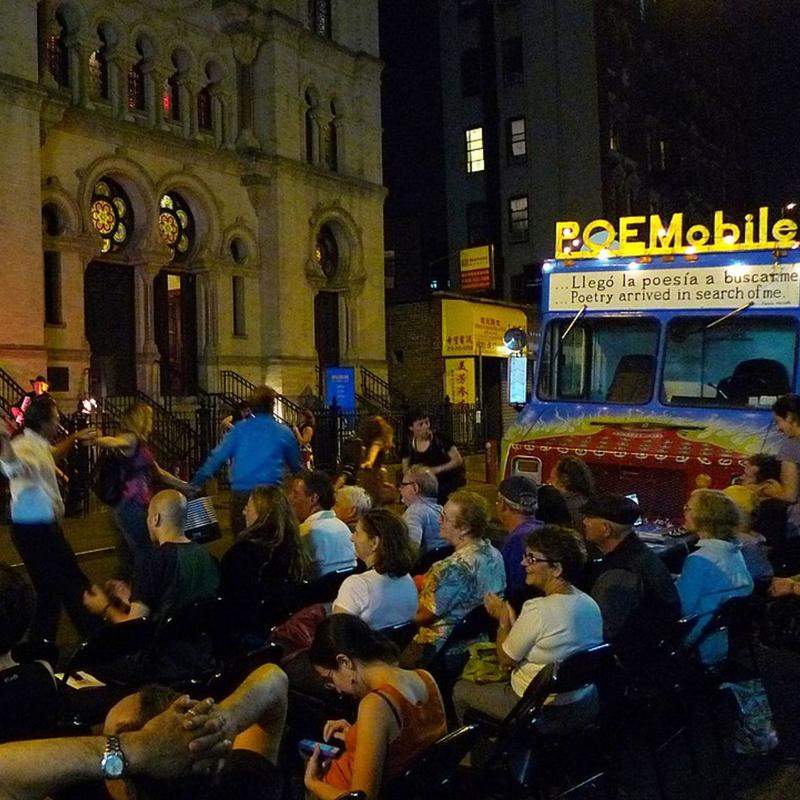
Well, here in New York, that on the road edition of the Smithsonian Folklife Festival will be something called the People's Poetry Project. It'll take place in a variety of venues around the city and also include what the curators call a POEMobile that will travel around the five boroughs. Joining me now, two of the lead curators for the People's Poetry Festival, Bob Holman and Steve Zeitlin. We will also talk in this segment and invite your contributions to another project of theirs, their fourth forthcoming book called Across the Great Divides: A Search for Poetry, Soul and Understanding in a Divided Nation.
Joining me now on both of these projects are Steve Zeitlin, founding director of the New York cultural group City Lore, and Bob Holman, poet, filmmaker and proprietor of the Bowery Poetry Club. Steve and Bob, always great to have you on the show. Welcome back to WNYC.
Bob Holman: Thanks for having us.
Steve Zeitlin: It's wonderful to be here. You're great. Brian.
Brian Lehrer: I want to talk about your book project first, to invite the listeners to participate. Then we'll get to the People's Poetry Project. First, congratulations on getting an actual publisher since you were last here collecting poems for the book. Steve, would you introduce folks to the idea behind the project called Across the Great Divides, and how you're trying to use poetry to get there?
Steve Zeitlin: Yes. We feel like there's never been more of a need to find the humanity in people, on all sides and to tone down the hatred, and almost step away from politics into the humanity that exists in people's lives, and the way in which they approach their lives. We feel like this book is an effort to look at the humanity on all sides of the political aisle, not by saying, "This is who I'm going to vote for, but this is why I believe what I believe. These are the roots of it." Maybe the roots of it are in a place in where you grew up and how you came to believe what you believe. That's the idea of the book. Bob, do you want to add anything to that?
Bob Holman: Just to say that we're looking for voices across the entire political spectrum. I think that Brian's spectrum here may be different from what happens across the country, but we're still looking for your poem to go back into your education as a political being. Who was it and what was it that set you on this road? Because we all started from the same place, in mommy's womb, but what happened after that to get us on such different sides of the divides?
Brian Lehrer: I'll reiterate the language that you gave us the other day to help solicit poems from our listeners that they should be on iconic American symbols like the flag, the Statue of Liberty and the Declaration of Independence, and whether we have lived up to our ideals, is the way you've written it up. Maybe Trump tries to live up to his deals. Other people live up to their ideals. 212-433-WNYC. Again, they're looking for poems from any political or cultural perspective, especially if you yourself have written them dealing with iconic American symbols like the flag, the Statue of Liberty and the Declaration of Independence, and whether we have lived up to our ideals.
We mentioned earlier in the show that this would be coming up, so we're re upping it here to see if anyone has something you wrote that you think fits the ask. Who knows, it may wind up in their book. 212-433-WNYC, 212-433-9692. To get you all going, Bob, as the performing poet in the room, I gather you've brought some examples of poems you've collected for the project from places and cultures very different from those we tend to find in New York. I see that one example is the Cowboy Poetry Gathering in Elko, Nevada. I assume that would produce some very different writing than we might find in Flatbush or Flushing or on the Upper West Side. What you got for us to read from?
Bob Holman: You're absolutely right, Brian. You know, both Steve and I have been to the annual Cowboy Poetry Gathering, and it is the largest poetry festival in the country. Over 10,000 people come. I saw a horse on a stage there, and it's an extraordinary event. Here's a poem by Sariah Knight from Texas. It's written like most cowboy poetry, in rhyme. This is rhymed couplet. You poets out there, and you all are of course, perk up your ears to check out her brand fangled new use of the couplet rhyming form. It's Sariah Knight's poem, American Boy.
He drinks water from a hose,
I rarely put sunscreen on his nose,
He plays in the dirt,
Because dirt don't hurt,
He has a holster with a toy gun,
When he's older he gets a real one,
He doesn't wear a helmet when he rides his bike
He watches movies with John Wayne and the like
Every day he'd rather be outside than inside,
Which is hard when sunshine and school time coincide,
He has a few chores morning and night,
He's a regular boy who likes to wrestle and fight,
He doesn't have a single video game,
Boys need less screen time, I proclaim,
He carries an old timer pocket knife,
Even though he's cut his hand once or twice,
When the flag goes by, he takes off his hat and puts his hand over his heart,
I've come to realize being an American boy is becoming a lost art.
Brian Lehrer: So--
Steve Zeitlin: By the way, when she sent in that poem, she said that she sent it in because she had tried to raise her own four boys as true American boys.
Bob Holman: She's a Texan, and how do you like that? In my family, there ain't no guns allowed. Not even a toy one that looks something like it, but in this case, we've got a holster for a toy gun so when he's older, he can get a real one, you know. We have education going on.
Brian Lehrer: There's one from Texas. Catherine in Manhattan has one that she says she just started to dash off two minutes ago hearing our solicitation and our invitation. Catherine, you're on WNYC. Hello?
Catherine: Hello. Hi Brian, hi everyone. Well, this is a quick one. Here I go.
Give me your poor, your tired
Salaam alaikum, Om Liberty,
I gaze at your lamp held high,
Hola, Mami Libertad,
I feel your direct, warm and welcoming gaze
Shalom Ima Liberty
I am grateful for the freedom of religion you offer.
That's as far as I got.
Brian Lehrer: That's a good start. Thank you very much.
Bob Holman: You got eight lines in four languages. I think that sounds very New York.
Brian Lehrer: Let's keep going. Let's keep going. Gregory in Harlem, you're on WNYC. Hi, Gregory.
Gregory: You know, I also, Brian, thank you very much, just wrote this as you mentioned it. It's based on the Star-Spangled Banner and it's a couple of lines.
Oh, you say that you see,
But the dawn ain't that bright,
And those that you hail,
Most likely aren't right.
Steve Zeitlin: Well, that--
Bob Holman: Keep going. Keep going. We need a new anthem. I'm glad to hear it's coming from Harlem.
Brian Lehrer: That's great. Gregory, thank you very much. All right, here's a text that challenges the premise. Listener writes, "Steve, slapping together a handful of clichés isn't going to depoliticize America. Sorry." Your reaction?
Steve Zeitlin: We asked people to be part of this as a utopian endeavor, so we believe that it's worth trying and maybe it will do some good.
Brian Lehrer: I should say for full disclosure, that you have now hooked up with my brother, the writer and designer, Warren Lehrer, who you say is bringing his design skills and other creative elements to the book. This book will have a visual element as well as the language of the contributing poets?
Steve Zeitlin: That's correct, yes.
Bob Holman: That's exactly right.
Steve Zeitlin: Also, Across the Great Divides becomes a visual symbol for him as well. That's one of the reasons he was interested in it, because he can visualize those divides in the poems.
Brian Lehrer: Here's another poem that came in in a text message. Short enough for a text message because it's a total of five characters. It goes PC, okay! PC, okay.
Bob Holman: PC, okay. Translate those abbreviations as you will, Brian
Brian Lehrer: Lorna in Peekskill. We'll do one more here. Lorna, you're on WNYC. Hi.
Lorna: Hi. Thanks so much for having me on. I just took a few carols, and one of them stands out, especially in terms of what your guests are trying to do. I took Away in a Manger and it became Away in Detention. I can read maybe a couple of verses for you.
Brian Lehrer: Please.
Lorna: Away in detention,
No cribs for their beds,
Frightened little babies,
Lay down their sweet heads,
The starlight streamed,
Through cracks in the door,
While the children of immigrants,
Sleep on the floor,
This baby is grabbed from Maria's breast,
And Jose is handcuffed and under arrest,
Today's harrowed system with its brutal hand,
Assaults rightful residents of this stolen land,
They round up little Jesus, Maria, and Jose,
Label them illegal and send them away,
The family is stranded with no kith or kin
Like the Christmas of yore,
There's no room at the inn,
In this season of caring and sharing in light,
Let's follow our conscience, stand up for what's right,
Leave bigotry, hatred and cruelty behind,
And work till there's justice for all humankind.
Brian Lehrer: Merry Christmas, Lorna. Thank you very much. Wow, what a contribution. How would that go over in Texas, Bob?
Bob Holman: Well, I don't know. I do like the way, though, that she was able to use a song. Tuli Kupferberg's para songs are often used for the submissions that we get, Brian. Take a song-- I loved it with the National Anthem, and put in your own words. What's inspiring to me is how we get such an immediate response. If somebody says to you, "Write a poem," you're going to rear back and say, "What?" But you say it over the radio and you open up that kind of thinking, all of a sudden, please, let's write that poem and send it into us. Poetry@citylore.org is where you send it. Poetry@citylore.org for us to see them. These won't be off the top of your heads. You'll be rewriting and editing them, and we are choosing the best ones. Right, Steve?
Brian Lehrer: Give that email address for submission one more time, and then I want to ask you about your other project.
Bob Holman: Poetry@citylore.org.
Brian Lehrer: Now, we've got about three minutes for you to tell us about the People's Poetry Gathering that you're producing here in New York starting in September in conjunction with the Smithsonian Institution, now that they got kicked off The National Mall for the first 4th of July since 1967, so the Trump administration could stage something there instead that they're calling The Great American State Fair. They are taking it on the road, the Smithsonian, by funding various things in various places. Who knows, maybe this is going to wind up being a good thing, or at least having a major silver lining, because the Smithsonian is taking the Folklore Festival all over the country to many venues, and you are curating the New York edition. What can we expect?
Steve Zeitlin: Well, for one thing, the POEMobile, which is a wildly decorated poetry truck is going to do a poetry event in each of the five boroughs where we project poems onto walls and buildings in conjunction with live readings. They were excited about going to every neighborhood in New York as much as we can. We're also hoping to get the POEMobile into the West Indian Carnival Parade and things like that. But the big part of our festival will be from October 23rd to November 1st, where we're going to be doing things, turn lower Manhattan into a poetry village.
Bob Holman: It already is a poetry village, isn't it, Steve, with the Bowery Poetry Club, the Poetry Project, and the Nuyorican Poets Cafe, which is going to be part of this celebration because they're going to be opening after three years, reopening after their Nuyo reconstruction, and the poetry slam will be moving back from the Bowery. The Endangered Language Alliance is going to be bringing in poets from some of the 700 languages of New York, 100 of which we think are endangered. Poets House is going to be having workshops. It's going to be, as Jerry Rothenberg called it, a Woodstock of poets,
Steve Zeitlin: Or as Stanley Kunitz put it, a populist bacchanal.
Brian Lehrer: Good luck with both things. The People's Poetry Gathering coming in September and October, and collecting poems for your forthcoming book, Across the Great Divides: A Search for Poetry, Soul and Understanding in a Divided Nation. Thanks for including Brian Lehrer Show listeners for this, and Happy Poetry Month, you two.
Bob Holman: Thank you very much, Brian. How do I get to the other side? You're already on the other side.
Brian Lehrer: And that is The Brian Lehrer Show for today, produced by Lisa Allison, Mary Croke, Amina Srna, Carl Boisrond, and Esperanza Rosenbaum. Our interns this spring are Arlo Bivins and Jack Walker. Zach Gottehrer-Cohen produces our daily politics podcast, and Megan Ryan is the head of live radio. Juliana Fonda and Milton Ruiz are at the audio controls. Stay tuned for Alison.
[music]
Copyright © 2026 New York Public Radio. All rights reserved. Visit our website terms of use at www.wnyc.org for further information.
New York Public Radio transcripts are created on a rush deadline, often by contractors. This text may not be in its final form and may be updated or revised in the future. Accuracy and availability may vary. The authoritative record of New York Public Radio’s programming is the audio record.
