City Politics: Mamdani's Transition Plans Continue
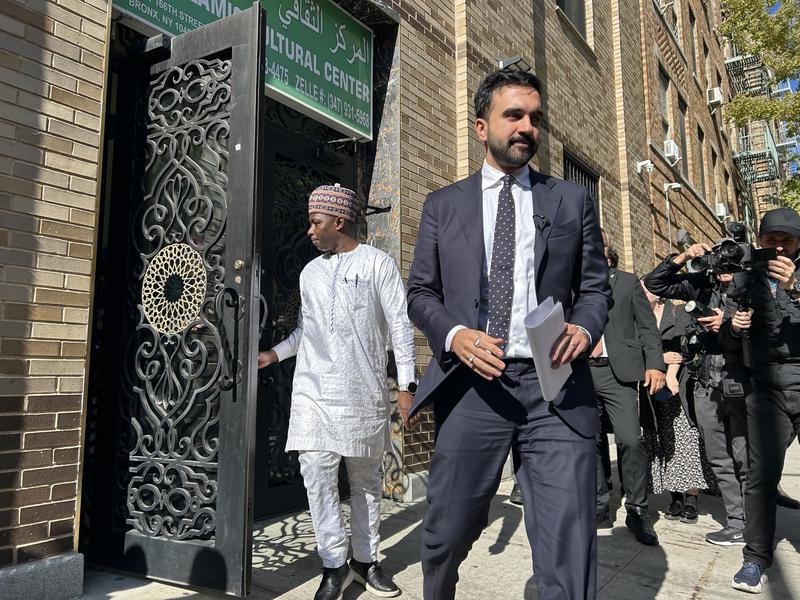
( Arun Venugopal )
Title: City Politics: Mamdani's Transition Plans Continue
[MUSIC]
Brian Lehrer: It's The Brian Lehrer Show on WNYC. Good morning, everyone. It's been five days now since the surprisingly warm public appearance by Mayor-elect Mamdani and President Trump. That seemed to represent a truce in Trump calling Mamdani a communist and Mamdani being very active in calling Trump a fascist, but I say truce because that means an agreement between opponents to stop fighting for the moment. It's not the same as a peace treaty, right? You've probably heard key soundbites by now, like the president saying, "We agree on a lot more than I would have thought, and that some of his ideas really are the same ideas that I have."
Trump said that, but don't tell Trump's Treasury Secretary, Scott Bessent, who was back on CNBC already yesterday, saying this.
Treasury Secretary Scott Bessent: He is clearly the leader of the Democratic Party now. I think it speaks to how open-minded the president is that he invited him into the Oval. Senator Schumer never endorsed him. I don't even know if he's met with him. President Trump wants the best for New Yorkers. I can tell you, my impression of the mayor-elect is he's a young man with a lot of old ideas that have never worked.
Brian Lehrer: Scott Bessent. Maybe they're already creeping back to the message for next year's midterms that Mamdani is a dangerous radical socialist who's clearly the leader of the Democratic Party right now, as Bessent put it there, leader of the Democratic Party. On the Mamdani side of the equation, he elaborated on Monday on one of the things that he and the president disagreed about in the closed-door portion of their meeting.
Mayor-elect Zohran Mamdani: What I said to the president is that New York City sanctuary laws have a provision within them that allows the city to work with the federal government for a specific set of serious crimes, and that that has been the law for decades here in New York City. What's giving so many New Yorkers, including myself, a deep amount of concern is that the focus of ICE's immigration efforts have not been on those serious crimes. They have, in fact, been on children as young as 6 years old being detained and deported. They have been on New Yorkers whose crime seems to just be being here in New York City.
My commitment to public safety is, one, to keep all New Yorkers safe. That's where we have a difference of opinion, but that's one that I was also very honest and direct with the president about.
Brian Lehrer: The mayor-elect on Monday. We'll see if that disagreement winds up with Trump amping up ICE raids in the city. Just last week, though, before the Trump-Mamdani meeting, so we don't know if it changes anything, but just last week, Border Czar Tom Homan said on Fox, "I plan on being in New York City in the near future. We're going to do operations in New York City. We will increase the enforcement presence in New York City again because they're a sanctuary city and there are public safety threats," from Tom Homan. Meanwhile, the mayor-elect has made some more interesting appointments to his transition team. We'll talk about that.
He is getting criticized by Jewish leaders over his response to the intimidating protest outside Manhattan's Park East Synagogue last week against a group that helps American Jews to move to Israel, including the West Bank. Police Commissioner Tisch has also apologized for the NYPD's response to that protest. We'll talk about that. Also, one key transition team member is looking at how much executive power the mayor has under the law to do things unilaterally to curb abuses by corporations. We'll talk about that and more. With us now, WNYC political reporter Elizabeth Kim. Hi, Liz. Happy day before Thanksgiving.
Elizabeth Kim: Happy day before Thanksgiving, Brian. I will remind you and listeners that there are 36 days until Mamdani's inauguration.
Brian Lehrer: If we were cable news, we would have a countdown clock going second by second. Let's start with the follow-up on Friday's joint appearance with the president. So much of the reporting has been focused on Trump's surprising warmth. From the Mamdani standpoint, from a substantive perspective, especially, did that meeting change anything?
Elizabeth Kim: I thought what it did in the short term was relieve some anxiety because I think that a lot of political observers thought that heading into the election, should Mamdani win, that the city needed to brace itself immediately for the National Guard and for some federal cuts. Now, why did political observers feel that way? Well, because Trump said that. Those were his own words. I think that meeting, coming out of that meeting, it would seem very strange if all of a sudden, we did see the National Guard. Trump, coming out of that meeting, said he wants to see the city succeed.
There have been lots of people in his ear, including Governor Kathy Hochul, including business leaders, telling him that having the city succeed would not be having the National Guard be in the city. I think that the anxiety and fear around that has kind of come down a little bit. The question I have, though, to the extent that Congress and Republicans want to make federal cuts to things like education, to programs for low-income people, I'm thinking about food assistance. I don't know the extent to which the president elects to spare New York City.
I think that that is something that Mamdani will have to come to grips with very soon, because as we talked about, Brian, January is when the mayor is expected to come out with his preliminary budget. I said that when there's a new mayor, there's a little bit of a grace period. I looked back in the calendar, and I saw when Mayor Adams took office. His was issued in February, but I think that those kinds of cuts are still very real. I think even though perhaps there is not the specter of the National Guard, but ICE is still a real issue in the city. Just over the weekend, there was ICE presence over a crackdown of vendors in Chinatown. That does not go away.
Brian Lehrer: Yes, we played the clip of the mayor-elect on Monday, acknowledging his differences with the president on ICE raids, and as you point out, by implication, other detentions, or he was very specific about that. Detentions that are not focused on violent criminals. Mayor Adams, we should probably say, has criticized those, too. We'll see what happens going forward. Maybe it's too early to ask this question? Do you think there's a Mamdani side of this that he has to show the president in order for the president to hold back to some degree? In the clip, Mamdani said, "Yes, we're all focused on preventing violent crime."
Is there anything that you think he might have to show or might elect to show, to show that he's keeping that side of some kind of bargain, and that'll help the president be able to decide to keep from amping up ICE?
Elizabeth Kim: I have been thinking about this, Brian. Even to the extent that I-- I think a lot of us are still digesting what does Friday's meeting mean, and why did Trump-- what was his interest in being so friendly to Mamdani? I have wondered, it does put Mamdani, I think, in an awkward position. You heard what struck me about his remark at Monday's press conference. They were very similar to other remarks he made both at the White House and in another press conference he held on Sunday, is how polite he sounds. If we remember Mamdani, the candidate, and what helped catapult him as a candidate in the Democratic primary was the way in which, the force in which he was willing to stand up to Trump on immigration.
I'm thinking about that video that went viral. That day, when Trump's border czar, Tom Homan, was at the Capitol. There's that video of Mamdani joining other protesters in very angrily confronting Homan. Now, he is in this position, I think, because the president has extended this olive branch of, I think, wanting to seem like he's willing to play along. I started to think about how does that restrict him, right? Does that make him, in some ways, less willing to go on offense on things that he had talked about? He had said that he was going to be Trump's worst nightmare.
Brian Lehrer: We will see. You heard the Treasury Secretary Scott Bessent clip in the intro. One of the things he said was President Trump was more forthcoming with Mamdani than Chuck Schumer has been, as, of course, not only the Senate Democratic leader, but also as a senator from Mamdani's own state here in New York. Do you have anything on Schumer doing any outreach to Mamdani or vice versa?
Elizabeth Kim: No, Brian, but that is an excellent question. I think that that is something that we need to watch is the relationship between Senator Schumer and Mayor Mamdani. I mean, this would be an important relationship regardless, for any mayor, whether it was Mamdani or someone else, but particularly because Schumer did not elect to endorse Mamdani. What is his calculus there? What is his future in his party? Does he elect to run again, or is he primaried by someone like AOC? There has been a lot of talk about that. That's a relationship to watch, but we have not heard any special kind of outreach.
To my mind, Mamdani has not been asked, but for sure, those are two people who you expect to be in frequent conversation with one another. That is very important to New Yorkers getting the kind of federal aid that we need.
Brian Lehrer: Listeners, your thoughts or questions on the Mamdani transition. Welcome at 212-433-WNYC, 212-433-9692. You can call, or you can text. On the protest outside Park East Synagogue last week, for background, for people who aren't aware of this, a New York Times article published Monday said a rowdy protest descended last Wednesday on Park East Synagogue, one of New York's most prominent Modern Orthodox congregations, which had rented space to an organization that helps Jews move to Israel as well as to settlements in the occupied West Bank. Chants of "death to the IDF" and "globalize the intifada" rang through the air.
Mamdani, the mayor-elect, responded the next day, saying through a spokeswoman that he, "discouraged the language used at the protest and that New Yorkers must, quote, 'be free to enter a house of worship without intimidation,'" but the Times continues. "But it was what he said next that alarmed some Jewish leaders. He chastised the synagogue, saying through his spokeswoman that, 'these sacred spaces should not be used to promote activities in violation of international law,'"
Liz, that was a reference to helping people move to the West Bank, which many countries do consider a violation of international law, though my understanding is that the US does not. What kind of response has the mayor's initial statement gotten?
Elizabeth Kim: This happened, I think, around Thursday, and my expectation, in just reading some of the responses that I saw on social media, which was criticism. The criticism was based around what he said afterwards. It was not around discouraging the language, and that New Yorkers must be free to enter a house of worship without intimidation. I think everybody agreed and supported that response. It was what he said after that that I think provoked, for some people, just concern, and for some, outrage. It was that these sacred spaces should not be used to promote activities in violation of international law.
My immediate take on that was that is something that the mayor has invoked before, this idea of international law. I think you and other reporters have pressed him on the ways in which his stance on Israel could be reflected potentially in city policy, right? He often will say, "To the extent that it is not in violation, I want to uphold international law." I will say, though, for a candidate who ran on this idea, that his language would always be very precise. You will always know where I stand.
I have always felt that this statement of international law, the way he leaves it like that, is a little vague because I think immediately after that, and I saw it in some of the comments, that just people had to, and just reaction, was, "What does that mean?" I'm not sure that he was actually asked that much about it in the days that followed, because what happened was the Trump meeting then followed it, and that Trump meeting then overshadowed everything else, and it took over the news cycle. I thought that this incident in many ways did not get-- He did not get as many questions on it that I think he normally would have. On Monday, he was not asked any question about it, which I thought was very interesting.
Brian Lehrer: Yes. I had pressed him in one of his campaign interviews here about the bill that he introduced in the State Senate that was specifically targeting nonprofits in the US that he considers in violation of international law, specifically by aiding settlement activity in the West Bank, which is widely considered occupied territory. He was using that same language. As you say, it'll be interesting to see once he becomes mayor, if he tries to do anything like that at the level of city policy with the powers that he has as mayor. As one state senator, he wasn't able to get that through the state legislature, but he was on that same kind of track, criticizing just that kind of group that was holding that event.
Elizabeth Kim: Yes, Brian. I will say, and I do want to say that I think people who are very read into the conflict in the Middle East and Israel know what he means by international law, but I also think that there are people who do not understand it. I believe it was also something that came up when he was asked about his position on the Cornell Tech campus on Roosevelt Island. Now, that is a campus that is currently in development. As an assembly member, he said that he would boycott the campus because the university partner with Cornell is an Israeli university that has reported ties with the Israeli military.
He was asked about that again recently, and he said, "To the extent that anything violates, I will not support anything that violates international law." Again, I'm saying that people who are read into it perhaps may understand, but I think he owes New Yorkers more than just putting that out there, in the same way that he talks about human rights violations. I think, to the extent that he promised New Yorkers that he would be very specific and we would always know where he stands, I think it deserves some elaboration. I think that a lot of the confusion and maybe concern that came out late last week over this statement could have been helped if his spokesperson had clarified exactly what he meant by that.
Brian Lehrer: Yes. By the way, I said he was in the State Senate. Small mistake. He was in the State Assembly, but after his initial response to the incident at the event, he later issued a statement to the Times. I had read some of their reporting, reaffirming that "nothing can justify language calling for death to anyone. It's unacceptable." He also discussed it. He was asked about it on NBC's Meet the Press with Kristen Welker on Sunday. Here's a minute of that.
Kristen Welker: As reporters were leaving, you were answering a question that I think was hard for a lot of people to hear about. Your response to protests outside of a Manhattan synagogue. Your initial response to that incident did receive some criticism, as you know. What is your message to Jewish New Yorkers who feel you won't be tough enough in your response to antisemitic incidents?
Mayor-elect Zohran Mamdani: That I am looking forward to being the next mayor of New York City and fulfilling the commitment I've made to Jewish New Yorkers over the course of this campaign, which is a commitment to not only protect them across the five boroughs, but to celebrate and cherish them. What that looks like is rooting out antisemitism. It looks like increasing funding for hate crime prevention programs by 800%, and it also looks like ensuring that we have NYPD protection outside of synagogues and temples, especially on the high holy days.
I want to just say, recently on Yom Kippur, there was a horrific antisemitic attack in Manchester. A rabbi in New York City reached out to me and said, "Could you ensure that there's additional police protection outside of the synagogue for today?" I said, "Absolutely." I also asked, what if that rabbi did not know the next mayor of New York City? We have to make it so that it doesn't matter who you know. It matters that you will get that safety and security because you're a New Yorker. That's the administration I'm going to put together.
Brian Lehrer: Mamdani on Meet the Press. One last thing on this, Liz. Why did Police Commissioner Tisch, and of course, this is as a member of the Adams administration at the moment, apologize for the NYPD's response?
Elizabeth Kim: This is very interesting, and this is another reason why this incident is noteworthy. It's something to watch to the extent in which there is daylight between Mamdani and his police commissioner, which we know there are. They have real policy differences on criminal justice reform, but they also have a difference on this issue of Israel, and also, I believe, policing protests. The reason she said that or the reporting is that she apologized, and it was a closed-door event. She didn't do it in front of reporters, but she apologized, reportedly, because she felt that the police did not do enough to really secure the entrance of the synagogue so that people can walk in and not be intimidated, which she said--
Brian Lehrer: Enough of a margin between the protesters and the participants.
Elizabeth Kim: Exactly. That has led to yet another idea or proposal that that Times article mentions, which is, I believe the rabbi of that synagogue has suggested that there would be some kind of state legislation in which they limit protests at houses of worship. That will be very interesting to see how Mamdani responds. I imagine there are some kind of First Amendment concerns with something like that. I don't know how it can be implemented, but that's also something to watch. I think also what this incident has shown is, during the race, Mamdani really leaned, of course, laser-like focus on affordability, but you could not deny that his political identity was really forged in pro-Palestinian activism.
You could not deny that, but the way he often answered that was, "This is not something that New Yorkers are concerned about. This is nothing that, as mayor, I don't have. I can't shape national foreign policy." I think what we're seeing is that his rhetoric matters. In incidents like this, his rhetoric and the statements he puts out are going to matter, in addition to any kind of local policy that he can implement.
Brian Lehrer: When we continue, in a minute, we will talk about developments on Mamdani's transition team, focusing on two people in particular. Kathy Wylde, sometimes referred to as the "Billionaire Whisperer," and Lina Khan, who we might say is anything but. Stay with us. Brian Lehrer on WNYC.
[MUSIC]
Brian Lehrer: Brian Lehrer on WNYC. As we follow the Mamdani transition with WNYC and Gothamist political reporter Elizabeth Kim, let's talk about new transition team appointees. One notable one is Kathy Wylde, who is leaving her longtime post as head of the Partnership for New York City, which represents big businesses in the city. She's been called the "Billionaire Whisperer." In June, she said the city's business community is terrified of Mamdani. Now she's joining Mamdani's Committee on Economic Development & Workforce Development. Why would she join, and why would the mayor-elect have her?
Elizabeth Kim: Since Mamdani won the Democratic primary, she has tried to facilitate a relationship between him and the business community. When she's talking about the business community's fears, I think she's talking about what she's heard from them. She herself, I think she sees herself as trying to help the mayor, and in helping the mayor, help the city. I thought it was interesting. I saw a recent New York Times story in which she basically said she did not vote for Cuomo, meaning that she voted for Mamdani.
Brian Lehrer: Did it mean that? She could have not voted.
Elizabeth Kim: Oh, that's true. Maybe I'm misreading it, but I think it said that she voted for Mamdani.
Brian Lehrer: Yes, I do think I've seen that elsewhere.
Elizabeth Kim: I thought it was interesting that she revealed that. I think that it is a signal that she is trying to support this new mayor.
Brian Lehrer: Here's more from the mayor-elect's announcement on Monday of more transition team members.
Mayor-elect Zohran Mamdani: We stand here with a remarkable opportunity to create a better New York, the kind of opportunity that arrives, if we're lucky, once in a generation. I could not ask for a better team to set that foundation. New Yorkers have given us a mandate to deliver the change that has so often been denied in this city, a change to make this a city that each and every person can afford. We will now seize that opportunity with both hands to create a transition that will be defined by the same thing as our administration, excellence.
Brian Lehrer: Tell us more about this growing transition team and how much we can even read into what it means, because these aren't going to be the commissioners in his administration. These are just people unpaid, I think, correct me if I'm wrong, who are just helping him set up his administration.
Elizabeth Kim: It's actually a little bit of both, Brian. My reporting is that, yes, these are the people who will help shape the appointments, the decisions, but I don't think we should be surprised if these are the people themselves. I know for a fact that some of these people are in the running to head certain agencies or to have certain roles in the administration. I think it's a little bit of both. What the mayor has said is these are the people guiding the appointment decisions, but also policies. What are the policies that the city should make as its priority heading into the new Mamdani era?
Brian Lehrer: We talked about Kathy Wylde as a member of the transition team. We'll talk about Lina Khan, but here's Judith in Manhattan calling in with a transition question about a name that we're not hearing. Judith, you're on WNYC. Hello.
Judith: Hi. Yes, I'm excited about the new mayor. I voted for him, but in the primary, I voted for Lander as my first choice. I wonder if-- it feels to me that he's being thrown under the bus. Maybe he was used during the primary and election to assuage some of the supporters to vote for Mamdani. Now, he's disappeared from the headlines. I wonder what going on and what's you're thinking about that.
Brian Lehrer: Judith, thank you. Yes, Lander had been rumored for the possible position of first deputy mayor, the number two position in the city. Dean Fuleihan, a veteran of the de Blasio administration and other things, got that job instead. What is going on between Mamdani and Brad Lander as far as you can tell, Liz?
Elizabeth Kim: That's an excellent question, Judith. It was definitely something that was on our radar. Me and my colleague, Brigid Bergin, several months ago, prior to the November election, we reported that there was tension between Mamdani and Lander. Lander was basically telling a lot of people, he wasn't being shy about it. He said he wanted to be first deputy mayor. Mamdani had a conversation with him in which he tried to do a reset and remind him that he had not made any kind of promises to him. Then he put out a statement, which he said a lot during the general election, which is he had not made any personnel decisions.
I think what came out of that, and we had heard that Mamdani was perhaps uncomfortable with the idea, or at least uncertain whether Lander was the right person to be his first deputy mayor. Again, that is a very important position. It's someone who is running point on the budget. This person becomes the acting mayor when the mayor is not in town or unable to serve. This was a monumental decision for him. The fact that he had doubts about Lander I think showed that it wasn't really clear that Lander would be getting that job. Then the question became, if Lander didn't get that job, was there another job in the administration that he would be up for?
The New York Times recently, I think a couple weeks ago, followed up on our reporting and said that Mamdani had a conversation with Lander, basically telling him that there was no position in his administration, really urged Lander to primary Dan Goldman in New York 10.
Brian Lehrer: Is Lander speaking out about this at all? I haven't heard anything.
Elizabeth Kim: I think he has been still supporting Mamdani. To his credit, I think in the final weeks or final month of the general election, you couldn't tell. If there was tension, you couldn't tell because they were still out there together. I remember when Mamdani did that sunrise presser at City Hall. Lander marched across the Brooklyn Bridge with him. He has been a presence on the campaign, but he has acknowledged that he is interested in perhaps running for Congress. We'll see. We'll see how that materializes. He hasn't announced a formal run yet. I suppose that will be his next chapter.
Yes, what Judith said is true. I think a lot of people who, whether they voted for Lander as their first choice, or whether they just like the idea of this Mamdani-Lander ticket, it was this cross endorsement that was billed as this progressive bromance, it's totally rational to now be wondering what happened to that bromance? Wouldn't it have been beneficial for them both? Lander is seen as this policy walk, city comptroller. He was on the city council for many years. He cofounded the Progressive Caucus in the city council, but it didn't work out. It will be something that I think maybe more will come out of it in the months to come as to exactly what broke down and what it was that perhaps Mamdani wasn't comfortable with in having Lander join his administration.
Brian Lehrer: Rebecca in Manhattan has a question about the Trump-Mamdani meeting. Rebecca, you're on WNYC. Hello.
Rebecca: Hi. First of all, I actually want to just echo what Judith mentioned about Lander. I was also a Lander voter. I've been really disappointed to see how he's been pushed aside in the transition, but I guess that's just politics. Anyway, what I was originally calling about is I've been really interested in the reaction among Mamdani supporters to the Trump meeting. I feel like if Cuomo or any other mainstream New York Democrat had had that kind of chummy meeting with Trump, they would have been called a fascist. There would have been unbelievable blowback.
I don't know, I guess I'm just curious what you guys think about why the reception to that has been either like, "Oh, he's so strategic," or like, "Oh, he's just so charming." It just seems like he's getting a really soft landing on that one.
Brian Lehrer: Liz?
Elizabeth Kim: Well, two things. First thing I want to say, it was interesting what Rebecca said about Lander. I want to say that one of the reasons that we were so interested in what Mamdani was telling Lander and pushing him back was because I think it says something. Rebecca says, "Well, that's just politics," but it said something, it revealed something about Mamdani and how he was going to approach building his administration, which is, to some degree, he was willing to be a little bit cutthroat. Both Rebecca and Judith both observed that, "Oh, they seem like such a good alli-- They struck this alliance." Their supporters had expectations.
What Mamdani showed was that he doesn't feel like he's obligated, either to the supporters who like them both or to Lander. I think that says something. Going back to her point about Trump and how Democrats are reacting, I think that's a fair criticism. That is exactly why I thought, on Trump's part, is this some kind of three-dimensional chess that Trump is playing? Does it, in fact, quiet Mamdani a little bit? I was pointing out, when you listen to his remarks from that presser, to me, it struck me, "Man, he sounds so much more polite than he did as a candidate." Has Trump somehow managed to muffle him a little bit? Is that what he was out to do?
Brian Lehrer: Let's go back to the transition team, maybe a opposite number to Kathy Wylde, and that's Lina Khan, who was head of the Federal Trade Commission under President Biden and is known as an anti-monopolist, like tough on antitrust laws that stifle competition. Now she's helping Mamdani build his administration. Here's a clip of Lina Khan Sunday at a Pod Save America live event.
Lina Khan: Coming from the FTC, I'm going to be especially focused on things like how do we make sure that we have a full accounting of all of the laws and authorities that the mayor can unilaterally deploy. I think one thing that was really shocking to me at the FTC was just how much dormant and unused and underused authorities had just been on the books. Literally, Congress had passed laws, sometimes saying things as uncontroversial as it should be illegal to say your products are made in America when they aren't. Sometimes, they had just been ignored by the FTC and not really enforced.
I want to make sure, to the extent that the city has a robust set of laws that the mayor can enforce, that we're going and understanding what is the full authority.
Brian Lehrer: That's really interesting, Liz, but it sounds more like federal policy than municipal policy. Is it clear yet how any of that applies to running the City of New York? Because she did, as I say, come from being Biden's Federal Trade Commission chair.
Elizabeth Kim: Her involvement in the Mamdani administration, and it sounds like she's going to have a role. The way she has been talking in these podcast interviews, you very much expect her to have a job. The question is what job? We don't know yet. What she has said is that what she is doing, and it was the same approach she took with the FTC, is she is basically poring through city and state statutes. She believes that there are some really old laws on the books that have never been used and that Mamdani could use to help him achieve his affordability agenda.
Now, Semafor, several weeks ago, had a really interesting piece on this that gave a real example of something that she's thinking about. There is in the books, and it's very little used. It's something called a law against unconscionable, that was the word they used, unconscionable pricing. It hasn't been used, but it was used during the pandemic, and it was used against retailers who were basically price-gouging on masks. The policy-- one of the examples that they gave, that they said reportedly Khan is thinking about was she was thinking about the price of concessions in baseball stadiums or sporting venues in general, the price of beer at Yankee Stadium, for example, and why the price of beer is so much higher than the beer that you would buy maybe if you just stepped outside the stadium and bought it at a corner market.
Of course, you can't bring it into the stadium. That's one of the rules. That was very intriguing, and it prompted a lot of reaction from public policy thinkers, economists. I had talked to James Parrott. He was a chief economist under David Dinkins. He's a left-leaning economist, and he thinks that an idea like that is very interesting, because, of course, yes, if Lina Khan is somehow able to exercise this old law against unconscionable pricing to do something like that, there would be litigation.
You would expect that, but it is such a populist idea that you do wonder that even this idea of the owners of these teams fighting the Mamdani administration on just having fair pricing on food in baseball stadiums, whether that by itself would in effect be a win for the administration. These are the things that I think we're watching. I think she's one of the most intriguing picks that he's made. She is the co-chair of the transition, so she is ostensibly one of the people who are leading the appointments of other people in his administration. Like I said, she is talking a lot. She is giving a lot of interviews and giving people a lot of insights into where she stands ideologically.
Also, like she said, she basically told us that this is what she's doing. She is just looking through city and state statutes, and she believes there are things there that mayors of the past have not fully utilized.
Brian Lehrer: Some comments coming in from listeners on Mamdani's response to the synagogue protest. One says, "Member of the Orthodox Jewish community. Upset about what Mamdani said about the protest at the synagogue. Part of what happened is not that the protesters yelled horrible things to the Jewish people that were there. They also yelled in their faces." Another one says, "There is nothing ambiguous about international law. You can look it up quite easily. About time Israel was held to the standards it should be." There are a few others on either side of that. One more before we run out of time on a possible omission from the transition team. Mike in Flatbush, you're on WNYC. Hello.
Mike: Thanks so much, Brian. Quickly. Yes, I'm really excited about Lina Khan. I wonder if she's paying attention to what Hal Steinbrenner just said a couple of days ago about the lump payment that the Yankees give to the city, which actually benefits him, but he was crying poverty. I thought that was interesting. I call as a substitute teacher and someone who also just signed a 3% lease renewal. Thank you, Mayor Adams. My concern, as reported by Chalkbeat, is that there are no K12 teachers on the education transition team, and the housing transition team doesn't seem to have any actual current tenant organizers representing tenant unions, NYCHA, Save Section 9, any of that.
It's very nonprofit-heavy. For example, Jed Walentas, the REBNY chair. I guess Jessica Wylde's fingerprints-
Brian Lehrer: Kathy Wylde.
Mike: -can be seen in these transitions-- Kathy Wylde, thank you. Can be seen in these transition teams. It's concerning to me. I don't know what kind of realpolitik Mamdani is playing at, but those grassroots rank-and-file enthusiasm doesn't seem to be represented, at least in those two areas. Thank you so much for taking my question.
Brian Lehrer: Thank you for your call. Liz, does your reporting indicate that his characterization of who's on the transition team is and who's not is accurate?
Elizabeth Kim: Those are great points. I will tell you, Mike, that one of the first names that popped out at me when I was just glancing at the list was he appointed his favorite social studies teacher. There is a teacher, but you're right, they're not in the education committee. He appointed Marc Kagan, who is a social science teacher at Bronx Science and also happens to be the brother of Supreme Court Justice Elena Kagan. He appointed Marc Kagan to the transportation committee. Now, you might ask, "Well, what's his connection to transportation?" He used to work for transit. He used to work for the subway system.
I thought it was very interesting that he has talked about him as being his favorite teacher, and you just see it on the list. It says, "Marc Kagan. High school teacher at Bronx Science." You're right. I think there were some complaints about-- the way I heard it was that his housing committee was dominated by YIMBYs. That's the Yes In My Backyard movement, but this is a tension that we're going to see play out, I think, in the Mamdani administration, which we've already seen, actually, under Adams, because the YIMBY movement has gained a lot of traction, not just in New York City, but really nationwide. It's because of the housing crisis.
I think, in New York, where there is a lot of concern and debate about gentrification, that this will be something that, especially, this mayor, is going to be held accountable for. I think, yes, there was a lot of scrutiny over those kinds of picks. I forgot what else. Yes. I did see the Chalkbeat article. Yes, no teachers on the education committee. That's a fair question.
Brian Lehrer: Last thing. We've talked a lot about who's coming. One question about who's going. Mamdani is asking, I see the number, 179 Eric Adams staffers to resign their positions, which has prompted yet another round of tension between the incoming and outgoing mayors. Is that unusual, though? Obviously, there is a transition in a transition. People from the old administration are asked to leave. A new mayor, like a new president, a new governor, has the opportunity to pick their own people. Is there anything unusual here?
Elizabeth Kim: I am not sure, Brian, because my first thought when I saw that was there was not this kind of news story during the transition between de Blasio and Adams, but certainly, Adams did get to pick. You want to bring in your own people. If you're bringing in your own people, your predecessor's people can't stay. I don't know if it was done in the same way. My understanding that this was a letter that was sent to one of the deputy mayors, and there was a list given to the deputy mayors. The news was being told yesterday. You could see it. It was being painted as ruthless by the mayor's people. The mayor's spokesperson put out a very tough response.
He texted me this morning, "Every new administration has a right to build their own team. While there may be reflexive reaction to terminate employees, being mayor must come with a level of compassion and respect." Yes. Were there people from de Blasio's mayoral staff that did stay? Yes, I can think of some people in his-- communication staffers, for instance, that did stay. I think by and large, the mayor got to pick the bulk of his senior staffers. It's not that unusual. I just don't know whether it's the attention that people are paying to this.
There's also the question that this is also not-- Mayor Adams's administration is sort of scandal-scarred. This seems to be something that would be expected for the new mayor coming in, especially one that campaigned on restoring integrity of the City Hall.
Brian Lehrer: WNYC political reporter, Elizabeth Kim. You can also read her work on Gothamist. Liz, I hope you have a great Thanksgiving. I hope you get some days off, and thanks for coming on with us. Talk to you next week.
Elizabeth Kim: Same to you, Brian. Bye.
Brian Lehrer: Brian Lehrer on WNYC. We turn the page, and much more to come.
Copyright © 2025 New York Public Radio. All rights reserved. Visit our website terms of use at www.wnyc.org for further information.
New York Public Radio transcripts are created on a rush deadline, often by contractors. This text may not be in its final form and may be updated or revised in the future. Accuracy and availability may vary. The authoritative record of New York Public Radio’s programming is the audio record.