
City Politics: Early Voting Has Begun
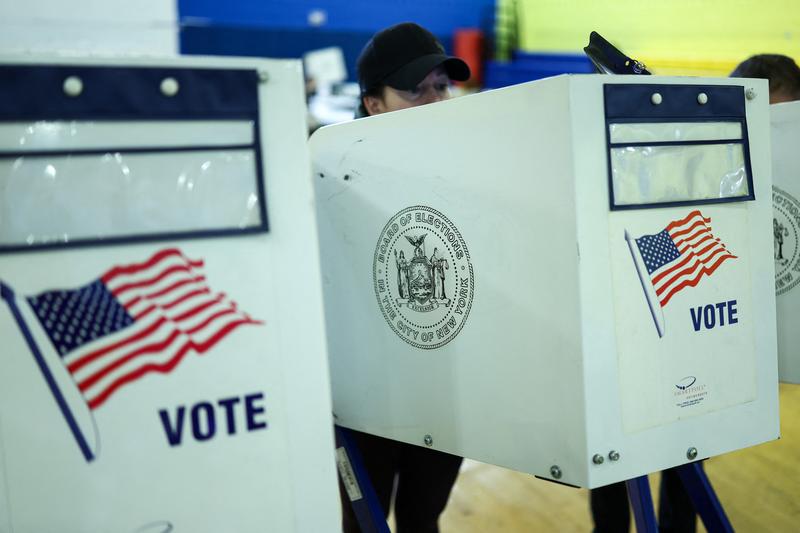
( Charly Triballeau/AFP / Getty Images )
Title: City Politics: Early Voting Has Begun
[MUSIC]
Brian Lehrer: It's The Brian Lehrer Show on WNYC. Good morning, everyone. All this week we are in almost full-time election mode. Now that early voting has begun in both New York and New Jersey. We will continue to have some other guests, too, I want to say. Like today, we'll check in and invite you to call in on Hurricane Melissa's impact in Jamaica. You'll be able to tell us what you hear from your loved ones or anyone else down there and what they need, and we'll tell other listeners how they can help. We'll have somebody who's involved in the relief effort as a guest.
We'll have Calder McHugh from POLITICO on the young Republicans who said the quiet part out loud in racist group chats that have gotten some of them fired from their real jobs. Mostly election issues and election endgame coverage. Later this morning, our 30 Issues in 30 Days election series continues. We're almost done with Issue 28. Safe injection sites and other opioid harm reduction policies as an issue in the New York City mayoral race. Zohran Mamdani raised eyebrows among advocates when he seemed to change his position in last week's debate.
We begin today with mayoral campaign news. We'll do New Jersey governor's race news tomorrow when it's Jersey Thursday on the show, as we've been doing this election season. As many of you know, it's been Liz Kim Wednesdays during this run, WNYC and Gothamist political reporter Elizabeth Kim joining us weekly. She is joined today by our senior political reporter, Brigid Bergin, who's been following the very robust early voting turnout. Happy Wednesday, Brigid. Happy Wednesday, Liz. Happy Wednesday, Liz.
Elizabeth Kim: Happy Wednesday.
Brigid Bergin: You as well
Brian Lehrer: Liz, can you believe this is your last appearance in this weekly series? It seems like the mayoral race has been going on forever. Does it feel like that to you?
Elizabeth Kim: It does.
[laughter]
Elizabeth Kim: It's been a long race, but we don't usually have a competitive general. This has been a lot of fun.
Brian Lehrer: A program note, listeners, Liz will be back next Wednesday, the morning after election day, even though she'll be up maybe later than an 18-Inning World Series game covering the return. All praise and thank yous will be welcome at that time. Brigid, how about if you begin today with your article on Gotham is called Voter Turnout Surges in New York City Mayor's Race with Boomers and Gen X Leading the Charge. How big is this surge, first of all?
Brigid Bergin: This is based on the first weekend of early voting. That's two days of early voting. The surge is significant. We saw five times the number of people participating in early voting this first weekend of early voting compared to four years ago. Of course, that was when Eric Adams was running against Curtis Sliwa in what was considered a not so competitive election at that point. One of the things that we were interested in is did we see some of the trends that were so key to understanding the primary and why Zohran Mamdani was so successful and won the Democratic nomination hold in this general election?
One of the things we looked at is how old were the people who were participating in this general early voting. That's where we saw a pretty significant shift. Whereas during the primary, voters 25 to 35 dominated during early voting, based on our analysis. In the general election, voters ages 55 and older were turning out very strong. They made up just over 50% of the early voting. Those voters 25 to 34 were making up about 16%. Now, that's a much smaller share that we're talking about there. The experts that we spoke to said this could be a good sign for the Cuomo campaign. In the most recent Quinnipiac Poll, the former governor was outpacing Mamdani among those voters 65 and older, and they were tied among voters 50 to 54.
In many ways, it felt like a shift from both what we had been seeing in polls and certainly what we were seeing during the early voting in the primary.
Brian Lehrer: From what I remember about the results in the primary, voters under 35 were actually the largest share. That doesn't mean they were a majority, but when you look at the major age blocks, under 35 were the largest share, which almost never happens.
Brigid Bergin: Yes, and that is one of the things that we've been really interested in. Will those young voters continue to be as enthusiastic and show up at the polls in the way they did during the primary? I've talked to experts who offer a pretty heavy dose of caution that early voting, by all accounts, is still relatively new in New York City. We've only had one other mayoral election with early voting. In terms of the shifts that we're seeing, are we seeing people who would normally vote just vote early and therefore not necessarily an increase in overall turnout, but just a shift in behavior?
Or is this indicative of what will be a higher turnout election because it is so competitive? Are we also potentially reverting back to some of the models that we often see in overall election turnout, where older voters really dominate at the polls?
Brian Lehrer: Before we bring Liz in, can you say confidently that Boomer and Gen X turnout is good for Cuomo, or is it not that simple? Certainly, the pre-election polls would indicate that it should be good for Cuomo. I see New York Magazine has an article, early voting turnout tea leaves seem to indicate optimism for Mamdani. I don't know.
Brigid Bergin: Yes. I don't think it is that simple, Brian. I will preview that. We have another version of this story coming today. Listeners, check out gothamist.com later today for an updated version of this story. I won't scoop myself. However, we did talk to voters at early voting sites, and you do hear some of the nuance. You do hear some older voters explaining why they're voting for Cuomo. Some people cite his experience. Some of his messaging around support for Israel and combating anti-Semitism has really resonated with some of these voters. Not all older voters are supporting him.
We spoke to some older voters who are also Mamdani supporters who his message around affordability and also just the idea of a new kind of Democrat and a new face in politics was something that really resonated with them. We are not trying to read the tea leaves per se, but we are trying to provide a view of data that we think is really interesting, and we think voters and the campaigns also find it very interesting.
Brian Lehrer: Right. The large number of Baby Boomers and Gen X voters would seem to indicate a lot of Cuomo voters. On the other hand, large turnout per se probably would indicate a lot of Mamdani voters. This is where the New York Magazine Intelligencer article goes on this too, that they acknowledge your reporting on the Gen X and Baby Boomer voters combined making up 50% of early votes cast. They also note that Mamdani voters tend to be the more enthusiastic, and enthusiasm begets turnout. Maybe that's an indication that a lot of those people are Mamdani people. We don't know. You also though have-- Oh, go ahead, Brigid.
Brigid Bergin: One interesting point, I was talking with political scientist, Susan Kang, this morning, who's a professor at John Jay College of Criminal Justice, and getting her take on some of these numbers and fully transparent. She is a member of the Democratic Socialists of America. She has a point of view. One of the things that she thought was interesting about the turnout so far in terms of how to interpret the ages was that she was still seeing a lot of discussion among voters her age-- she's in her 40s, about the ballot initiatives and trying to make sense of what the implications would be, how to make those decisions, seeing the split among supporters.
In some cases, people who are trusted voices in their community being very pro, and similarly, trusted voices in the community being very opposed. That voters are really wrestling with those questions, which is not something that they had to decide during the primary. There could be some decision making still happening related to that other piece of what voters are asked to decide in this election, that once they have made up their mind, we may start to see some of those numbers tick up as well.
Brian Lehrer: We were going to get later, but I guess we'll get to it now, to the question of how many people are undecided on the ballot questions about affordable housing and really the strange bedfellow coalitions that have formed on each side. Mamdani's decision not to take a position. Sliwa was against those measures, Cuomo's for them. Mamdani said in the debate last week and previously that he hasn't decided or he's not taking a position on those. I want to ask you about that, Liz, in a minute, because I know you wrote that up.
Listeners, let's start our Last Minute Deciders thread going here. If you decided on a mayoral candidate or any of the ballot questions in the last two weeks, call or text 212-433-WNYC. We'll do it again on election day, maybe again even before election day. If you have made up your mind in the last two weeks on a mayoral candidate or on any of the ballot questions, you can text or call in with the process you went through and where you finally landed. 212-433-WNYC. 212-433-9692, or with any other questions or comments for Liz Kim and Brigid Bergin. 212-433-WNYC, 433-9692. Call or text.
Liz, you want to do that part now? You do do an article on Mamdani deciding to stay out of the housing construction ballot questions. As I said, Cuomo took a yes position. Sliwa took a no position. Mamdani took no position. How come?
Elizabeth Kim: Yes, Brian, I just wanted to add something to the conversation before about what motivates people to go and vote early. You were mentioning the New York Magazine argument that its enthusiasm. We certainly saw that during the primary. What I was wondering heading into early voting, because we had seen the race take on maybe some darker tones, some more racist, Islamophobic tones, I was wondering, would fear be a motivator for some people? I think that that's a question. I don't know. That's something to think about, too. I don't think that it can only be enthusiasm.
I think there are people on Cuomo's campaign who are trying to make people afraid of Mamdani. Would that be enough to get them out there? Getting back to the housing ballot question--
Brian Lehrer: There's positive enthusiasm, and there can be such a thing as negative enthusiasm-
Elizabeth Kim: Absolutely.
Brigid Bergin: Certainly-
Brian Lehrer: -or extreme aversion.
Elizabeth Kim: Absolutely. You can tell that is exactly what the Cuomo campaign is banking on.
Brian Lehrer: I guess we could even say in the presidential election last year and in all three in which Donald Trump won, a lot of people who maybe weren't crazy about Hillary Clinton, weren't crazy about Joe Biden, weren't crazy about Kamala Harris, or so enthused, really wanted to turn out to stop Donald Trump.
Elizabeth Kim: Exactly, exactly. Getting back to the housing ballot question, I really thought that that was the main-- that, to me, was the main takeaway of that second debate. Was that you had the Democratic mayoral nominee, who is the frontrunner, declining to take a position on a ballot question that he will be expected to fill out when he goes to the polls, and his supporters and all the people who show up at the ballot. I still find this stunning. The fact that he has continued to put it off, he has since told reporters that he will very soon come out with a position, but that he still has not told voters. I think that that's important, and I think it's something to highlight.
Because if, in fact, he wants to be mayor, voters deserve to know what is your position on how the city should fast-track housing? Of course, the reason he doesn't want to take a position is because it's politically thorny. If he were to say yes, it would put him in opposition to the council, who is opposed to this, because it does represent a significant shift in the balance of power. If he were to become--
Brian Lehrer: More to the mayor and away from City Council on making housing development decisions, neighborhood by neighborhood.
Elizabeth Kim: Exactly. Yes. It would certainly be to his advantage if he were to become mayor and to have that kind of power to really fast track and move housing. You can see why he doesn't want to put out a position and come out and say, "Yes, I am in favor of something like this that would potentially give me more power if I were to become mayor." There's a lot of things he has to think about. The council is going to have a race for speaker. If he were to become mayor, he will certainly want to try to sway that process and not offend any of the council members in advance.
Brian Lehrer: On the strange bedfellows, City Council progressives, and Liz or Brigid, tell me if you think this is a fair characterization. City Council progressives skeptical of developers bringing negative change to their areas, gentrification, whatever. Curtis Sliwa, representing single family homeowners in the most conservative parts of the city who don't want big buildings or lower income people coming there, they're on the same side. You get other progressives, like Brad Lander and Brooklyn Borough President Antonio Reynoso, supporting the proposals along with developers and along with Cuomo. We did a whole hour on this on Monday.
Is there anything you can add, either of you, to give undecided voters any advice on how to make up their minds based either on who they trust or what aspect of this they're most concerned about?
Elizabeth Kim: I will say, Brian, that I have been asked by a lot of people. Brigid, you're probably pinged a lot, too. I have been pinged. A lot of people have texted me to ask me, "What is your take on these housing ballot initiatives?" I've had deep conversations about this with our housing reporter, David Brand. I think a lot of it boils down to how you view this idea of member deference. Now, in some situations, it has been viewed as really clogging up the process. It could really hold up. It really does hold up a lot of rezonings, a lot of project approvals.
You can think about it the other way, that if you think about your council member as advocating for your community and what your community needs, then that's seen as pretty much what you want. That's seen as beneficial. If you are living in a community that hasn't seen insufficient investment, this is an opportunity for your council member to argue for equity and extract as much as they can for their community. On the flip side of that, how much is too much? Do the negotiations become so protracted that the developer threatens to leave the table? Is that good for the city?
Because you also have to think, yes, they are building the housing in a specific location, in a specific neighborhood, but it is beneficial to all of New Yorkers. That's a more sort of taking a more holistic view of the process, right?
Brian Lehrer: Yes, that's the tension. Brigid, anything to add?
Brigid Bergin: Yes. [chuckles] One of the things that I often do is send people to our colleague David Brand's great explainer at gothamist.com that breaks down the questions and really translates what a yes vote, what a no vote actually means, and the impact, along with telling you who's in favor and who's opposed. Similar to what Liz was saying, I think one of the things that is worth keeping in mind, the way our city government is structured, the mayor has a lot of power already, and one of the key functions of the City Council is related to land use. Is that something that voters think is worth reducing their influence on in order to solve, which is something that we know is a major crisis in the city, the shortage of available housing?
I think there are some really serious issues voters need to weigh. It's not necessarily an easy decision, but there are some good resources out there. I think it's not necessarily something that's going to break on clear, as you laid out party, or ideological lines, that there are going to be strange bedfellows for some very reasonable reasons.
Brian Lehrer: By the way, a couple of people are texting that they thought I said Donald Trump won three elections. That's not what I said. I said a lot of people voted against Trump in his three elections. By that, I meant the three elections that he ran in. Obviously, he won in 2016, lost in 2020, and won in 2024. For anybody for whom that was unclear, obviously, when I said in his three elections, I mean his three election campaign. Just making sure you know I know that. We do have a late decider on the ballot questions calling in. Let's go to Joy in Manhattan. Joy, you're on WNYC. Hello.
Joy: Hello. How are you guys?
Brian Lehrer: Good. What you got?
Joy: Okay. I was pretty confused about this issue and kept trying to read stuff and got so much mail from the City Council, which frankly made me suspicious of their motives. Read stuff on both sides and really looked at it, and ended up deciding to vote for them. The reason is that it seems to me, as everybody observes and the council observes, the council veto gives communities more influence than they would have otherwise. My instinct is to think that the communities are more likely to be NIMBYs and opposing things that the city needs, i.e., more low-income housing.
I really can't imagine a situation where the community is supporting something in terms of low-income housing, that everybody else is going to go against, and that somehow enabling-- then giving the City Council this power will lead to more housing. It seems to me it's just too easy a way for upper-income communities to keep poor people out of the neighborhood, frankly. Or communities with a lot of single family homes who don't want increased density because they're afraid it will harm their property values or they want to delude themselves they live in the suburbs to keep it out when the city as a whole really needs it.
That was why I decided to go against it-- I mean to vote in favor of the things. I did have a lot of doubts because there are situations where the communities are opposed, notably to the casinos and the big developments they're trying to do in Forest Hills and stuff. I think it's Forest Hills, I'm not totally sure which neighborhood. I think it's Forest Hills. The things that are going to create noise and really mess up residential neighborhoods, where I can see the mayor is going to support that stuff because it's going to bring in property tax revenue and the neighborhoods will certainly oppose it.
I was scared on the grounds that this may really hurt neighborhoods who want to not have inappropriate commercial activity in their neighborhood, like casinos. I think, on balance, we're going to do better with public housing and low-income housing and whichever category of housing it is that people can actually afford to live in if we override some of the community's ability to keep it out.
Brian Lehrer: Got it. Joy, thank you very much for sharing your process. Maybe that's helpful for people. Brigid, there is such a thing as a split decision on this. We had progressive City Council Member Lincoln Restler on the show the other day arguing against Proposition 4, but for Propositions 2 and 3. The way that breaks down, I think for him, is that it's Prop 4 that would take away the power of the local members of City Council generally to try to veto things that are proposed for their neighborhoods. Prop II makes it more easy to develop in general in some of those real low rise, single-family home, more conservative districts that are averse to any construction. The Curtis Sliwa neighborhoods, if you will.
Just acknowledging that that's a thing. There is such a thing as a split decision on this, which Lincoln Restler articulated on Monday.
Brigid Bergin: Sure. These questions really break out the process in different ways. That Prop 2 you mentioned is related to affordable housing being developed, and Prop 3 is what is called modest housing and infrastructure projects. The Prop 2 is supposed to, as you said, expedite that housing in those 12 community districts that have been producing the fewest number of affordable homes. That's where you might get into neighborhoods like Manhattan's Upper West Side or Northeast Queens or Staten Island's South Shore, and see more housing expedited in those communities.
Then, that Prop 3 is where you're getting into other kinds of infrastructure projects. The argument, and I will say that I'm cribbing from the notes of my great colleague David Brand, but this would give the City Planning Commission more of a role in those projects, which is intended, I think, to help some smaller developers complete some of the steps to get shovels in the ground.
Brian Lehrer: I'm going to take one more call on this before we get back to the candidates and their end games. It's Liz in Inwood who I will say I first knew through the show as a politically engaged person who we talked about various things with on the show. Now, I know her also as a neighbor, [chuckles] and a member of the community board up here. Liz, are you calling to say that you're undecided? Because if you're undecided, I don't know who can make up their minds.
Liz: [laughs] Thanks for taking my call. Yes, I'm on the fence on this. As with so many things in public policy, how this plays out is going to depend on who the actors are, and we can't know that. There are times when community boards, including-- I want to make clear I'm not saying speaking for the community board, I'm speaking only for myself. There are times when community boards in the collective do take what strikes me as kind of a NIMBYist approach. We've seen this on our board and we've seen this in every single one of the other boards throughout the city.
There's an aspect of taking a little bit of that power away that could potentially make sense. There are times when city planning comes up with an idea that a local board doesn't like, but turns out to be a good idea. Placing some more power with the city agencies could turn out well in some cases. It could also obviously turn out really, really badly. The fact that the shortened timeline for this proposed change, which would make borough president review and community board review concurrent as opposed to sequential, really gave me pause.
I get the value of speeding up the process for smaller projects. I'm concerned for all of the many ways that this could go wrong. I just getting on a plane tomorrow for California. I have to vote today. I'm just not sure what to do-
Brian Lehrer: You and Mamdani--
Liz: -but vote yes on number 1.
Brian Lehrer: Oh, that's for the Adirondack forest.
Liz: Yes. At first I thought, "Oh, no, that's a bad idea." I know you love the Adirondack as much as I do, and I don't want anything bad to happen to them. I didn't realize that this is a vote to basic-- this proposition would put into compliance development that's already happened. It's not going to pave the way, pun very much intended, for new stuff.
Brian Lehrer: On the housing proposals, you and Mamdani are both going to put on blindfolds, play Pin the Tail on the Donkey in your voting booth, and then look up and see which you actually voted for.
Liz: Well, I'm probably going to go with Lincoln Restler. I think I might be yes on 2 and 3 and no on 4.
Brian Lehrer: That kind of split decision. Liz, thank you very much. Liz Kim, one other aspect of this-- We're going to take a break because we have to do that, and then we'll continue. We're going to segue back to the candidates because Liz has a story coming out about Black voters in largely gentrified neighborhoods compared to other parts of the city. It relates to housing development, but it also relates to larger theme, Mamdani, Cuomo, Sliwa issue. We'll continue on that and with more of your calls and texts, Liz Kim and Brigid Bergin, right after this.
[MUSIC]
Brian Lehrer: Brian Lehrer on WNYC as we continue with WNYC political reporters Liz Kim and Brigid Bergin, and your calls and text, especially if you're a late decider, let's say any time in the last two weeks for New York City mayor or on any of the ballot questions. 212-433-WNYC. 212-433-9692. Liz, I see you have a story coming out about Black voters and largely gentrified neighborhoods compared to other parts of the city. I haven't seen it yet. What are you reporting on?
Elizabeth Kim: Yes. Before I get to that, Brian, I want to give listeners one more thing to think about with the housing ballot proposals, because you had two very astute listeners raise this question about NIMBYism. I want listeners to also remember that there are scenarios, and these are actually more likely scenarios, where the housing is being proposed for an underdeveloped, poor neighborhood. There is the specter of a developer who wants to bring in a lot of luxury units. What has happened in the past is there are situations in which the council member is fighting for more affordability in those units because they're thinking about-- this has to do with gentrification.
They're thinking about "How do I keep my longtime constituents in this neighborhood, and how do I keep their families in this neighborhood?" It's just an important thing when voters go and look at this issue to think about. It's not always about a wealthier, gentrified neighborhood trying to reject low-income housing.
Brian Lehrer: Exactly. Exactly. That's part of the complexity. Your new piece.
Elizabeth Kim: Yes. I wanted to look at this issue of Black voters in this election because one of the really surprising things that happened, which defied political wisdom in New York City, was that Zohran Mamdani won the primary without a Black majority. I wanted to look at it through the lens of gentrification, because if you look at a very detailed map of where he won, you really saw that he was able to run up the score in gentrified neighborhoods. What exactly does this mean? What is the sentiment on the ground among Black voters? You already see this issue shaping the race. Why? Because Cuomo and his new endorser, Mayor Eric Adams, are making an issue of it.
I went to a press conference last week in East Harlem where the mayor officially endorsed Cuomo. I brought some tape of what they said.
Brian Lehrer: 20 seconds of Mayor Adams here.
Mayor Eric Adams: Who is his base of support? Gentrifiers. Gentrifiers have raised the rent in this city and disrespected communities for far too long. He's the king of the gentrifiers. This is going to be a raw, buckled fight on the streets, one block at a time, one building at a time. We're ready to take it on. That's why I'm here today.
Brian Lehrer: Is that fair that Mamdani represents the gentrifiers, or that's who his base is?
Elizabeth Kim: It's hard to deny the map. You look at the map, and he did very well in neighborhoods that are gentrified, where you can see perhaps more affluent, more liberal people who have come in and displaced what were traditional middle-class Black neighborhoods. What does that mean? I think there's a lot more complexity to it than just saying that if you're living in a gentrified neighborhood, that somehow your politics don't align with Zohran Mamdani. It's certainly a framing that the Mayor and Cuomo himself are really eager to seize.
I will point out, I was talking to the friend of your show, Christina Greer, last night about this.
Brian Lehrer: Fordham political science professor. Go ahead.
Elizabeth Kim: Fordham political professor. She reminded me that this kind of messaging, what she said to me, it is a tale as old as time. This idea where you would pit longer, more established residents versus newcomers. It's also--
Brian Lehrer: Does this set up the six-second Cuomo clip that you also brought?
Elizabeth Kim: Yes. Listen to that.
Brian Lehrer: Here we go.
Andrew Cuomo: We're going to get the Latino vote, we're going to get the Black vote, we're going to get the white vote. We're going to get every New Yorker who's a real New Yorker.
Brian Lehrer: Who's a real New Yorker?
Elizabeth Kim: Exactly.
Brian Lehrer: Is that code for something?
Elizabeth Kim: Yes, it is. I want to point out, too, and your listeners will probably remember this, this is not a new message for the mayor, for Eric Adams. Do you remember when he said quite controversially when he was running for mayor? This was when he was Brooklyn Borough president, this idea of, "Go back to Iowa, go back to Ohio." That was another case where he was talking about the detrimental impacts of gentrification to Black New Yorkers who were, in fact, his base.
Brian Lehrer: When he says real New Yorkers, is it because in the primary-- Brigid, you probably know these numbers. I think in the primary, one of the demographics that really favored Mamdani was people who had come to the city in the last 10 years. People who were here longer, more tended to vote for Cuomo. Although that just might be another way of saying older people voted for Cuomo, younger people voted for Mamdani. What about that dynamic, if you have anything on it?
Brigid Bergin: Yes, that's one of the things that I reported during the general election was a look back at who were some of these new and younger voters that had fueled Mamdani's success during the primary. He did do very well with new voters. When we were looking at early voting during the primary, by the end of it, one of the things that was incredibly striking about that early voting turnout during the primary was that a quarter of the voters were first-time Democratic primary voters. That compared to 3% during the the early voting period in the primary four years before.
Brian Lehrer: First-time primary voters can be people who just aged in, they might be 19 years old or in their 20s, or they could be people who recently arrived in the city.
Brigid Bergin: Exactly. One of the things that we then looked at more recently was, when did some of these folks register? Again, this was during the primary when we could look at-- this is analysis we did of the primary when we could look at the overall turnout.
One of the things we found was Mamdani put out this video a few days before the voter registration deadline ahead of the primary, reminding voters who are potentially newer to the city, not necessarily brand new, but maybe you've been living here for a few years, you're still registered to vote at your old apartment in Atlanta or your parents house in Texas, and really giving them a call to action to update their voter registration to New York City. Because, as he said in the video, "You live here now." There was this huge uptick in the number of people who registered after that video dropped.
Now, we can directly connect that, but I did speak to many voters who registered in the month of June, and several of them cited that video to me unprompted directly. I think that kind of call to action has shown that it can be effective. The general election campaign has taken a different tone and has run differently. He did put out a video calling on people to make sure to register to vote. It will be interesting when we can look at the full voter turnout of this election if we see similar upticks in registration. There's some factors here that are really different.
Obviously, this is not a primary. We've got anyone who's registered to vote participating. Really interestingly, we have some of those non-affiliated voters playing an interesting role, and maybe some Democratic voters who are kind of the people that Liz is talking about. People who are in communities that didn't-- Black voters who maybe were not inspired by the choices they had. People potentially who were waiting for Eric Adams to be their candidate for them in the general election since he opted out of the primary, and so they could have sat out that race.
Brian Lehrer: Few texts. Listener writes, "If Mamdani is getting more votes in gentrifying neighborhoods, couldn't that be that lower-income people who are afraid of being priced out, those people in those neighborhoods?" Also, some people are reacting to the Cuomo clip, saying, "Real New Yorkers." One just writes, "Real New Yorker, a racist statement." Another one doesn't see it that way, writes, "Why does everything have to be seen as code words? He could simply be talking positively regarding anyone who'll vote for him." People reacting to that.
Brigid, your article on turnout quotes a Mamdani campaign person on their get-out-the-vote effort helping to lead to this big early voting turnout. Here's a clip of Mamdani on The Daily Show with Jon Stewart, Monday night, as Stewart asks him how he thinks he's going to win.
Jon Stewart: What do you feel like you've got to do to close the deal with New York citizens?
Zohran Mamdani: It is in many ways the same thing that got us here, which is canvassing.
Jon Stewart: Oh, really?
Zohran Mamdani: For all of the focus on rallies, on commercials, on debates, it really comes back to people speaking to other New Yorkers about the city that we all love. We have 90,000 volunteers right now.
Jon Stewart: On your campaign?
[applause]
Zohran Mamdani: On our campaign. It's 90,000 people who are picking up the phone, phone banking someone that they don't know. 90,000 people who have knocked on a door of a New Yorker they've never met.
Brian Lehrer: Mamdani on The Daily Show. Brigid, the New York Times reports that Mamdani had 3,000 get-out-the-vote volunteers working the city over the weekend. 2,200 knocking on doors, and 800 working the phones. It quotes the campaign saying they've knocked on 158,000 doors since last Monday. The Times says the Cuomo campaign planned to knock on 350,000 doors by election day, but the article suggested that those canvassers are paid rather than volunteers, with about $4 million for the field operation coming from a pro-Cuomo PAC, it said. Do you have a sense of whether the two campaigns are ultimately about equal strength and get-out-the-vote staffing?
Brigid Bergin: I think one of the things that is been a signature of this entire mayoral race has been the ability of the Mamdani campaign to engage volunteers and build up this grassroots volunteer force which has had a certain social dimension to it, in addition to all the work that they're doing to reach voters and persuade voters. We saw that they had this huge rally at Forest Hill Stadium on Sunday night featuring Vermont Senator Bernie Sanders, Representative Alexandria Ocasio-Cortez. Andrew Cuomo also had a rally that day. It was not in a stadium. It was a smaller rally. I think both campaigns are trying to do their best to rally their supporters.
One of the things that I thought was interesting was that right after our story ran on Monday, the Mamdani campaign clipped the headline and put together an email that they sent out to their supporters, saying, "Look at who the turnout is," and asking for them to sign up for canvassing shifts. I think this is something that is energizing, potentially, both campaigns. They know that it is a sprint to the finish, that they both need to campaign with a lot of energy. It seems that the Mamdani campaign has more volunteers compared to the Cuomo campaign.
To Liz's point earlier, some of their closing messages are landing with voters in different ways. There are voters who may not have participated in that primary who may have heard some of these closing messages, who are driven by fear or driven by other anxieties that they see when they think about Mamdani, that may be turning out in a way that they didn't during the primary. There's also Curtis Sliwa, the Republican who is doing his own work to rally his base, who remains a factor. He is still a candidate in this race. He has not, by any means, stepped out of it.
Brian Lehrer: In fact, let me play a Sliwa clip. We've heard of Mamdani clip. We've heard a Cuomo clip. Here is Sliwa on NewsNation last night, where even at this point, they asked him if he might drop out.
Curtis Sliwa: That ongoing argument that I should drop out is gone. It's done. I voted on the first day of early voting. 250,000 people have voted as of today. More in the next few days, and then, of course, November 4th. I don't know how many times I have to say it. I'm the only Republican candidate. I'm the law and order candidate. Andrew Cuomo, the architect of no cash bail that's caused a crime crisis. Zoran Mandami, his apprentice, raised the age, closed the prison. They're both in agreement. They're like two peas in a pod. I give people an alternative choice in this election.
Brian Lehrer: Liz, if Mamdani is closing on, "I'm going to try to do all these things for you," and Cuomo is closing on, "Be very afraid," how do you see the Curtis Sliwa endgame? He's only run a consistent distant third in the polls.
Elizabeth Kim: I think he is appealing to Republicans. Although I will make this very interesting point that John Mollenkopf made to me yesterday. He's a political science professor at CUNY. He pointed out to me that traditionally, historically, the base of the Democratic coalition in New York City has been made up of Black voters and Jewish voters. He told me that each time that either of those groups have defected from that coalition, has paved the way for a Republican. Now, in this case, it's different because we do have a Republican in the race, but we also have Andrew Cuomo who is a Democrat but who is running as an independent.
I think that scrambles the formula a little bit here. It doesn't directly say that, "Oh, Curtis can win." Although certainly I think he does have a shot at winning because we do have a situation in which-- I was talking before about looking at the map, Mamdani did not win the majority of Black voters in the primary. Can he improve on that? Can he win? Polling has suggested that he is around 52%. He has been trying very hard to court more Black voters by going to Black churches. Then there's also the other issue of Jewish voters and his positions on Israel.
As a pro-Palestinian activist, does that in fact turn off some Jewish voters and make them want to defect from the Democratic coalition? Where do they go? Do they go to Cuomo? Would they go to a Republican? That seems like a tall order given the fact that they have traditionally also been very die hard Democrats.
Brian Lehrer: Right. Though we should also say Mamdani insists he will protect the safety of every New Yorker and respect everyone's religion and views, even if-
Elizabeth Kim: Absolutely, Brian.
Brian Lehrer: -he himself doesn't support Israel as a Jewish state on the foreign policy level. We should add on that that there's been a big backlash to Cuomo suggesting on a radio show last week that New Yorkers should fear Mamdani mayoralty if there's another 9/11, and then laughed when the host said Mamdani would be cheering them. Backlash to things Mamdani has said or not clearly enough condemned for sure, and also things Cuomo has said, and some ads he's running are causing backlash, saying he's stoking anti-Muslim hate.
Elizabeth Kim: Brian, I should point out that also he won the majority of Jewish voters during the primary.
Brian Lehrer: Mamdani?
Elizabeth Kim: Mamdani did. We've had this conversation about how establishment Democrats have been a beat behind on this issue, that in fact, Mamdani's views have reflected more popular opinion about the war.
Brian Lehrer: A couple of texts to close this out. One says, "When you talk about Mamdani winning in gentrified Black neighborhoods in the primary," this says, "Mamdani also won in Bay Ridge, Ozone Park, and Richmond Hill, non-gentrified, heavily immigrant neighborhoods." Adding that. Two, on canvassing, one writes, "Get-out-the-vote canvassing may be overrated. I was one of thousands of New Jersey volunteers who canvassed for Democrats in Pennsylvania last year for Kamala Harris. That didn't work."
Another one writes, "I've door-knocked for Zohran in both the primaries and the general, and the change in tone in baseline name recognition has been profound." Suggests the get-out-the-vote canvassing for Zohran, as the writer calls him, is working. All right. I guess we should leave it here as obviously TBD, to be determined, and it ain't over until it's over. Obviously, we'll continue to cover it with many points of view and your voices on the phones and in texts right through election day and beyond. I'll give you a program note. We will be on with special coverage on election night.
I'll be anchoring starting at eleven o'clock. Sean Carlson and Brigid, you'll be co-anchoring in the nine o'clock hour after the polls close in New York. I'm on after the polls close in New Jersey. Look forward to staying up late with you all on election night.
Brigid Bergin: Should be a good night.
Brian Lehrer: Brigid Bergin, senior political reporter. Liz Kim, political reporter, has been joining us every Wednesday throughout the election season. Thanks a lot for today.
Elizabeth Kim: Thanks, Brian.
Brigid Bergin: Thanks, Brian.
Copyright © 2025 New York Public Radio. All rights reserved. Visit our website terms of use at www.wnyc.org for further information.
New York Public Radio transcripts are created on a rush deadline, often by contractors. This text may not be in its final form and may be updated or revised in the future. Accuracy and availability may vary. The authoritative record of New York Public Radio’s programming is the audio record.
