City Politics: Adams Outgoing; Mamdani Incoming
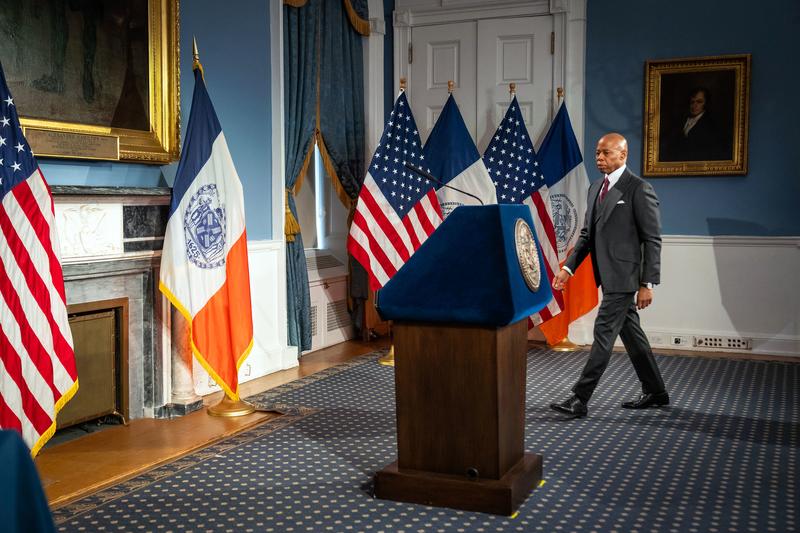
( Ed Reed/Mayoral Photography Office / Flickr )
[music]
Brian Lehrer: Hey, that's not The Brian Lehrer Show theme. You know what it is?
[music]
Brian Lehrer: That is Mayor Adams' walk-on and walk-off music at many of his news conferences and other events, as we turn now to WNYC and Gothamist political reporter Elizabeth Kim, who's been joining us on Wednesdays, covering the Eric Adams to Zohran Mamdani mayoral transition. We may have heard that music for the last time yesterday because among the items in the last week is a fiery farewell media event by Adams yesterday.
Also, Mamdani's invitation to New Yorkers to meet with him one-on-one. How many of those did he do in one day on Sunday? Also, the apparent elevation, to New York City Council speaker, of Julie Menin being described as a moderate who is not Mamdani's first choice, and more. We'll play some clips and talk, and invite your calls and texts. Hi, Liz. Happy Wednesday.
Elizabeth Kim: Happy Wednesday, Brian.
Brian Lehrer: Let's start with the outgoing before we get to the incoming. We heard the Adams' walk-on walk-off music there. What was this sort of farewell media event that the mayor held?
Elizabeth Kim: I like how you're calling it a media event, Brian. [chuckles] Yesterday, I called it a swan song. He's been doing select interviews on his way out, but this was largely expected to be the last time he convened the political press corps in City Hall. This is actually typically done by the mayor as a-- There's always an annual year-end reflection. This is obviously his last term, so it was a reflection on the entire term. It was held in the rotunda. He had his top aides, as he typically does, gather on the staircase around him.
You heard it. That is a remix of-- His typical walk-on music is to Empire State of Mind, but it seemed as if he came up with yet another more extended version of this. The mayor has always been great at stagecraft, although I think his critics would say this was a lot more over the top than his others. What was interesting about that, he comes on with that very jubilant music, but then when you hear the tenor of his remarks, it really clashed with that because ultimately, he sounded both bitter and resentful.
Brian Lehrer: You have a clip of that from yesterday. Should we just play it here-
Elizabeth Kim: Yes.
Brian Lehrer: -or do you need to set it up any further? Okay, here we go. Mayor Adams yesterday.
Mayor Adams: First mayor to have five women deputy mayors. First mayor to have a woman police commissioner two times.
[applause]
Mayor Adams: First mayor to have a Dominican deputy mayor. First mayor to have a Filipino deputy mayor. First mayor to have a-- What's my-- East Indian deputy mayor. First, first, first, first, first. Don't stay on one first. Talk about the first mayor being indicted, but dammit, don't miss the other first that this mayor has been able to accomplish.
Speaker 4: That's right.
[applause]
Mayor Adams: Have it all come together because that's how you record history. History is not selectively picking out one piece that fits into your narrative. History is showing the totality of what an individual does, and that's what we have to do here. That's what this time capsule is about.
Brian Lehrer: Was that bitter, Liz, you used that word, or just proud?
Elizabeth Kim: I think it was bitter, Brian. That was really the overarching message of this press conference was that he is angry that his legacy is in many ways cemented by the federal corruption indictment. Not only the federal corruption indictment, but also the way in which the case was dismissed. It came after he was currying favor with President Trump, and it was described by federal prosecutors as a quid pro quo with the Trump administration. He doesn't want to be remembered for that alone.
That is in part why he has come up with this idea of doing this time capsule. The time capsule idea was to have other symbolic items that memorialize his policy achievements. I think he is angry because ever since he announced that he was not running for reelection, I think he has been desperately trying to salvage his legacy somehow. This, yesterday, was the culmination. He's had a very combative relationship with the press, but even I was surprised that he elected not to take questions.
This would have been his last opportunity to really talk to us. Through talking to us, I should say, he's also talking to New Yorkers. We are asking questions on behalf of New Yorkers. He elected not to do that, and I thought that said a lot about his state of mind in these last few weeks.
Brian Lehrer: Which is exactly why I called it a final media event rather than a press conference, which I think it was originally built as, but it's not a press conference if you don't take questions from the press. I want to play another clip of Adams. Maybe this also falls into the celebrating his legacy category, but I think it's more than that. This is from Sunday, after the Bondi Beach Hanukkah celebration attack.
He promised extra security for public menorah lightings in the city and at synagogues, but he also used the announcement to take a couple of political shots at Mayor-elect Mamdani. Here's one of those in which Adams defends the NYPD Strategic Response Group, or SRG, in its current configuration, which Mamdani wants to dismantle and change.
Mayor Adams: I'm sure the investigation will determine what happened, but I do know this, specialized units play a primary role and function to go and respond to terrorist attacks of this nature. It is ill-advised to talk about the dismantling of the SRG team, the same team that went into 345 Park Avenue when we had now a lone gunman that took the lives of innocent New Yorkers. It took the courage of a civilian to take down one of the shooters. The country was lucky that the civilian was there.
Public safety can't be luck. Specialized units like SRG are trained for these encounters, and this illustrates the necessity of the Strategic Response Groups, who are ready to respond to terror attacks on a mass scale.
Brian Lehrer: Mayor Adams on Sunday. Now we should say, I'm sure Mamdani would not say that he wants any kind of slower or less effective response to active shooter situations. Do you know what Mamdani does envision, or if he had any reaction to Adams raising that issue in that way?
Elizabeth Kim: Mamdani has not held a press conference this week yet in which--
Brian Lehrer: I think he's got one starting momentarily.
Elizabeth Kim: Yes, right. That's exactly right. I wouldn't be surprised if he was asked about it. After that shooting, which happened in the summer, it was in July, Mamdani was in Uganda at the time, and then he immediately flew back to respond to it. I was at that presser, and I asked Mamdani to clarify on what is the role that he does see for the SRG. His position on it has always been that he wants to disband the SRG because of his objections to the way they police protests.
This was seen during the George Floyd protests, where there were violent clashes and even injuries to protesters, Brian. This also led to lawsuits and multimillion-dollar settlements by the city. Mamdani has raised those issues by saying that it is inappropriate for this unit to be doing that kind of work. At the same time, he said that responding to something like a mass shooting is their job, and that is the kind of role that he does see for a unit like that.
I don't know that it would still be billed as the strategic response unit, but it's true, he has yet to really clarify. If he will just dismantle this unit, what will he put in its place, and what will it be called? Who will staff it? Those are the details that we do not yet know.
Brian Lehrer: Yet, it sounds like Adams was misrepresenting.
Elizabeth Kim: I think so. The two of them have had this difference on this policy since the Midtown shooting. This has become an issue. Adams has warned the public immediately, almost days after that shooting, that Mamdani had said that he wanted to disband it, and this is why it is important. I think that that's fair. It's a fair difference of policy and an argument for these two individuals to have. On the other hand, like you said, Brian, he has been using these last few weeks in office as an opportunity, not just to cement his legacy, but to undermine his successor coming in.
Brian Lehrer: I want to ask you about Republican Queens City Councilmember Vickie Paladino and the response to her after Bondi Beach. She called for "the expulsion of Muslims from Western nations." Now, the incoming City Council speaker, Julie Menin, who leads the council's Jewish Caucus, among other things, was asked about that here on Monday's show with a follow-up from me. The caller asked if Menin would support a censure or expulsion of Paladino from council for that expression of anti-Muslim hate. Here's part of her response.
Julie Menin: In January, we will be naming all the committees, we'll be naming the chairs of all the committees, including the chair of the ethics committee, and that will be a matter for them to take up. To be clear, I do not support those comments. I denounce those comments, and they are extremely troubling.
Brian Lehrer: You don't want to take a position, it sounds like, on whether a censure or expulsion is warranted. Why not?
Julie Menin: Well, it's not up to the speaker under our council rules. It's up to the ethics committee. Basically, how the process works is, a complaint is filed, the ethics committee meets, and then the ethics committee makes a decision on whether they're going to censure. Under our council rules, it's not up to the speaker. It's up to the ethics committee. We have to follow those rules. To be clear, I completely disavow those comments and find them absolutely derogatory.
Brian Lehrer: Julie Menin, the incoming City Council speaker, here on Monday. Liz, I think the outgoing speaker, Adrienne Adams, took basically the same position. It's up to the committee, not her. Is that right?
Elizabeth Kim: That's right. I think some could read Speaker Adams' comments as maybe a touch more stronger in suggesting that there should be consequences. She had said that it is the responsibility of the council's Committee on Standards and Ethics to bring disciplinary action against council members. Maybe you can see that as maybe she's urging them to do something. Brian, this is something that the council has wrestled with, and it's not just with Vickie Paladino.
I was thinking about when this issue came up immediately of Councilmember Inna Vernikov. Now, she, last year, I believe, had brought a gun, and she was arrested for it. She brought a gun to a public protest. It was a pro-Palestinian rally, and she had brandished a gun.
Brian Lehrer: She was on the other side of that, we should say.
Elizabeth Kim: Exactly. It was viewed by critics as an intimidation tactic, and there was questions at the time, should she be censured? There was a conversation by the council's committee about whether to do it, and they ultimately didn't. Now, with Paladino, this came up during the mayoral race because she had at one point also on her social media feed, which, we should also mention, is managed by her son-- That is an open secret in politics. She herself is not doing the tweeting. It is her son who is managing that account.
At the time, she had said that Zohran Mamdani should be deported. Zohran Mamdani, who is a citizen, should be deported. That, at the time, also elicited very strong rebukes from council members, from Zohran Mamdani himself, and there was again the question of what should the council do? It's this tricky line that the council is always walking between allowing a council member to have free speech, but also at what point does that cross the line into hate speech? What are their powers, and what are their responsibilities to the public to recommend a disciplinary action like censure?
Brian Lehrer: On the election of Julie Menin by her City Council peers, it surprised some people for how quickly it happened, and also that she is not from the same progressive camp as Mamdani. She's not a right-winger like Vickie Paladino. I think we heard that in that clip, but she maybe arguably is not as progressive as much of the council majority. Why Julie Menin?
Elizabeth Kim: I have a one-word answer for this, Brian, and it's labor, labor unions. Julie Menin has been running for over a year. I think it's really important to point out that she was-- Under Bill de Blasio, she was the Commissioner of Consumer Affairs at a time where it also morphed into the Department of Consumer Affairs and Worker Protection. That latter part is really important because it allowed her to cultivate a lot of relationships with the union.
Coming in in the late stages of this speaker race, she was able to bring out the support of the Hotel and Gaming and Trades Council, 32BJ, which represents building workers, and also the UFT, which is the teachers' union. The unions play a very important behind-the-scenes role because if you can have their backing, a lot of council members who are thinking about their own reelection and the kind of financial support and boots on the ground support that they need to run again, are thinking about the way unions are going.
Also, even if you're not running for reelection, but you're thinking about your political future, you need unions. That's why they really helped-- Her ability to coalesce this kind of support really helped her bring herself to the finish line. Then on top of that, she had the backing of two very important party leaders,Queens Congressman Greg Meeks, and also Congressman Adriano Espaillat, who represents Upper Manhattan and the Bronx.
Brian Lehrer: Both of whom might get primary next year from the left, as you said. Right?
Elizabeth Kim: Exactly. [chuckles] Yes.
Brian Lehrer: Do you expect Menin, therefore, to be a check on Mamdani in any way, as some media have speculated? She is certainly proclaiming her solidarity with him on the universal childcare agenda, also free buses, I think, but there are these articles floating around. If you Google Mamdani Menin, you're going to get, "Moderate Julie Menin seen as a possible check on Mayor Mamdani."
Elizabeth Kim: That was a narrative that came out during the race. I think part of that narrative came out because, at the time, it was still viewed as a competitive race. Those running against Menin, I think, thought that it was to their advantage to depict her as a moderate, to depict her as someone who would be a check on the mayor in hopes of getting allies of the mayor-elect and even the mayor-elect to perhaps intervene in the race.
I think if you listen to what she said so far, she's expressed a lot of support for Mamdani and his policies. Everything from universal childcare, free buses, city-run grocery stores, and then there's also that union tie. Both she and Mamdani are coming in with the support of these unions, who are relying on them to come out with legislation that is very much in support of protecting workers and perhaps being a check on corporations. These are all areas where she and the mayor can collaborate on.
Brian Lehrer: Interesting.
Elizabeth Kim: The other reason I think we should reserve judgment on what their relationship will be is because, look, four years ago, when Adrienne Adams became the speaker. On the surface, here was this Black moderate from Southeast Queens, just like the mayor. On the surface, it seemed as if they could form an alliance, but that was ultimately not what happened at all. They had a very contentious and combative relationship. That's because the council, as a body, is very progressive, and the speaker, in many ways, has to govern according to the priorities of her members.
Brian Lehrer: I'll acknowledge that many of the texts we're getting are critical of Adams for the tone with which he's leaving office and handing off to Mamdani. One listener writes, "Did de Blasio work to undermine Adams in a similar way? Adams is a small man." Another one, "I prefer Bloomberg's dignity in not criticizing de Blasio to Adams' defensive, angry, press-averse blustering. Press adverse blustering." A sample of those.
The mayor-elect held listening sessions one-on-one with some New Yorkers on Sunday. Here is a clip of his video inviting people to sign up.
Zohran Mamdani: Hello, New York City. Tomorrow, Sunday, December 14th, I will be spending 12 hours from 8:00 AM to 8:00 PM, sitting down with New Yorkers one-on-one. Tell me about your life in New York City, what you care about, what you need, what kind of team you want me to build at City Hall. Whether you're civically engaged or this is your first time, I want to hear from you.
Brian Lehrer: Can you say anything about how that went? 12 hours, really? 12 hours of one-on-one conversation, and who got the privilege of actually sitting with him?
Elizabeth Kim: Brian, I thought that was so interesting that he elected to do this because this is obviously a very, very busy time for the mayor-elect. He has yet to make a lot of really important appointments. For instance, I'm thinking of schools chancellor, and he still has, I believe, multiple deputy mayors to name. He elects to take out, not just a few hours of his day, but 12 hours of his day to meet one-on-one with New Yorkers.
I think what he's thinking about is how does he harness this incredible energy that he has created out of this movement, this movement that came out of his campaign, that was funded by really small donors. How does he keep that going? I think that is something that he's thinking about as he goes to City Hall is how does he bring that grassroots enthusiasm with him and how does he sustain it as he governs. I think that they came up with this idea is, to meet one-on-one with New Yorkers. It will be interesting to see how he is able to, I guess, continue that relationship going into City Hall.
Traditionally, the mayor has town halls. Will he do that? This was certainly different in the fact that it was closed press, and I think maybe you can say that that's a criticism of it too. There were some reporters who did try to attend the event, and they were just able to basically stand outside and try to catch some interviews with people on their way out, but we have no idea what those conversations are like. Arguably, there should be some transparency there.
Brian Lehrer: The mayor-elect, I'm not breaking news here, has said publicly that he will be doing Ask the Mayor on this show like de Blasio did, Adams did not, so certainly he'll be getting some questions from listeners, from New Yorkers right out in the open once that begins. By the way, before you go, you-- Sorry, your story. You had a story. [chuckles] Sorry. You had a story questioning the received wisdom that he will be the city's 111th mayor. You have confirmed that he will not actually be the city's 111th mayor, correct?
Elizabeth Kim: That's right, Brian. He's going to be the 112th mayor. Just to recap to your listeners, several weeks ago, it might be over a month now, I got an email from a historian in DC who's been doing some research on the ties between slavery and early mayors. He told me that in the course of his research, he came across-- This was primary sources. He was basically looking at the papers of a colonial governor at the time, and he said the city is actually missing the second term of this mayor named Matthias Nicolls.
He was the sixth mayor of what was then considered New York City, but he also was the eighth mayor of New York City. That second term, and it's a second nonconsecutive term, which does get counted, means that he gets counted twice. It's just like the way we count presidents. President Trump is both the 45th and the 47th president. I know it's confusing, but he points this out to me. I look at it, and everything checks out. His sourcing checks out.
What's even weirder is that this was not the first person to stumble across this. He told me himself, and this has been discovered. It was, in a way, a rediscovery. There have been other people, at least three times, going back to 1935, who have pointed this out to the city, but the city has never changed its official roster of mayors. After I did that initial story, someone from the municipal archives reached out to me and said, "I think I have something you might want to see," and sure enough, he found a book. It was called the Mayor's Courts Minutes.
At the time, mayors also presided over court proceedings. He found the book for me. We looked at it, and there, in calligraphy written in quill and ink, we saw the second term of Matthias Nicolls memorialized. They put out a social media tweet saying, "Mayor-elect Zohran Mamdani is not the 111th mayor." I will say, on a final note, that Mayor Adams knows this. I reached out to his administration, but I thought it was in some ways kind of fitting that he went out yesterday, calling himself the 110th mayor. He's not going to let that go.
Why is a number important? I know that for Mayor Adams, he really identified with that number. He often liked to call himself 110. He has a whole YouTube video series that is called 110. I think it's just a way for people in their mind to impose order on a long list of mayors. I think it's also important to note that the history of the city is much older than the history of the nation, and that's why it gets tricky sometimes. That's why this mayor, I think, was missed.
Brian Lehrer: Well, we do a lot of history on this show, but I think you just gave the first-ever reference to something written in quill and ink. Liz Kim will continue to report and come on this show with her reporting as a New York City political reporter for WNYC and Gothamist. Thanks for today, Liz.
Elizabeth Kim: Thank you, Brian.
Copyright © 2025 New York Public Radio. All rights reserved. Visit our website terms of use at www.wnyc.org for further information.
New York Public Radio transcripts are created on a rush deadline, often by contractors. This text may not be in its final form and may be updated or revised in the future. Accuracy and availability may vary. The authoritative record of New York Public Radio’s programming is the audio record.