Change is Coming for New York's Catholics
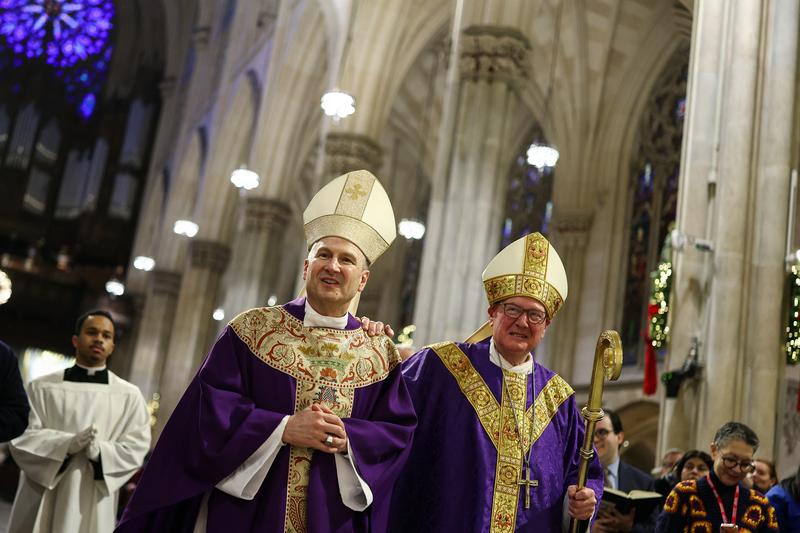
( CHARLY TRIBALLEAU / AFP via / Getty Images )
[music]
Brigid Bergin: It's The Brian Lehrer Show on WNYC. Good morning again, everyone. I'm Brigid Bergin, senior reporter in the WNYC and Gothamist newsroom, sitting in for Brian today. Here's some news from the Vatican that's important for the 2.5 million Catholics in the Archdiocese of New York. Cardinal Timothy Dolan is retiring and Pope Leo has appointed the next leader of the church here in the archdiocese that covers Manhattan, the Bronx, Staten Island, and several counties north of the city. His name is Ronald Hicks, and he's a Midwesterner, just like Pope Leo.
Some observers have said his style and approach might also be similar to the new Pope's. If that's true, this will signal a big shift in leadership for New York's Catholics. Here with me now to talk about both Cardinal Dolan's legacy and the new archbishop is Daniel Rober, an associate professor and the chair of the Catholic Studies Department at Sacred Heart University. Hey, Professor Rober, welcome back to WNYC.
Daniel Rober: Great to be with you, Brigid.
Brigid Bergin: Professor, we're going to get to Cardinal Dolan's legacy in a few minutes, but first, can you tell us a little bit about this new archbishop, Ronald Hicks? Is he originally from the Midwest, and what kind of work has he done as a priest and a bishop?
Daniel Rober: Sure. He grew up in the south suburbs of Chicago, very close, as he said yesterday, to where Pope Leo grew up. He is somebody who really takes inspiration from a saint named Oscar Romero. I'd like to center that a little bit as we begin our conversation. Romero was the archbishop of San Salvador in the late 1970s who was assassinated by the Salvadoran government, right wing government, for his outspokenness and activism. He's somebody who was only canonized as a saint quite recently by Pope Francis after that process was kind of blocked by various people in the Vatican. He is somebody, and the Salvadoran church is something to which Bishop Hicks is quite devoted.
He took four years of his priestly ministry in Chicago, received permission from Cardinal George at the time to go to El Salvador and work there as a priest. He talked about that as transformative for his ministry. He's evoked Pope Francis as talking about wanting to have the smell of the sheep, as wanting to be with the people. He's talked especially about the Latino church as having an impact on him.
His motto, his episcopal motto is in Spanish. Traditionally, bishops would have this in Latin, or more recently, a lot of American bishops have had it in English, but his is paz y bien, peace and good, which is the motto of the Franciscans, which of course, connect to Pope Francis and St. Francis. He is somebody who really takes inspiration from the Latino community and from his experiences in El Salvador as well as that of St. Oscar Romero.
Brigid Bergin: Professor, I mean, how does that contrast with-- I'm not sure I know who Cardinal Dolan's favorite saint is. It's quite a Catholic thing to have our favorite saints. What does that say about the incoming archbishop's priorities that he was so closely associated with working for these people who were struggling, working for and working with the poor?
Daniel Rober: I think it shows that he wants to be somebody on the ground with the people. There are many Catholics in this archdiocese who are poor, who are struggling, who are immigrants, who are people who are right now very afraid at what might happen to them. He evoked that yesterday when he talked about immigrants coming here to the shores of New York City. The Statue of Liberty, Ellis Island, all these symbols of immigration to the United States here in New York that has been ongoing. I think you will see him as somebody who wants to become close to those kinds of people.
Cardinal Dolan, of course, is quite gregarious and has been quite media-friendly, but he's also been somebody who a lot of people have seen as catering to the wealthy, to donors, which, of course, the church always needs donors. You could go to the great churches of Europe and all that and see the legacy of that also, but sometimes in ways that seem to rub up against the priorities of Pope Francis, for example, of what Francis called a poor church for the poor.
I think that's something that we'll see Bishop Hicks emphasizing quite a bit, especially because under Cardinal Dolan, the New York Archdiocese has contracted. It's had to sell a lot of property, a lot of real estate. Its big office building on First Avenue has been sold. It's becoming less of a kind of real estate empire than it was under the Cardinal Spellman back in the 1950s and 1960s, and more of a church on the ground with the people. I think Bishop Hicks will be a good fit for what the church has become and what it really needs to be.
Brigid Bergin: Listeners, especially Catholics or those of you with Catholic roots or maybe lapsed Catholics, we'd love to hear from you now. You can call and text to share your thoughts either about the outgoing leader of the New York Archdiocese, Cardinal Timothy Dolan, or the incoming archbishop, Ronald Hicks. The number 212-433-WNYC. That's 212-433-9692.
Do you have a memory of Cardinal Dolan, good or maybe not, to share? He was never shy about sharing his views on political life here in the city. If you have thoughts about the direction of the church so far under Pope Leo, including his big decision naming a new leader of the New York Archdiocese, we'd love to hear from you. The number 212-433-969. You can call or text that number.
As those calls come in, I think something a lot of listeners might be wondering is, will the future Archbishop Hicks be more like Pope Francis, who seemed to be a bit more reform-minded and signaled acceptance to LGBTQ Catholics and just a more openness for change, or will he be more of a conservative voice within the church? What's your perspective on that?
Daniel Rober: As soon as the kind of rumors were confirmed that Bishop Hicks was being nominated, I immediately thought back to the famous line of Pope John Paul II when he appointed Cardinal O'Connor and said, "I want a man like me in New York." Pope Leo appointing Bishop Hicks is very much in that vein, particularly in the sense that Bishop Hicks has immediately become kind of a Rorschach test for what Catholics think he might be, just as Pope Leo has been.
I think much like Leo, besides being from Chicago, he is a man who likes to listen, who likes to pay attention to what's going on on the ground. He's also somebody who I think clearly has taken inspiration from Pope Francis, as did Pope Leo. Again, I mentioned his motto in Spanish, paz y bien, echoing the motto of the Franciscans. Of course, Pope Francis was a Jesuit, but was evoking St. Francis with his name.
I would see Bishop Hicks as being more comfortable with perhaps Pope Francis and his legacy than Cardinal Dolan was. He was somebody who came up through the ranks of the church in the days of John Paul II and Benedict XVI and had a particular way of going about things that kind of came out of that era. I think Bishop Hicks is more comfortable with synodality, which is this reform process of getting Catholics listening to one another and of the church apparatus and institution, listening to the people, of everybody being in conversation, having a conversational church. I think that's something that Bishop Hicks pursued in Joliet, something I would hope to see him pursue in New York.
Again, Cardinal Dolan was outspoken politically and sponsored a lot of conservative initiatives, but was also somebody who was comfortable, did not interfere with the LGBT ministry of my friend Father Jim Martin from America Magazine, who founded Outreach Ministries, which has had conferences here in New York. Again, while Cardinal Dolan has associated with a lot of conservatives, he is not been the most hard line in terms of some of those pastoral realities compared to other bishops around the country.
Brigid Bergin: I want to talk a little bit more now about the outgoing Cardinal Timothy Dolan and his legacy. A listener texted, "Lapsed Catholic here, but fully gave up on Dolan as he did the convocation for Trump, I believe twice, antithetical to any values I or my family hold dear." Professor, you were talking about how Cardinal Dolan has been more outspoken politically. What else should we know about his legacy?
Daniel Rober: Sure. I think, again, Cardinal Dolan became archbishop of New York in 2009, and this was right around the time of the beginning of the Obama administration. Pretty shortly after being named archbishop, Cardinal Dolan was also elected president of the United States Conference of Catholic Bishops in a move that at the time was quite controversial because the vice president at the time, Bishop Gerald Kicanas, who ironically was a mentor to Bishop Hicks in Chicago and was mentioned in one of the articles about him yesterday.
Cardinal Dolan became somebody who was in combat with the Obama administration over the contraception mandate to the Affordable Care Act. He became somebody who, in many ways, was critical of left and liberal political leanings and was more comfortable with conservatives, was more comfortable with President Trump than with President Obama or even President Biden. I think that did rub a lot of Catholics the wrong way.
His phone call with President Trump from the pulpit of St. Patrick's during the pandemic in 2020 where he said he talked to President Trump more than he talked to his own mother. Yes, I think that did make people uncomfortable, especially because while Cardinal Dolan would say the right thing about the church's teaching on migrants, in many ways, because it's undeniable, the church has teachings that are very pro-migrant in favor of people being able to escape political persecution and poverty. He was somebody who was not seen as somebody who was going to go to the barricades for that.
Again, I think this is something where Bishop Hicks may face tests fairly quickly, although it seems like perhaps after Mayor-Elect Mamdani's meeting with Trump in the Oval Office, that there may be some holding off on ICE activities here compared to other places like Hicks's native Chicago. He is somebody who I think, especially with the model of Romero in mind, may be a bit more willing to be combative to get in the streets to make himself an object of criticism in a way that Cardinal Dolan clearly wanted to be liked by people on various sides, but was most comfortable, I think, with conservatives.
Brigid Bergin: I want to bring in some of our listeners. Let's go to Julie in Hastings, New York. Julie, welcome to WNYC.
Julie: Thank you so much, and thanks for doing this segment. Yes, I agree with the guest on everything. One thing with regard to Bishop Hicks being-- a lot of the coverage has said that he is very much like Pope Leo wanting to be a unifier. I think that's true. Two examples I think are, on the one hand, at the press conference when Cardinal Dolan introduced Bishop Hicks, Cardinal Dolan said that he admired him and he gave him hugs and so forth.
Even as the guest has indicated, Bishop Hicks is a admirer of Oscar Romero, that the Reagan administration supported the government that assassinated Archbishop Romero. He's a unified. He has the potential to be a unifier. I think that that's what he wants to do. How do you square those two things? The conservative cardinal and the radical saint and the new bishop? Well, if you ask the new bishop how to understand him, he says, "Look to Jesus Christ," I'm trying to find, "Follow Jesus Christ," which may sound like trite, but I think he means the greatest commandment, love God and love your neighbor.
Brigid Bergin: Julie, thank you so much for that call.
Daniel Rober: Thanks, Julie.
Brigid Bergin: Professor Rober, you want to react to that?
Daniel Rober: Sure. I mean. If Cardinal Dolan had not said he admired Bishop Hicks, that would have been a kind of man bites dog story in the sense that there is a certain way of doing press conferences as bishops. Cardinal Dolan spent time in Rome. He has what's called Romanitas. He knows how to talk to people. Even if there are some elements of this that may be less than appetizing to him, like the announcement the week before Christmas and the fact that Bishop Hicks is going to be installed on Cardinal Dolan's birthday, February 6, which some people have taken as perhaps a slight.
Yes, I do agree that Bishop Hicks is going to want to be a unifier, and he is somebody who is going to try to bring Catholics together. He's not somebody who's going to want to step into divisive issues within the church. I also think he's somebody who's going to need to look at ways to listen to Catholics who might be disaffected, who might be lapsed, who might have been uncomfortable with things that Cardinal Dolan did, like our previous texter said.
There are some Catholics who have felt that under bishops like Cardinal Dolan, that only very conservative Catholics are really Catholics. I think Bishop Hicks is coming from a legacy in Chicago and elsewhere of trying to have more of an open door to various perspectives within the Church. I think that's a healthy balance.
Brigid Bergin: Professor Rober, I want to make sure we touch on two very important issues related to the Catholic Church and right here in New York City specifically. Earlier this month, the New York Archdiocese announced that it's working towards a settlement with victims who say they were sexually abused as minors by priests and others associated with the church.
The church has been selling extremely valuable real estate properties here in the city to fund that multimillion dollar settlement, including its Manhattan headquarters and the land that is beneath the luxury Palace Hotel. I think it's fair to say this has been a defining crisis of the modern Catholic Church. What is Cardinal Dolan's legacy on dealing with the sexual abuse crisis?
Daniel Rober: Sure. Well, I think it's not coincidental that this announcement came right after that. Cardinal Dolan has been somebody who has been tasked with cleaning up a matter that, of course, was really transpired under his predecessors, Cardinal Spellman, Cardinal Cooke, Cardinal O'Connor, and he's had to divest the church. I mentioned earlier, the power plant on First Avenue, the former chancery that was sold, which for those who would ride the M15 bus pass, was kind of a defining place of Catholic power built by Cardinal Spellman.
In many ways, he's had to clean up a mess that was not of his own making. Given Cardinal Dolan's kind of status as a very institutionalist person, it's kind of symbolic of the way the Church as an institution, as a, as I said, real estate empire, has been kind of brought to its knees by this, morally, financially, and otherwise.
Bishop Hicks made good comments about this yesterday, saying, "This is an ongoing sin that the church has to face." He didn't say, "Well, thank you, Cardinal Dolan, for getting all that over with and now I can have a clean slate." He knows better than that. Again, what I would hope this allows the Church to do is to really focus on the basics. Not having an opulent high rise office overlooking the East River, but being out there in the church's ministries with the people, getting on the ground with the people.
I think, on that level, there's an opportunity here for Bishop Hicks to have, again, not a clean slate in the sense of that for the victims and for those whose schools and parishes have had to close because of all of this, because the archdiocese can't support them. It's an ongoing grievous offense. Again, I think it's something that allows the church to really be the people of God, to be out there with the people, to have what Bishop Hicks, quoting Pope Francis, called the smell of the sheep.
Brigid Bergin: Sure. In that vein, Last month, the US Conference of Catholic Bishops issued a rare special message condemning the sweeps and deportation of immigrants, and it spread down through congregations as priests discussed it at mass. This statement was clearly in opposition to the Trump administration. Is the future Archbishop Hicks likely to be a strong advocate for immigrants here in the city? It sounds like from your description, wanting to-- the smell of the sheep, if I paraphrase it correctly, he would be.
Daniel Rober: Sure. He's come out very strongly in favor of that statement. That statement was very much influenced by one of his mentors, Cardinal Cupich of Chicago, for whom he served as vicar general, which is essentially top lieutenant for several years in Chicago. Yes, I think that is something that you will see him be very strong about. Again, he's somebody who's made so clear that the Latino church is what formed him. He has spent time in El Salvador, where a lot of migrants are coming from.
With regard to these matters, or for that matter, with possible war in Venezuela, he is somebody who doesn't see these as theoretical matters. He has been there on the ground. He has seen the reality of where people are coming from and how they live. He has ministered to those people. He sees those people as part of the church, just as much or more than he sees the wealthy donors who bishops have to wine and dine in order to keep ministries open. I think that's a really important thing.
Brigid Bergin: Professor, as we're also talking about Cardinal Dolan's legacy, has there been much critique of the role that Cardinal Dolan played or, frankly, did not play when it came to the migrant crisis here in the city over recent years?
Daniel Rober: Yes. I mean, again, I think, like I said, he is somebody who is willing to say the right things about the church's teaching on these matters, but is somebody who is, again, very comfortable with conservative wings of the church, many of which are well represented in the Trump administration. Again, he is somebody who has partnered very closely with the Napa Institute, run by Timothy Busch, a major conservative donor. They've put on events here in New York the past couple of years, major eucharistic processions.
He's wanted to emphasize kind of piety and wants to argue that there's sort of a resurgence in Catholic faith among young people, which I think is a bit more of a blip or welcome in its way, but is not telling the whole story. He is somebody who has not looked to confront the administration on these matters. Yes, but I don't think he's somebody that anybody expected to do that, frankly.
Brigid Bergin: Sure. Professor Rober, before we let you go, many of us are still getting to know Pope Leo so far. He's been the leader of the world's Catholics just since May of this year. What kind of mark do you think he's made in? Is there anything in particular you think is worth highlighting?
Daniel Rober: Yes. What I'd like to say with Pope Leo is he is somebody who has been-- for somebody who has been viewed correctly as a kind of cautious and measured person. He has been somebody who, from the get go, has been willing to wade in and comment on American issues in a way that's been a bit surprising.
Most notably, I was mentioning Cardinal Cupich, who is somebody that Bishop Hicks has been close to in Chicago. He was going to honor Senator Dick Durbin with an award that Senator Durbin ended up declining because of the kind of outcry. Cardinal Cupich got a lot of criticism for the fact that he was going to honor a politician who is outspokenly pro-choice for other things that he has done related to immigration and other matters, for social justice issues.
Someone asked Pope Leo about it. Pope Leo, rather than just saying, as would be easy to say, "Well, I don't know much about this." He actually started by saying, "Well, I don't know much about this," but then kind of show that he did and said, "Yes, you have to understand that the church has teachings on all of these things that we can't just delineate one side of the political aisle or the other. You can't have somebody saying, 'Well, I'm all pro-life, but I'm anti-immigrant, and so I'm representing Catholic teaching.' It doesn't work that way."
Pope Leo, in that way, has been willing to stand up for the full range of Catholic teachings and, in many ways, pull the rug out from under some of the kind of conservative arguments that a lot of allies of Cardinal Dolan have tried to make over the years that conservatives are more welcome in the church in some ways than people who might look at things a different way.
I think Leo is somebody who keeps his cards close to the vest, but when he feels strongly about something, is willing to act and speak. I think it'll be very interesting to see how that continues to play out, particularly with various things that might or might not be happening.
Brigid Bergin: Professor Rober, just in our last 30 seconds, do you know if Bishop Hicks has welcomed women leaders into the Catholic Church and if there's any chance we might see some modernization of the church in that respect?
Daniel Rober: This is a great question. I think this is something that's crucially important. Recently, again, another thing that came out that was not from Pope Leo was recently a document from the Vatican disappointingly punting again on the question of women's ordination as deacons. What I will say is with each generation, one would hope that you find leaders who are more comfortable being around and working with women, which some leaders in the past have not shown.
I would recommend, too, as somebody who is a devotee to the martyrs of El Salvador, that I would hope that Bishop Hicks brings forward two New Yorkers who were murdered there shortly after Archbishop Romero, Eda Ford and Maura Clarke, both examples that would be very helpful for thinking about women's leadership and ministry in the church.
Brigid Bergin: My guest has been Daniel Rober, an associate professor and chair of the Catholic Studies Department at Sacred Heart University. Professor Rober, thanks so much for your insight and for coming into the show. Have a great holiday week next week.
Daniel Rober: Thank you, Brigid.
Copyright © 2025 New York Public Radio. All rights reserved. Visit our website terms of use at www.wnyc.org for further information.
New York Public Radio transcripts are created on a rush deadline, often by contractors. This text may not be in its final form and may be updated or revised in the future. Accuracy and availability may vary. The authoritative record of New York Public Radio’s programming is the audio record.