
Call Your Senator: Sen. Kim on the Affordable Care Act Subsidies and More
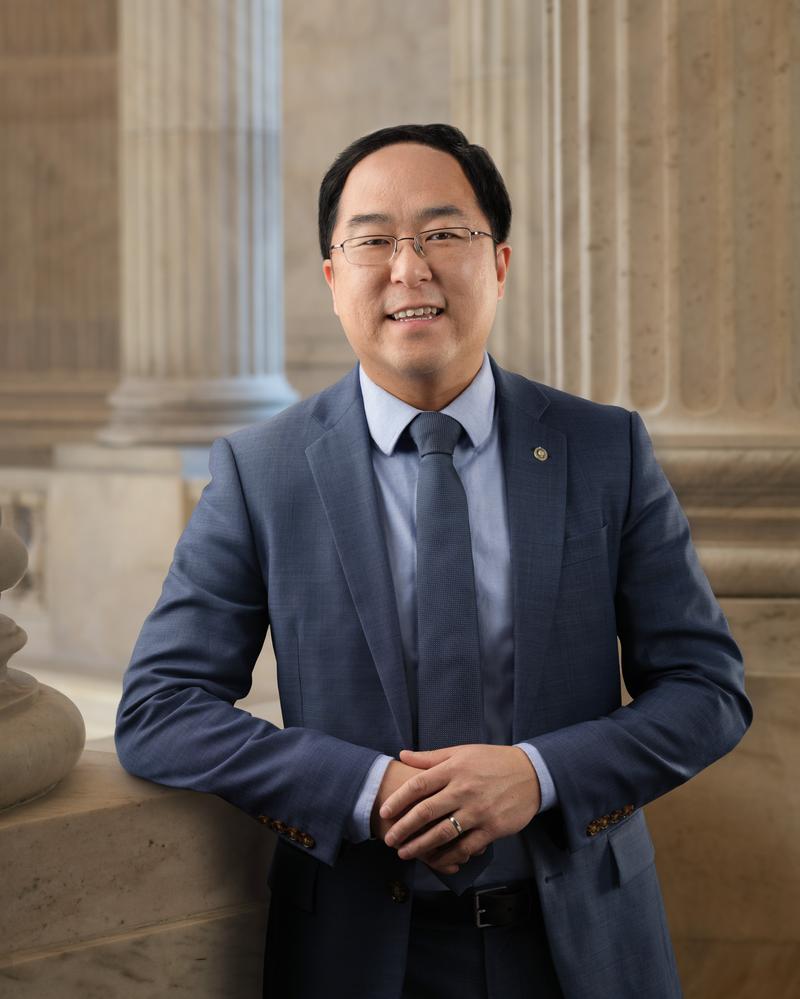
( U.S. Senate Photographic Studio / Office of the Senator )
Brian Lehrer: It's The Brian Lehrer Show on WNYC. Good morning again, everyone. Now, our monthly Call Your Senator segment. My questions and yours for New Jersey Senator Andy Kim, our lines are open with first priority for New Jerseyans, but others may call as well at 212-433-WNYC. Call or text 212-433-9692. It's been quite an eventful month since we last spoke with Senator Kim.
The government shutdown ended. We'll ask him about his vote, the controversial defection of members of his party in the Senate, and whether he thinks there will actually be a vote to extend subsidies for the Affordable Care Act, the issue the Democrats centered for the fight. Some other news in Washington we'll want to get the senators' take on there is the release of those Epstein emails put out by House Democrats last week. A Senate vote on releasing the fuller Epstein files is not assured.
Maybe some advice for Governor Elect Mikie Sherrill. They both used to be in the House of Representatives together and have now both moved up to statewide elected offices, and other thoughts on the election and how it sets up next year's midterms. Senator, we always appreciate that you do this. Welcome back to WNYC.
Senator Andy Kim: Yes, thanks for having me back this morning, Brian.
Brian Lehrer: The federal shutdown ended without a guarantee to continue funding subsidies for the Affordable Care Act at current levels or the increased levels that the spike in insurance costs would take. You did not vote to end the shutdown. We want to be clear about that. What do you make of the actions by your seven Democratic colleagues who did?
Senator Andy Kim: Well, look, first of all, I just have to start by saying shame on Trump and the Republican leaders for putting us in this position. They put all of their effort and so much intensity behind their efforts to lower taxes for billionaires to push forward on their dangerous agenda, and just left so many millions of Americans left holding onto the mess, and now they're seeing their health care costs spike.
Just start with just understanding why we're in this position to start with. Look, yes, I for one wanted to be able to continue to push to try to get a deal here because I made a promise to so many of my constituents that I would fight as hard as I humanly can to be able to deliver the costs that they deserve. One family was telling me they pay about $500 now a month; it's going to go up to about $2,000 a month. This is just absolutely unacceptable. Yes, I'm going to continue to fight. I am frustrated how things turned out, but this is not over. I'm going to continue to push and continue to give it everything I got.
Brian Lehrer: Our first caller, right on Line 1, is a New Jersey listener who has a personal story about exactly this. Laura, in Jersey City, you are on WNYC with Senator Andy Kim. Hi, Laura.
Laura: Hi, thanks for having me, and thank you, Senator Kim, for listening to me go over my issue. My premiums are going to increase by about $500 a year, and I'm losing my subsidies. I will be paying double. It'll be around $1,400 a year. I have to pick a plan by a certain date in December. I'm not given any hope that the subsidies will be extended. I have to pick a plan.
I either have to roll the dice and pick the more expensive plan, figure out how to pay for it, which I really can't, or go to a lesser plan, cross my fingers that I don't get really sick next year. As a self-employed person, you have the added uncertainty of us not knowing what we make from month to month. Our income varies. The Affordable Care Act has never been very good in that aspect.
I also want to say I don't want subsidies; I want the government to figure out how to get the cost of health care down for us. No one has explained to me, ever, why we are getting hit so hard with the Affordable Care Act with these increases, but the rest of the health care industry, people in my income bracket are not seeing these double-digit increases when they're working for corporate America. That's several questions, but this is my situation, and I know I'm not alone. Please, what can you do? What can you tell me to do? [chuckles]
Brian Lehrer: Senator?
Senator Andy Kim: Yes. Thank you, Laura. I'm sorry for what you're going through and just the squeeze that it's putting you in, and just a choice that you have to make. It's about taking the chance and going for something lesser or trying to pay more, which you said you can't afford. Just look, in the richest, most powerful country in the world, you should not be in this situation.
You really hit the nail on the head. It's about not just "How do we pay for our health care?" but "Why does our health care cost so much to start with?" The struggles that we're seeing right now, and a lot of it is coming downstream to the Affordable Care Act. When it comes to those on private insurance, they're getting subsidies from their employers. There's other aspects of this that are straining them when it comes to what we just saw with the gutting of Medicaid earlier this year.
That's part of what is causing this upward pressure in costs, that when hospitals and when insurance companies and others are seeing that their revenue is going to go down with these cuts in Medicaid, we're seeing them increasing costs elsewhere. The Affordable Care Act is one of the places that's easiest for them to push up. We're seeing how the Republican efforts are already affecting people's health care and is driving up the costs.
I agree with you. We need to find a longer solution to this. That's why I've really tried to push my Republican colleagues to accept this one-year extension of the subsidies of the tax credits while we try to put forward a plan that can be longer-term to address some of these other issues that are out there. It's not going to fix everything, but it would have at least been able to stave off this crisis that you and many others across New Jersey and over 20 million across this country are facing.
I'm sorry that we failed you. We did not give you the support that you needed, but I promise you, I'm going to keep at it for you and for many others, and we'll try to be able to do everything we can to help you address these needs right now.
Brian Lehrer: Well, to Laura's quandary, are you confident that the GOP Senate Majority Leader John Thune will make good on the promise to hold a vote on renewing the ACA subsidies? That was the key to the end the shutdown deal. If that vote comes next month, as Senator Thune says it will, and if the House were to go along as well, then before Laura has to pay her bill for 2026 and everybody else who's on the Affordable Care Act policies, maybe the extension will come. What do you think the chances are?
Senator Andy Kim: Well, first of all, we will have a vote. I do feel confident in that. Now, Leader Thune is not committing to supporting it, to putting any muscle behind rallying Republicans. In fact, it's quite the opposite. I do think we'll have a vote, but it'll be a very difficult one. Nonetheless, I think it's important to push ahead. As I said, I'm not giving up on this. There are millions of Americans that are struggling, and they can't just accept an answer like, "Well, we tried our best."
We actually have to keep pushing on this. I do want to try to make some progress. About a week or two ago, I did have an open channel to a number of Republicans on the House of Representatives side, and they agreed that they wanted to move forward on extension of these tax credits. There are Republicans that support this for various reasons, but regardless of that, what their motivations are, I do think that there is still a majority of members of Congress in the House and in the Senate that would support an extension if it wasn't for Trump, Speaker Johnson, and others putting their thumb on the scale and pressuring them not to move forward.
That's what I find so upsetting here, is that I do believe that there is majorities that can pass this. It's just for politics, for partisanship, and for politics, for Johnson to want to keep his job. Speaker Johnson was worried that he would lose his job in the same way that Kevin McCarthy did if he moved forward than that. I just think it's shameful to put your own career, your own ambitions ahead of the health care of millions of people.
I will do everything I humanly can to try to get a bill that can pass forward in December. If it fails, I'm going to just keep fighting and keep going and hopefully get to the point where we can have the majorities that we need in Congress to be able to deliver what Laura and many others deserve, which is actual, affordable health care.
Brian Lehrer: On the politics of how the shutdown ended, listener writes, "Senator, will you stand up to craven and inept Democratic leadership and call for Schumer and Dick Durbin to step down?"
Senator Andy Kim: Yes, look, I understand that frustration, just that many are feeling. I feel it, too. Like I said, first of all, shame on the Republicans for putting us in this place. I hope that-- and I saw how that kind of action really got the attention of voters in New Jersey. I think the midterms are going to be an absolute disaster for the Republicans because of all this, but look, it isn't just because of any one person.
I was there in the caucus meetings and in the deliberations and the debates, trying to think through what comes next, and just seeing the intransigence of Speaker Johnson and Trump refusing to even negotiate. Look, I've been even really tough on myself for the last week or so, wondering maybe if I had started that negotiation with the House Republicans earlier, maybe if I had pushed harder, that we could have generated some more pressure upon Trump.
There's a lot that I go back and forth on in my own head about what I did, what others did. Look, I am certainly going to do everything I can to try to make sure that the Senate caucus is as strong and unified as possible, that we continue to fight as hard as we can, and there are going to be disagreements. I did my best to try to be persuasive. I fell short. I will continue to push, but right now, with this vote coming forward in December on the ACA, I am just plowing ahead and trying to put all of my effort to try to put together as strong of a bill as possible and try once again to be able to get something through passed. Again, I completely understand the frustration that people are feeling right now and the concern that they're at, and I feel it in my heart, too.
Brian Lehrer: It sounds like you don't want to just come out and say flat out, "We need a Democratic leader in the Senate who has more fight."
Senator Andy Kim: Well, I guess I would just say is when I look at what happened, when I look at the debates that I was in, in these caucus meetings, I don't think anybody in the caucus could have been able to hold everybody together on every single decision. It's something that I've been learning about how to operate within the Senate and to engage. It's really about setting forth the right kind of plan and strategy to be able to mobilize.
For me, I think about it in terms of "What am I trying to achieve?" What I'm trying to achieve right now is to be able to deliver affordable health care to millions that are on the cusp of seeing skyrocketing costs. What is going to help me achieve that right now? Right now, like I said, my focus is on this vote in December and pushing forward to that. I'm going to try to continue to push our caucus to do that in as powerful and strategic of a way.
If I get to the point where I feel like that that changes need to happen, of course, I'll keep that in mind, but right now, after the last November this past election that we had the other week, what I really saw was that the people, they do want change when it comes to what the Republicans are doing. I really do hope that we can push forward in that direction and get the majorities that we need that can honestly be able to have the leverage needed to stand up against Trump.
Brian Lehrer: Most of our calls and texts are on the issue of health insurance affordability. I'm going to take at least one more call on this, and then we'll see how much time we have to sneak in other issues. Gail in Fair Lawn, you're on WNYC. Hi, Gail.
Gail: Hi, Brian. Thanks for taking my call. I'm the owner of a small business, and while I'm extremely empathetic about the ACA and the costs going up there, we also have to address the bigger issues. For my business, insurance premiums are set to go up 29%. I have 35 employees that we cover. It's unsustainable. I also sit on the council in Fair Lawn, and we're covering employees whose insurance premiums are up to $60,000 a year for a family. This is catastrophic, practically. I don't see what our solutions are to this. I don't hear a conversation about this.
Senator Andy Kim: Yes. No, you're absolutely right. It's not just about the ACA. That was something where the attention was put on it because of just what we were going to see in terms of the cliff that millions were facing, but you're right, millions others are facing this problem in enormously different ways. My family is experiencing it in a really tough way right now when it comes to care for my father, who's aging, and the challenges that he's facing.
What you said there, 29% increase, that is such a challenge. I'm sorry for what you're going through on that front. I don't mean to shift the blame here, but I'll just say this really hits at just the brokenness that we have of this for-profit health care system that we have, the idea that it's just about we have this profiting off of the sickness of so many Americans.
It's just so broken in terms of just where the priorities are. It should be about helping people. It's not about making billions of dollars in profits. There is just a brokenness with our system at large in terms of how it's focused and where the money is going. It is just always leaving the American people on the wrong side of the equation. It just always is something that we're going to struggle with until we can finally have the fixes that we need to.
Brian Lehrer: Gail, let me ask you the following--
Gail: Thank you so much, Senator Kim. Oh, sorry. I just wanted-- Go ahead.
Brian Lehrer: Let me ask you a follow-up question, then you can ask yours, but what the senator is implying also goes to this question from another listener. Gail, for you as a small business owner as well as in your local government, I'm going to put this to you from another listener. Listener writes, "Why don't we just move to single payer? I figure corporations would be happy not to pay for it anymore." Would you, as a small business owner, like to see a Bernie Sanders Medicare for All-style single-payer system?
Gail: Yes, and that's exactly what I was going to get to. We, as business owners, we, as taxpayers, we can't support this system anymore on our own. There has to be a single-payer system.
Brian Lehrer: Tax would go up to pay for it. I think even Sanders says that. That's okay with you?
Gail: We're paying for it. I feel like I'm a small socialist state paying for all these services for my employees. I'd much rather have someone else paying for the insurance and just paying a tax for it.
Brian Lehrer: There's a sound bite, the small socialist state of 35 employees, as she gets forced to be a small socialist state. Senator Kim, would you vote for Medicare for All?
Senator Andy Kim: Well, look, I certainly want universal health care and one that isn't about profiting off of the sickness of people. I'm open to it. I think right now, I would say I have concerns about the idea that RFK, Jr., would control, then, my family's health care. How do we do this in a way where we don't let some of these very dangerous people be able to make decisions that can be catastrophic for so many folks?
When I see how they just gutted Medicaid, for instance, they are making severe damage to Medicare right now. How do we insulate and protect it? There are some ways to do it, and I've been looking into it. I think there are ways where we can have that universal system that is able to protect us from those that are seeking to do harm. Yes, right now, I do agree that we want to make sure we move to a place where businesses and individuals, they don't have to go through all this and try to address.
It's enormously costly and not just money, but in time for all of these businesses to be the manager, it makes no sense to move in that direction. We can lower costs if we have everybody pull together and be able to have a system that is not for profit, but again, I want to make sure that it doesn't have RFK, Jr., at the helm.
Brian Lehrer: That's an interesting issue that you're raising and may be a dilemma for supporters of Medicare for All. You're saying--
Senator Andy Kim: There are ways that we can try to address that and insulate it, but when I've seen how, with the Republicans in control, that they can gut Medicaid because it's a government health care program, we do have to find some ways to be able to make sure that there's protections. I'm not discounting that type of idea. I think it's important. I've lived in countries before when I worked abroad that had universal health care systems. That's what we should be pushing for, but again, we need to make sure people like RFK, Jr., these Republicans in Congress are not in a position where they can just hollow it out, and then we're left with no other choice.
Brian Lehrer: We've got about five minutes left. You are a supporter of Mikie Sherrill's campaign for governor. Now that she's won, any advice? You serve together in the House in the New Jersey delegation.
Senator Andy Kim: Yes. Well, look, first of all. I'm excited for her. I'm excited for New Jersey. I'm excited that this energy is going to hopefully propel us back into the majorities, not just in the House. I think we have a real chance of winning back the Senate, and we got to give it everything we got because we know Supreme Court justices and other things could very well be on the line.
For my state, her message of affordability, focus on affordability, and change, it's the same message that we saw in Virginia. It's very much in the Valley. It's the same message we heard in New York and California, and elsewhere. I think that that is where the focus needs to be on and really just trying to deliver for people in a way that Trump clearly is not, as he's focused on putting out more gold plates in his Oval Office or starting a war in Venezuela.
We need to be focused on delivering for the people. I hope to be a good partner to her in our state. I'm excited. I think we're representing a new generation of leadership that is stepping up right now that I think the people are yearning for, to see those new voices, those new perspectives, and those new ideas in the mix. We really need to be able to seize on this, to be able to build momentum going forward to the midterms and then into the next Presidential, but people in New Jersey are struggling, as we've heard from Laura and others today. I want to work with Mikie to try to bring some relief here.
Brian Lehrer: POLITICO has a story today that it frames as a Kim vs. Murphy proxy fight over who will succeed Mikie Sherrill in Congress. I see you're supporting former Congressman Tom Malinowski. The governor is supporting Essex County Commissioner Brendan Gill. You were competitive with Governor Murphy before, I'll remind people, in driving his wife Tammy out of contention for a Senate seat, and on the whole question of the so-called county line on the way ballots are constructed, and let me take a phone call about this. This will be our last call. Allie in Maplewood has an opinion about this. You're on WNYC with Senator Kim. Hello, Allie.
Allie: Hi there. Hi, Senator Kim. Saw you at No Kings in Maplewood. Big fan. Love what you did with the county line, which makes me question, why are you endorsing a candidate who is wonderful? Tom Malinowski, wonderful guy. Wish he had been in my district when he was a congressman. He doesn't live in New Jersey 11. I thought you were here to open up opportunities. Are you suggesting that there's no one in New Jersey 11 who is qualified to run for Congress, who's going to be as good as Tom Malinowski?
Brian Lehrer: By way of background, Malinowski was in Congress. He was defeated by Tom Kean, but that, of course, is in a different district. What do you say to Allie in Maplewood?
Senator Andy Kim: Yes. No, look, I completely respect Allie. I completely respect your opinion here. I think that voters will have to decide. What I, first of all, am excited about is that voters can decide. Getting rid of the county line is something that has really opened it up. When you see all these different candidates stepping up, that is exciting to me because that's not what happened before.
People would have to ask for permission to step up in different ways. Look, I asked these same questions to Tom when he was telling me about this race, because I shared some of those concerns. Look, he's been working in the district, he's moved to the district, but the voters will decide whether or not that's good enough for me as someone who's working statewide and thinking through the work that I'm trying to do in this 11th district or elsewhere.
First and foremost, I need somebody that can work with me to stand up against Trump during this moment where the Republicans hold a trifecta, where they hold both chambers of Congress. This is someone who is going to come in well, right now, in just a couple of months, not after the midterm. They will come into this moment where Trump holds his trifecta. Certainly, I know Tom knows the job, knows his way around the House of Representatives, has the relationships, and I think he can certainly be somebody I know can work with me on day one.
That was something that I appreciated. He is also somebody that took a chance and fought back against the machine politics at a time when really no other elected official was willing to work with me to try to do. That means something, that there's a word that's engraved above the door in the Senate. It says "Courage." It's not just about words; it's about when things are, and the pressure is really on you. What are you going to do?
Tom took a chance and stood up to fight this broken politics that we have in New Jersey, when again, nobody else was willing to step up at the time. I respected that. That was something that gave me a sense of his character. Look, that was my opinion, but ultimately, this is up to the voters. That's what I love right now, is that the voters of the 11th district will decide who their next congressperson will be, not party bosses, nobody else.
Brian Lehrer: Let me ask you one final question, and I know you got to go in a minute, but often we end light after dealing with a lot of the serious topics that we do when you're on. Today, I want to end heavy because I know about your career in public service, which has included work at USAID. We've talked about that. When Trump paused all foreign assistance by the US Government earlier this year, advocates warned that millions of people would potentially die from preventable causes.
Now we're hearing about actual deaths. Writing in The New Yorker, Dr. Atul Gawande, former head of global health at USAID under Biden, as you know, shared an estimate recently that 600,000 people have already died across the world, two-thirds of them children, because the US has withdrawn from medical and anti-poverty assistance to the extent that it has. Does that estimate seem plausible to you?
Senator Andy Kim: Absolutely, it seems plausible. Atul Gawande is one of the best experts on these issues. I've had a lot of confidence in his estimates, but even if the number is half that, even if the number is a quarter that, it just shows the moral failure that we are seeing right now. It's just something that I hope people internalize that. USAID, this foreign, it was never about charity; it is about responsibility that we feel, but also it's about our own role within the world.
This idea of "What does it mean for America to be a global leader? What is it that we're pushing towards?" The level of credibility that we are losing when I go around the world and these leaders are talking about how we've just abdicated so much of the responsibility that we had before to be able to lead in different regions to help people that we could, I find that to be absolutely atrocious.
It's not just that; it's on one side of the equation. Now. We have a situation, for instance, in the Caribbean, where we have one aircraft carrier, we have seven destroyers, one nuclear-powered submarine, two guided missile cruisers. The President is putting all these resources into trying to start this new war. This isn't America-first; this is America alone. This is really just about Trump-first.
This is just a foreign policy that's about him trying to profit off of the Oval Office, cutting these side deals in real estate and crypto, rather than focusing in on what it is that we can do to be able to support our leadership, that is supporting our communities, our families. That's what I hope people take away from just the absolute catastrophe that we're seeing with our foreign policy right now.
Brian Lehrer: That's our monthly Call Your Senator segment, my questions and yours for New Jersey Senator Andy Kim for this month of November. Senator, we always appreciate, and I know our listeners appreciate, that you do this and that you're accessible in this way. Thank you very much for today.
Senator Andy Kim: Thank you.
Copyright © 2025 New York Public Radio. All rights reserved. Visit our website terms of use at www.wnyc.org for further information.
New York Public Radio transcripts are created on a rush deadline, often by contractors. This text may not be in its final form and may be updated or revised in the future. Accuracy and availability may vary. The authoritative record of New York Public Radio’s programming is the audio record.