
Call Your Senator: Sen. Andy Kim on Munich, and More
[MUSIC – Marden Hill: Hijack]
Brian Lehrer: It’s The Brian Lehrer Show on WNYC. Good morning, everyone. They were just talking about Reverend Jesse Jackson on the BBC, right? I don't remember ever hearing three obits in a row on an NPR headlines cast, but at 7:30 this morning, three stories in a row were about the deaths of Reverend Jackson, the documentarian Frederick Wiseman, and the actor Robert Duvall. Three giants from three very different walks of life. There they were, three stories in a row. I just don't think I ever heard anything like that before.
We're planning now to talk about Reverend Jackson's impact in some depth on tomorrow's show, but I just want to say a few things right now because most of the obits I've been hearing and reading this morning are in the context of Jackson's influence on national politics, which is, of course, the main story, and they were just talking about that on the BBC.
There is also a New York impact story. Reverend Jackson's 1988 presidential campaign in the Democratic primary was also very much a voter registration campaign. He knew he wasn't going to win the nomination, but along the way, he inspired many African Americans and others to register to vote for the first time. That helped David Dinkins, the following year, 1989, get elected mayor of New York.
Now, Dinkins first had to beat Mayor Ed Koch in a Democratic primary and then Rudy Giuliani in the general election in '89. One of the reasons analysts said at the time that Dinkins was able to do that was Jesse Jackson's 1988 voter registration and turnout campaign, hooked to his presidential campaign in the Democratic primary in New York in '88, when Jackson was running; voter turnout was up substantially from 1984, when Jackson also ran in the primary. Jackson came in a strong second to Michael Dukakis in '88 with 37% of the vote.
In addition, Spectrum News NY1 looked back on that influence a few years ago and even gave Jackson's New York primary showing some credit for Dinkins running at all. New York one recalled, "Jackson's strong showing in New York's presidential primary in 1988 suggested that a Black Democrat could defeat Mayor Ed Koch. Dinkins, by then the Manhattan borough president, was the logical choice to be that candidate in 1989," from NY1.
There is definitely that New York impact story in addition to the national impact one that I wanted to center today. Reverend Jackson was on this show several times. I'm also going to play one clip for now that also says something about his role within the national Democratic Party. This clip is from the 2012 Democratic National Convention. That was President Obama's reelection year, right? Jackson obviously was supporting Obama, but he was also still being an activist within the party, as we heard in this answer to the question that I asked him during our coverage.
Brian Lehrer: I read on Politico that you said you would like to hear more about poverty at the convention. Do you think President Obama has not focused enough on that in his administration?
Reverend Jesse Jackson: Well, I think the president and the competition and the Congress must deal with the crippling fact of 50 million Americans who are in poverty, 54 million who are food insecure, and 44 million on food stamps. Poverty undercuts the health care protection. It undercuts education. It undercuts our dreams. I would hope at some point, with so much focus on Ohio, 30 counties in Ohio are in Appalachia. What a great moment to revisit what President Johnson spoke of the War on Poverty, University of Ohio at Athens, and revive a commitment to wipe out malnutrition and lift up the malnourished.
Brian Lehrer: Reverend Jackson with me during the 2012 Democratic Convention, saying even the Obama administration, as Obama was running for reelection, wasn't centering poverty enough. More on Reverend Jackson coming tomorrow with Karsonya Wise Whitehead from the Association for the Study of African American Life and History.
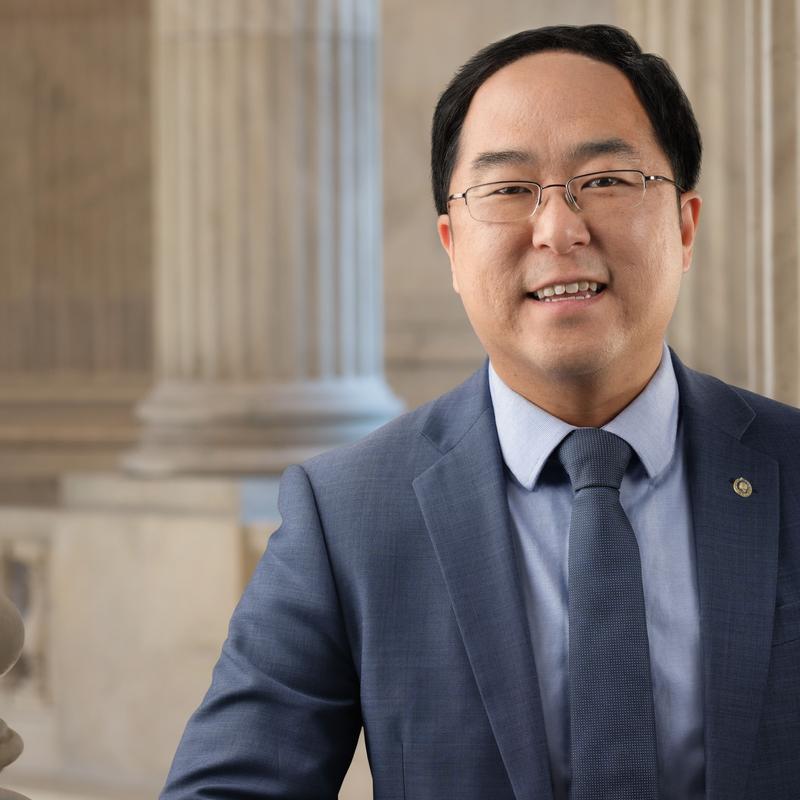
New Jersey Senator Andy Kim will join us shortly for a monthly Call Your Senator segment. He is just back from the Munich Security Conference. Foreign affairs is a key interest of Senator Kim's. He was on the Foreign Affairs Committee when he was in the House. To set this up, I want to play an extended excerpt from Secretary of State Marco Rubio's speech at the conference. You may have heard little sound bites and newscasts, but we can do extended excerpts here with the luxury of time on a two-hour show.
The Munich Security Conference includes the United States and what we used to casually call the US's allies in Europe. Now, of course, the extent of that alliance is more of a question than a given, and that's what Secretary Rubio addresses here. What you may find most interesting in this clip is how he tries to connect the United States and Europe through a kind of MAGA cultural heritage lens. This runs just over two minutes, and we'll talk to Senator Kim on the other side.
Secretary of State Marco Rubio: We in America have no interest in being polite and orderly caretakers of the West's managed decline. We do not seek to separate, but to revitalize an old friendship and renew the greatest civilization in human history. What we want is a reinvigorated alliance that recognizes that what has ailed our societies is not just a set of bad policies, but a malaise of hopelessness and complacency.
The alliance that we want is one that is not paralyzed into inaction by fear, fear of climate change, fear of war, fear of technology. Instead, we want an alliance that boldly races into the future, and the only fear we have is the fear of the shame of not leaving our nations prouder, stronger, and wealthier for our children. An alliance ready to defend our people, to safeguard our interests, and to preserve the freedom of action that allows us to shape our own destiny, not one that exists to operate a global welfare state and atone for the purported sins of past generations.
An alliance that does not allow its power to be outsourced, constrained, or subordinated to systems beyond its control, one that does not depend on others for the critical necessities of its national life, and one that does not maintain the polite pretense that our way of life is just one among many and that asks for permission before it acts. Above all, an alliance based on the recognition that we, the West, have inherited together. What we have inherited together is something that is unique and distinctive and irreplaceable, because this, after all, is the very foundation of the transatlantic bond.
Acting together in this way, we will not just help recover a sane foreign policy. It will restore to us a clearer sense of ourselves. It will restore a place in the world. In so doing, it will rebuke and deter the forces of civilizational erasure that today menace both America and Europe alike.
Brian Lehrer: "Civilization erasure," Secretary of State Marco Rubio at the Munich Security Conference. With us now is New Jersey Senator Andy Kim for his monthly Call Your Senator segment. My questions and yours for the Garden State's junior Democrat, of course, Cory Booker is the senior one, on Munich or anything else relevant to the work of the Senate. 212-433-WNYC, 212-433-9692, call or text. First priority to New Jersey constituents, but others may call. 212-433-9692, call or text.
Senator Kim, thanks for doing this as always. Welcome back to WNYC.
Senator Andy Kim: Good morning. Thanks for having me back.
Brian Lehrer: I'll get your reaction to that Rubio clip in a second, but why did you attend the Munich Security Conference?
Senator Andy Kim: I attended the Munich Security Conference because, right now, we are seeing American foreign policy turning its backs on our allies and our partners and causing so much damage for our own economic security. If people want to know why this is important, it's because our security, our strength, our ability to protect our families, it's integral when it comes to our foreign policy. I represent a state that lost hundreds on September 11th. We saw well over 2,000 people killed just in our region. It was the NATO alliance, it was our European partners that came to our defense and came to secure our nation, our region: New Jersey and New York.
We know this transatlantic alliance. We know its importance. We know it is something that makes us stronger. I've seen the Trump administration time and time again belittle this alliance, doing everything they can to be able to weaken it, and as you saw and heard in Marco Rubio's speech, continuing to disrespect our allies and just again, weakening our nation.
Brian Lehrer: Well, Vice President JD Vance, some of our listeners will remember, made big news at Munich last year when his speech directly admonished Europe's governments and mainstream society, I guess, for marginalizing the far-right parties there. This Rubio speech got a lot of press for being more friendly to Europe. I see that you've said the actual message may not have really been much different from Vance's. How did you hear it?
Senator Andy Kim: Look, everyone, including myself, is happy that JD Vance wasn't there. I think we all recognize that he is someone who has deeply insulted our allies and our partners. With Secretary Rubio's speech, I mean, this is someone who continues to talk about this in this Christian nationalist way and has-- The people that admired Rubio's speech in Europe were people in the far right, like Orbán and others, who are just continuing to push their societies in a direction that MAGA has done in the United States.
This was a speech that did not mention Russia once, did not talk about China, did not talk about the real threats, was just talking about this civilizational approach, said that we shouldn't be living on the fear of climate change, wants to just push us in a different direction, lecturing the people who came to our defense after September 11th. I lived and worked on a NATO military base in Afghanistan. I saw our partners and our allies coming to our defense.
The idea that Secretary of State Rubio would come and lecture our allies just weeks after Trump was threatening to use military force to take over Greenland, sovereign territory of a NATO ally of ours. Again, it was something that people there in the room, as I was as well, just very much pointed out the hypocrisy.
Brian Lehrer: One of the lines in the clip that we played was, "The alliance that we want is one that is not paralyzed into inaction by fear, fear of climate change, fear of war, fear of technology." It sounded like he then went on to be petrified of immigration. Did it sound like that to you?
Senator Andy Kim: Yes, absolutely. The number of times he talked about mass migration. Again, like for me, as someone whose family does not come from a heritage and lineage back to Europe, and I'm hearing my own Secretary of State talking about the connections between the United States and Europe. I understand and, of course, respect that lineage there, but that is not all of America. For Secretary of State Rubio to be bashing migration, to be talking as if we are not a nation of immigrants. Again, the New Jersey-New York region is one of the most diverse areas in the entire country. Huge percentage.
Over 20% of New Jerseyans were not born in the United States and are immigrants, including my parents, including my wife. These are important. For Rubio to just diminish that and talk about it in a way as if the migration and the immigration did not bolster the United States, it's a sense of strength, our strategic advantage globally, when so many nations are seeing their population numbers declining. We are continuing to benefit from being a magnet for global talent around the world. It was just really unsettling.
I'll tell you, in the meetings that I had with leaders from around the world, around Europe, one thing just became clear. They just said, "We can't wait for America anymore. We cannot wait for you to get your act together." It was really humiliating to just hear how much we have degraded in the eyes of other nations. Not only that we are degraded, other leaders literally told me that when they talk about America in their meetings, that they talk about us as a national security threat now. They talk about us as worry about what we might do, especially after the threats against Greenland and Denmark, the insulting of our allies.
This is all going to leave us weaker. It's going to weaken our economy, it's going to raise prices for us, and it's going to make us less secure with our families.
Brian Lehrer: What about the aspects of supremacy in that speech: European supremacy, cultural supremacy? He basically said it flat out, which could be heard as white supremacy when he referred to it in the clip as the greatest civilization in human history, and then later referred to an alliance that "does not maintain the polite pretense that our way of life is just one among many." Again, suggesting that the European or European heritage way of life is better than everybody else's.
Then, when he referred to deterring the forces of civilization erasure, considering the strength, political, economic, military strength of the US and Europe compared to almost anywhere else, to be placing that in the context of fear of civilization erasure. These are assertions of supremacy, aren't they?
Senator Andy Kim: Absolutely. We could feel it right in the room. I felt it very personally as well. Look, today is Lunar New Year. It's a great day of celebration. Happy Lunar New Year to everyone who is celebrating across our region and our country. It should be a reminder again that our diversity is supposed to be our strength, not supposed to be this source of fear such that the Secretary of State, I mean, literally our top diplomat for the rest of the world giving this kind of speech that is just turning our backs on so many of our allies and our partners in Asia, in Africa, elsewhere around the world.
It's the kind of hubris and arrogance that just turns so many people off. It's going to realize that you want to be a friend before you need a friend. As I said, we needed friends and allies after September 11th, and we will again in the future. We're going to now have to ask ourselves, is anyone going to answer the call? Is anyone going to be there for us when we need them? Because we were not there for them. I just think that that's something--
As someone myself, I worked in national security and diplomacy my entire career, well before Congress. I saw the importance of this abroad, and I feel it here at home as I got an 8-year-old and a 10-year-old. I don't want them growing up in an America that is despised and ridiculed by the rest of the world. I don't want them to grow up in an America where we face such real threats as we do with Russia, for instance. We have a Secretary of State that is too scared to even mention the name Russia because he knows that he has a president that admires Putin more than he does someone like Zelenskyy in Ukraine.
This is something where we just continue to see just how backwards things are. I hope people recognize this stuff matters. This isn't just a conference of world leaders; this is showing how America First under Trump means America alone. We will find ourselves more and more alone the more that we go down this path.
Brian Lehrer: Listener texts a very simple question. "Isn't Rubio a Latino immigrant?" Of course, his family, I'm not sure if he himself, you can remind me, or his parents, came from Cuba and saw the United States as a beacon of freedom and a place where many Cubans wanted to come from and have come from to this country. He's now upholding US values and civilization as he describes them, kind of in opposition to more people who we could say are like him coming to this country. How do you understand that?
Senator Andy Kim: Look, I'm not going to be able to get in the mind of Secretary Rubio. I believe in his speech, he actually talked about how his family dates back to royalty, I think, in Spain.
Brian Lehrer: In Spain, yes.
Senator Andy Kim: Look, I'm not going to go into that because I can't read his mind, but any secretary of state, regardless of their own lineage, should be able to recognize that they represent all of us, every single person in America. As a result, they can't pick and choose. His speech, Rubio's speech, was all about the past. It was all about the history. What about the future? What about the next 250 years of our nation? It is not going to look, nor should it look exactly like the last 250 years. We can respect our heritage, and I hope that they can respect it by not taking down plaques about slavery in Philadelphia and other things that we've experienced.
I wish that they would look at all of it, rather than just selectively pick and choose which cathedral they love in Europe and what church they love, and think about all the elements of our history and our shared ties, and then push that into the future and say this is the trajectory that we're on. I hope people, regardless of your political opinions, should recognize-- I hope you agree that Secretary of State Rubio represents, should represent all of us, not just the people that voted for Donald Trump, not just the MAGA movement that he is clearly just trying to win over.
This is something that, for me, again, as a career public servant who worked at the State Department, worked under multiple secretaries of state, worked under both Republican and Democratic administrations, I just felt embarrassed being in the room listening to that speech. Was it better than JD Vance? Of course, any speech would have been better than JD Vance. How low of a bar we now have set globally, where this is accepted and praised.
Brian Lehrer: A very different newsmaker at the conference with a very different take on Western values was New York Congresswoman Alexandria Ocasio-Cortez. Here's a clip of her from an interview on Friday in Munich responding to a question about her take on whether Trumpism is establishing a new post-rules-based international order.
Congresswoman Alexandria Ocasio-Cortez: Over the last five years, we've seen such a breaking and such a fraying of these alleged Western values that people wonder if it ever existed in the first place. I don't know if it's necessarily that we were in a post-- if we are in a post-rules-based order. I think it's possible that we were in a pre-rules-based order, and we have an opportunity to explore what a world would look like if we upheld democracy, human rights, trade that actually centers working-class people instead of accruing, overwhelmingly, the benefits of trade to the wealthiest. If we reoriented a new era that could actually help people and show how foreign policy and healthy foreign policy can show up and help them in their lives.
Brian Lehrer: AOC at Munich. Senator Kim, your reaction to that idea that, don't forget, not everything was so great, not everyone or everywhere in the United States was equally included before Trump came to power.
Senator Andy Kim: Yes, absolutely. Look, first of all, with the clip you just showed, it shows why it's important to have a diversity of voices from the United States at Munich, at other forums. I want to be able to show that, again, the Trump administration does not speak for all of us. It's important that that message is out there because it gets so caught up. Many of the leaders are just trying to navigate the next three years. I tell them, "Look, I will be a senator far long after Trump is no longer in the Oval Office." There are many people that want to turn it in a different direction.
No doubt, we had a lot of problems, both domestically and globally before Trump. I mean, you were paying tribute, as do I, to Reverend Jackson, who centered his life about lifting up those that didn't have a voice. It's so easy when you're in Munich at the security conference, or you're walking around the halls of Congress in D.C. We cannot have a politics that is just some exclusive club for the well off and the well connected. We need to make sure we are lifting up the voices of the millions that are struggling at a time when we have spiraling inequality.
Every day in America is the day with the greatest amount of inequality in our nation's history. Every day is just getting worse and worse. I don't want that on my watch. I don't want that to be the America that my kids grow up in. What Trump is doing is making things worse. We are seeing him reducing us down to transactionalism. Look what he's doing, not just to other countries, he's doing it right to our region. The same thing that he's doing to basically have extortion foreign policy with our allies in Europe and elsewhere, he's doing that to us with the Gateway Tunnel, trying to make us name Penn Station after him in order to be able to move forward with a project of national importance.
Again, I hit it home that this is not just about foreign policy. It's right back in our own backyard. It's affecting 1,000 construction jobs. It's affecting our commutes, our future. That is not the way. Whether it's about rules-based foreign policy or just obeying the Constitution of the United States here at home, that is something that should have no question. Unfortunately, we have a president that doesn't believe in it.
Brian Lehrer: What's the status of the Gateway Tunnel? I think I read that funding is back on.
Senator Andy Kim: Some of the funding moved forward. Do I know for certain that the next tranche of funds will absolutely happen? No, unfortunately, I cannot say that to you, Brian, because we need that assurance. We need to be able to make sure that this project goes forward. This is something that is funding-approved by Congress; it's necessary. I have Republican mayors joining me in town halls in New Jersey, saying this is not a partisan issue. We need to make sure that we're going to move forward with that type of urgency.
Look, were we able to get some of the funding released? Yes, but we're also seeing crazed tweets from Donald Trump about this continuing to be a problem. We're going to continue to fight. I believe the courts are on our side because the courts are on the side of the law.
Brian Lehrer: Another listener asks in a text, "Why would--" Now, there were so many texts coming in, and it already blanked off my screen. The gist was, why would Europe ever trust us again, even after the Trump administration, if a more friendly government comes into power because the US elected Trump twice? What would you say to that listener?
Senator Andy Kim: I would say that's unfortunately exactly what I heard from European leaders. There was a resolve amongst them after-- Every single one of them told me that the crisis with Greenland a couple weeks back was just-- it just broke through the threshold. The threat of military force against a NATO ally, it just was too much. I met with the prime minister of Denmark and the prime minister of Greenland while I was there, and just hearing from them, especially given how many soldiers they lost in Afghanistan on our defense of the United States.
They made it very clear to me that regardless of what happens with the 2028 election, even if it changes parties, there's going to be deep, deep concern about the United States for a long time. This is a cut deep to the bone, and things are fundamentally different. There is damage being done that is irreversible, not all of it, but there is some being done that's irreversible and is going to fundamentally change how the world engages with us. It's unfortunately pretty much just a stark reality. It's just, across the board, going to make us weaker and poorer. That's just a result of what is unfortunately unfolding before our eyes.
Brian Lehrer: We're going to go on to other topics after a break. More of your questions and mine for Senator Andy Kim, our monthly Call Your Senator segment with the New Jersey Democrat. Call or text 212-433-WNYC, 212-433-9692.
[MUSIC – Marden Hill: Hijack]
Brian Lehrer: Brian Lehrer on WNYC, as we have about 10 more minutes with New Jersey Senator Andy Kim, our monthly Call Your Senator segment. Peter in Greenpoint, you're on WNYC with Senator Kim. Hello, Peter.
Peter: Hey, Brian, thanks for taking my call. Listen, I'd like Senator Kim, I appreciate him very much, to just connect all the dots here for us, okay? Sure, they can stick white supremacist mouthpieces in front of European audiences and shock everyone, but they don't really care about that white supremacy angle so much. That's just to get the punters and the rubes and the suckers to vote for their program. What is their program? Oligarchy. Oligarchy needs destabilization. Volatility is great for billionaires, bad for the rest of us. We can't pay for eggs, but they love volatility.
Now, the destruction of NATO stability is the core, or one of them, of their destabilization regime. Now, NATO has poured wealth into America for the better part of 80 years. We have become very rich because of this relative stability over 70, 80 years.
Brian Lehrer: Peter, thank you very much. What do you think about his theory that all of this is really in pursuit of the financial interests of the oligarchs?
Senator Andy Kim: I was in the Capitol rotunda for Trump's inauguration, and he gave a line there, where he said, "This is going to set off a new golden age in America." 13 months into his presidency, what we see is that it's a golden age for the people that were up on stage with him. It was a golden age for the billionaires, a golden age for those that backed him. It's clearly a golden age for Trump's family, as they've made billions of dollars since last January 20th.
Brian Lehrer: Then why was the core of his electoral support working-class Americans?
Senator Andy Kim: Donald Trump is preying on our grievances. There are no doubts, huge problems. As I told you, the deep level of inequality that's out there and what Donald Trump has done so effectively is said the problems that you are facing, the reason why you can't give your family the kind of life that you deserve is because of these other people, whether that's about immigrants to this country, whether that's about the unfair trade practices with other countries, including our allies and our partners. You heard Marco Rubio say the same. It's about a fear of climate change.
In the same way that the EPA literally just rolled back this incredibly important measure called the endangerment finding, something that's going to hamper and significantly reduce our ability to fight climate change. This is just a green light to fossil fuel industries, a green light to the businesses and the business leaders that backed Donald Trump. It is reducing everything down to this level of reversal. One thing I didn't say before that was just so present in Munich was this isn't just about America's decline. It's playing right into our competitors and our adversaries.
No one loved Marco Rubio's speech more than Vladimir Putin. Didn't even get mentioned once. A Chinese leader was on the stage right after Marco Rubio and literally said to the rest of the world, "We are now the global power of consistency and reliability." He literally was talking about how if America is unreliable, we are the ones that will fill that gap. China was portraying themselves as a leader in fighting climate change at a time when our Secretary of State was saying we don't care about climate change, and in fact, the fear of it is holding us back.
It really is coming at our costs, and it's lifting up the countries that have been wanting to see the United States declining. We're doing their job for them. We're making Vladimir Putin, making him very happy in terms of how we're doing his job for him. Yes, I do think that when you look at who's benefiting from this, you can't help but see the billionaires, the biggest corporations, and others very, very happy of moving away from these efforts that they see as getting in the way of maximizing their profits.
Brian Lehrer: Mary in Fair Haven, New Jersey, you're on WNYC with Senator Kim. Hi, Mary.
Mary: Good morning, gentlemen. Senator Kim, I would appreciate it if you would address the SAVE Act. I think it's pending as opposed to passed. I definitely see it as yet again, another attempt by Mr. Trump to suppress the vote by making it extremely difficult for people to register who haven't already registered, et cetera, et cetera. There are a lot more points that one could make, but I know you're familiar with them, and I'd really appreciate if you'd address this because there's a lot of confusion out there.
Frankly, at age 83, having been widowed for many years, I don't even know where my birth certificate is, let alone could I match it up with my married name. By the way, I don't think I'm required to anyway, but that's part of the confusion. I'd really appreciate your clarification.
Brian Lehrer: Mary, thank you very much. Just for our listeners' context, and Senator, you can add to this description if you want, but very simply, the Republicans in that act, if it passes, want proof of citizenship to register to vote and government IDs to actually vote, correct?
Senator Andy Kim: Yes, that's right. In particular, the things that are just really alarming is if a married woman changed her last name to take her partner's name after marriage, that she would now have to bring a birth certificate with her original name to be able to register. Again, just making it so much more difficult. It should not be easier to be able to buy a gun in America than to vote in America. There are ways we can do this that are going to be secure, are going to be safe, and be able to engage in.
Look, I'm somebody that believes that if we want to make this easier and to engage, yes, we could do things like automatic voter registration and other things that actually are going to make it easier for us to be able to ensure who's voting and not. These are the kinds of problems that, again, prey into that sense of grievance that I was just talking about. Again, trying to create this specter as if there's mass fraud when it comes to our elections and trying to instill fear in people that that's the reason why they're not living the life that they want to live.
The SAVE Act is something that very much plays into that sense of fear of the other, that xenophobia that we're seeing build up. Rubio's speech was a part of-- That's all tied together. You got to connect those different dots from all these different things that we're seeing.
Brian Lehrer: Even though the government's own statistics show that voter fraud is vanishingly rare, certainly not enough to change elections at the presidential level or statewide Senate elections, or almost any elections, the polls show that a lot of Americans think that a government ID to vote, which is different than that birth certificate requirement for a married woman you were talking about before and the caller was talking about, but a government ID when you show up at the polls or send in your ballot is common sense. What do you say to them?
Senator Andy Kim: Look, what I would say is, first of all, we make it difficult. Are we going to now require, as mentioned, if we need to be able to validate our citizenship? We know a huge portion of Americans don't have passports. Our driver's license don't have our citizenship on them. A REAL ID is not considered to be a valid ID for the purposes of the SAVE Act. What, are we going to make passports free? Are we going to make them available to everybody? Like, what is the mechanism by which we can do this in a way where we don't basically institute some new poll tax where people have to go and pay money to get a new ID to make sure that we can do this in a way that doesn't disenfranchise people?
That's the mechanism of this that we need to be thinking about is like, how do we ensure that, again, everybody has the most fundamental rights? This is right at the top of the most fundamental rights of our democracy. I just haven't seen how we can ensure it. What we see in particular is that this is not done in good faith. This piece of legislation and others that I saw, they're designed in ways that are specifically trying to fundamentally change the electorate, and it's used for a political tactic. We should not shy away from pointing that out.
Brian Lehrer: Did you just say that the REAL ID, that kind of modern driver's license that you need now to get on an airplane, even that would not be good enough for voter ID under this bill?
Senator Andy Kim: Will not be good enough for registering to vote. That's right. It does not list out your citizenship.
Brian Lehrer: I want to ask you one more thing about the fear that they're trying to suppress the vote in the midterms. I know we're at the end of our scheduled time. Do you have two more minutes? If not, I'll respect that.
Senator Andy Kim: Happy to.
Brian Lehrer: This is a clip of Homeland Security Secretary Kristi Noem, very controversial in recent days for describing a role for Homeland Security in the midterm elections and how she put that here. Listen.
Homeland Security Secretary Kristi Noem: Elections is another one of those critical infrastructure responsibilities that I have as well. I would say that many people believe that it may be one of the most important things that we need to make sure we trust is reliable and that when it gets to election day, that we've been proactive to make sure that we have the right people voting, electing the right leaders to lead this country through the days that we have, knowing that people can trust it.
Brian Lehrer: "Making sure we have the right people voting, electing the right leaders." That sounds to a lot of people like election rigging. She clarified later that all she meant was make sure people registered to vote in voting have done so legally. Do you accept that?
Senator Andy Kim: Look, I will say, when you say electing the right leaders, that, of course, is absolutely wrong. There is no determination that Homeland Security or government should be playing that way, should be protecting our election for everybody, and should be there for the American people. Only the American people can choose their leaders. Kristi Noem has demonstrated over and over again just a deep incompetence, just an inability not only to do the job, but just weaponizing the job against the American people. I'll continue to call for her to step aside or be removed.
Again, it's not just her. We see Pam Bondi doing this at the Department of Justice. We see Kash Patel talking about this kind of stuff at the FBI. We see just across the board, even-- The reason why is even if these secretaries and these leaders like Noem and Bondi are removed, they'll just be replaced by someone who will just continue to do Donald Trump's bidding, because it was Donald Trump himself that is setting the tone for this. Him and Stephen Miller are pushing this dangerous agenda across our nation. Donald Trump himself has talked about federalizing our elections, which just inherently goes against our Constitution.
Donald Trump himself is trying to continue to spread the lies about the 2020 election and other things that he's doing to discredit our democracy. I will continue to condemn cabinet officials like Noem and others. We have to continue to remember that this all comes back to Donald Trump. That's what the voters need to keep in mind when they're going to the midterm elections later this year.
Brian Lehrer: In the context of Kristi Noem and you as a member of the Senate, last thing, there is still a stalemate in the Senate, as you know, over Homeland Security funding, because Democrats want rules, changes to how ICE operates in the US. No masks, wear body cameras, things like that. How do you see this resolving?
Senator Andy Kim: Look, it's not just the Democrats that are demanding this; the American people are demanding this. We can't have ICE standing in Jersey City saying that they don't need to have warrants at your home. We don't need ICE to be there at Delaney Hall holding people there in conditions that I saw with my own eyes that are not humane. We cannot have ICE trying to take warehouses in Roxbury and across New Jersey and across this country to basically set up these inhumane detention facilities to continue to promote what we see as just lawless actions against the American people.
When I had the chance to be able to question the ICE director in a hearing last week, I asked him, "As you're pulling down the surge from Minnesota, can you promise you're not going to surge somewhere else, that this isn't going to just move to another state like New Jersey or elsewhere?" He refused to do that. He refused to say that they won't be using this tactic that so clearly was about occupation, occupation, federal occupation of an American state and an American city.
Yes, we have to stand up against this. I'm not going to fund any of this and be complicit in any of this. If we're going to have anything move forward, it needs to be about reasserting law and order, reasserting the Constitution, and reasserting protections for American people at a time when they are terrified of hearing from people in New Jersey now feeling like they have to carry their passports around for fear that they're going to get stopped on the streets. That's not the America, that's not the community that I want to raise my kids in.
Brian Lehrer: That's our Call Your Senator segment with New Jersey Senator Andy Kim for February. Thanks a lot, Senator Kim. Talk to you in March.
Senator Andy Kim: Thank you.
Brian Lehrer: Brian Lehrer on WNYC. Up next, doctor and New Yorker staff writer Dhruv Khullar on GLP-1s and addiction. Stay with us.
Copyright © 2026 New York Public Radio. All rights reserved. Visit our website terms of use at www.wnyc.org for further information.
New York Public Radio transcripts are created on a rush deadline, often by contractors. This text may not be in its final form and may be updated or revised in the future. Accuracy and availability may vary. The authoritative record of New York Public Radio’s programming is the audio record.