
Bad Bunny Bowl
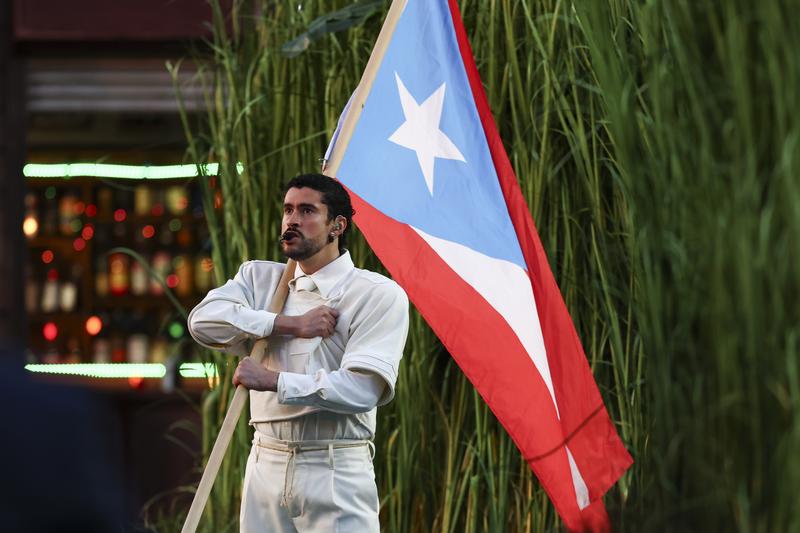
( Kevin Sabitus / Getty Images )
Brian Lehrer: Brian Lehrer on WNYC. Did you watch the Bad Bunny show, I mean, the Super Bowl last night?
[music]
Bad Bunny: God bless America; sea Chile, Argentina, Uruguay, Paraguay, Bolivia, Peru, Ecuador, Brazil, Colombia, Venezuela--
Brian Lehrer: God bless America. Every country in America in that stretch of Bad Bunny's performance, just about every country. It is Super Bowl hangover Monday. Seattle Seahawks 29, New England Patriots 13. Congratulations, Seahawks fans. For many of New York, I know anybody but the Patriots, yay. As usual, at least as often, the bigger story might be everything around the game. The commercials that tried to sell us comfort, distraction, and AI, the halftime show that did become kind of a cultural Rorschach test, and the political counter-programming that seemed determined to turn a football Sunday into a culture war rally.
You heard the Turning Point USA, Charlie Kirk's group had an alternative halftime show with Kid Rock. Then we wanted to watch Bad Bunny and make your own choices or make your own judgments, but of course he headlined. The reaction before and after tells us a lot about where the country is right now.
Whether it's about the crypto commercials, gambling, or during the Super Bowl, which they made a point of saying at the beginning, you could do all through the game in one of the ads, AI. GLP-1 weight loss drugs, making you concerned if your pee is yellow. Wait, isn't everybody's pee yellow? That was in one of the commercials. With us now is Slate staff writer on culture, Nadira Goffe. Nadira, welcome back to WNYC. Hello.
Nadira Goffe: Hey, thanks for having me.
Brian Lehrer: You want to start on your take on Bad Bunny and what it meant?
Nadira Gooffe: Yes, absolutely. Bad Bunny, Puerto Rican singer and rapper, one of, if not the current most popular artist globally, was announced as a headliner for the halftime show, and right away, the decision was sort of political or taken as political. This is an artist who was in the middle of a tour during which he strategically bypassed all 50 US states for fear that ICE would target his concert goers and instead opted for a Puerto Rican 31-show residency.
He, the weekend prior to the Super Bowl, won a Grammy and said ICE out. He won multiple Grammys, but during one of the speeches, he said ICE out and gave a really passionate speech advocating for immigrants. Trump decried this choice right away. He would be the first solo headlining halftime performer to perform entirely in Spanish.
Everyone was wondering how would he go about it. Would he adopt a Kendrick Lamar-style, very pointed political message like the singer or rapper did the year before, or would he lean more into the joy and the celebration? Or would he do a mixture of both? Would he have subtitles, would he not? It turns out that he leaned in on Joy. He didn't have subtitles. Mostly because, as I read it, even though I am Caribbean and so some of the references were particularly legible to me. As I read it, the message wasn't necessarily about understanding the words he was saying, but more so in understanding the vibe or the overall ethos of his performance, which is joy is resistance and joy under the threat of persecution is a revolutionary act. Creating a record of history of what's happening to the place that you're from is also a political statement.
Brian Lehrer: Justin in Union County, you're on WNYC. Hi, Justin.
Justin: Hi, Brian. Longtime listener, first-time caller. Just surprised at how emotional the show made me last night. He did a great job, and I'm overcome with joy and pride today, and a new sense of hope that we didn't have yesterday before the show. Really, really refreshing and really glad to see it.
Brian Lehrer: Justin, thank you very much. Why Nadira, do you think in the first place, the NFL, which you know, to a lot of people, they basically blacklisted Colin Kaepernick not that long ago for taking a knee to protest police brutality. Why did they book a artist who was going to sing in Spanish?
Nadira Goffe: Great question. I don't know that the NFL did in so much as Jay Z, famous rapper husband to Beyonce, did. Jay Z has been partnered with the NFL and commandeering or overseeing the halftime show performance as a cultural event for the past few years. Ever since that switch, we've had more diverse performers. Kendrick Lamar's performance was very anti the state of America.
Also, over the years, that show, that platform hasn't been without its political moments or without statements. I definitely credit a lot of the more diverse performance that the show has seen over recent years to Jay Z and to the things that he's doing in partnership with the NFL, which is a controversial partnership, but it is what it is. It gives us moments like now, the most-watched Super Bowl halftime show of all time.
Brian Lehrer: John in Monmouth County has an ad that he didn't like during one of the breaks. Hi, John.
John: Hey, Brian. Long time, multi-time. The ad about the Ring doorbells being used to find lost dog in the neighborhood. It's all nice and warm and fuzzy. I thought about it, and it scared me a lot because I thought, well, what's next? They send out an alert saying, "There's an undocumented person running through your neighborhood." Of course, in their words, it would be dangerous, criminal, whatever. It just scared me. I don't have a Ring camera. I don't know the mechanics of how those things work, but it felt like that could be where we're going.
Brian Lehrer: Sounded like surveillance to you. Nora in Sleepy Hollow, you're on WNYC. Hi, Nora.
Nora: Hi. I'm trying to take you off-peak. Can you hear me?
Brian Lehrer: Yes, you're on. You're good?
Nora: Okay. I'm trying to say this exactly the right way because it's the only way it's going to get heard. I'm a singer. I sing a lot of century-old songs. I sing more modern songs, too. I haven't really heard my way into the music, and I wish there were subtitles because I just wanted to know what he was saying. I should speak Spanish. I have Nicaraguans in my family, but they speak English, so I haven't had to learn.
I've seen this guy interviewed. I was very impressed by him. I was impressed by him at the Grammys. I think he's genuine, but the women in the show, in the presentation, the way they were dressed, so hypersexualized, the dances they were doing. Some of the men were doing similar dances, but they weren't dressed like that. It just feels to me like so often in progressive statements with progressive people, the thing that's hidden in plain sight, but either we're not allowed to talk about it or nobody even recognizes there's something to talk about, is we can't get past this representation of women in a way that, if it were men, would make people cringe.
Brian Lehrer: Nora, thank you. Nadira, did you have any of the same feelings?
Nadira Goffe: No, though I don't think that that detracts from other people who do have similar feelings. As someone who is of Caribbean descent, me and my family members dress like that, we dance like that. It's a part of the culture, particularly of the reggaeton culture, that Bad Bunny is pointing out in those moments, in that particular type of music and that particular type of dancing.
Also, just as a counterpoint to that. One of my favorite moments of the entire show was at the very end when he's calling out very beautifully, and emotionally, and powerfully all of the different countries of the Americas. There you see women who are wearing all white. They're wearing long white skirts and white tops, which to me seemed like some Call to Santeria, which also has a basis in my family. I have family members who practice.
There were all sorts of representations of women I found on that stage, I guess, is what I'm trying to say. I can understand why, if you're not necessarily as familiar with the reggaeton scene or anything like that, that it would feel a little out of place.
Brian Lehrer: On a commercial, a listener writes, "I am a millennial, and the Backstreet Boys karaoke commercial for Coinbase was the pinnacle of a dystopian experience. My friends and I sang along to Backstreet's Back, but we were suspicious. Then it hit us, bam, Coinbase, and we longed for a simpler time." You're laughing.
Nadira Goffe: [chuckles] Yes, I hated that ad. I think it was genius because it got everyone. I think it was clever in that it was sneaky and it really profited off of nostalgia, which I think sells almost as much as sex these days. It was sneaky, and I don't want to be peddled crypto because I yearn for an era of boy bands or whatever, but it isn't the most nefarious ad that was shown that night. I agree with the other earlier caller about the Ring camera ad. There was a Mike Tyson realfood.gov ad that I thought was particularly nefarious and nasty, and lots of bad ads, no good ads. [chuckles]
Brian Lehrer: Another Bad Bunny clip for another 12 seconds of music.
[MUSIC - Bad Bunny: INoLVIDABLE]
Y yo he tenido muchas novias
Pero como tú ninguna
Ya no tengo mi sol, me paso en la luna
Si te pienso, me tiro de una, eh-eh
Brian Lehrer: John in Sunnyside might have liked hearing that again. Hi, John, you're on WNYC.
John: Hi, everybody. I felt it was like you're walking around the neighborhood, and you stumble into a block party, and you're warmly welcomed and asked to join. Next thing you know, you're having some ribs and drinking a beer. It was great.
Brian Lehrer: [chuckles] Thank you. The set, building all of that with the tropical vegetation and everything else in the middle of the football field. Amazing that they were able to do that in the break between the game and the show.
Nadira Goffe: Yes. An ode to plantation labor in Caribbean history with the sugarcane fields. There was an entire mini house party or porch, a facade of a convenience store or marketa that even had a "We Accept EBT" sign. The attention to detail was really, truly astounding. Certainly one of the most intricate sets I've ever seen on a halftime show performance.
Brian Lehrer: As we run out of time, we had the one caller who said he got more hope for the future just from watching that halftime show. Do you think this builds toward anything else, or was this just a good, fun, but meaningful statement in the middle of a football game television show?
Nadira Goffe: It's a really good question. I don't necessarily know how many minds it will turn for people who were dead set against it, especially since there was another Turning Point USA show that they could have watched. I do think for people who were maybe unfamiliar with Caribbean or Latin culture, I think it was a really beautiful welcoming and a really beautiful showcase. I think it really broke down barriers of what artists like Bad Bunny stand for, which isn't us versus you, but this idea of a more united America that includes all of us, even Canada. [chuckles]
Brian Lehrer: By the way, just as an afterthought, I thought it was an enjoyable game.
Nadira Goffe: Did you?
Brian Lehrer: It was this defensive struggle where you didn't know for a while if no touchdowns might be scored. Then Seattle, as people predicted, blew them out. Anyway, thanks for talking about the Super Bowl. Nadira Goffe, Slate staff writer on culture, bye.
Nadira Goffe: Bye.
Copyright © 2026 New York Public Radio. All rights reserved. Visit our website terms of use at www.wnyc.org for further information.
New York Public Radio transcripts are created on a rush deadline, often by contractors. This text may not be in its final form and may be updated or revised in the future. Accuracy and availability may vary. The authoritative record of New York Public Radio’s programming is the audio record.
