
Artists Fight to Save An Upper West Side Church From The Wrecking Ball
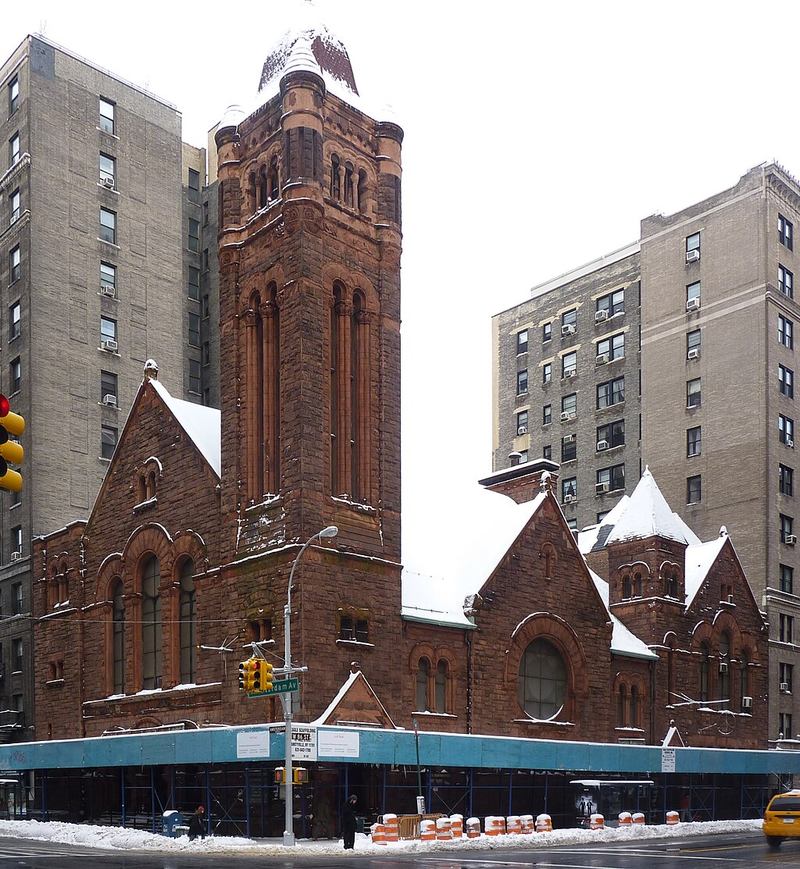
( James Russiello at English Wikipedia, CC BY-SA 3.0 <https://creativecommons.org/licenses/by-sa/3.0>, via / Wikimedia Commons )
Brigid: It's The Brian Lehrer Show on WNYC. Good morning again, everyone. I'm Brigid Bergin, senior reporter in the WNYC and Gothamist newsroom, sitting in for Brian today. Now we're turning to a building on the Upper West Side. On the corner of 86th Street in Amsterdam, there's a church that's over 130 years old that's at the risk of being demolished, and many people are trying to save it from the wrecking ball.
For context, the West Park Presbyterian Church was designated as a landmark in 2010, which means that it's protected by the city from demolition because of its historic significance. In order to tear it down and to sell the land to a developer, which is the church's goal, the city's Landmarks Preservation Commission needs to approve what's called a hardship application. That's more or less what it sounds like.
The church is saying to the commission, "Listen, we can't afford to run this place anymore. The building has fallen into disrepair where we are not able to fix it. Please take away this landmark designation so we can offload the land." The church has already made plans to sell to a developer who intends to build luxury high rises with a carve-out for a small theater in the basement and a small social justice fund, which would mostly go to supporting other churches across the city.
There's been a big swell of support in the community to save the crumbling building from being demolished because it has, for decades, served as an affordable arts and community center. There are a number of high-profile celebrities who have joined the fight to preserve the building, including my guest, Mark Ruffalo, who is well known for his activism on a range of issues. We're also joined by Peg Breen, the president of the Landmark Conservancy, who's been another leader in the fight to protect the church and keep it an affordable arts center. Mark, Peg, welcome to WNYC. Thanks so much for joining me.
Peg: Our pleasure. Thank you.
Mark: Thanks for having us.
Brigid: Mark, I want to first ask you about your relationship to the building. It's been an affordable arts and performance space for decades. This is your neighborhood. Can you tell me what the building has meant to you and to the community as a whole?
Mark: First of all, it's one of the last Romanesque pieces of architecture left in New York City. It really is beautiful in and of itself. When you go inside of it, there's something so special about it. It has an age and a culture to it and beauty and its woodwork and the stained glass windows and high arching ceilings that we just don't see much of left in New York City. For me, just personally, it's this performance arts space. It's a worship space. It's a civil rights space.
It has this incredible history, and God's love we deliver started there. The anti-nukes movement in New York City started there. The first gay marriage was done there. Joseph Papp started basically the public theater out of there. It just had this incredible long line of social justice, worship, and performance, and it's still serving all those things. For me, as a young artist in New York City, it was essential for us to work it out, to figure out what we were doing, to nurture our talent.
By the way, it's affordable. It's the last affordable space in New York City at $10 an hour for a rehearsal space, when everywhere else in New York City is $100 an hour. It's really a significant thing, and these spaces are gone. 25% of art organizations have lost their physical space during the pandemic, and nearly 50 theaters, since 2020, spaces like this have closed down.
Brigid: Peg, I'm wondering if you can get into some of the nitty-gritty of the details here in terms of what the Landmarks Preservation Commission is currently weighing. I mentioned this hardship exemption, which would allow them to sell the land. I know there was a hearing last month where a lot of people testified about how important the space is as a community center, as Mark was just laying out there. I also read that the counsel for the commission explicitly said that the testimony about the good work of the church is "not relevant to the commission's ultimate resolution on this matter." Can you explain what qualifies as a hardship exemption and what factors are relevant to their decision?
Peg: Sure. There are four things that the church or the Presbytery has to prove to do hardship. Two of them we, in a sense, give them. They have a contract to sell the building, presumably based on whether they get hardship, and the developer is ready to move on a project. Fine. They also have to show that to make improvements on the building that are necessary, they could never get a 6% rate of return on the investment.
They're claiming $50 million to repair the building, but they're talking about inside, outside, I'm not quite sure what else, and you never do anything like that. It's an exaggerated amount. It's an exaggerated project. We deal with construction projects all the time. You phase them in. Every independent engineer that looked at this building says it's going to cost much less than they say it will to fix the exterior. The Landmarks Commission, a couple of years ago, hired an independent engineer who put the price tag to do what was necessary to cure the building violations and take the sidewalk bridge down at $6 to $9 million, which would easily provide them with a 6% rate of return if they were renting it on that basis.
The other issue is, can this church still serve its original purpose? It's been a home for congregations, and an African-American congregation has been worshiping there on Sundays for years, until they were tossed out when the Presbytery threw out all the tenants in there. Their attorney, the Presbytery's attorney, is trying to make a new argument that it can't be used simply because it would cost too much to fix it. They've inflated the cost. Even after they threw out the tenants, they had their own events there until they realized that that was probably undermining their argument. We think that they have not proved hardship, and that is what the Commission has to look at.
Brigid: Before I've even asked our listeners to participate in this conversation, I have a whole bunch of people who have called in. For those of you who have not and who are just joining this conversation, we're talking about the future of a church on the Upper West Side and the conflict over whether it should be maintained as an affordable arts space or whether the land should be sold and developed. I see, Peg, you want to add something?
Peg: I was going to say, the Landmarks Conservancy has been involved in this church since 2001, when Councilmember Gale Brewer and the neighbors first started talking about raising money for the building. We wanted to put them on the National Register of Historic Places, which would give them our grants, we have grants for landmark religious institutions, and make them eligible for other grants that were available at that time. They refused to let us do that. The fastest-growing Presbyterian congregation in the city was renting space in other buildings. They wanted to rent space there. They turned them down.
They have turned down money from the center, who recently had enough money to fix the building violations and take down the sidewalk bridge. City of Yes, which passed a couple of years ago now, allows individual landmarks to sell air rights in a wider space. They said, no, it's too impossible for them. We hired a zoning expert who came up with ample spaces where they could sell air rights and felt that they were making too much of an argument that they couldn't. They have not helped themselves.
Brigid: Listeners, we're having this conversation, and we want you to be a part of it, particularly listeners who are in this neighborhood. Do you have an opinion on what should happen to this building? Are you conflicted? Do you think more housing is always good, no matter the cost? Maybe you're seeing a similar fight play out in your neighborhood and want to share a little bit about that and how that connects to this one. You can call or text the numbers 212-433-9692, that's 212-433-WNYC. Let's start with Jim on the Upper West Side. Jim, you're on WNYC.
Jim: Hi. Thanks for taking my call. I'd like to support what Pam Breen said, that this is a self-inflicted hardship. They have created the hardship. They shouldn't get the benefit for creating the hardship. My experience with The Center at West Park is that I helped produce a play on the life of Shirley Chisholm. The play brought in students from, I think, five different schools in Harlem, 300 students during the daytime for a production that they had to pay nothing for, that in the end let them experience the life of Shirley Chisholm and give them the belief that they too could become somebody special.
In the end, this is the sort of thing that would be lost if this building were torn down. I think that it's a real shame that they're even considering it. The reality is, when you get down to the technical side of it and the laws associated with it, this is a self-inflicted hardship. Do not reward the Presbytery for creating their own hardship. Thank you.
Brigid: Jim, thank you so much for that call. Jim, someone who's very much in favor of maintaining the church as it is, let's go to Sonia on the Upper West Side, who has a different perspective.
Sonia: Good morning. I'm Protestant. We own and manage our own church. These few members who are left in the church have lost ownership and control of their own building to actors, people who have never attended services or helped their congregation, but are emotionally deciding their future. I also feel it's just being forged as a, I don't know, correct word, a false argument. The congregants want to sell their building to a builder who will build a new sanctuary, affordable and going rate apartments, as well as a performance space.
There are other performance spaces in our neighborhood right here on 86th and West End Avenue, a church with movable pews creating huge performance spaces, Mark, that are very reasonably priced. I have a question for you. Do you support the Forestburgh Theater near you in Sullivan County? I don't know why you've latched onto this. It's an ugly space, ugly scaffolding that's dirty, and homeless stay there.
Brigid: Sonia, thank you. A very different perspective from Sonia. We're having a little bit of a technical issue in the studio for Peg, so Mark, I'm going to toss it to you to respond because I think you heard part of what you said there. I'll recap because I know we were having some issue with headphones. We had Jim from the Upper West Side, who called in and talked about some of the work that he has seen done in the theater, including in a production that involved retelling the life of Shirley Chisholm.
Then we had Sonia from the Upper West Side, who is very much opposed to maintaining this space, says that it should be the right of the congregants to sell it, and then, in particular, is challenging the notion why this space versus some other local theater spaces that have also faced hardship. In that brief recap, Mark, if you want to respond to it.
Mark: Listen, I'm all for more and more performance art spaces. This is a billion-dollar industry here in the city. Like I said earlier, nearly 50 theaters and cultural venues have been lost in the city since 2020. I'm with Sonia about that, and I'm saying yes, and why tear this place down when it can actually thrive? The Center was making $1.7 million a year. Just because the Presbytery wasn't able to manage the business aspect of it doesn't mean it can't be done. The Center proved that it could be done. They offered them $36,000 a month rent, which was 10 times what anyone was paying there before.
The fact of the matter is this can be saved, but also it's a question of landmarks. What is landmarks for if it's not for saving these kinds of spaces? That's really what's at stake here. Who does New York City belong to? Does it belong to the people who will buy a $5- and $10- and $20-million apartments in a building and tear down what is essentially this incredibly thriving public space? Do we need another? Shouldn't we be saving these spaces instead of tearing it down when it can be viable?
Peg: Could I just add that they would greatly reduce the space? They're saying that they're going to have an auditorium in the basement, but it's like 143 seats versus several [crosstalk].
Mark: 143 seats versus 600 seats. We have 7 performance arts spaces in the church right now where people can do $10-an-hour rehearsals. We need those spaces.
Brigid: We actually have a caller who used to work at the Center who's on the line. Let's go to Bailey in Brooklyn. Bailey, thanks for calling WNYC.
Bailey: Hi. Thanks. It's so good to be talking. I used to work at Center at West Park, and it was such an honor and a privilege. I get to work with them as an artist now occasionally. I have a theater company that supports queer and non-binary and trans emerging artists, and for a space to give us rehearsal space funding to uplift our voices in a time where it's very hard as an emerging artist, as a queer person in the world, actively helping us, I cannot stress how important Center at West Park is to my development, to the development of emerging artists all throughout New York City.
Brigid: Bailey, thank you so much for calling. We appreciate that. Let's go to Jesse on the Upper West Side. Jesse, you're on WNYC.
Jesse: Thanks. I'm listening to the conversation, and I think something is getting lost here. Most people on the Upper West Side really enjoy theater, really enjoy landmark buildings, but we also need cheaper rent. The reason why rents are so high is because we have a housing crisis. There's just not enough housing being built. I totally get that the housing the developer wants to build here is going to be luxury. I take that for granted, but the reality is that more inventory, more supply, is going to bring down prices eventually.
We can have a conversation about who New York belongs to, the theater, landmarks, but the reality is that the number one priority of the city right now needs to be to build more housing everywhere. If this spot allows us to do that, we should do it. I also like the fact that there will be theater space there, and so we're not losing the theater space. We are losing the church that is literally falling down anyway. [crosstalk]
Brigid: Jesse, thanks for your call. Too, again, trying to keep the perspectives coming in fast and furious and a little bit balanced. Let's get some response from Peg.
Peg: The church is not falling down and can be fixed and maintained, but also you can build housing in this city without destroying landmark buildings. In fact, courts have ruled that you're not guaranteed the most money you can get for selling a property if you do get through hardship. One more luxury apartment building on the Upper West Side is not going to solve the problem. This is coming at the same time that both a mayor and a governor who say housing is their number one priority each have plans to help nonprofit theaters get spaces. It's also a very important issue for the city and the state.
Mark: And the mayor.
Brigid: Let's talk about the elected officials and their role in this. You mentioned the council member, Gale Brewer, and some of the work she has done on behalf of this organization in the past. As you mentioned, Governor Hochul announced a plan just this morning to provide funding for nonprofit performance arts organizations in the city. Mayor Mamdani has made two announcements at least along with small arts organizations and has expressed similar support for investing in affordable arts spaces and really just making art in the city accessible, something that is not only for those who can afford often the very expensive tickets to go along with it. Mark, how do you see some of those initiatives affecting West Park Presbyterian in particular?
Mark: I was at a fundraiser for the mayor's inauguration, and his speech was all about how we need to make performance arts spaces affordable for artists here. He just gave 1,500 tickets away for free. This is a man who really does what he says he's going to do and believes in what he's saying. I see this is perfectly in line with what Hochul and Mayor Mamdani are looking to do here. Affordability also has to do with people who work here, and the arts is one of the biggest economic drivers. It certainly is employing the most people in this city.
By the way, the study for Center for an Urban Future is saying that artists are leaving the city. We're the only major city in the United States where the artists are actually leaving. That's because there's no affordability, not just in housing but also in places and spaces where we do our art. This is in line with the mayor's priorities, in line with Governor Hochul's priorities, and we are proving that it can be done.
Brigid: Peg, I know you don't have a crystal ball, but I want to ask you about what would happen if you do win this fight. People like you who are championing the space don't actually own the building. The church does, and the church would, of course, prefer to take the payout, as we've been talking about. Can you tell me about the relationship between the preservation advocates and the church leadership, and how you would hope to proceed if ultimately you win this fight? They're not obligated to keep the space running as an art center, but do you think they're open to it?
Peg: I think it might be difficult, but I think that there is a way to talk to them. You're correct that even if we win hardship, the Landmarks Commission can't say, "You must keep The Center for West Park." The preservation groups would be trying to save this building no matter what was in there, as a matter of fact, because it's one of the most beautiful buildings in the city. I think the Presbytery has to look at its own finances, too, and there will be offers. There will be offers from nonprofits or cultural groups to use this building.
Given the great history of the Presbyterian activity on that site and in this area, everybody else is trying to honor it, and we hope that counts for something. We understand how difficult it is. They've got a lot of churches, congregations are shrinking in all denominations, and we understand that. Trust me, if the Center for West Park made this offer to almost any other congregation that we deal with, they'd take it in a second.
Brigid: Let's go to Brian in Queens. Brian, you're on WNYC.
Michael: Hey, thanks. It's Michael, but I appreciate having the opportunity to come on. I love the show. I just want to make a few just premises. I think we all agree on the following, which is that there's an affordability crisis in the city, and the lack of housing contributes greatly to that. I think we could also all agree that increasing housing supply is obviously going to bring down the prices. That's just basic supply and demand economics. Then the last premise is that any time we approve any sort of development, it's a trade-off of some sort. We're giving up on something to approve a development.
Now, folks in Queens and other outer boroughs are asked to make that trade-off all the time in order to bring prices down and create a more affordable city. We have a lot of momentum going with the election of Mamdani, and it just feels like any time anyone on the Upper West Side, Upper East Side, or any of the more affluent areas is asked to accept a similar trade-off, there's always an excuse. This just feels like a lot of Mark Ruffalo's other activism, which is just elitist-based and just not focused on the regular person in the city. I'll take the answer offline. Thank you.
Brigid: All right. We got a little dig there against you, Mark. I do have another caller who has got a different perspective, but I want to give Mark a chance to respond, particularly because the caller called you out by name. The trade-offs that some people who are maybe further away from this neighborhood are looking at. This particular caller was from Queens. Any response to that caller?
Mark: There's so many empty spaces in New York and around the city that can be developed. We don't have to sacrifice landmarks for this. It's just a false equivalency. Yes, let's build affordable housing, but this isn't going to be affordable. To say, oh, because there's going to be 20 more $5 million to $10 million apartments on the Upper West Side, somehow, miraculously, his rent is going to come down, it just isn't the way it is. This city is predatory. The real estate is predatory in this city. Rents can be cheaper here. I saw them raising my neighbor's rents 50% during COVID to get those people out of their apartments. There is other things that we can also do to help people.
Brigid: Peg, I know you're eager. I want to read one text before you jump in. A listener writes, "I work in preservation architecture. There is no way the price tag is correct for a single building. Replacing one historic building with apartments is not going to solve the affordability crisis. Who wants to live in New York City devoid of its architectural character and art spaces? Not me. There are so many other places to build. This is a money grab." With that listener texting, Peg, how do you want to respond?
Peg: First of all, there has been an enormous development in this city in recent years. There are parts of Brooklyn and Queens that are barely recognizable from what they were once. Prices haven't come down. There is no guarantee that how much you build is going to lower the prices. I think Jacqueline Kennedy Onassis said it best. Years ago, when she was trying to save Grand Central, she was worried then about would New York just turn into a city of glass boxes. She said if there's nothing left of the city's history and beauty to inspire our children about the past, where are they going to get the courage to fight for her future? This is a fight for the future of New York, and saving this building is a part of that.
Brigid: Peg, in terms of the timeline we're talking about here, when does the commission have to make its final decision?
Peg: It's not like you've got 30 days to make a decision or whatever. There's no time frame, and it's not listed in the next couple of meetings that they're having. This is a big issue, so we don't know when they're going to resolve it. Hopefully, in the next month or two.
Brigid: As I mentioned, before I even asked for people to call in, our lines completely filled up. They are still completely filled up. Out of respect for our listeners, I want to bring in one more caller who I think has a personal story. Let's go to Anwar on the Upper West Side. Anwar, you're on WNYC.
Anwar: Good morning. I'm a playwright, or at least I decided to become a playwright. I went around Manhattan, and everybody wanted my arm and a leg. By chance, I stopped at the church on 86th Street in Amsterdam, knocked on the door, and Debby Hirshman listened to me. I said, "I have this play, but I don't have the big bucks." She asked me a few questions, and next thing I knew, my play was booked. I had 4 nights, 400 attendants fully attended. It gave me the courage, and now I'm ready to stage my second play.
I am speaking from a selfish point of view that I live on the Upper West Side. I know a lot of people on the Upper West Side. This church was accessible to all the people that I knew and that came to the play. It's a beautiful church. I'm not going to go into that. There's been many hearings on how beautiful and how important it is.
I can also tell you that I studied in Europe, veterinary medicine, and there are fabulous churches there. When you walk by them, you feel something of history. Where I live on the Upper West Side, when you walk by the West Park Presbyterian Church, you also feel history. I feel, for the sake of New York, not only for myself as a playwright, that I hope that this church will remain intact. So far, I'm pleased with the Land Preservation Commission because, obviously, so far, they see the value of this church. That is all I have to say. Thank you very much.
Brigid: Anwar, thank you so much for that call. Mark, go ahead.
Mark: That's the story. Those are the people calling in. That's the story. There's nothing elitist about that. There's nothing elitist about giving people a chance in a city that's incredibly expensive. This is where everyone comes to make it. That's my experience. I'm not getting paid. I get nothing out of this. I'd rather be home with my family, honestly. I get nothing out of this other than I know the importance of these spaces for young actors.
By the way, when I'm there doing what I do, I'm there with a bunch of young actors who are coming up and watching me do it and learning. That's all these celebrities are doing. No one's making any money here. We're not getting rich. The idea that this is somehow an elitist conspiracy of celebrities to save this church is so insane to me. Yet it's an act of charity for the young artists in this city who are grinding it out, who every year, it becomes harder and harder and harder, and who are leaving our city in droves. Those are the working-class people that we are fighting for. The idea that somehow I'm benefiting from this as an elitist is so antithetical to what you just heard from that caller.
Brigid: I'm so grateful that you both came in in person, joined me. I'm sorry that you are missing time with your family, but we're grateful that you are here. I want to thank all of our callers, those of you representing both sides of the issue. We're always grateful to have an open forum here on The Brian Lehrer Show so people can share their perspectives and engage in a conversation where we're not screaming at each other. It's a nice and refreshing alternative through-
Mark: It really is, yes.
Brigid: -some of the other conversations you might be hearing. My guests have been Peg Breen, the president of the New York Landmarks Conservancy, and the award-winning actor and activist, Mark Ruffalo. Peg, Mark, thank you so much for being on the show.
Mark: Thank you for having us.
Peg: Thank you.
Brigid: Coming up next, former Mayor Adams has ventured into the world of cryptocurrency, and his first project is already a flop. We're going to talk about it. Stay with us.
Copyright © 2026 New York Public Radio. All rights reserved. Visit our website terms of use at www.wnyc.org for further information.
New York Public Radio transcripts are created on a rush deadline, often by contractors. This text may not be in its final form and may be updated or revised in the future. Accuracy and availability may vary. The authoritative record of New York Public Radio’s programming is the audio record.
