
Arguing Birthright Citizenship
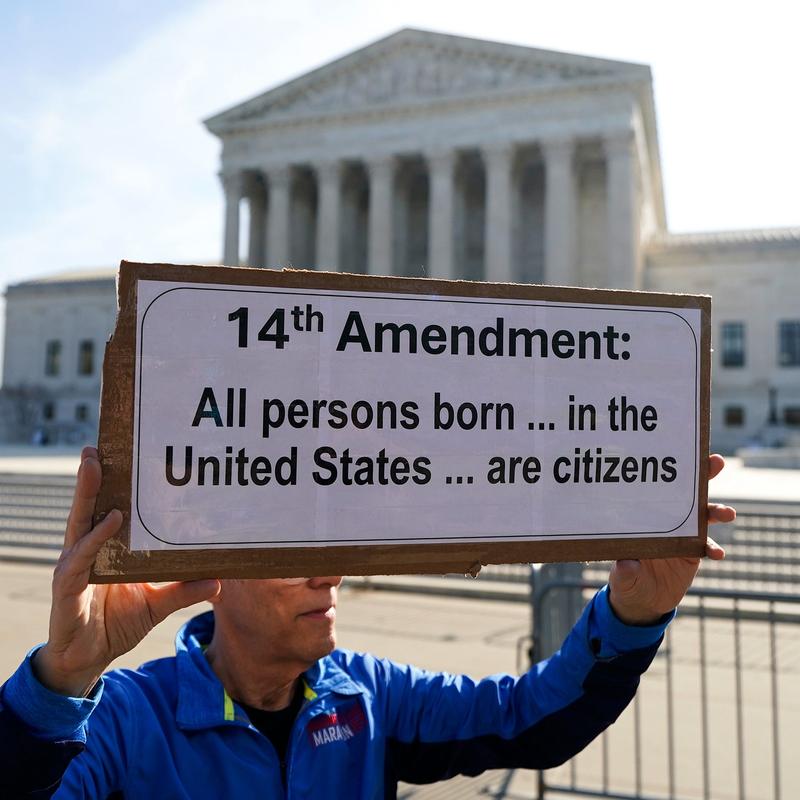
Brian: It's The Brian Lehrer Show on WNYC. Good morning again, everyone. Let's play some excerpts from and get analysis of the birthright citizenship oral arguments this morning at the Supreme Court. It's technically called Trump v. Barbara, although maybe it should have been more accurately been called Trump v. Barbara's Kid. Barbara is a woman who came here from Honduras in 2024 seeking political asylum and had a baby in 2025. It's the legal status of the baby, of course, that's actually at issue.
President Trump issued an executive order that says at least one parent has to be a US citizen or a legal permanent resident, often called a green card holder, for the baby to automatically be a citizen. The 14th Amendment, in contrast, says all persons born or naturalized in the United States and subject to the jurisdiction thereof are citizens of the United States. The arguments were scheduled for one hour at ten o'clock, so here we are at seven minutes after eleven. Let's see how it's been going.
We'll hear some excerpts now and get analysis from Emily Bazelon, who teaches at Yale Law School and is a staff writer for The New York Times Magazine as well as contributing opinion pieces on legal affairs for the Times, and she is co-host of Slate's Political Gabfest podcast. Emily, thanks for doing this instant analysis for us. We appreciate your willingness. Welcome back to WNYC.
Emily: Happy to be here. Thanks for having me, Brian.
Brian: We'll do some instant replay to set up your instant analysis in a minute, but if you were writing a headline for what you've heard so far at the court, what might it be?
Emily: Birthright citizenship is entrenched in our history and our understanding of the Constitution, and I think most of the justices are starting from that premise. The government has, for very good reason, a real uphill battle here, and I hear a lot of skepticism from the justices toward the Solicitor General and his arguments. So far, we've only heard from the Solicitor General, not from the other side.
Sometimes you need to hear both sides before you can really get a sense of where the justices are landing. So far, they seemed to just be with a lot of doubt, the idea that a president, by a stroke of a pen, can upend more than a century and a half of law that all recognizes birthright citizenship for everyone born in the United States.
Brian: They're not even through the first side yet. This idea that the oral arguments were scheduled to be one hour long, I guess that is only a suggestion, huh?
Emily: Yes, it has really become notional and not the reality. In important cases, the arguments tend to go much longer, two and a half hours, and as you said, we're not even halfway through yet, presumably.
Brian: The question at issue here is whether Trump takes the Constitution to be merely a suggestion. That, of course, is going to be up to the justices. Here's the first clip we'll play. Sorry, let me just pull this up and make sure I have it right. This is Trump's Solicitor General, John Sauer, 30 seconds.
John Sauer: Key point we make there is that that word "reside", if you look at, for example, section 1473 of Justice Story's commentaries, was understood to mean domicile. When they say "subject to the jurisdiction," and then they go on to say you're a citizen of the United States and the state in which they reside, the very text of the clause itself presupposes that the citizen is domiciled in the United States. If they're present in a state at all, they reside there. Reside means domicile in the Constitution, and we think that strongly supports our interpretation as textual evidence of our domicile-based theory of jurisdiction.
Brian: Boy, was that legalese to my ears, Emily. Why are they talking about "reside" and "domicile"?
Emily: That was a lot of word salad. The 14th Amendment says, "All persons born or naturalized in the United States and subject to the jurisdiction thereof are citizens of the United States and of the state wherein they reside." This whole argument is about "subject to the jurisdiction thereof." Does that create this giant exception to birthright citizenship such that if you owe allegiance to another country because you're here, but you're not an American citizen already, you're not naturalized, then you don't count? Your kids are not subject to the jurisdiction thereof.
The Solicitor General is trying to argue that when the 14th Amendment was ratified, people had this idea that it was based on domicile. That you were only subject to the United States jurisdiction if you had domicile in the United States, and that residing and domicile meant something permanent, did not mean that you had just shown up here without authorization. That is the argument.
Brian: Here's another clip. This is Justice Gorsuch questioning Solicitor General Sauer, and this is still on the question of domicile. They haven't even gotten yet in these clips. We'll see if they did eventually. I'll ask you, Emily, to the idea of the straightforward language of the 14th Amendment, all persons born in the United States. Here's Justice Gorsuch with the Solicitor General.
Justice Gorsuch: Whose domicile matters? It's not the child, obviously. It's the parents you'd have us focus on. Is it the husband? Is it the wife? What if they're unmarried? Whose domicile?
John Sauer: In the executive order, it draws a distinction between the mother and the father. That's really the mother's domicile. I think that would matter.
Justice Gorsuch: Well, but 1868 matters, you're telling us. What's the answer?
John Sauer: The 1868 sources talk about parents. I'm not aware of them drawing a distinction between mother or father, but they say the domicile of the child follows the domicile of the parents.
Justice Gorsuch: How are we going to determine domicile? Would we use contemporary sources on what qualifies as domicile in a state, or do we look in 1868? Do we have to do this for every single person?
John Sauer: Again, I don't see a strong distinction between those because, of course, domicile is a high-level concept that has been pretty consistent over centuries, which is lawful presence with the intent to remain permanently. When you've come to a new nation, and you say, "I'm here to stay," you become part of their political community, and you become akin to a citizen. That's reflected very strongly in the case I cited before.
Justice Gorsuch: Just to circle back to Justice Kagan's point, it's striking that in none of the debates do we have parents discussed. We have the child's citizenship. The focus of clause is on the child, not on the parents, and you don't see domicile mentioned in the debates. The absence is striking.
Brian: Give us a little more on domicile, and then I want to go to some other aspects of this case.
Emily: The Solicitor General wants a narrow reading of domicile. This idea that you can only confer citizenship on your kids born in the US if you have your domicile here, you are lawfully present. Justice Gorsuch is saying, "Wait a second, I'll go one step down this road with you. I'll take seriously this idea of domicile. Never mind for a moment that it does not appear in the text of the 14th Amendment." Then Gorsuch is saying, "Domicile based on whose understanding? At what point in time? Are we really talking only about what domicile meant in 1868? Then what do we do about the fact that nobody in the debates was talking about who the parents were?"
I think the import of that point is that if citizenship was supposed to turn on the status of the parents, if you only got birthright citizenship if your parents were domiciled in the US, had lawful precedent, or something more permanent, then why aren't any of the members of Congress talking about the 14th Amendment asking who those parents are, what was their status? There's just no discussion of the parents whatsoever. I think Gorsuch is expressing skepticism that the government can now claim, "The status of birthright citizenship all turns on the status of these parents, because the parents are nowhere to be found in the debates."
Brian: That's really interesting. Now, the 14th Amendment, passed after the Civil War, was a response to the Dred Scott Supreme Court decision in 1857 that said Black people could not be citizens of the United States. Trump's essential argument is that they didn't have the context of today's legal and illegal immigration distinctions, so the 14th Amendment really doesn't have anything to say about this executive order. If he's right historically, can he still be wrong legally?
Emily: Yes, he could still be wrong legally for a few different reasons. One is that we have the text. It says what it says. The conservatives on the court, and actually some of the liberals, are very committed to looking at the text. That would be one answer. Another answer is there is an important precedent from the Supreme Court in 1898 that recognized the citizenship of someone born in the US whose parents, they went back to China afterward, but at the time, they were not citizens of the US. There's that precedent.
Then there is a 1952 statute which repeats the exact words of the 14th Amendment about birthright citizenship in a moment in which there was lots of discussion of illegal immigration. This was a common concept. In fact, the government had gone on big efforts, raids, an operation, unfortunately called Operation Wetback, to try to arrest and deport illegal immigrants by then.
The statute is really at odds with this notion that, even if you agree with the Trump administration that the 14th Amendment was not passed to confer birthright citizenship on people who were not born to permanent residents or citizens, whatever you want to say, there is still this 1952 law at a time when it was just a very different understanding and real recognition of immigration. In that moment, Congress recognized birthright citizenship.
Brian: You mentioned the 1952 law, and I think this is important, it could become important as these oral arguments go on, that in addition to the 14th Amendment, Congress did pass laws in 1940 and 1952 that included basically the exact birthright citizenship language of the 14th Amendment. I see that the Trump argument is that those laws were based on Congress misunderstanding, they use the word "misunderstanding," of the birthright citizenship clause in the Constitution. Could the justices say this case is as simple as, "Hey, Congress passed a law, they're allowed to do that," so it doesn't matter what we think the 14th Amendment meant?
Emily: They could do that. There's actually a kind of canon, a rule of how you construe the Constitution and how you make law, which says, if you have a plain old law that gives you the answer, you can just stop there. You don't have to get to the deeper, weightier matter of constitutional interpretation. Going into this argument, I think a lot of people thought, "Maybe the justices will just stick to this 1952 statute, maybe they can all agree 9-0 that the government loses, and they'll just call it a day."
The arguments have not really gone in that direction. They've been spending a lot of time, at least up until we started talking, on the 14th Amendment, suggesting that they were really engaging with that analysis. We'll see. They could still take the out of the statute. The difference if they did go in that direction would be that then Congress could presumably come around and pass a law that ended birthright citizenship, and then you'd be right back where you started, wondering if that law is unconstitutional based on the text of the 14th Amendment.
Brian: I want to play about a minute and a half exchange between Chief Justice Roberts and Trump Solicitor General John Sauer that gets to this basic argument of, "It's plain language in the law that says all persons born or naturalized in the United States." You'll hear Justice Roberts refer at the beginning of this clip to the term "birth tourism," which is generally a derogatory phrase that people against birthright citizenship use to refer to people who come here primarily to have a baby so that they have an anchor for citizenship in the United States. Here's that minute and a half exchange. Justice Roberts speaks first.
Chief Justice Roberts: You mentioned in your briefing and also this morning the problem of birth tourism. Do you have any information about how common that is or how significant a problem it is?
John Sauer: It's a great question. No one knows for sure. There's a March 9th letter from a number of members of Congress to DHS, saying, do we have any information about this? The media reports indicate estimates could be over 1 million or 1.5 million from the People's Republic of China alone. The congressional report that we cite in our brief talks about certain hotspots like Russian elites coming to Miami through these birth tourism companies. Here's a fact about it that I think is striking. Media reported as early as 2015 that, based on Chinese media reports, there are 500, 500, birth tourism companies in the People's Republic of China whose business is to bring people here to give birth and return to that nation.
Chief Justice Roberts: Having said all that, you do agree that that has no impact on the legal analysis before us?
John Sauer: I quote what Justice Scalia said in his Hamdan dissent, where their interpretation has these implications that could not possibly have been approved by the 19th-century framers of this amendment. I think that shows that their interpretation has made a mess of the provision.
Chief Justice Roberts: It certainly wasn't a problem in the 19th century.
John Sauer: No, but of course, we're in a new world now, as Justice Alito pointed out, where 8 billion people are one plane ride away from having a child who's a US citizen.
Chief Justice Roberts: It's a new world, it's the same Constitution.
Brian: "It's a new world, it's the same Constitution." Boom. From Justice Roberts. Emily, do you take that as a strong indicator of how he might vote in this case?
Emily: Yes. I think it's interesting that he's asking about this question, and then the idea that this is, the government is exaggerating, it seems, this problem, and arguing that it obviates all our history of giving birthright citizenship. I think Roberts is skeptical about that. The other thing I want to point out is that if the government is really concerned about this idea, they could start by just denying visas to people who are pregnant, who are outside the United States.
Now, that would not address people coming in the country illegally when they're pregnant, but the stories about this idea of birth tourism are always about people with a lot of money coming from countries like China, going to these cushy maternity centers. The State Department has the power to end visas for that if they really think it's a problem.
Brian: I'm thinking of the Second Amendment, the right to bear arms, which starts with the clause that the reason for it is so a well-regulated militia can be formed as needed to protect a free state. That, of course, doesn't apply anymore in the new world we're living in because people don't use their personal weapons when they join the military, but the court has said the right to bear arms part still stands because that's what the words say. Do you see that as an analogy for the pro-birthright citizenship side, and might that even come up as an argument?
Emily: Yes. I think the idea that the court should be consistent in how it is interpreting confusing clauses in the Constitution is a very fair request of the court. Look, one of the biggest problems for the government here is that "subject to the jurisdiction thereof" has been interpreted in a very, very narrow, small exception kind of way ever since we've had it, "the children of foreign diplomats." The notion that suddenly you're going to expand it to cover tens or hundreds of thousands of people, it begs for skepticism.
Brian: I want to play another clip. This is Justice Sotomayor questioning Sauer, and she brings up the prospect of unnaturalizing or denaturalizing people who were born into this circumstance. That is, their parents were not here legally, but they were born in this country prior to the executive order that Trump issued last year. Let's hear how that went.
Justice Sotomayor: I'm asking whether the logic of your theory would permit what happened after the court's decision in Trinh, that the government could move to unnaturalize people who were born here of illegal residence.
John Sauer: No, we believe the court should do what it did in Sessions v. Morales-Santana, where there was a ruling that would have deprived people who were already citizens citizenship. The court said this applies prospectively only, and we think that's the appropriate course here.
Justice Sotomayor: That's not what we did in Trinh.
John Sauer: We think that Sessions provides the proper course here, and that's what we're asking. We are not asking for any retroactive relief.
Brian: Emily, there's references there to several past cases. What's Trinh?
Emily: Trinh is an older Supreme Court case in which the court talked about denaturalizing people after the fact. I think what you see here is Justice Sotomayor taking this Solicitor General down a potential kind of parade of horribles, the idea of, "If you win, there's nothing in the logic of your victory that would prevent you from coming back the next time and trying to actually strip citizenship from people." You see the Solicitor General walking as far away from that idea as he can because he knows that that is an even heavier lift than the one he has today.
Brian: Interesting. Let's take a phone call. Here's Cynthia in Sunapee, New Hampshire, who has a question, maybe a comment. Cynthia, you're on WNYC with Emily Bazelon. Hello.
Cynthia: Oh, hi. Thank you so much for taking my call. My comment is that, right now, birthright citizenship is conferred by virtue of a birth certificate that says you were born in the US. If that is no longer the case, then your citizenship is conferred by the citizenship of one of your parents. You'd have to prove that one of your parents is an American. The upshot of that would be that moving forward, anybody who wanted to apply for a passport or who wanted to register to vote in a state like New Hampshire, which requires proof of citizenship, much to my horror, they'd have to prove the citizenship of a parent, which is a nightmare.
It's bad enough to have to prove your own because a lot of people don't have their own birth certificates. To get that information on your parents would be even harder, because supposedly, Trump is saying that this only applies to children of people who are here illegally. How is a clerk taking a passport application or a voter registration application going to know the status of your parents without that documentation?
Brian: That's a great question. Emily?
Emily: I think that you are correctly pointing to one of many practical questions that would come into play. If you really ended birthright citizenship, you live in a world in which people are going to be asked to prove things that right now we take for granted. We base our decisions about who gets to vote, for example, on their own citizenship, their own legal status in the United States, not their parents.
You're right that if we change that, we would be moving into a world in which the identity documents of parents would be really crucial to establishing who can do what in the United States. There are countries in which that is totally the norm. When I was checking last night, it looked to me that there are 33 countries that have birthright citizenship the way the United States has it, which means there are lots of places where it works differently. You're right, it would be a real unsettling of how we do things here.
Brian: Cynthia, thank you for your call. We could take a few more for Emily, calls or texts, 212-433-WNYC, as we break down what have come so far in the birthright citizenship oral arguments at the Supreme Court. There was a previous Supreme Court challenge to birthright citizenship back in the 1890s about a person named Wong Kim Ark, as you know, born here to Chinese immigrant parents.
Wong Kim Ark left the country for a while and was denied re-entry, then he claimed he was entitled to return because he was born here and therefore a citizen, and he won. Trump's argument there is that that is not relevant precedent in this case because the Wong Kim Ark parents did have permanent legal immigration status, the parents did. Legally speaking, does that make the Wong Kim Ark case irrelevant?
Emily: It's certainly not irrelevant, but the government, you're right, is arguing that there is a hole in it, that it doesn't cover all of the ground that supporters of birthright citizenship wanted to, and I think for a long time assumed because of the status of Wong Kim Ark's parents. The idea is, if they were here with permission, then that doesn't prove that there is this utterly solid precedent for the idea that people whose parents are here without permission get birthright citizenship. That's the distinction the government is trying to make.
Brian: Law professor Stephen Vladeck said something on Morning Edition today about the Supreme Court's apparent eagerness to take this case. He said when a precursor to it came to the court last year, justices from across the bench actually urged the Trump lawyer to bring this case back to them on the merits. Justice Barrett even put that in writing in the decision on the earlier case. Do you think that gives us any clue about how Barrett or anyone else might vote?
Emily: Not really. I think what I interpret Barrett as saying then is we're in this realm then, last year, of this question about whether district court judges can grant what are called universal injunctions. That's the kind of procedural question that's before us. I thought what Barrett meant last year was, "If you want us to decide straight up on the merits, birthright citizenship, then you need to bring us that case." That's not what this is here. I didn't read it as her inviting them, necessarily, because she was eager to overturn this long, historic understanding of birthright citizenship. I thought she was trying to separate the two questions.
Brian: Interesting. Let me get you into the weeds a little bit on the language in the 14th Amendment, the relevant clause here. It says, as people have heard many times now, "All persons born or naturalized in the United States and subject to the jurisdiction thereof are citizens of the United States and of the state wherein they reside." "All persons born" seems very straightforward. I see there could be debate over the meaning of "subject to the jurisdiction thereof." Are there competing ways to understand that clause?
Emily: I think that there have not really been competing ways. For example, if you look at the past of all kinds of questions about citizenship that have arisen, you don't see the Supreme Court denying citizenship to anyone because their parents were not lawfully precedent in the United States. It just has not been our understanding of what "subject to the jurisdiction thereof" has meant. The only exceptions really are this idea of the children of foreign-born diplomats who have this very clear allegiance to another country and are not present here in a way that would suggest that they wanted to stay at all. It's like a particular small exception, not a general one.
Even in Wong Kim Ark, which we were distinguishing before, there is a lot of language in that opinion that embraces an understanding that is an English common law principle that goes back hundreds of years, that temporary sojourners, that their kids still got birthright citizenship. I think this is the problem with the government's argument. They're trying to take very narrow exceptions and blow them up and project them back into history in a way that just wasn't how people were thinking then about citizenship and immigration.
Brian: Listeners, if you're just joining us, we have a few more minutes with Emily Bazelon, who writes for The New York Times Magazine and teaches at Yale Law School and co-hosts the Political Gabfest podcast for Slate, breaking down the birthright citizenship case oral arguments that have been taking place at the Supreme Court this morning. Here's a question from a listener. Listener writes, "I wonder if the topic of country of origin or skin color of contemporary immigrants was brought up by the justices, because I don't believe," writes this listener, "the administration would have an issue with babies of white immigrants from England or South Africa being granted citizenship."
Emily: People were not talking about race at the argument in that way. I think what's important here about this point is that we all understand that if right now the Supreme Court ends birthright citizenship, there is going to be this deep sense of racism in the motivations behind it. The Trump administration sometimes is explicit about, for example, speaking in very derogatory terms about Somalis or other immigrants from Africa. You can't separate ending birthright citizenship right now from these race-based, really angry positions that people on the right are taking.
It seems to me like it's important to understand that in lots of parts of the world, countries don't have birthright citizenship. I don't think we would judge all of Europe or Asia as being inherently racist because of that. To end it right now in the United States is a different thing because of all the anti-Somali, anti-Black, anti-brown immigrant rhetoric from the administration, and because of the reality of who's coming here and how the face of the American population is changing and becoming more brown and Black, and the way in which some people who've been here feel threatened by that.
Brian: For listeners who didn't know and who haven't seen any video or still photographs of this, and I don't even know if anybody can shoot that in the court, Donald Trump is there. He is the first president to ever attend any Supreme Court oral arguments, and he chose to do it on this case. Alan in Brooklyn is calling in about that. Alan, you're on WNYC. Hello.
Alan: Good morning. Given his previous statement saying he wanted to terminate the Constitution and his often saying that people who opposed him, previous appointees, should be found to be traitors and executed, isn't his presence today in the light of those details a kind of prima facie intimidation where it wouldn't otherwise necessarily be for any president to watch a Supreme Court hearing? The circumstances, to me, raise at least a threshold argument for him intimidating them or attempting to intimidate by being there.
Brian: Interesting. I know from previous calls that Alan is a lawyer, so he's making a little bit of a legal case there, Emily. On that or any other aspect, what do you make of Trump being there in person?
Emily: I like how this listener is saying in another context, maybe this would not be intimidation, but in this one, how do you conclude anything else, given all the ways in which the Trump administration and President Trump personally has been attacking the Supreme Court. Given also, I think, his response to the tariff decision in which he really blasted them, called them sick for disagreeing with his administration. With all that context, for him to show up today does seem like he is trying to send a message that he expects them to do what he wants.
I think another way to read it is just as theater and performance. Frankly, there's a way in which I feel trolled by this whole case, this whole idea that we're going to upend this long, long-standing commitment to birthright citizenship the country has made. It feels to me like the Trump administration issued this order as a bait, not really expecting to win, but enjoying the politics of it. They're the ones standing for this nativist, ethnocentric America, and they're daring the court to stop them.
If Trump loses, he'll just shake his fist at the court and call them a lot of names. You can see his showing up here today as part of that. He's trying to add to the drama, maybe distract us all from the war in Iran, who knows? It's just the kind of move he likes to make. It gets him a lot of attention, and people are talking about it.
Brian: Oh, I'm glad you brought that up. I brought this up with another guest earlier in the show. One theory is that this is a constitutional long shot that Trump has always known is a constitutional long shot. Here we are heading toward the midterm elections, which he knew from day one. He issued this executive order about birthright citizenship on day one last year as he was inaugurated. He could have known that the timeline of it coming to the Supreme Court would be around now, and the decision might come around June.
If he loses, or even if he wins, but either way, this will be a headline. The polls seem to indicate, Emily, you can put on your political podcast co-host hat for this one. I think the polls seem to indicate that the idea of automatic citizenship for people who are here illegally is not a popular idea in America, that the Trump position, politically speaking, is more popular. Maybe this is just a big political show for the sake of having another feather in his cap for swing voters who he hopes will take his side in the midterm elections.
Emily: Yes, that's plausible. It's also something that deeply resonates with his base. The MAGA base does not want citizenship for lots of people coming into the country without authorization, again, from Central America, Latin America, from Africa, from Asia. That is the changing composition of the American population that a lot of MAGA folks really are resisting. Then there is this question that you were raising before about what the general population, what the median American voter thinks about birthright citizenship. For so long, it's been deeply taken for granted.
I would imagine that most people didn't really think twice about whether it was impossible to end it. To the extent that people are concerned about people coming into the country illegally, and then getting ahead of line of the people who are waiting, and then also taking things when they get here, to the extent that that is a real concern, the idea that you would come and then your kids get to have all the benefits, I guess you can build up some resentment against that. Trump, sure, would love to tap into that.
Brian: Before you go, can I get your quick take on yet another executive order that the president issued just yesterday that may well wind up with the Supreme Court, the one restricting mail-in voting, as The Washington Post describes it? The order directs the US Postal Service to send ballots only to voters who appear on a list of citizens to be compiled by the Department of Homeland Security, and it goes on from there. It's a fairly complicated way to go about this.
The post office has to do something. Homeland Security has to do something. He's got the Social Security Administration in there, too. Do you know how DHS would compile a list of eligible voters, and is it at all possible that this could be applied to this year's midterm elections, with as complicated a system as that would be to stand up?
Emily: I'm just going to start with this order really raised my blood pressure. I do think that it will get struck down in court because it is the kind of sweeping federal control of elections that is just really not how election law has worked, not what the Constitution envisions. Let me start there. The Department of Homeland Security has been trying to amass data from other state and federal agencies since Trump took office.
This is a project of DOGE, actually, in the beginning, and so I guess they think they can come up with some kind of list that then they'll give to the post office. This idea that voters would have to enroll with a federal agency, with the post office, in order to get these ballots that are coming from the states, it all is just about a thicket of restrictions and trying to make it harder for people to vote.
Brian: Emily Bazelon, who is now going to be dismissed and go and be able to lower her blood pressure again, teaches at Yale Law School and is a staff writer for The New York Times Magazine, as well as contributing opinion pieces on legal affairs to The New York Times. She is co-host of Slate's Political Gabfest podcast. Emily, thanks for coming on and doing instant analysis with us. We really appreciate it.
Emily: Thanks so much for having me. My pleasure.
Copyright © 2026 New York Public Radio. All rights reserved. Visit our website terms of use at www.wnyc.org for further information.
New York Public Radio transcripts are created on a rush deadline, often by contractors. This text may not be in its final form and may be updated or revised in the future. Accuracy and availability may vary. The authoritative record of New York Public Radio’s programming is the audio record.
