
Are 'Porch Pirates' Stealing Your Packages?
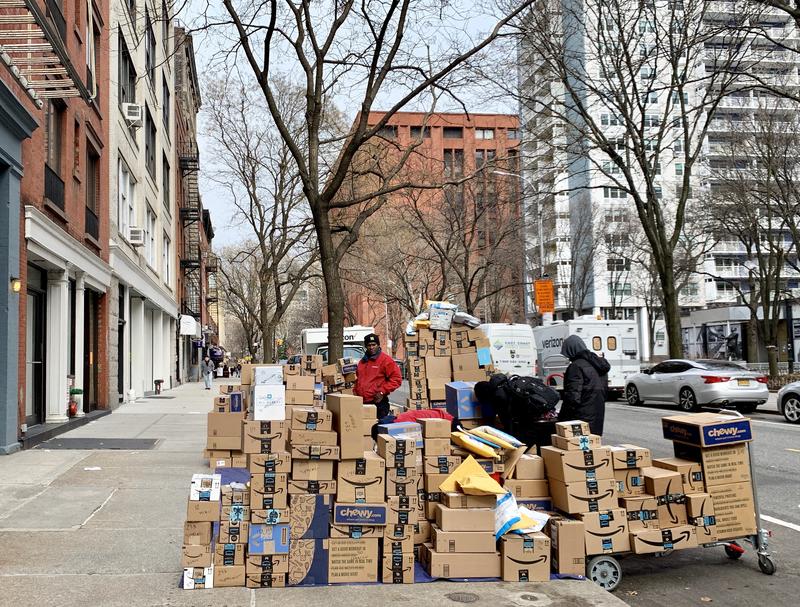
Brian Lehrer: Brian Lehrer on WNYC. Package theft. Those of you who live in buildings, can you even make it through your lobbies yet with all the holiday season packages from Amazon and wherever starting to pile up? Those of you who live in private homes, can you make it through your porch? Our real question is, do you deal with a lot of package theft? Has this become a bigger issue for you and your neighbors in recent months or years? Also, tips for how you can deal with it so that other listeners can take a page out of perhaps the success in your package theft prevention book.
Building supers, landlords, residents, private homeowners, I know package theft happens in both contexts. Maybe some of you have even heard of the New York City Department of Transportation's pilot program, Locker NYC, where they're setting up public lockers to help ensure safe delivery. Joining us now to talk about this is Julie Besonen who has an article in The New York Times, actually from a few years ago, about how her East Village building came together to address a rampant package theft problem there and then. Hey, Julie, thanks for coming on. Welcome to WNYC. Hi.
Julie Besonen: Thanks for having me.
Brian Lehrer: Do you have a success story?
Julie Besonen: We had some success [chuckles]. No, it's a problem all over again because my building has a lot of turnover since it's close to NYU and Cooper Union. We get a new batch of students usually every fall. We successfully battled it in 2021. The package theft got terrible during the pandemic. We banded together and started taking in packages for each other, carrying them up the stairs. That really seemed to work.
We got our landlord to put in a camera so we could see how they were getting in. In one case, a man who stole one of my packages was just able to open the front door with either a credit card or a MetroCard. They fixed the lock, but now it's happening again. We have new residents who are putting up signs saying, "Please return my package, no questions asked." That's how it always starts is with blame. You think it's happening that it's a fellow tenant stealing. Then I have to set them straight and say, "No, there's people getting in the building, somehow."
Brian Lehrer: I want to bring on a longtime superintendent of a building in Chelsea who's been coming up with ways, I'm told, to help his residents deal with package theft for years now and might have some tips. It's Dominic Romeo. Dominic, welcome to WNYC.
Dominic Romeo: Thank you for having me. Season's greetings.
Brian Lehrer: Season's Greetings to you. What do you do at your building?
Dominic Romeo: The caller that you're speaking to right now raises a really good point. Points of entry are very important, and you're not going to know what they are until you have a camera system. The first thing I recommend is indeed a camera system to figure out how they're getting in. Once you figure out how they're getting in, call a locksmith to try to prevent them in the future for doing that by-- You can add like one of those guards that blocks them from using credit cards to pick the locks with, which is one of the main reasons or ways for them to get in.
The biggest way for a resident to get their package stolen is simply by one of these package fees or grinches, I call them, around the holiday season, is to ring somebody's bell. That's one of my biggest problems as a building superintendent. You can be proactive all you want and block them as much as you can, but it really is educating your tenants in regards to not letting them in in the first place, and to look for the signs.
If you have a video intercom, you can see their face. If they're wearing a facial mask with a hat to cover their face, they are definitely going to steal your package. If they're holding a large tote bag, these tote bags, as I write to my residents every year, are not meant to drop off your packages. They're meant to haul away your packages. If you have a video and you can see them with a giant tote bag covering their face, they're going to be a package. Don't let them in in the first place is my recommendation. It's about educating the tenants of what I've observed and all the little tricks that they perform to get into your building.
Brian Lehrer: That's a number of very good tips right there. Listener writes, "Package theft is a massive problem at my building in Prospect Park South in Brooklyn. Amazon installed a locker in the lobby, which helps, but everything else gets stolen. I have all my non-Amazon packages sent to a friend's apartment in the neighborhood whose building has a package cage." Joanna and Dobbs Ferry are on WNYC. Hi, Joanna.
Joanna: Hi. I don't know if you've seen, but there are so many videos out there of people sabotaging the packages or putting fake packages out just to lure people up. They get out of their car, you see them on the cam camera at the front door. They come up, they pick up a package, they get to their car, and it explodes, and it's just filled with like spray paint, spray glitter, spray, spray pink stuff all over their face and hands. They drop it and don't know what to do. It's a great way to stop [chuckling] people from doing it. It's wonderfully funny.
Brian Lehrer: Although people may be stealing the real packages alongside the fake packages if there isn't better security. Right?
Joanna: That's true. I just think people are getting so fed up with it that they put up-- Wants to, you know, get the person who's doing it. There's a whole string of videos put together of people doing this. They run up to the front doorstep, grab the package, get to the car. Boom. They're standing there with blue muck all over their face and clothes and inside the car. It's just fantastic.
Brian Lehrer: Well, I hope it's only damaging enough to be good for a laugh, and nobody's actually getting hurt. Celia in Washington Heights, you're on WNYC. Hi, Celia.
Celia: Hi, Brian. Thank you for taking my call. I live in an older building built in 1915. It has an exterior door into a sort of a pre-lobby, and then the door from that pre-lobby into the big lobby. It's just kind of a large cavernous space. We have had problems with this since before the pandemic. It got really bad during that period and the super here convinced the building management company to put in a lockbox where they would get in touch with anybody who was in the building who was getting a package and then let you know that you had the package in the lockbox and you then had to go down, have to go down and get it yourself.
That worked very, very well for quite a while, but in recent years, like this year, last year, and perhaps it's been-- The problem has been growing again that many of the people who do the deliveries don't know that there is a lockbox. Don't know how to use it, don't care, perhaps also, some of them, and they leave it. They leave it in the lobby. Now, the only thing that I ever found that worked was to where there was a place on an order form to leave a message for the carrier. I would say "Leave in lockbox in lobby." I actually left instructions.
Brian Lehrer: That's interesting, too. Dominic, did I hear you having a reaction to some of that?
Dominic Romeo: Yes, I have to go against-- although they are fun videos to watch when they there's paint exploded in people's faces, keep in mind, these are just Internet stunts for people to get likes. Anything using explosives could force some sort of projectile and accidentally maim somebody, and then you're in trouble legally. Steer away from anything you see on the Internet is always good advice.
One thing that I do, that I recommend everyone does, is, as soon as you get some package stolen and you have a visual picture of them, post that picture saying, "My building has just gotten packed or stolen from this person." Do not let people into your building that you don't know. Look for the tall tale signs of if they're wearing a faceful mask, don't let them in.
If they're wearing a construction vest, those yellow construction vests. I inform my residents that every courier has a uniform and none of their uniforms consist of a construction vest. If you see somebody with a construction vest that's trying to get into the building claiming to be Amazon, it's not Amazon. This is about having your community, your building, be aware of these things to prevent people from coming in in the first place.
Brian Lehrer: You have a lot of good visual tips that you've been giving. Julie, your building, I understand, transitioned a few years ago from a mom-and-pop landlord to a real estate company. Do you think that the management company response is different from the mom-and-pop response?
Julie Besonen: Well, very much so, because when it was owned by a mom-and-pop family, we had a live-in super. That super would also take in packages for us. The first order of business when the real estate company bought it was to kick out the super. We just have a remote kind of super who comes around. It's very difficult to get them to respond. They had disconnected the cameras when they were renovating the building. We had to get every single tenant to sign a petition to get the cameras reinstalled so we could see how people were getting in. There's just a much more lack of response, I would say.
Brian Lehrer: Do either of you know-- You just have 20 seconds. When people get caught, are they being prosecuted?
Dominic Romeo: No, not at all.
Julie Besonen: I don't know. Also, with my neighbors, they rarely report the theft. They just order it again and have it replaced.
Brian Lehrer: Dominic, you say no. Do you want that?
Dominic Romeo: Yes, I would like that. This falls into line with the broken windows theory where every little crime matters. The problem with what I've been experiencing is that a lot of these companies, they have insurance for their goods that get stolen, so they don't mind sending a new product. Whereas if you actually had to pay for this product again, we wouldn't see this go on for too long.
Brian Lehrer: Julie and Dominic, thank you very much for sharing your experiences and your tips. We really appreciate it. Listeners, stay tuned for All of It.
Copyright © 2025 New York Public Radio. All rights reserved. Visit our website terms of use at www.wnyc.org for further information.
New York Public Radio transcripts are created on a rush deadline, often by contractors. This text may not be in its final form and may be updated or revised in the future. Accuracy and availability may vary. The authoritative record of New York Public Radio’s programming is the audio record.
