
Another Idea to Bring Down NYC's Sky-High Grocery Prices
Amina: It's The Brian Lehrer Show on WNYC. I'm producer Amina Srna filling in for Brian today, who is taking care of a family member. Now we'll focus on one of the prime examples of New York City's affordability crisis, the cost of groceries. There's a lot to complain about when it comes to how expensive things have gotten around the city: skyrocketing rents and property taxes, increased subway fares, meals at restaurants, the list goes on. One major gripe we hear over and over again is the cost of groceries.
A pound of bananas costs how much? Not only do we face sticker stock every time we walk through the aisles of our grocery stores, but the varying costs between stores make it all seem so arbitrary. You can't help but feel ripped off when the CTown kiwis are a full $3 more than the ones sold at Whole Foods. Mayor Zohran Mamdani identified this problem on the campaign trail when he promised a pilot of a chain of city-run grocery stores that would provide an affordable option.
According to a Data For Progress poll published after the primary, the idea was popular no matter what political party you ascribe to. 72% of Democrats, 64% of Independents, and 54% of Republicans all like the idea of implementing a municipal grocery store in their borough. A new article in the most recent edition of Vital City argues that Mayor Mamdani's proposal is a "distraction." Its author, Stephen Smith, says that to get cheaper apples, the Big Apple must correctly diagnose why prices are high. With me now to share his diagnosis and prescriptions for our grocery store woes is Stephen Smith, executive director of the Center for Building in North America. Hi, Stephen. Welcome to WNYC.
Stephen: Thank you for having me.
Amina: That $3 price fluctuation in kiwis definitely maybe sounded familiar to you. You opened your piece in Vital City with that striking comparison. Can you walk us through what you found when you went grocery shopping that day and what it tells us about the state of grocery prices in New York City?
Stephen: Yes. For the last couple of years, I've been mostly doing my shopping at the giant Wegmans at the Brooklyn Navy Yard. I've been biking there. Most people drive, but I bike there from Williamsburg. It was really cold in the beginning of this year, and I just got back from a trip. I'd emptied out my fridge, and so I had to restock, so I went to my local grocer, which happened to be a CTown.
I didn't grow up in New York, but I've been in New York for, I don't know, 10, 15 years. I became so used to the prices, but after shopping at Wegmans for the last couple of years, going back to that CTown, it was really striking how much more expensive everything was. The things that I could remember the price of were 10%, 20%, 50% more at the CTown. It awoke something in me, and I've been thinking about this issue for years, so I decided to write this article about the things that I see driving up the cost.
Amina: According to an April 2025 report on food insecurity from the New York State Comptroller, grocery prices in the metropolitan area have surged 25.2% since 2019. How did the New York City grocery market get so much more expensive in such a short period of time?
Stephen: New York City groceries have, I think, been expensive for quite a while. The major issue that you notice is that the grocery industry in the United States and really internationally has been consolidating in large national brands, and in some cases, multinational brands. Trader Joe's is owned by a German company, so is Aldi and Lidl. In New York City, we have resisted that trend. Historically, we had a lot of family-owned, very small green grocers just operating out of a small storefront, but those have been closing recently, and we're left with these local and regional chains. A lot of them are technically coops, not like the Park Slope Coop, but owners' coops. Those are things like Associateds or CTowns or Key Food.
When these groups were created in the 20th century, they were a form of consolidation. Rather than individually-owned stores, they would band together and get discounts on wholesale purchases. They've sort of been overtaken by these national chains, Walmart, which is not in New York City at all, Whole Foods and Trader Joe's, which are expanding here, some of the international ones, like Lidl and Aldi. They're growing in New York, but they are still a relatively small share of the market.
These regional and local chains, they don't have the buying power, they don't have the technology, they don't have the self-checkout to really compete on cost. They don't compete on cost, they compete on convenience. The city makes it quite difficult for national chains to open in the city. That is what I see as the fundamental problem.
Amina: Listeners, help us report this story. Which regularly-purchased items surged in price lately? Did you stop buying cereal or peanut butter or ravioli because the cost hit a certain point? Have you noticed any major cost discrepancies between your local grocery chains? What's your cost-saving grocery shopping strategy? Do you buy your frozen foods at Trader Joe's and your fruits at a market stand, maybe? We can also take your comments, questions, and arguments for our guest, Stephen Smith, executive director of the Center for Building in North America. Call or text us at 212-433-WNYC, that's 212-433-9692. We got an early caller. Larry in Brooklyn, you're on WNYC. Hi, Larry.
Larry: Hey, hi. I told your screener, and I told her-- I'm not going to ramble on too long, but my age has something to do with this. I worked in a local non-chain supermarket when I was a kid. I'm 67 years old. God, I keep forgetting. I was a delivery boy in stock shelves. This was before the delivery apps, and they existed all over. This was in Queens. The Atlantic published an article in 2024 saying that in the '80s, unsurprisingly, in the Reagan administration, enforcement of something called the Robinson-Patman Act just was cast aside, stopped. This forbade the large chains, not just in groceries, but anything, from getting better prices from distributors and manufacturers than small stores. We stopped that.
According to this writer, and your screener looked it up, it seems to be what put a lot of these small local supermarkets out of business, just killed them. I've seen this, and I sort of knew this from my experience growing up in a neighborhood where it was mostly served by a local one-shot, one-owner, not-chain grocery store. It was fisher's market on 37th Avenue in Queens. I worked there for a few years, and as a kid, and the whole bit. Nothing like that exists anymore, which is the food desert issue. I'm wondering if your guest, Mr. Smith, has any thoughts on that, if that's part of what he thinks contributes to the food desert problem. I'm just curious [inaudible 00:07:52].
Amina: Larry, you so much for your call, and shout out to our fact-checking screeners. Stephen, you just mentioned the green grocers that Larry was talking about. Where are they going? What happened to them?
Stephen: The really small green grocers, frankly, they're just retiring. There were a lot of Korean-owned first-generation immigrants, and their kids don't really want to keep up the business. What remains is these local chains, either directly owned like Gristedes or these sort of co-ops like Key Food or Associated. I personally do not really buy the antitrust argument. If we zoom out and look internationally, all throughout the world, there's been huge consolidation in groceries.
The reason why my fridge was empty was because I was visiting my family in Romania. In Romania, you have the same consolidation that you see in the United States outside of New York. You have a couple of grocers. A lot of them are sort of pan-European. In Switzerland, 80% of the market is dominated by two supermarket chains. They're called Migro and Coop. In the United States, you don't see as much consolidation. It's not two companies running 80% of the market, but you see consolidation, and New York has successfully resisted that.
What is the result? The result is the landscape that you see, which is pretty high prices, not great quality. There's natural reasons to consolidate. People want fresh food year-round, from foods that don't naturally grow in your area. There's a lot of technology that requires a lot of investment in R&D, a lot of labor-saving technology that brings down prices, like self-checkout. That stuff is not easy. Every time I go to Wegmans, they seem to be refining it, and it gets better, but better and better at making sure you're not marking the organic things as organic.
There is a bill in the state legislature to attack the issue with this antitrust angle, and it puts the state in the position of judging, are these wholesale prices fair? Are you offering the same price to these different buyers? The city and state often struggle to deliver more basic services than this, and regulating a really low-profit-margin industry with opaque prices, I'm just not sure the state can handle it. Outside of New York, there has been a lot of consolidation in these national chains.
While people do complain about the prices outside of New York, it's nothing like the prices inside of New York. We have this natural experiment, a place like New York, where city council has really tried to keep out the national chains, especially in industrial districts, where there's the large sites that the national chains like for their 40,000, 50,000, 60,000-square-foot stores. What is the result of promoting these local chains? It's really high prices.
I know there are people whothink that more aggressive antitrust enforcement would do it. I don't really see that. If I look internationally, if I look at the landscape globally, the consolidation, I don't really see it. Not that there should be just one or two grocers, but there are a number of national grocers. They compete. I think the scale is generally good for consumers and good for prices, and you see it every time you leave the city.
Amina: Stephen, we're getting several texts on Walmart. Somebody writes, "We need some Walmarts." If national chains like Walmart can offer lower prices, why aren't they all over the city? Is this an issue of zoning?
Stephen: Ah, Walmart, yes. Walmart is the enemy of city council. Walmart tried to enter the city in the 2000s, I believe, or 2010s maybe. It was, they tried to open a store at a shopping center in outer Brooklyn, in the Gateway Center, Gateway something or other. In New York City, there's three major zoning districts: residential, commercial, and industrial. National grocers are used to really large footprint stores with a lot of parking, enough room for 40,000, 50,000, 60,000, 80,000 square feet.
The places you find these are the industrial districts, because the residential and commercial districts in New York City tend to be broken up into little townhouse, tenement, 10,000 maybe square foot lots. The industrial districts are the easiest places for these chains to open. The New York City zoning resolution has long had a restriction on any big box retail store over 10,000 square feet opening in an industrial district. To get around this, you need essentially a vote of the full city council.
The city council has been very anti-Walmart, and they've made it very clear that if Walmart tries to enter, we will not allow it, so Walmart doesn't try anymore. There are ways around it. If you open a store literally underground, you can get around it. In Williamsburg, there's actually two of these stores. There's a Whole Foods, and there's a Trader Joe's, both of which are underground. They've avoided that. Very expensive to build underground, though. Walmart doesn't want to do that.
Unfortunately, there was a corruption scandal about over 20 years ago involving what was then the Fairway in Red Hook, which tried to open in one of these industrial districts, and did successfully open. The council member of the district in Red Hook, where it was trying to open, voted in favor of it and was caught on a wire or something, extorting a huge amount of money from the developer of it. Then the Whole Foods in Gowanus opened in one of these industrial districts, and they had to distract city council.
They put these fake windmills in the parking lot and solar panels in the parking lot back when that was really expensive. At the time, Whole Foods was not owned by Amazon, and they had a huge fan base. For someone like Walmart and really most other grocers, it's just too much effort to assuage the city council and to open in these districts. City council keeps a tight grip on any of the "industrial districts" in the city, and those are the most natural places for a Walmart. I guess you'd have to ask your city council member, "Why do you not want them here?"
Amina: Stephen, we're getting a couple of callers with reports on the ground about their grocery prices. Let's start with Eric in Prospect Lefferts Gardens. Hi, Eric. You're on WNYC.
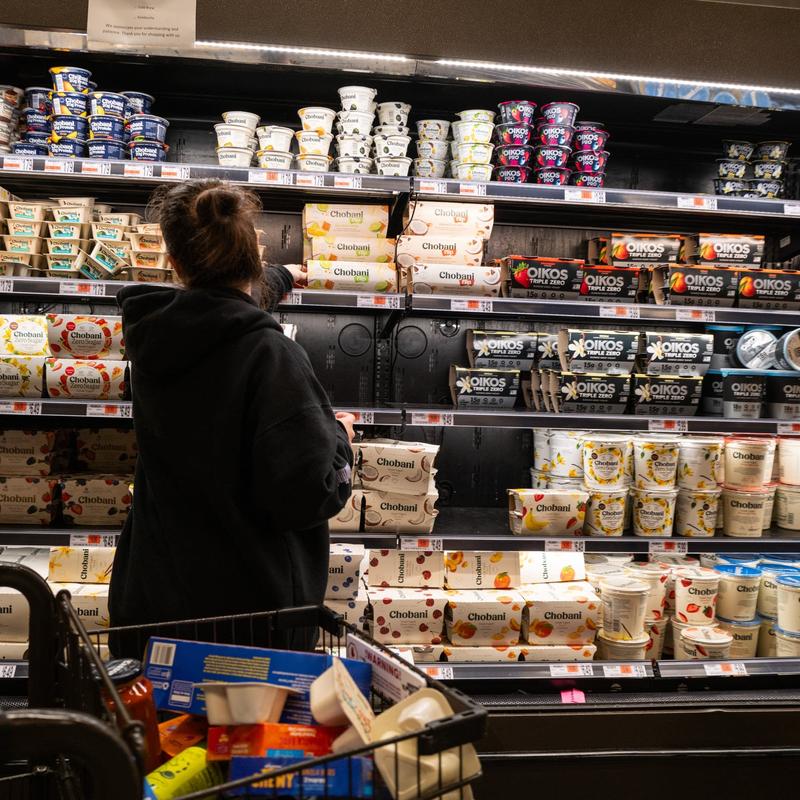
Eric: Hey, good morning. I shop at a bunch of different stores around town. My local shop is Lincoln Market, and I've noticed that the container of Chobani yogurt is $3 more than at Whole Foods, and I've wondered if that's because Whole Foods gets a better deal wholesale. I can't think of any specific examples, but I've noticed other prices at the Lincoln Market just seem a lot higher than other places. I tend to go to Trader Joe's when I can for just basic stuff because it does seem to be cheaper. I'm also happy to report there's a Lidl opening in my neighborhood soon. It's under construction right now.
Amina: Eric, thank you so much for that. Let's take another caller. Ross in Brooklyn, hi. You're on WNYC.
Ross: Hey, how's it going? Nice to talk to you. We have two small children, so we're a family of four, and our typical grocery price was between $200 and $350 a week. We were trying to budget and figure out how to make it more affordable, so we switched to the subscription Farm to People, which we get tons of produce and milk and fresh bread from She Wolf Bakery. Our bill is about $150 to $180 a week now, and it's all locally sourced within 200 miles of the city. That has saved our cash flow, basically.
Amina: Ross, thank you so much for your call. Stephen, you want to weigh in on a couple of things that we heard there? Anything sticking out to you?
Stephen: Yes. Prospect Lefferts Gardens or Flatbush, as my grandma called it, was the first neighborhood I lived in. I remember when I first moved to New York, trying to find a grocery store in that neighborhood, the supermarkets were pretty low quality, but there were a lot of green grocers that were good for some things. Unfortunately, they've been closing. As for how does Whole Foods deliver so much lower prices for Chobani? A lot of that is opaque to us. Is it that they get a better deal? I'm sure they get a better deal.
Is it that the operation of the store is more efficient with the self-checkout and the large volume of customers? It's probably that, too. Are the stores in generally lower-rent places? I know that market you're talking about, it's near the subway. It's pretty high rent. Probably some of that, too. Are the profit margins lower? Yes, they might be. Publicly traded companies, I'm not sure they demand the same profit margins as these small, privately owned businesses. I think something that our government has to ask is, are they in the position to figure out why and to change the underlying economics of this, or are there some things that the city just has to accept, like that national chains have lower prices?
Given all the problems in New York City and the difficulty that the city has in executing basic city functions, I think it's really not their job to figure out why and try to change it, but just give in to some things. One of the things to give in to is that the national chains have lower prices, and you should probably call them up and say, "What do we need to change to even level the playing field for you and have you open more stores here?" Because they're lower. For whatever reason, the prices are lower.
Amina: Let's go to a caller who wants to ask about wholesale opportunities. Frank in the Lower East Side, hi. You're on WNYC.
Frank: Hi. I'm just curious to know if there's any renewed interest in wholesale opportunities like the old fish market, like what Essex Market was meant to be, and markets that you see in other cities, like Baltimore, where you have a venue where people can bring produce in.
Amina: Thank you so much for your call, Frank. Stephen, I know you write about Hunts Point Produce Market. Go ahead. Where do you want to come in on this?
Stephen: These old produce markets, around the world, they're disappearing. Where I just came back from, in Bucharest, in Romania, the major produce market called Obor has made the exact same transition that Essex Market made, from this true wholesale market to more of a food hall style thing. New York City historically had a consolidated wholesale market. It was moved at some point to the Bronx, to the Hunts Point market. It is currently city-owned land, and it's this coop of wholesalers. It's in really poor condition.
There's not enough refrigerated space, so a lot of the produce is actually stored in refrigerated trucks that are just permanently parked there, which is terrible for the air quality in the neighborhood. Actually, some of the money from congestion pricing is going to try to build a more modern facility. This is one of the basic city functions that we struggle with, is maintaining this market, and I think it's great that they're going to try to clean up the market and build real space.
Something that would also be helpful is to just allow, in the industrial districts, moving away from the retail stores into the wholesale, to just make it easier to build cold storage facilities or regular warehouses. Throughout the industrial districts, there are wholesale facilities. Like housing, it's really hard to build industrial space in New York.
The Department of City Planning had this prototype that they were trying to roll out across the city to allow bigger warehouses in northern Brooklyn, specifically in Greenpoint, Williamsburg, and Bushwick. The city council member there, now the Brooklyn borough president, Antonio Reynoso, was nitpicking the whole thing, and eventually it died. The plan was to allow higher densities. In that area, there are a lot of wholesalers, some of which would probably like to expand their facilities.
The issue of a wholesale market, it's tough for it. This is historically something that has been really left to the market. The city really needs to figure out what is the role that we have here. At minimum, I think the role is to make it easier for wholesalers to do business in the city. Start with allowing larger warehouses here so that the wholesale transactions can happen in New York and not New Jersey, Connecticut, farther away, where it just costs more to bring them into the city.
Amina: If you're just joining us, we're talking grocery store prices with our guest, Stephen Smith, executive editor of the Center for Building in North America. Stephen, before we get into your solutions, let's talk about Mayor Mamdani's proposed city-owned grocery stores. You say that he correctly identified the issue, but his solution is "unresponsive to the problem." How come?
Stephen: Historically, this is something that has been left more and more to the market. The city taking it over, they'd have to demonstrate some competence in some of the things that you need to run a grocery store or even be a landlord to one. One would be, how do you simply build and maintain and lease out a building? The city's track record here is not great. I live near one of the older public housing projects in New York City, and there's tons of retail space that's vacant.
Forget running a grocery store. What if the city just wants to lease space to one at a lower rent? They can barely lease the space that they have in NYCHA housing. Then you go to run a grocery store or even to act as a landlord, you have to build and maintain a building. What are things that the city has to do? They have to provide education. They have to build and maintain schools.
What does the city pay to build or rebuild, let's say, a library? It's over $2,000 a square foot, which is a massive number compared to what the private sector does or even what they do in New Jersey, which might be a quarter or a fifth, something like that. If the city can't even affordably build a library, how do we expect them to run a grocery store or even act as a landlord? When you're running a grocery store, you have difficult decisions to make about labor and trade-offs about technology, and the city is not the best at balancing these things. City council is very deferential to labor.
If labor says, "We don't want self-checkout," or in California, for example, in Long Beach, California, they passed a law that you need, I don't remember what it is, but one employee to man every three or four self-checkout kiosks. The Wegmans, it's one employee for a dozen or more. What if they make those demands? Is the city going to be able to resist them? Probably not. It's a real issue, the cost of groceries. I don't have a lot of faith in New York City to run grocery stores. I think if you look at their basic competencies, I think time and resources would be better invested in schools, libraries, et cetera, than running their own grocery stores, when this is really a solved problem outside of New York City.
Amina: Another critique of the Mamdani proposal is that the city doesn't have a good track record of being a landlord. You mentioned the cost of building and renovating libraries just now. In your article, you write about the empty storefronts on NYCHA properties. Why doesn't building on city-owned land help?
Stephen: In a previous line of work, I was a broker, and at some point, we brokered a deal where a nonprofit funded by the city leased a space. It was really shocking to see how long it took the city to give approval to the deal, close the deal. They weren't even doing it themselves. They were doing it through a nonprofit. The city moves very slowly. I know a lot of that is to avoid corruption and favoritism, but they move very slowly compared to the private sector, and time is money in business.
There's a lot of red tape, there's a lot of restrictions, political restrictions, technocratic, bureaucratic restrictions. It just doesn't move very fast, and maybe some of that is for the best. You don't want government, as they say, moving fast and breaking things like in the private sector, but I'm not sure that it's really amenable to a super low margin thing like groceries. There's not a lot of profit in grocery stores, so one thing the city can do is not make a profit, but it's not like the private sector is making a huge profit in groceries either. I don't really see the city as a very nimble actor here.
Amina: Let's go to another caller with a report from the ground. Diane in the Upper West Side, hi. You're on WNYC.
Diane: Hi. Thanks for this story. It's a little confusing, though, at this time. My experience is on the Upper West Side of Manhattan that there are larger stores. They're not giant stores like the Whole Foods, but there are larger stores like H Mart and some of the other West Side Market, that kind of thing, that are able to operate pretty profitably and have pretty good prices, usually lower prices. Just like, I know, six blocks away, there's a D'Agostino that operates right near where I live that the prices are like twice as much as H Mart.
I spend a lot of time on the North Fork of Long Island, where the IGA operates, in IGA's prices in really rural, low population areas, so smaller spaces, fewer customers, and they are able to operate, and their prices are about half what is charged at the D'Agostino. I just don't understand how IGA is able to operate small scale, and H Mart in the very same neighborhood on the Upper West Side is able to operate, and then just blocks away, D'Agostino has to charge twice as much. I just don't understand the law in relation to everybody's consolidating larger spaces and stuff like that. If we all go the direction of larger spaces, giant stores, aren't there going to be even larger food deserts? I just hope the guest can explain this a little to me. I don't get it.
Amina: Diane, thank you so much for your call. Stephen, what stands out for you there?
Stephen: I think D'Agostino versus H Mart is an interesting comparison. D'Agostino is now, I believe, owned by John Catsimatidis, who owns Gristedes. I spent a lot of time speaking negatively about some local and regional chains, but H Mart actually was founded in Queens and has now gone national. It's Asian focused groceries, and they have done really well. They offer relatively low prices. I think it's a little ironic generally everything is more expensive in Manhattan, but I do see better grocery options at least below 125th Street in Manhattan than in the outer boroughs.
Some of this is there's not a lot of industrially zoned land in New York City where there are these size restrictions. Some of them might just be the sheer volume of people. I think the city should look to H Mart, very successful in both expanding and bringing down prices, and try to use that as a model for the rest of the city and try to duplicate what works.
I would say in general, I think what you're going to see in Manhattan is the market at work, which is frankly the H Marts, the Whole Foods, the Trader Joe's, some of the better-run local chains like the West Side Market, frankly running out the Catsimatidis-owned brands. He actually told Vital City that he might not be in the business for much longer. When you look in the stores, you see why. Not a lot of people shopping there. Prices are very high. I think in Manhattan, at least below Harlem, the competition works relatively well, and they should try to duplicate that outside of the city and let the weaker places like D'Agostino's fail and let the H Marts and the Trader Joe's and Walmarts succeed.
Amina: Some listeners have asked about Walmart and bringing in Walmart to New York City, and we're definitely getting some pushback. Here's a text: "This is a frustrating conversation to hear. Walmart, really? At what cost are these low prices achieved? Most often on the backs of hyper-exploited workers. Also, talking about grocery prices in isolation of conversations around wages is not getting at the main issue. I am a born and raised New Yorker, and it's broken my heart to see the city get covered by national chains destroying the character of the city."
Also, another listener had texted that compared to stores like Costco, where employees are unionized, this listener says Walmart employees are not. Stephen, wouldn't good union jobs in a critical sector of the economy help New Yorkers afford the cost of groceries and lead to a more professional workforce? Wouldn't we want to encourage the creation of union jobs?
Stephen: This is fundamentally why Walmart is not allowed in the city and why city council keeps such tight grip on this. When you leave it to government to make these decisions, they make the decisions, and the decision they've made is to prioritize some of these local chains over the national ones, largely over the issue of unionization. For example, Gristedes and D'Agostinos, I don't think they're all unionized, but a lot of them are unionized, whereas none of the Walmarts are unionized. It's a judgment call. Everyone buys groceries.
Not very many people work at grocery stores. It's a political question. Do you prioritize lower prices or these union jobs? I think there's a sort of sense that locally owned stores, the owners are more sympathetic in some way, but you look at Gristedes, John Catsimatidis is a huge Republican donor. When you protect his business against Walmart, that's where the profits are flowing. They're being donated or spent on his run for mayor. Walmart, for all of its flaws, is a publicly traded corporation.
If you have a retirement account and you own a little bit of Walmart, you own a little bit of Whole Foods as well. It's a judgment call, and you have to look at the prices and say, "Is this worth it?" Frankly, for me, nothing is worth stepping into at Gristedes, but every New Yorker has to make that decision for themselves.
Amina: Let's go to another call. Katie in Brooklyn, you're on WNYC. Hi, Katie.
Katie: Hi, yes. Thanks for taking my call. I'm a manager at a very small coop, the Windsor Terrace Food Coop, and I was just wondering why you haven't brought up the ideas of more food coops, small coops. We're a very unique coop that we are very, very small. We're not like the Park Slope Food Coop. I'm just wondering why there aren't more proposals to encourage more communities to start what we have started at the Windsor Terrace Food Coop. I had a couple of some of the challenges that we have. We're just trying to break even, which is very difficult. It's hard for us just to make the minimum, and they keep raising the minimums with our suppliers. I was just wondering if you had a few things to say about that, commenting on coops.
Amina: Stephen?
Stephen: By the way, in this conversation, I mentioned coop, a different kind of coop, which is this associated CTown. Those are really owners' coops. When New Yorker think of a coop, they might think of the Park Slope Coop or some of the smaller ones like Windsor Terrace. I guess there aren't very many of them. It's a model that works in Park Slope, and trying to make it work in Windsor Terrace, and I hope it does, but I don't see a lot of them throughout the city. I definitely don't see a lot of them throughout the country.
There's only so much you can do to push against these trends and push against the minimum order volumes, and there's reasons for those minimum order volumes. That's how they keep down their prices, the suppliers keep down their prices. I don't know a ton about them, but I haven't seen a lot of success outside of New York in general with it. Works in a couple neighborhoods, but the vast majority of Americans, people around the world, New Yorkers, are not shopping at these local coops.
I'm interested in experimentation with it, but I suspect it will always be a niche way to shop. I think most people don't want as deep of a relationship with the supermarket or the retail stores they go to, don't want to put in the time to volunteer, and I think you got to respect that. I think city policy should also focus on where most people are shopping, which is not the coops.
Amina: As we run out of time, I have a few questions left for you. What about public grocery stores operated by the military? According to Forbes, the military has 236 PX commissaries across its branches offering tax-free goods to enlistees and their families, and they generate about $4.6 billion in revenue a year. A quote from the article: "If the PX were a US grocery chain, it would rank in the top 20 by sales nationally." Would or wouldn't this work in New York City?
Stephen: Top 20 by sales nationally sounds like not one of the larger ones. Sounds like they probably said it that way because it's towards the bottom. It's a market economy. We live in a capitalist country. Most countries are trending towards capitalism and not running their own grocery stores. I see the same issues that you see with city-owned grocery stores. Fundamentally, I think it's something that the market does pretty well outside of New York, and it's a creative idea, but I'm not sure that it would be implemented very well. I'm not sure New Yorkers would actually take very well to the US military selling grocery stores here.
I think in general, the problem with groceries in New York is so dire. You literally cross the city line from Queens to Nassau County, and you're at a Walmart. Probably the highest-grossing Walmart in the country is literally on the city line between Queens and Nassau County, and the prices are lower. I just think rather than fighting against the trend with these more niche solutions, the city should really just get the basics right first. Military or local antitrust, these ideas, they're not proven. We have proven ideas, which is invite the top 10 national grocers in and be a little more accommodating of them, and I just think it's a more realistic solution.
Amina: We will have to leave it there for today. My guest was Stephen Smith, executive director of the Center for Building in North America. Stephen, thank you so much for your time today.
Stephen: Thank you very much.
Copyright © 2026 New York Public Radio. All rights reserved. Visit our website terms of use at www.wnyc.org for further information.
New York Public Radio transcripts are created on a rush deadline, often by contractors. This text may not be in its final form and may be updated or revised in the future. Accuracy and availability may vary. The authoritative record of New York Public Radio’s programming is the audio record.
