
Amnesty International's Work on Gender Justice
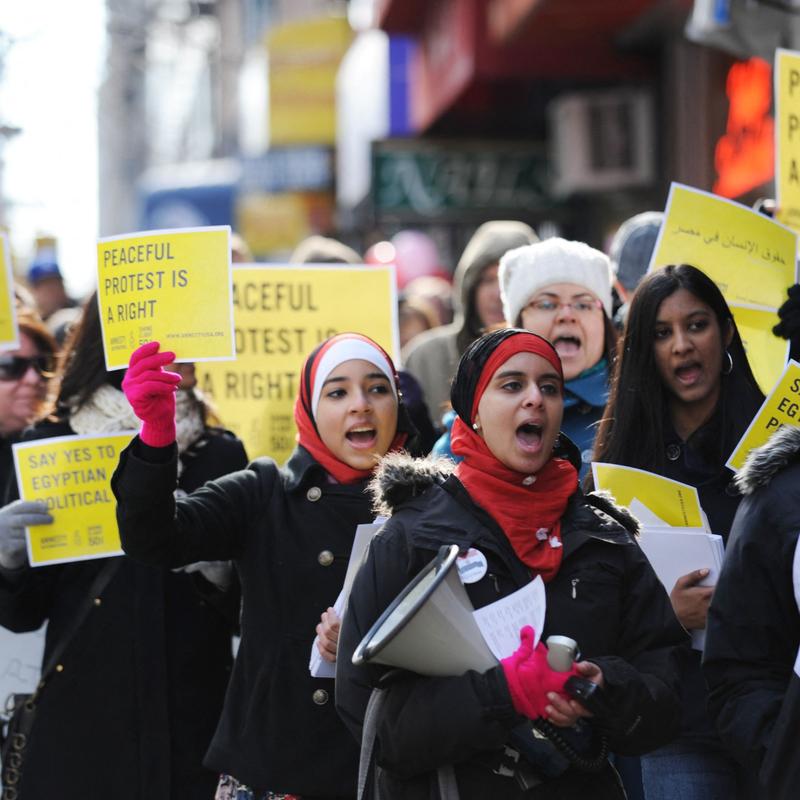
Brian Lehrer: It's The Brian Lehrer Show on WNYC. Good morning again, everyone. We are joined now by Agnès Callamard, Secretary General of Amnesty International. This week in New York, an Amnesty International delegation led by our guest is calling for robust efforts to protect and advance the rights of women and girls at the 70th session of the Commission on the Status of Women. This is called CSW70 because of that.
The delegation is pressing for more access to justice for survivors of gender-based violence, meaningful accountability for perpetrators, protection of sexual and reproductive rights, and stronger safeguards for women human rights defenders. If you're thinking Epstein here, if you're thinking Iran here, we will touch on both of those things, but also more. Agnès Callamard is here now to preview the 70th session of the Commission on the Status of Women and to talk about what Amnesty International in particular is trying to do to advance the rights of women and girls worldwide, including in Iran, Afghanistan, Gaza, China, and more, and, yes, the United States. Agnès, welcome to WNYC. Thank you so much for joining us.
Agnès Callamard: Thank you for having me.
Brian Lehrer: I actually want to begin with a clip that we played earlier in the show in another context in which, as it turns out, your name got mentioned by the 2023 Nobel Peace Prize winner, Narges Mohammadi, for her fight against the oppression of women in Iran and her fight generally to promote human rights and freedom in that country. As some of our listeners know, she has spent most of the past two decades in prison in Tehran's notorious Evin Prison. I'm going to play a clip of Narges Mohammadi from 2024 when she was out of prison for a short time. Listeners, you will hear that she thanks our guest by name in this clip.
Narges Mohammadi: I want to express my deepest gratitude to every Amnesty officer across all countries, especially Amnesty Iran, and most of all to you, Ms. Agnès Callamard. I have to say, for your relentless efforts, your work on Iran, on my case, on cases of other Iranian activists and Iranian political prisoners, on executions in Iran, and on ending gender apartheid has brought so much hope to me and others and my friends in prison.
Brian Lehrer: Narges Mohammadi, the 2023 Nobel Peace Prize winner. I presume you've heard that clip before. I think that's in the video.
Agnès Callamard: Of course. Yes, no, I was online with her. We were having a conversation. This was one of the rare moments where she was out of prison. As you know, she was brought back in an arbitrary fashion, redetained in December of 2025.
Brian Lehrer: Our guest from earlier in the show, Christiane Amanpour, reported last month that Mohammadi has been subjected to beatings and "life-threatening mistreatment" by Iranian authorities during her latest arrest and detention. The Nobel Committee itself complained about that. What can you do at Amnesty International, being on the side of right, but to actually put pressure on the Iranian government in this case to, A, spare her life, B, treat her decently, C, release her.
Agnès Callamard: Well, it is definitely one of the largest, biggest challenge because the Iranian authorities have shown complete disregard for international justice, international pressure. However, in the case of Narges Mohammadi, I think the public scrutiny, the interest that she generates, the publicity that the Nobel Prize has given her are a shield. They are shielding her to a certain extent against the worst that could be done against her. We need to leverage that public profile that she has. That's what we do. We do that when we engage with the authorities, but we also do that when we engage with other government.
I'm not going to lie. The international context makes it extremely difficult to ensure protection of people like Narges and of the others who may be less well-known, but who are also on the front line of fighting for women's rights and human rights in Iran. Hundreds, probably thousands, have been detained following the January protest, which may have been the worst possible forms of repression that we have recorded in Iran. We have been monitoring the situation in Iran for years, for decades, but I don't think we've seen that level of repression and killings ever.
Brian Lehrer: I know Amnesty tries to stay out of explicit politics, but does what you were just describing, and Narges's story and history make you want this war to end in a particular way or for the Trump administration to the extent that they have this choice to continue to regime change or not?
Agnès Callamard: No. I think that as a human rights organization, we are absolutely resisting the binary proposal that is being brought forward to us. It's not an option. Right now, it is civilians in Iran that are paying the highest price, both from the Iranian authorities and from Israel and the American bombings. It is not an option. You don't have to choose between being detained or killed by the police or being bombed by an American or Israeli plane. That is not an option.
Both of them are in complete violation of international law, so that is our position. We are calling right now for an end to the attacks on civilians. We are calling for diplomatic efforts to be multiplied so that people's lives are spared. Right now, it's civilians paying the highest price. Let's make no mistake. These are those on the front line of fighting for freedom. You do not expect people that are being bombed to now raise and defend rights and freedom. It's just not possible.
Brian Lehrer: Listeners, we can take some comments or questions, calls, or texts for Agnès Callamard, secretary general of Amnesty International, who is in New York right now for CSW70. That's the 70th session of the Commission on the Status of Women. 212-433-WNYC, 212-433-9692. Obviously, it doesn't have to be Iran. There are so many countries who in their press release to us [chuckles], regarding her appearance here today and here in New York at this conference, so many countries that got mentioned explicitly in so many areas.
Afghanistan, Burkina Faso, Gaza, China, Hungary. We'll talk about the United States, too, 212-433-9692, if you have a question for her. Give us the big picture. For people who don't know about CSW70 or CSW at all, the Commission on the Status of Women, what is it exactly that's taking place here in New York this week and next?
Agnès Callamard: Okay, so CSW is a moment where governments come together to do a range of things, but the most important one is to insist on universal norm-setting for the protection of women, for women's access to justice, for the fight against violence against women. It is a real important exercise in international commitment towards universal rights for women.
It is particularly important right now because, as you know, there is a systemic movement against women's rights by an anti-rights movement that is extremely well-organized, that is also well-funded and well-coordinated. CSW is coming at a critical moment. I have to say, it started with a big bang with a success story, which I think needs to be highlighted. Yesterday, all the 47 members of the commission adopted a political statement on the status of women and on women's access to justice, which basically reiterated what had been established and adopted in previous years.
Why is it a success? It is a success because the United States, with a number of other countries, tried to derail the adoption of that statement. They tried to weaken the statement. They tried to amend it, and they failed. In fact, the United States failed to a very large extent. There was a vote yesterday around that political statement. There was one country that voted against it. It was the United States. It is remarkable because we hear so much about the United States really-- well, I will say bullying the rest of the world into walking their lines.
Yesterday was a demonstration that when government come together, when they push back against fear or against appeasing the bullies, they succeed. That's what happened yesterday, and it must be highlighted. We have a political statement, which is as good as it could be given the international context, which does not go back on previous commitment and which has completely isolated the United States' attempt to derail the process. We see that as a big success.
Brian Lehrer: As a victory, yes.
Agnès Callamard: Absolutely.
Brian Lehrer: I didn't even know that development from the last day, so I'm really glad you brought it up for our listeners. What, to the best of your understanding, was the reason that the United States tried to block the adoption of that position? Was it about abortion rights? What was it from the Trump administration that they were keen on?
Agnès Callamard: They were absolutely keen to eliminate all reference to sexual and reproductive rights, to gender rights, a reference to something called "unilateral coercive measures," which is basically unilateral sanctions, and to economic justice. For the United States red lines, they tried to enlist the support of other governments. They did get a couple of governments to support them, particularly on the issue of sexual and reproductive health. When it came to the vote, those countries decided to abstain, so there were six of them, rather than to vote against the political statement.
They failed. They failed to bring other countries along. I have to say, the strongest appeal that they had that the United States put together was around sexual and reproductive health. This is, for us, a battleground. It has been a battleground for decades. It continues to be a battleground, even though the trends are towards stronger recognition of sexual and reproductive health around the world. On that issue, the United States is an outlier. It's moving backward. Most countries are moving forward, which is toward the bigger, larger recognition of women's bodily autonomy and right to choose.
Brian Lehrer: Well, we have to take a break. We're going to take a break. When we come back, I want to ask you if the Jeffrey Epstein story plays into your work for women's rights at Amnesty International in any way. We'll talk about some other countries as well, and listeners with you, 212-433-WNYC, call or text, with Agnès Callamard, secretary general of Amnesty International.
[MUSIC - Marden Hill: Hijack]
Brian Lehrer: Brian Lehrer on WNYC as we continue with Agnès Callamard, secretary general of Amnesty International, in New York right now for CSW70. That's the 70th meeting of the Commission on the Status of Women. 212-433-WNYC, call or text if you want to ask her a question. Howard in Forest Hills, you're on WNYC with Agnès Callamard. Hello.
Howard: Hello. I'm a former member of the board of the American affiliate of Amnesty International. I'm talking about in the 1980s. I'm wondering, at that time, I know that the German section of Amnesty wanted to bring in all sorts of other issues because they didn't have a civil liberties union. Amnesty said, "No, we have to limit what we're doing." I know that Amnesty has expanded their concerns to, I don't know how many more, three or four other major issues. I'm wondering because I have hardly heard Amnesty on the media for, I think, years. I'm wondering why has Amnesty spread its concerns so widely?
Brian Lehrer: Do you accept the premise, Agnès?
Agnès Callamard: Well, 1980s is a long time ago. It was a different world. If the question is regarding why are we working on women's rights, well, I think it's pretty self-evident. A, it's half of the world population. B, the violations of women's rights is as old as humanity. Three, as events around the world are demonstrating, it remains one of the major battleground for universal rights for dignity. Women are in the forefront of victimization in armed conflict. They are at the forefront of victimization of repression in many states. It is absolutely evident that a human rights organization have to engage, defend, protect, and transform women's human rights.
Brian Lehrer: I see that the Commission on the Status of Women, moving on to another issue, has issued a statement about the Epstein files, which they say are exposing networks of powerful men for exploiting and abusing women and girls with impunity for decades. Now, obviously, nobody's going to defend pedophilia and the kind of violent abuse that Jeffrey Epstein is now known to have widely victimized people with. What's the commission's or what's Amnesty's entry point into this issue to prevent further such things?
Agnès Callamard: Well, I think it's two or threefold. First of all, it is a global criminal network. As any kind of global criminal network whose modus operandi is massive abusers of people's rights and people dignity, it is on the agenda of human rights organization. Second, it is not just any global criminal network. It is a criminal network of people involved in politics, involved in finance, involved in culture at the highest level.
In other words, it means that the elite institutions of the world were implicated in the sexual exploitation and abuse of women and girls. That's the second reason why we need to be concerned about. It is a deep corruption of politics. It is a deep corruption of democratic governance. It is a deep corruption of our society. The third reason why we need to get involved is because of the impunity. It's because of the impunity. It's unbelievable that years, decades in the making, we still do not have true justice being delivered to the survivors.
It is amazing that the survivors are confronting a kind of systemic silencing that is also allowing the perpetrators to largely keep in power, as you know very well in this country. For all those reasons, in many ways, it is a symbol of why it is so difficult to combat violence against women and women's human rights violations and why it is so crucial that we keep demanding transparency on the release of the Epstein files and the end of impunity.
Brian Lehrer: I see that Amnesty has criticized in various ways both Israel and Hamas in the context of October 7th and then the war in Gaza. Is that a topic that the Commission on the Status of Women will be taking up this week in any way?
Agnès Callamard: Yes, it is. The position of women in conflict, or in the case of Gaza, what we believe to be a [unintelligible 00:20:38] or genocide, is top of the agenda for CSW. It concerns, of course, Palestinian women in Gaza. It concerns women in Sudan, women in Ukraine, women and girls as well in Iran, in Lebanon, in Israel. That is top of the agenda.
Amnesty International just released, in fact, a briefing on the situation of Palestinian women in Gaza, where we do highlight the fact that women's access to basic health, to reproductive health, to maternal support is deeply, deeply hampered and violated. They really are among the primary victims at this point in time of the ongoing genocide. They are the primary victim of the fact that 37 humanitarian NGOs have been deregistered and, therefore, unable to provide medical and health support to women and girls. It is a very big priority for CSW and for Amnesty International.
Brian Lehrer: Let me move on to China, which gets much less press in the United States in this regard. There's been a growing feminist movement, I know, since around 2015 that's picking up energy from Amnesty International's perspective. What are they protesting, and how's it going?
Agnès Callamard: Well, the feminist movement of China is growing, but it is getting increasingly repressed as well. It is demanding, more or less, the same thing that women demand elsewhere, which is more control over their body, more autonomy, the ability to get organized, to come together to fight violence against women, including impunity for act of violence, which is also deeply ingrained within the Chinese political system. They are also getting together to fight for stronger protection in the context of the workplace, in the labor environment.
The concerns of Chinese women are very similar to our concerns, but they are confronting a great deal of repression. China is emerging sadly as possibly the-- I will not say the winner of the current destruction of the international system, but they are certainly not getting the level of attention and negative attention that they should get because the situation of human rights in China is and remains a top concern for Amnesty International.
From the Uyghurs to the repression of human rights lawyers, of lawyers, in fact, lawyers working for labor issue work, for the trade union China. It is important in a context where, indeed, we must denounce Donald Trump's bullying and attacks on the international system. We cannot forget that there is no alternative, decent alternative being put forward by China. The situation of women in China is a case in point.
Brian Lehrer: As we start to run out of time, here's a question from a listener in a text message that's about the United States, but I think it also raises a global question for you in terms of how you can be effective. Listener writes, "I have so many friends who worked for UN Women and Girls and other global nonprofits, NGOs. Many of whom have now lost their jobs after DOGE cuts or just general lack of funding in the past year, that I have been so troubled as to what is even happening now, and it goes on. With the weight of this all on your shoulders, how do you even begin to prioritize order and act moving forward? How do you wrap your arms around the scale of these issues?" It's a great question. How do you grapple with that?
Agnès Callamard: Yes, it's a great question. Your listener is absolutely correct. For the last 12 months, we have seen an organized attack against international solidarity and against civil society in general. There has been a huge defunding of civil society, including in countries where they are so needed throughout the world. It is true for women's human rights organization, for organization working for sexual and reproductive health, and for organization working for LGBTQI.
They have been really decimated by the decision of Donald Trump to defund USAID. I have to say, other governments failed to step in. In fact, many governments followed suit on also defunding international solidarity. This is what we are confronting. Amnesty International is large. We have the backbone to resist those attacks because we are funded through peoples. We are a movement-based organization.
It is individuals such as your listener that I want to thank who are funding organizations like Amnesty International. We have the backbone. Indeed, what we are confronting is absolutely huge. What do we prioritize? We prioritize, first and foremost, on the basis of where we can have an impact. Where can we deliver the greatest protection for women and for universal rights?
Women human rights defenders remain a big priority for us. Why? Because when we protect a woman human rights defender, there are huge ripple effect across their country, across their community, across the world. They remain top of our agenda. We are here, in fact, at CSW with extraordinary brave women's human rights defenders, and allow me to speak about Yanar Mohammed, who was just murdered in Iraq. She was a friend of us. She was an icon for us.
Women human rights defenders are losing their lives as we speak. They must be. They are top of our agenda for Amnesty and for other organizations through their work. They are on the front line. They are on the front line in Gaza, in Sudan, in Ukraine, in the United States, where there has been so much pushback against women's rights. Their work is essential. Their fight is essential. We must resist for them and with them.
Brian Lehrer: Agnès Callamard, executive-- the secretary general, I should say, of Amnesty International, as she discusses the 70th session of the Commission on the Status of Women, that's part of the United Nations, and to talk about what Amnesty International does to advance the rights of women and girls worldwide as a participant in the CSW70, 70th anniversary conference, or 70th session anyway, of the Commission on the Status of Women of the United Nations. This is just getting started. It goes this week and next week. Do you want to close just by telling listeners who may have not even known about this previously and just gotten informed of it through your appearance here, if there are ways that they can follow it or even participate if they want.
Agnès Callamard: Look, you follow it by joining Amnesty if you want, going into the Amnesty's website. Going into CSW website, you will see what events are happening there. Many public events around the city in New York. More generally, dear listeners, if you believe we must protect women's rights, that we cannot tolerate the obscene impunity, if you cannot tolerate the attacks on women's rights anywhere in the world, come, get organized. Join an organization. Join Amnesty. Join others. Now is the time to fight back. The historical moment has never been more crucial. We must come together, and we must resist the attacks on women's rights around the world.
Brian Lehrer: Agnès, thank you so much for giving us some of your time.
Agnès Callamard: Thank you to you.
Copyright © 2026 New York Public Radio. All rights reserved. Visit our website terms of use at www.wnyc.org for further information.
New York Public Radio transcripts are created on a rush deadline, often by contractors. This text may not be in its final form and may be updated or revised in the future. Accuracy and availability may vary. The authoritative record of New York Public Radio’s programming is the audio record.