
American Conflicts: As It Ever Was
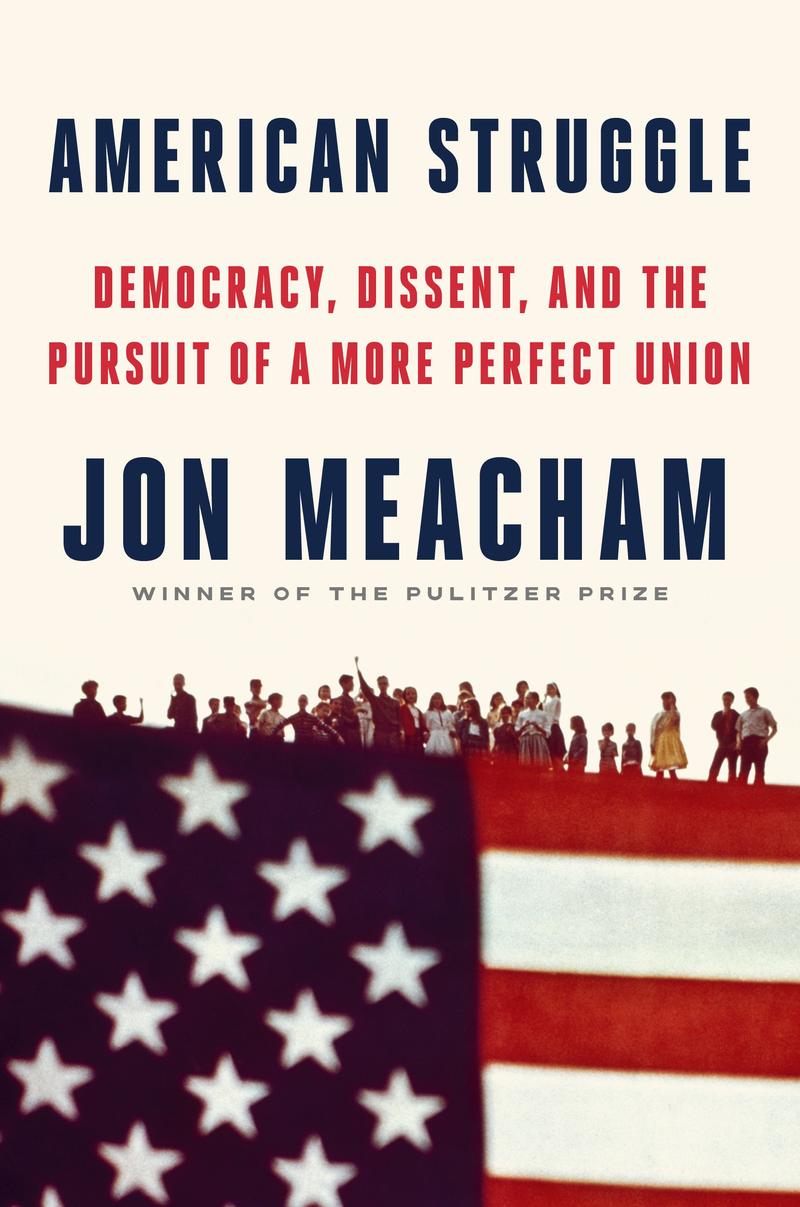
( Random House, 2026 / Courtesy of the publisher )
[MUSIC - Marden Hill: Hijack]
Brian Lehrer: Brian Lehrer on WNYC. For those of you who've been listening since the top of the show, you know that I tried to introduce one of the nation's great historians here on Presidents' Day, and then we had some kind of technical or other kind of problem, and Jon Meacham wasn't there. The bicycle guests hopped on real quick, so thanks again to Neil and Sophia for doing that. They were going to be the second guests today. Maybe you don't need to know all this housekeeping.
If you were listening at the top, you know we were going to have Jon Meacham, but we didn't yet have Jon Meacham. Now, one of the nation's great historians of presidents, in particular for this Presidents' Day and of the major themes of American history overall, Jon Meacham, who, in 2022, published a biography of Abraham Lincoln. Of course, Presidents' Day is sort of this combination of Washington's birthday and Lincoln's birthday.
His book called, And There Was Light: Abraham Lincoln and the American Struggle. He has also written books about Presidents Andrew Jackson, Franklin Roosevelt, Thomas Jefferson, and George H.W. Bush. I don't think I'm leaving any out. For this moment in history, Jon Meacham has a new book called American Struggle: Democracy, Dissent, and the Pursuit of a More Perfect Union. Jon, it's always an honor to have you on the show. Welcome back to WNYC.
Jon Meacham: You're very kind. I love being described in such superlative terms, but I can't tell the difference between Eastern and Central time, so that may undercut the generous introduction.
Brian Lehrer: That's what happened at ten o'clock.
Jon Meacham: My apologies.
Brian Lehrer: I see that the words "American struggle" appear in the title of both your new book and your Lincoln book, Abraham Lincoln and the American Struggle, and now, American Struggle. What do you mean by American struggle?
Jon Meacham: The perpetual, perennial debate and conflict that we have in the country between our worst instincts and what Lincoln called the better angels of our nature. I think the country is as subject to this human tension as we all are. I think that I know that if I do the right thing 51% of the time in a given day, that's a pretty good day. I probably don't have as many of them as I would like.
I don't want to drag you into that, but I suspect you might have some sympathy or appreciation of that. The struggle is, can we live into and make real the aspirations of the Declaration of Independence, or are we going to become a people controlled not by generosity and the rule of law, but by selfishness and appetite? I think it is a minute-to-minute, hour-to-hour, day-to-day, year-to-year unfolding battle.
Brian Lehrer: We will talk a lot as we go about the current moment, but let's take some particulars from history to help set it up, because that's what you do. In your Lincoln book, for example, I think one of the things that you might call a struggle is that he was against slavery, but he wasn't an egalitarian or an abolitionist. I saw you put it that way on MS NOW this morning. Can you talk about that complexity of Lincoln in that respect, being against slavery, but not an abolitionist or egalitarian?
Jon Meacham: Absolutely. It's very hard to put your mind back there, right? If you're Abraham Lincoln, you're against slavery. He was against slavery, but in a very specific 19th-century way. He was anti-slavery, which meant he did not want slavery to be expanded. The expansion of slavery was seen as essential to its ongoing survival, right? The people in what became the Confederacy were eager to expand their reach.
It was called the Golden Circle. Remember the Knights of the Golden Circle. The center of the circle was going to be Havana. Four presidential administrations heading into Lincoln's had tried to annex Cuba because the slavery would become the economic engine of a region, a circle. Ultimately, a nation in the secessionist view that really would scrape at the top, Richmond, and go all the way down into the Caribbean.
There was this imperial vision of slave-owning vision. Lincoln understood that. He wanted to stop it. The way to stop it was to stop the expansion of slavery. That said, as he said in his first inaugural to slave owners, "You have nothing to fear from me," because he was not going to interfere with it where it already existed. That's a complicating element to the story. Not to diminish in any way or to be self-righteous about Lincoln, but that is part, as you say, of this struggle.
He was not someone who actually really-- I don't want to say what he envisioned, but he certainly didn't expect the kind of multiracial, integrated democracy republic that we live in today. That's only been founded. We're all going to be talking about the 250th for the rest of the year, and I love that. I love anyone talking about what happened in 1776, but let's be very clear. The democratic, lowercase D, institution that our country that we live in now really only dates from 1965 with the Voting Rights Act and the Immigration and Nationality Act.
Brian Lehrer: With respect to Lincoln, you write in your Lincoln book about solutions he was willing to consider or embrace, like mass deportation of Black Americans to Africa or the Caribbean. Maybe he really believed in such things. Maybe he was just being pragmatic with respect to what he thought white audiences might agree to in exchange for ending slavery, but did his set of beliefs evolve during his presidency to get from where you described him in 1860 to the Emancipation Proclamation, for example?
Jon Meacham: There is this trope in the Lincoln story, which is that he grew and changed. He did grow. He came to live more fully into and act more fully on his moral conviction, as he put it at Cooper Union, that slavery was wrong. What the white South wanted in many ways, as Lincoln said then, was not only to be told that we would leave them alone, but they wanted to be told they were right. There was an emotional component there. The Lincoln of the Emancipation Proclamation, the Lincoln of 1864, was a more devoted and more effective warrior against slavery. In 1864, he ran on a platform calling for what became the 13th Amendment, which was unthinkable, really, in 1860, only four years before.
Brian Lehrer: The new book is a collection of your writings, I will tell the listeners. It's not just about presidents. You've got Abigail Adams in there, the wife of John Adams on women's rights. You've got Fannie Lou Hamer. You've got the early 20th-century socialist presidential candidate Eugene V. Debs, who Mayor Zohran Mamdani quoted in the very first line of his election night victory speech. How many years of your writings about what you call the American struggle does this collection span, and how many years of American history itself?
Jon Meacham: It starts in 1619, which, though I am older, I did not start then.
Brian Lehrer: [chuckles]
Jon Meacham: It feels like that sometimes. This is a collection of primary voices. This is a chorus, if you will. Chorus suggests harmony. Perhaps that's not the right metaphor, but it is a convening, as we say now, of formidable, important, often overlooked and marginalized voices about who we are and who we ought to be. What I wanted to do was really have-- It's almost as if calling different people to the witness stand to tell us about America.
It starts with the summons to the first Virginia representative government in Jamestown, goes all the way through Steve Levitsky of Harvard, the author of How Democracies Die, and a piece he did in Foreign Affairs just of last year. It covers the gamut. It is a way for us, I think, I hope, to see that this has been a close-run thing, as Wellington said of Waterloo, all the way through. The reason we managed to create a more perfect union by and large is because we have heeded the voices that seemed on the margins at the time, but which should always have been in the center of the square.
Brian Lehrer: Listeners, your questions, comments, or stories welcome for historian Jon Meacham on this Presidents' Day, on anything past or anything relevant about the present, which we will get more explicitly to, in the context of his new book, American Struggle: Democracy, Dissent, and the Pursuit of a More Perfect Union. 212-433-WNYC, call or text with your comment, question, or story, 212-433-9692. Following up on the last answer, how different is it for you to write about presidents, and you've done these various notable biographies of presidents, than to write about dissidents or pro-democracy reformers who you center in this book?
Jon Meacham: This is the whole context of the country, right? I sometimes feel guilty, and particularly on Presidents' Day. Folks who do what I do naturally, inevitably end up centering, or perhaps even over-elevating, a particular president in a given era. It's a narrative necessity in many ways. It's a way of telling the story in a way that's quite clear, but presidents are both constrained and liberated by those in the polity of that given era. When we talk about the age of Jackson or the age of Roosevelt, okay, absolutely, that's a useful way of discussing things.
What made the age of Roosevelt possible was, on the New Deal side, the work of people like Frances Perkins, right? The remarkable, at that point, less effective, but persistent and brave early civil rights work, the voices of interventionists who were fighting back against the America First people. The history of a constitutional democracy is not simply the history of those who achieve and amass ultimate power, and then wield it.
It is the story of all of us who invest in a system that invests that person with power, and then what that power is able to actually accomplish within a political framework that's created by our expectations, our hopes, our fears, our activism, or lack thereof. I think we're all seeing this right now, right? There are so many people in the America of 2026 who have two questions. One is, how is this happening? The second is, how can I keep it from happening? Those questions are unique and powerful to our time. They're powerful at our time, but they're not necessarily unique to our time. The question itself.
Brian Lehrer: I'm interested in the fact that you brought up, how do we get out of this? I think it would be accurate to say that when we talk about current affairs on this show, we get a lot of calls and texts from listeners who don't want to just acknowledge what's going on in the government today, no matter how stark terms any guest may put it. Many of those listeners who are horrified by what's going on want to ask what they and others can do about it. Since you do center pro-democracy reformers in the essays in this book, the subtitle puts the words "democracy" and "dissent" side by side. Does history provide any lessons for today in that respect?
Jon Meacham: Absolutely. In a way, history provides the only lessons. The only lessons that I can think of, and correct me if you think I'm overstating or missing something, is dissent from a-- If there is a prevailing consensus or a prevailing power structure that is doing things, which you, as a member of the democratic covenant, again, lowercase D, find to be out of sync and undesirable, then the insight and the power of American constitutional democracy is that you take your stand within that arena against that prevailing course of action.
You seek to manufacture opinion that will translate itself into votes and a climate that will stop, reverse, reset, pick your verb, that prevailing course of action. That's what citizenship is. That's what democratic citizenship is. Look, we haven't been invaded by aliens. Alien life forms from outer space did not come into the United States in 2015 and create this decade, right? This is the fullest manifestation of many perennial forces that are always present in the American body politic.
It's just that, at our best, we've managed to make those forces ebb as opposed to flow. Right now, they're flowing. What does history tell us? Well, history tells us that until 20 minutes ago, until 1965, we lived under some forms of functional apartheid in my native region in the American South and elsewhere until 1965. If you want the best example, the most vivid example, is look at the civil rights movement, the freedom movement for Black Americans in the middle of the 20th century.
Let's take a step back, right? John Lewis and Dr. King, and you mentioned Fannie Lou Hamer, are in this book, in their own voices, right? They don't need me. What do we know from that story? We know that there was a prevailing consensus that the Supreme Court in 1896 had said that separate but equal was constitutional. Generations acted on that under, if you will, the color of that. It created a segregated, unfair society. It was the individual witness. It wasn't particularly powerful people.
It wasn't until 1954, even the Supreme Court again. It wasn't an American president. It wasn't the United States Congress heading into the middle of the 20th century that said, "No," right? It was individual people. It was Ida B. Wells, this wonderful essay column of hers in this book. They said no. Because of the remarkable acts of, to me, unimaginable bravery, the conscience of the country, as Frederick Douglass said, was roused. It wasn't because powerful political actors decided to do it.
As someone who writes about the American presidency, I wish that I could say that Wilson, Harding, Coolidge, Hoover, FDR, that they came to power, looked back at Plessy v. Ferguson, and said, "No," but they didn't. Everyone is complicated, et cetera, so I stipulate that, but it wasn't that. It wasn't. It was a series of court cases. Then a chief justice, appointed by Dwight Eisenhower only because of the unexpected death of the chief justice, Fred Vinson, in September 1953, that, by May 1954, creates a unanimous verdict.
Even then, it took 10 more years for the Civil Rights Act to pass and 11 years for the Voting Rights Act to pass. What the Supreme Court was doing in 1954 was unusual and vivid. It was a force of the rule of law. The rule of law can play this role. Individual agency, protests, dissent can play this role. There's rarely one factor. I think that's going to be true today, honestly. I think it'll be the institutions. I think it'll be individual citizens that will say, "No, we are not going to be an authoritarian country for long."
Brian Lehrer: We'll continue in a minute on this Presidents' Day with presidential historian and historian more generally, Jon Meacham. His new book, American Struggle: Democracy, Dissent, and the Pursuit of a More Perfect Union. When we continue, we'll get right to some of your calls and texts. We'll talk more explicitly about the current moment, as Jon was just doing, but we spent most of our conversations so far talking about history. We'll plant ourselves even more in the present. I'll ask him about something I saw him say on television this morning about this administration engaging in political sadomasochism. What? What's the masochism part of that? More with Jon Meacham and you. Stay with us.
[MUSIC - Marden Hill: Hijack]
Brian Lehrer: Brian Lehrer on WNYC, as we continue with historian Jon Meacham and his new book, American Struggle: Democracy, Dissent, and the Pursuit of a More Perfect Union. By the way, if you don't get enough of Jon Meacham here or want to see him in person, he'll be doing a 92nd Street Y book event tomorrow night, Tuesday night at seven o'clock in conversation with John Dickerson. Maybe John Dickerson will have something to say, too, about no longer working at CBS News, but I don't know. They sell tickets for both in-person and live streaming attendance. Take your choice at 92y.org for that tomorrow-night, Jon Meacham/John Dickerson event. Steve in Hell's Kitchen, you're on WNYC with Jon Meacham. Hello.
Steve: Hi. Hey, I want to suggest that we look at what happened in the '20s, where the Congress decided that there's enough of us here. Used to be, every census, we'd increase the number of districts. We've now frozen the number of districts, and the districts get bigger and bigger. They're pushing 800,000 people. Used to be 30,000. Maybe it used to be we'd get to 70, and then they would add districts, and so forth.
I think this is a huge thing that gets overlooked. It is what creates the opportunity for gerrymandering. It removes people from close relationships with their representatives. It also distorts the Electoral College, such that people in Wyoming, because they have only one representative, have basically three times the say as to who becomes president than, say, a resident of New York or California.
Brian Lehrer: Steve, I'm going to leave it there. You're raising a very particular issue. Jon, do you want to address it at all in the context of your book or this broader conversation today?
Jon Meacham: I will just say about the 1920s. That's a very astute analogy. 100 years ago, anti-immigrant sentiment, institutional racism, the rise of the second Klan, which had been refounded after at Stone Mountain, Georgia, in 1915. We were emerging from a global pandemic. We were emerging from an unsettling, cataclysmic war. The 1924 Democratic convention over at Madison Square Garden went to 103 ballots because there were 347 Klan delegates there who wouldn't vote for Al Smith because of his Catholicism.
The 1924 Immigration Act, which I think the caller is alluding to, uses a national quota system, which was what prevailed until the moment we discussed a moment ago, the 1965 Act undid it, basically. You also had the rise of a new technology, which we're currently on. [chuckles] Radio wasn't really commercially available in the country until 1924, '25. It was a first time, one more thing, as I think about it, huge demographic change. The 1920 census was the first time more Americans lived in cities than on farms. You had these conditions for a kind of extremism that I think, in many ways, we are experiencing today.
Brian Lehrer: Peter in SoHo, you're on WNYC with Jon Meacham. Hello, Peter.
Peter: Hello. Thank you for taking my call. I just have one brief question. I would like to ask Mr. Meacham to imagine that today is 75 years from now, February 16th, the year 2101, and you've just completed a history of the Trump years. What would be the title of your book?
[laughter]
Jon Meacham: Oh, my goodness.
Brian Lehrer: 75 years from today. That means it would have been over and digested, and whatever was permanent from it would have been permanent. Whatever was rolled back from it would have been rolled back from it. That's a tall order for a historian, but, Jon, have you ever given that any thought?
Jon Meacham: I weirdly do think like this. Although I will say this, if I'm publishing a book in 75 years, that means The Jetsons underestimated the possibilities of the future. That's a caveat. What we don't know, and this is a vital question, is was this an exception, or did it become the rule? The title of that book would be determined. Would it be the beginning of what became a 75-year run with a broken social covenant and a constitution that proved incommensurate to the challenges of the 21st century, or was this a cautionary season? I certainly pray it is the latter, but that would be what determines what that book would be.
Brian Lehrer: Well, do you see the struggle of today as uniquely threatening to the very institution of democracy as a student of American history?
Jon Meacham: Yes, I do. For a long time, I thought-- you and I talked about this along the way. This is where I am admitting where I was wrong. From 2015 until late 2020, I thought that President Trump represented a difference of degree, but not kind, that, basically, the forces that he embodied and manipulated and deepened were all recognizable, right? You could place it all on a spectrum. It wasn't a good part of the spectrum, but it was on the spectrum.
Then what I think of as the unfolding January 6th, not simply the attack on the Capitol, but the attack on the integrity of an evidently fair election, is a unique contribution to the distrust and the erosion of democratic institutions. If you think about it, no American president, including Andrew Jackson, went to such lengths to overturn an election because they didn't like the results. Jackson didn't do it in '24. Hubert Humphrey didn't do it in '68. Richard Nixon didn't do it in 1960. Hillary Clinton didn't do it in '16. Most notably, Al Gore didn't do it in 2000. I think we will be living with that virus that President Trump introduced into the body politic for a long time to come, and that is a unique threat.
Brian Lehrer: On this difference of degree and difference of kind, the terms you just used, I wonder how far you fear that that may go. Over the weekend, I went to see an exhibit at the Poster House in Midtown Manhattan called, The Future Was Then: The Changing Face of Fascist Italy. It was mostly displays of poster art that Mussolini used to help consolidate his power and push the fascist idea, but there was also text accompanying the art, including some quotes that were pretty chilling to a contemporary person who went to that exhibit without making any reference explicitly to anything here today.
I'll say they did not say, "This is a lesson for Trumpism," or anything like that. It was a poster art exhibit called The Future Was Then: The Changing Face of Fascist Italy. Let me read a few of the lines that were in the text surrounding the art. "The party rejected the view that violence is inherently negative or pointless, and instead focused on political brutality as a path to national rejuvenation and manifest destiny. In this case, the creation of a new Italian empire as an imperative."
Another one, a Mussolini quote that was up on the wall. "Fascism should be more appropriately be called 'corporatism' because it is a merger of state and corporate power." One more. It was a Leon Trotsky quote that was up. "Art, it is said, is not a mirror, but a hammer. It does not reflect its shapes." On that one, I'm thinking of the imperative Trump felt to change the Kennedy Center, or maybe the way he felt art has been used as a hammer by the left. Do you see any parallels in the way the current administration or the movement behind it are operating, or is that too much of a stretch?
Jon Meacham: I think those with eyes to see and ears to hear have an obligation to use the kind of critical thinking and capacity for reason that you used this weekend and render their own decision. They don't need me to tell them what to think. Look at what's unfolding, listen to what is being said, and render a decision about whether this is the direction in which you want the country to go. I've made my decision. I've been very clear, I think, that I believed and argued that it was not worth the risk to re-elect President Trump in 2024 because of the reasons I laid out.
I should say, I'm not a Democrat. I'm not a Republican. I've voted for candidates of both parties, but I've done what I'm recommending, right? I have looked. I listened. I have thought. I don't think there's any doubt that people who fully engage with the historical sensibility, informed by historical sensibility, will come to a conclusion that this is not the direction in which people devoted to, in their hearts and in their minds, to an American experiment informed by the Declaration, shaped by the Constitution. This is not the direction we want to go in.
Brian Lehrer: Jon Meacham, presidential historian who has written books about Andrew Jackson, Franklin Roosevelt, Thomas Jefferson, George H.W. Bush, and, for this moment in history, a new book, a collection of his writings called American Struggle: Democracy, Dissent, and the Pursuit of a More Perfect Union. Again, if you want to see Jon Meacham in person or on a live stream, he'll be doing a 92nd Street Y book event tomorrow night, Tuesday night, seven o'clock, in conversation with John Dickerson. They sell tickets for either in-person or live streaming attendance at 92y.org. Thank you for joining us, Jon.
Jon Meacham: Brian, thanks so much.
Copyright © 2026 New York Public Radio. All rights reserved. Visit our website terms of use at www.wnyc.org for further information.
New York Public Radio transcripts are created on a rush deadline, often by contractors. This text may not be in its final form and may be updated or revised in the future. Accuracy and availability may vary. The authoritative record of New York Public Radio’s programming is the audio record.