
Albany Update: Budget Status, Buffer Zones and Teachers' Pensions
[music]
Brian Lehrer: Brian Lehrer on WNYC. We're going to check in now on some of the sticking points in the New York State budget negotiations, now running six days late, and a number of big things at stake for New Yorkers. With me now is POLITICO's Albany bureau chief, Nick Reisman, to talk about Governor Hochul's affordability push and her standoff with the left over taxing the rich, plus early pension access for public school teachers, interesting debate that's getting a little bit of press. We'll dive down on that a little bit. Also, buffer zones around houses of worship, and how Republican gubernatorial candidate Bruce Blakeman is quietly all of a sudden trying to scrub some Trump from his campaign website, Nick reports. Nick Reisman from POLITICO, always good to have you. Welcome back to WNYC.
Nick Reisman: Hey there, Brian. Thanks for having me.
Brian Lehrer: Can we go right to this early pension access for public school teachers? They want to lower the retirement age?
Nick Reisman: That's right. There's a couple things that they want to do here. This all dates back to 2012, when then Governor Andrew Cuomo pushed through this less generous pension tier called Tier 6, and it was meant to save money over several decades. What happened was, labor over the last 12 years or so has really tried to chip away at some of the Tier 6 savings. They have argued that it has made it harder to recruit public employees-- not just teachers, but really anybody who works for either the state government or for a local government. That could be a school district, it could be a town, it could be New York City. They say it has made it harder to recruit these people.
So this year, there's been a lot of momentum building up, mostly among unions who carry a lot of political clout in New York, especially in the Democratic-controlled State Legislature, and they have been pressing to make these changes to the Tier 6 pension. That includes lowering the retirement age to 55, and they also want to lower the contributions that public employees have to make as part of their pension, so they would have less taken out of their paycheck as a result of that.
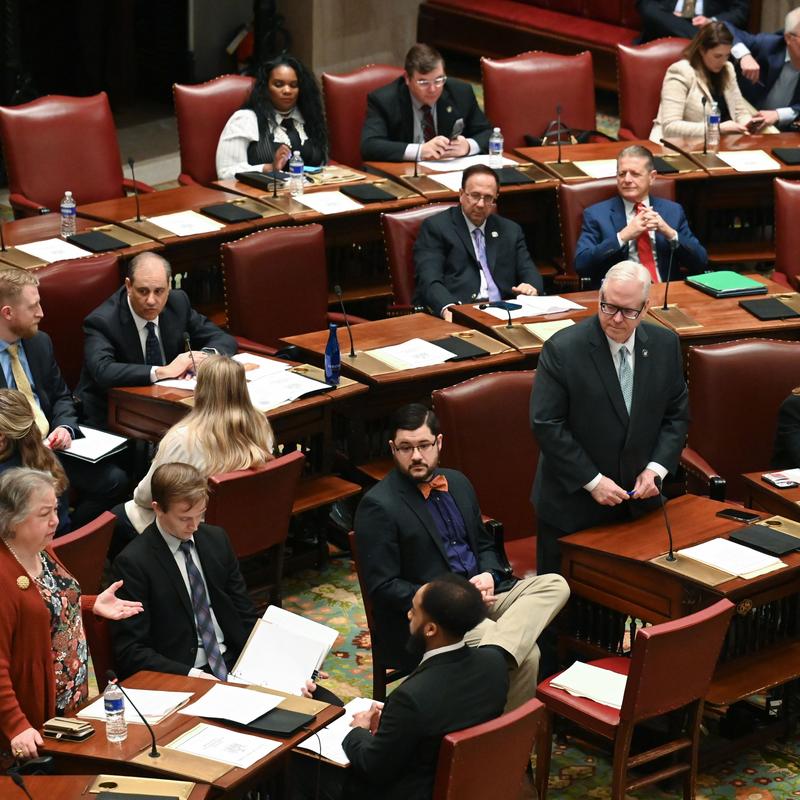
Now, this is something that the legislature has apparently been on board with. Governor Hochul spoke at a rally here in Albany a few weeks ago with labor unions to rally in favor of Tier 6 changes. The governor has not said what she embraces just yet, but a labor-backed plan that has been floated by the AFL-CIO would cost about $1.5 billion a year in New York, and that would be combined contributions from the state government, from New York City, from local governments, and school districts. So this is a potentially costly move for New York to make right now, but of course, this is all taking place against the backdrop of an election year in which labor unions are expected to once again flex their muscle.
Brian Lehrer: Yes, and I see that UFT president, Teachers Union President Michael Mulgrew, for example, is threatening to get or pressure his allies in the legislature to vote down the entire budget if it doesn't include these significant Tier 6 fixes. But for people who don't work in government jobs, Tier 6 is kind of an abstraction that can make the mind go numb. Is there a larger debate implied here, or is it more narrow than this about at what age public employees should be allowed to retire, and that that might even extend to what age other kinds of employees should be allowed to retire with their pensions if they're in companies that have pensions?
Nick Reisman: Right. And it's a good point to make here, Brian, that if you're a private sector employee in this day and age, odds are you do not have a pension. Or if you do, it's relatively modest. You're most likely in a 401(k,) if you have one at all. It's important to go back to 2012 when Andrew Cuomo was pushing this through. This was only a few years after the onset of the Great Recession. There had been a lot of government belt-tightening in those years from 2008 to well up until just a few years ago, so there had been a lot of concern about the long-term costs of the state's pension plan.
Now, it's also important to keep in mind here, as you said, the UFT is very, very politically active. I spoke with Michael Mulgrew a couple of days ago, who said that the outcome of this debate is almost certainly going to be kept in mind when the UFT makes its endorsements of state legislators. A number of Democratic state lawmakers have primaries that are coming up in only a few short weeks in June, so this private versus public sector pension plan is probably not at the forefront at this moment. But if you're a taxpayer who lives in a community that may have to make some decisions, some tough decisions about what its budget is going to look like as a result of these Tier 6 changes, you may also wind up voting accordingly as well.
Brian Lehrer: Here's Jesse in Manhattan calling on this before we go to this other issue in front of the legislature, the buffer zone for protesters outside houses of worship. Jesse, you're on WNYC. Hello.
Jesse: Hi. I currently work for the City, and I'm Tier 6 because I was hired right after the pandemic, and most of my other co-workers are also Tier 6. My union has been sending a lot of mailers about wanting us to go to Albany for these protests, mostly headed by the state teachers union, about what they call fixing Tier 6 to make it more like Tier 3 and Tier 4, where-- I think they previously had it where Tier 6 only vested after 10 years of unemployment, and they changed that back down to 5 years vesting, in line with Tier 3 and Tier 4. Also, Tier 3 and Tier 4, they only have to pay into their pension a fixed 3.5% of their income for 5 years or 10 years, something like that, and Tier 6 has to pay a variable amount, depending on your income, for the entirety of your employment towards your pension.
Brian Lehrer: So if you were hired later, there's more obligations to participate in your pension, and it's harder to get vested, right?
Jesse: Correct, but I think they've changed it-- as I said, they changed it back from 10 years to vest to 5 years to vest, so there's that. They count as a victory, but they're still talking about pension contributions.
Brian Lehrer: Jesse, thank you very much [crosstalk]-- Oh, go ahead, Nick.
Nick Reisman: No, I was just curious who his union was. I assume it's DC37, which represents City employees.
Jesse: No, I'm OSA.
Nick Reisman: OSA. Okay, thank you. Just curious.
Jesse: Yes. Organization of Staff Analysts.
Nick Reisman: Got you.
Brian Lehrer: Okay, thank you very much. Is the bottom line here something-- Because I know they have big pension funding discussions in the New Jersey Legislature as well. Is this the aging of the population and people living longer as well, and so there are more retirees with more years likely to go in their retirement, and pension math is not the same as it was a generation ago or two?
Nick Reisman: You know, that's a question probably for an actuary, which I just-- I don't know off the top of my head, but I will say this: On the pension fund writ large, Wall Street has done phenomenally well, spread out over the last five years or so. It's been on a phenomenal upswing, in large part thanks to a handful of very pricey stocks, many of them, by the way, in artificial intelligence. But the New York State pension fund is, I think, closing in around $300 billion or so. If anybody in Tom DiNapoli's office knows the exact number, please correct me, but it's done quite well. Your last guest talking about the war in Iran and some of the impacts in New York in particular, could wind up being the stock market gyrations that could put some of those gains at risk that we have seen in the financial market, so this is kind of a precarious time right now for the financial markets. Also, and I'm sure we'll get into this, the overall fiscal health of New York if this war is prolonged and some of the economic effects really become troublesome.
Brian Lehrer: This is the segment of the show where I thought we weren't going to talk about the war, but interesting how it relates even to things like teachers' pensions. Another thing holding up the budget, which was supposed to be passed by April 1st, that's when the new state fiscal year starts, and this doesn't seem like a budgetary issue, but there's a proposal to create buffer zones around houses of worship, closer than which protesters may not gather. What's exactly the standard, and what's controversial?
Nick Reisman: Well, at this point, what the governor has been seeking is, she wants a 25-foot buffer zone around these houses of worship. As far as I can tell up until this point, it seems like this is something that is most likely going to be included in the final budget. Based on some of the reporting we've done, there have been some polls that have been conducted by Jewish organizations and Jewish charities and nonprofits in New York, and they found that voters are broadly in favor of something like this. Now, of course, it depends on how you ask this question, but there have been polls showing a majority of Jewish voters, Christian New Yorkers, Christian voters, and also Muslim voters who are supportive of creating these protest buffer zones around these houses of worship.
The start of this was some of the pro-Palestinian demonstrations that we saw last year that had been gathering, started to gather last year around houses of worship. They are continuing in some instances, and there was enough alarm over this that it has led to this push for these buffer zones. Some of the opponents say that this is a potential free speech concern, but on the other side of this, you also have the other part of the First Amendment that guarantees the right to worship and freedom of religion as well, so it does play into both those concerns. As far as I can tell up until this point, that buffer zone legislation is probably going to survive more or less intact in the final version of the budget.
Brian Lehrer: The New York City Council just passed something related, but from what I've read, watered it way down. No defined distance from the house of worship, no protest-free zone explicitly, Mayor Mamdani expressed reservations about restricting the right to protest, so how different is what the city just did from what the state is debating? And where does this leave Democrats trying to thread this needle between protecting people entering houses of worship from intimidation, or even violence? Or maybe violence is a separate question because it's certainly already illegal, maybe it's from intimidation, you tell me, trying to thread the needle between that and free speech.
Nick Reisman: I would say the big difference this time around, though, is that it's included in Governor Hochul's budget. The governor has pretty broad purview over some of these policy measures that she likes to include in the state spending plan. It is why the legislature generally-- not just on this specific issue, but generally, do not like to see the governor include non-fiscal policy in the state budget. Because typically, what the governor wants, the governor will ultimately get in the budget when it comes to something like this.
Ultimately, the biggest difference here is Governor Hochul's advocacy for something like this. This does not seem like something she would want to trade away in the budget. In the final version of it, maybe it gets whittled down to 15ft versus 25ft, but-- Keep in mind, the governor, unlike the mayor, quite frankly, has been a staunch supporter of Israel, had traveled to Israel soon after the October 7th attacks,and this has been-- I think it's close to say, close to a priority for her in this budget. She has mentioned it frequently when she's listing her public budget priorities, so it's something that, with the governor's support, likely will continue on in a final deal.
Brian Lehrer: Before you go, let me touch briefly on some reporting you did about the Republican candidate for governor, Bruce Blakeman. He was denied millions of dollars in campaign matching funds last week over a paperwork issue. The Republicans are claiming that the state, which is run largely by Democrats, did this in a partisan way. You also reported explicitly on Blakeman quietly scrubbing language from his campaign website saying he "Stands with President Donald Trump," when that was one of his claims to fame that helped him win the nomination in the first place, was that he had gone from a more moderate Republican in the past to a big Trump supporter. So what's up with Bruce Blakeman?
Nick Reisman: Well, on the public financing situation, it's a very Kafkaesque concern here, where Blakeman was supposed to file a form that doesn't yet exist under the public financing regulations and rules. It's very, very New York state bureaucracy, but the upshot here is that Blakeman was denied these public matching funds. Which is deeply ironic, considering that Democrats for years had called for a statewide system of public financing similar to what's in place in New York City politics and elections right now, and this is the first year that it's in effect statewide.
The Democratic nominee for governor, Kathy Hochul, is not taking public matching funds, she's not participating in the program. Bruce Blakeman is trying to. The Republican has been essentially denied because of this bureaucratic snafu, if you will. So, more to be seen there, especially since Blakeman's campaign is most likely going to sue over this to try to get some of the money. On the Trump situation, this is a strange one, considering that he had on his website a part of a drop-down menu that said that he stands with President Trump, and lists some of the areas where they agree on issues like law and order and immigration, and yet he took that down off his website. I reached out to his campaign to ask what was going on there, and they sent me back a statement not denying it, but then attacking Kathy Hochul.
What's strange about this is that it really does highlight the conundrum that a lot of Republicans running statewide in New York face. Donald Trump is deeply unpopular in this state-- not just in New York City, but statewide, and Trump likely will be the boogeyman once again for Democrats in their elections, and an effective one at that. And yet Blakeman and any Republican running statewide needs to show to the Republican base, as small as it is in New York, that he's a Trump person, that he has the backing of the president, because Republicans, no matter where they live, are overwhelmingly supportive of the president and his policies. So it's a real contradiction. As you said, it's a real needle to thread here for Bruce Blakeman, and so far, it remains to be seen if he can wind up doing something like that successfully.
Brian Lehrer: Nick Reisman, the Albany bureau chief for POLITICO. Thanks for filling us in, Nick.
Nick Reisman: Thanks so much, Brian.
Copyright © 2026 New York Public Radio. All rights reserved. Visit our website terms of use at www.wnyc.org for further information.
New York Public Radio transcripts are created on a rush deadline, often by contractors. This text may not be in its final form and may be updated or revised in the future. Accuracy and availability may vary. The authoritative record of New York Public Radio’s programming is the audio record.
