
Albany Budget Deadline Day
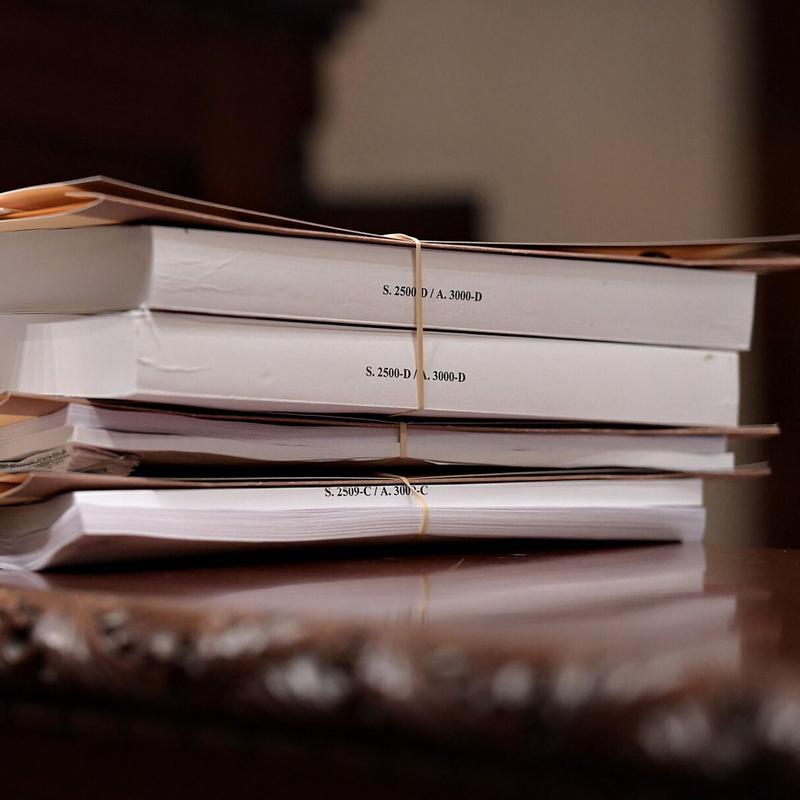
Brian Lehrer: Brian Lehrer on WNYC, and it's April 1st, first day of the new fiscal year for New York State when the new budget is supposed to have been passed. Governor Hochul and lawmakers in Albany have now officially missed that deadline for the fourth year in a row. They did pass a one-week extender to keep the lights on through next Tuesday, but negotiations are still very much ongoing.
On what? Well, the big sticking point that everyone's talking about is taxes, specifically whether to raise them on the wealthy to help fund Mayor Mamdani's agenda and close New York City's $5.4 billion budget gap, but there's a handful of other fights still getting worked out as well. With me now to take us inside the negotiations is none other than our own Jon Campbell, who covers Albany for WNYC and Gothamist. Hi, Jon.
Jon Campbell: Hi, Brian.
Brian Lehrer: The budget's late again, and lawmakers passed a one-week extender yesterday. Practically speaking, are there any consequences for everyday New Yorkers? I assume this is not like a government shutdown like we've been covering from Washington, where things actually grind to a halt.
Jon Campbell: Yes, this is very different from the federal shutdowns that we've seen over the years. That's largely because there's some boring budgetary, structural reasons for that, but also mostly because the lawmakers passed an extender yesterday. Basically, what that is, this one in particular is about a week long. It'll get us through Tuesday, through the early days of Passover, and through the Easter holiday. What that really, really does is it ensures state employees get paid. This year and in all the other late-budget fiascos over the years, these extenders have been passed to ensure the employees get paid.
No, you don't see the same kind of consequences that you do at the federal level, but that doesn't mean there are no consequences, especially school districts throughout the state, for example, rely on heavily on state funding. They're putting their budgets together for school budget votes in May. They need to know how much money they're going to have so they can put their own budgets together. Local governments, same kind of idea, so it's not that there's no consequences, but certainly not the consequences that you see on the federal level.
Brian Lehrer: Yes. For context, last year's budget didn't really come in until May 9th, so that's pretty far past the April 1st official deadline. Here's Assembly Minority Leader Ed Ra, Republican from Long Island, blaming it on the party in charge.
Ed Ra: There doesn't seem to be any urgency, any desire to meet this deadline anymore, which is crazy to me, given that we're in year eight of one party controlling our government here in Albany.
Brian Lehrer: Year eight of, I guess, the Cuomo plus the Hochul years. Cuomo actually always prized himself on on-time budgets. Did he get them consistently?
Jon Campbell: Yes, he did get them consistently. Really, of the last 40 budgets, 30 of them have been late. Of the 10 that were on time, 7 of them came under Andrew Cuomo. He prioritized on-time budgets as a symbol of government functionality, right? He came into office, he really, really prioritized on-time budgets, so he can say, "Look, I've got the trains running on time."
Now, Governor Hochul has taken a very, very different approach. She's taken the approach that the longer she waits, the better it is for her strategically. We've asked her over and over, and she says, "A good budget is better than an on-time budget." She has held out for things in the past, like changes to the state's bail laws, and has gotten some concessions from lawmakers. Remember, lawmakers aren't paid while their paycheck is withheld. They eventually get that pay when the budget is approved.
That's not the case with the governor. The governor continues to receive her pay. In all five years now, all five budgets that Kathy Hochul has presided over, they've all been late. This is either the seventh or the eighth consecutive late budget, depending on how you count some votes in 2019 that actually spilled over the deadline just a little bit. This is a rite of passage in Albany. The current governor, Governor Hochul, has made this a strategic play on her part to go beyond the budget deadline.
Brian Lehrer: All right, taxes. A few weeks ago, the state Senate and Assembly took Mayor Mamdani's side and incorporated his income tax increase on people with a million dollars or more of annual income and the highest-earning corporations as well into their proposed budgets. The governor's been against it. Mamdani, I see, has since circulated a narrower, more New York City-specific proposal, a set of corporate tax increases specific to city businesses that would generate about $1.75 billion a year, down significantly from the $5 billion statewide corporate tax he campaigned on, according to New York Focus. How much does this change the game?
Jon Campbell: Well, that's the thing here. That plan was circulated by Mayor Mamdani before the Senate and the Assembly put out their budget proposals earlier this month, and the Senate and the Assembly adopted those positions. Similar positions, I should say. There's other taxes on real estate and what's known as the pass-through entity tax credits that they want to scale back. They adopted similar position to the mayor.
Now, that's the thing here, right? We say the budget, the state budget, $260 billion state budget. The wild thing here is the governor and lawmakers haven't even really started talking about dollars and cents yet. We're into the new fiscal year. We're past the deadline now. All the talk to this point, the major negotiations between the major players here has all been centered on policy, right? They haven't even gotten to the point where they're talking about taxes and whether they will increase taxes on the wealthy, which the governor opposes, or increased taxes on corporations, which the governor has been a little softer on. They're not even to that point yet, so there's really no update from earlier this month.
Brian Lehrer: Mamdani is staying away from the Tax the Rich rallies. Bernie Sanders, some of our listeners know, drew thousands to the Bronx on Sunday. That was organized by the New York City DSA, Democratic Socialists of America, alongside some labor unions, but the mayor himself didn't show up. Is that a strategy?
Jon Campbell: I think it's safe to say, yes, that's a strategy. He has this allyship with Governor Hochul, right? Governor Hochul endorsed his campaign. He has endorsed her campaign. He needs her to pass all sorts of things in Albany. The way the government is structured, New York City needs permission from the state to do any number of things, whether it's raise taxes on the wealthy, raise the New York City income tax, raise the corporate tax, anything like that, which he wants to do to fund his agenda.
He needs the governor's support, or at least not her opposition. Going to a rally, a Tax the Rich rally, which is very, very much focused on trying to convince Governor Hochul to tax the rich when she has been opposed to that, could be antagonistic to the governor, a governor that he needs to get his agenda funded. I think that is strategic. It's a tricky balancing act because the left, the DSA, the Democratic Socialists of America, that is his base. Living in the real world, he knows he needs Albany allies on his side and, in particular, the governor.
Brian Lehrer: Another unresolved issue, car insurance. Governor Hochul has made reforming the state's auto insurance laws a major part of her budget pitch. You reported that Uber spent $8 million backing her position. What's she actually proposing, and why is it so contentious?
Jon Campbell: Yes, there's a handful of changes she wants to make, but the two big ones I'll touch on. One would change the way that courts award damages that result in car wrecks. The system right now, a person who is mostly responsible for a wreck, say a jury finds them to be 25% responsible for a wreck, they can still collect damages in court, though their award is reduced by a percentage of faults. If you're awarded $100,000, but you were 75% at fault, your award would be reduced by $75,000.
She wants to change that, so you can really, really only get a court payout if you are less than 50% responsible for a crash. If you were more than 50% responsible, you wouldn't be essentially eligible. She also wants to change what counts as a serious injury, where victims can seek additional compensation. She wants to narrow that. It gets complicated, but essentially, she wants to narrow that. This set up a really big fight at the Capitol between two titans of influence right now.
One is Uber, which you mentioned, which is funding an $8 million ad campaign through an entity known as Citizens for Affordable Rates, C-A-R, CAR. Get it? The other is the trial lawyers. The New York State Trial Lawyers Association, which has long been this huge lobbying force at the Capitol, has very close relationships with members of the legislature. Uber would stand to see their car insurance rates, in theory, go down, their litigation costs go down. That would be the same for other people with big fleets.
The MTA is pushing this, for example. The trial lawyers say you're taking victims' rights away, and that you're making it harder for a victim of a crash to seek and receive compensation. It's set up this big battle. So far, lawmakers are siding with the trial lawyers. The governor is on the side of Uber. She says it would also lead to lower car insurance rates. There's some debate about that, but that's the state of play here. The governor's insisting it would be in the final budget. Lawmakers are resisting. We're in a stalemate.
Brian Lehrer: I'll note that you spoke with MTA Chair Janno Lieber yesterday. Though this is, on the surface, just about cars, not mass transit, apparently, the MTA has a dog in this fight, too. Let's hear what he had to say.
Janno Lieber: Transit has a lot at stake in the auto insurance debate because transit operators, especially the MTA, are getting slugged with these massive windfall payouts, even when the transit bus or the transit operation is only slightly responsible for something, so we become a target for litigation.
Brian Lehrer: There's MTA Chair Janno Lieber with our Albany correspondent Jon Campbell. Jon, did that surprise you?
Jon Campbell: Well, no, because he has been speaking out about it in recent weeks, but it was a little surprising that he was at the Capitol specifically for that yesterday. He was meeting with senior lawmakers, basically trying to convince him of his point there. He went on to say later that it would be the same with anybody with a big fleet of vehicles. That is certainly the case with Uber, which is the reason why they're spending lots and lots of money trying to get this through.
The MTA says it spends about $50 million a year on these litigation costs and payouts associated with this, but also has to budget for $200 million or so just to account for the possibility of some particularly big payment or payments. This is on his brain. The governor is trying to shift the conversation away from Uber and how it would benefit Uber more toward what she sees as benefits for the general public. This is one way that we're going about it.
Brian Lehrer: All right, so taxes, car insurance law, how quickly to continue the decarbonization of New York State, all those things in play and more as the New York State budget is officially late here on the first day of the new fiscal year. We thank WNYC and Gothamist Albany correspondent Jon Campbell for giving us the latest. Jon, thanks a lot.
Jon Campbell: Thank you, Brian.
Copyright © 2026 New York Public Radio. All rights reserved. Visit our website terms of use at www.wnyc.org for further information.
New York Public Radio transcripts are created on a rush deadline, often by contractors. This text may not be in its final form and may be updated or revised in the future. Accuracy and availability may vary. The authoritative record of New York Public Radio’s programming is the audio record.