
Adam Gopnik's New York Stories
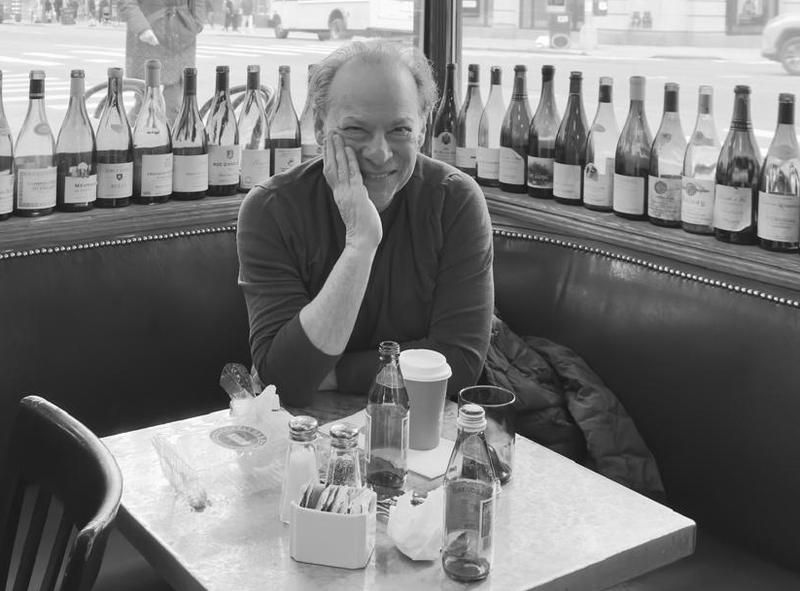
( Brigitte Lacombe / courtesy of the producer )
[MUSIC]
Brian Lehrer: Brian Lehrer on WNYC. I had the extreme pleasure yesterday of seeing the one-man show at Lincoln Center by New Yorker magazine writer Adam Gopnik. It was just called Adam Gopnik's New York. It was largely autobiographical. I call it observations about life in general through observations about his life in particular. I learned some things I didn't know along the way about some giants in literary and artistic and intellectual history. Adam once wrote an article called Proust and the Sex Rats. I'll let him explain.
Another one, Picasso gave his famous painting Guernica to the Museum of Modern Art here in New York in 1939, declaring that it could not be returned to Spain until Spain returned to being a democracy. After the Franco era, MoMA did return the painting in 1981. I wonder if any artists here might take a cue and loan out their works abroad for a while. Adam Gopnik's New York continues at the Clark Theater at Lincoln Center through next Sunday. He is also the author of many books and continues to write in The New Yorker after 40 years.
His last two pieces were about a Calder garden show in Philadelphia and one called Donald Trump, Architecture Critic. We'll get his take on that. He was last here in February and in August. The February one was about his insomnia. Adam, we always appreciate and learn stuff when you come on with us. Welcome back to WNYC.
Adam Gopnik: Thank you, Brian. It's a pleasure to be back with you.
Brian Lehrer: First, on the very fact of you doing a one-man show. It's one thing for a professional actor to memorize an hour and a half of lines for a play and deliver them with comic timing and everything else. Your day job is writer, not actor. You sit at a word processor. What made you want to do this or think you could pull it off?
Adam Gopnik: Well, I suppose there's just the sheer ham that's been inside me all my life. Brian, the funny thing is that I actually was a kid actor. I actually have a piece in The New Yorker this week, came out today about the history of child actors. I was, I have to confess, one of them. When I was a kid, Andre Gregory, the great avant-garde director, had a theater in Philadelphia and I was the Shirley Temple of the Philadelphia avant-garde. How's that for a narrow gauge boast?
I love performing. There's a direct relationship, I think, between the kind of thing I like to write, the personal essay about how your consciousness got changed by some experience and the act of telling it. One of my heroes, Bud Trillin, wrote many of the same kinds of things and also did a similar kind of show. It seems to suit a particular kind of writer anyway.
Brian Lehrer: Ah, in the mold of Calvin Trillin. A good mold to be in.
Adam Gopnik: The best.
Brian Lehrer: One thing I learned about you yesterday was that even though you started out as an art critic and were very successful at it, and I mentioned your Calder piece, you're still writing about art-
Adam Gopnik: Yes, I am.
Brian Lehrer: -you got more interested in writing about family life. As your readers know, you've done a lot of that. Can you talk about how that evolved for you? Some people might think it's mundane to write about your kids when you know so much about the creative and intellectual giants and the big think realities of history and today.
Adam Gopnik: I still try to write about those things. I wrote about Calder a couple of weeks ago. I wrote a long essay about Pissarro, the great French painter, not long ago. Those things still hold my attention very much. As I wrote someplace, "the world is made of rooms." Our actual experience takes place in one or two rooms with four or five people we're intimate with. One of the real jobs of writing is to make private life public.
I always say journalism, which I am proud to practice, is written from the outside in and real writing from the inside out. When you're writing from the inside out, inevitably you're writing about the people closest to you, the experiences you know most intimately, the spaces you inhabit. That's what I try and do in my writing. What I was trying to do in this show, in this Adam Gopnik’s New York is, as you saw, kind of combine the two.
Some of it is about people and very much outside myself; the great philosopher, Sir Karl Popper, Marcel Proust, Picasso, and so on. A lot is just about the intimate forms of one's personal life, in my case, going through psychoanalysis, and I hope through the process of talk therapy, becoming a somewhat more resolved human being.
Brian Lehrer: I actually did not know that fact about Picasso's Guernica until I heard you mention it in the show yesterday. I guess that's well known to a lot of people, but I didn't know it. Do you know any more about that? Like how much Picasso was a dissident against the Franco regime, or if he expressed it in his art? Go ahead.
Adam Gopnik: He was a passionate dissident against the Franco regime. Years ago, the great curator Kirk Varnetto, and I did a show called High and Low: Modern Art and Popular Culture at the Museum of Modern Art. One of the things that was in it was a kind of comic strip, the dreams and lies of Franco that Picasso had done in protest against Franco. He had insisted that he would not allow the Guernica, that great image of the destruction of a small town by Franco's forces, until Spain was democracy again. As I say in the show, they went and vamoosed and took the picture out. One of my regulars, when I was giving gallery lectures as a kid at the Museum of Modern Art, was so bereft by the loss that he decided to make a full scale needlepoint replica of the Guernica in lime and wool to take its place.
Brian Lehrer: Hilarious. Have you thought of any parallels for the here and now, like, okay, we're not in Franco Spain, but maybe along the lines of No Kings Day, maybe with your one-man show, or maybe Taylor Swift will only do concerts in Europe until some benchmark of democracy here? Anything like that?
Adam Gopnik: Well, it would be good, wouldn't it? Well, Bruce Springsteen has been touring Europe, hasn't he, speaking out quite courageously. We're still here, Brian. We're still here and we still are taking part. I've been writing as avidly as I can on the side of pluralism and democracy and constitutional order for the past decade. I don't intend to stop.
Brian Lehrer: Proust and the Sex Rats. Now, anytime you can write the words "Proust" and "sex" and "rats" in the same headline and have it be legit has got to be an opportunity for a writer. What led you to explore that piece of literary and, I guess, writer gossip history?
Adam Gopnik: Well, back in the '80s, my wife, Martha, and I lived in a loft in SoHo and like every loft in SoHo in that period and probably in this, it got infested with rats, which our exterminator referenced as the big boys. "You got the big boys now." My mind tends to work, Brian, horizontally. I leap from subject to subject. Probably what the zen adepts called monkey mind, I'm afraid I'm afflicted by. I got curious about rats.
That, being curious about rats in New York, an omnipresent subject, led me to discover that Marcel Proust, the great exquisite symbolist novelist, was obsessed, erotically obsessed with rats, or seems to have been. He enjoyed, and it's a horrible thing in a way, watching them fight. It brought him to a certain kind of excitation. I got fascinated by that and wrote a piece about it, and got a letter from someone in Seattle asking very sweetly for permission to call his punk rock band Proust and the Sex Rats. I can't imagine a better name for a punk rock band.
Brian Lehrer: Adam Gopnik with us, the legendary New Yorker writer, now with a one-man show at Lincoln Center playing through next Sunday. Saw it yesterday. You actually say in the show that you have a motto, like a motto for living and writing that you got from the legendary New Yorker writer Joseph Mitchell. The phrase is "a wild exactitude." Would you talk about that a little bit for our listeners and how you mean it?
Adam Gopnik: Of course. That's exactly right. Joseph Mitchell was one of my heroes, maybe my greatest hero as a writer. Wonderful writer, beautiful, soft North Carolina accent. I took him out for lunch once. We went for lunch at the Oyster Bar in Grand Central. I asked him, with that ingenuousness we always have with our masters and mentors, what it was that his whole generation, him, and A.J. Liebling, and E.B. White, and Lillian Ross, what had they all had in common. He said very gently, said, "Well, none of them knew how to spell. None of them knew any grammar, but each one had a wild exactitude of their own." That phrase, "a wild exactitude," illuminated my insights.
What I think he meant by it was exactly the quality his writing always had. It was filled with very precise, detailed facts, observations, exactitudes. Yet at the same time, it was lit from beneath by a wild and enigmatic passion, by a feeling for the city, particularly the City of New York, that had an almost hallucinatory edge. That's the quality that I love in all art. It's what we love in Van Gogh, the way that he puts all these simple sensual apprehensions together in a form that has some of the quality of a dream.
It became my motto. I am looking at those words right now as we speak, Brian, because I always keep them up above my little laptop. It's what we're searching to do, to be as exact as we can, and at the same time to honor our own inner wildness. That's my motto.
Brian Lehrer: I'm so glad to hear you give that description and explanation because I went out yesterday after the show scratching my head, thinking it's almost a contradiction. Wild is one kind of vibe. Exactitude feels like something very unwild. You just explain how they go together.
Adam Gopnik: They have to go together. Certainly in all good New Yorker writing, to be a little more modest about it, that's the quality it has. Bud Trillin's writing has it. A.J. Liebling's writing has it. More broadly, I think it's true about art. I wrote once that the point of art is to bring order to chaos without betraying the chaos. I think that says the same thing in another way. You want both in your work all the time.
Brian Lehrer: Your recent New Yorker article, Donald Trump, Architecture Critic. He is?
Adam Gopnik: Well, he got involved in this crazy thing where they had a diktat one of those kind of semi-Stalinist memos saying that all federal architecture from now on has to be in the neoclassical style, and there must be no brutalism or modernism of any kind. Quite apart from the very fact that we don't elect a leader to give us dictates on art, I thought it was extraordinarily, not surprisingly, ignorant about the history of American public architecture. One of the things that makes American public architecture so interesting is that it doesn't conform to a simple official style.
The Washington Monument, which is maybe our most immediately identifiable thing, that's a form of American minimalism. it was criticized when it was created in the 19th century, being far too simple. It didn't have a big statue of Washington on it, and yet what a powerful monument it is. Same thing's true about the Vietnam Memorial. When it was built, you remember, Brian, everybody attacked it because it was so simple, just lists of names that we should have, statues of soldiers. Yet it's the single most emotive and powerful of all memorials that we have. I wanted to register that, my own dissent from it.
Brian, a lot of people say that all the kind of little stuff that Trump does is less important than the big stuff. Of course, in one way that's true. But I think that the daily degradation of democratic decorum is a big deal too, and I wanted to protest it.
Brian Lehrer: Last question. How is it different to hear a live audience laugh and applaud like they were doing yesterday than to have people tell you, I love your writing in The New Yorker? How does it feel different?
Adam Gopnik: They're both welcome whenever I can get them. The difference is, I think, is that when I'm writing on the page, in a weird way, it's more intimate than when I'm speaking on stage because I'm sort of whispering in your ear. But when I'm performing on stage, I'm engaged with the audience. It's not just at the end, the applause, the welcome is the least of it. It's the look in people's eyes. It's the feeling of the air pressure rising and falling in the room. It's the walking, the tightrope of people's reactions. You can feel when they're disappointed or when they're delighted.
That engagement with an audience is something that someone who does indeed spend the majority of his day bent over a laptop, that's something that's deeply heartening and welcome and, if I may say, is one of the things that we come to New York to experience that immediate engagement with other people. That's what Central Park is about. That's what New York is about.
Brian Lehrer: Well, congratulations on the one-man show at the Clark Theater at Lincoln Center getting a second run. I know you had a first run in May. Thoroughly enjoyed it yesterday. I know it runs through next Sunday, the 26th, correct?
Adam Gopnik: That's right. We're doing matinees and evening performances on Saturday and Sunday. I love doing a matinee. It's no more beautiful words in English than Sunday matinee.
Brian Lehrer: [chuckles] Adam Gopnik, usually a New Yorker writer, now on stage at Lincoln Center. Thanks for joining us. Appreciate it.
Adam Gopnik: Thank you, Brian, so much.
Brian Lehrer: Brian Lehrer on WNYC. More to come.
Copyright © 2025 New York Public Radio. All rights reserved. Visit our website terms of use at www.wnyc.org for further information.
New York Public Radio transcripts are created on a rush deadline, often by contractors. This text may not be in its final form and may be updated or revised in the future. Accuracy and availability may vary. The authoritative record of New York Public Radio’s programming is the audio record.