
ACA Open Enrollment Starting
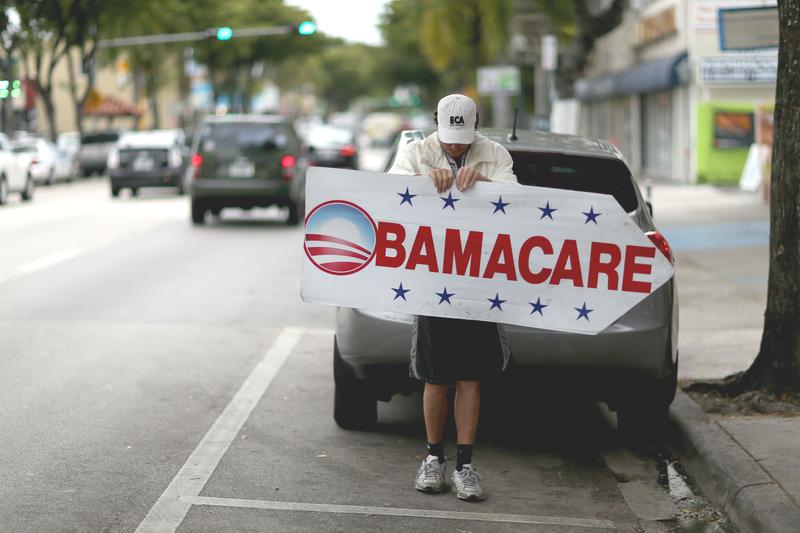
( Joe Raedle / European Parliament )
Title: ACA Open Enrollment Starting
[MUSIC]
Brian Lehrer: It's The Brian Lehrer Show on WNYC. Good morning again, everyone. This Saturday marks the start of the open enrollment period for this year for Americans who purchase your health insurance through the Obamacare Marketplace. As you know, this year, there's going to be sticker shock as the fight in Washington over renewing Affordable Care Act subsidies remains at a standstill.
When the Trump administration released a preview of the available plans on healthcare.gov just yesterday, consumers saw their rates surge, "an average of about 30% for a typical plan in states where the federal government manages markets and an average of 17% in states that run their own markets." That, per The New York Times, will explain what the difference is, but we're also going to help you navigate what's going on here and talk about the politics with Elisabeth Benjamin, vice president of Health Initiatives at the Community Service Society of New York and co-founder of the Health Care for All New York campaign.
She also has done a lot of work as what they call a health care navigator, helping people, individually, at least in the past, work through their choices on the Obamacare Market. Elisabeth, always great to have you on the show. Welcome back to WNYC.
Elisabeth Benjamin: Thank you so much. I'm delighted to be here.
Brian Lehrer: What does that 30% number mean? What does the 17% number mean for states that run their own Obamacare Markets?
Elisabeth Benjamin: Yes, well, unfortunately, in New York, which runs its own Obamacare Marketplace, premiums are expected to increase by 45% for people who are going to be losing these enhanced premium assistance. The problem with the Affordable Care Act was it wasn't because it was enacted by Democrats, who sort of followed congressional rules that you have to pay for any new federal expenditure; of course, that was completely thrown out.
That whole rule was thrown out with HR1. The Affordable Care Act wasn't as affordable as it should have been. That was remedied with the Inflation Reduction Act and the American Rescue Plan by congressional Democrats and the Biden administration. The Republicans who are now in charge of Washington are letting those enhanced financial assistance expire. As a result, the average increase in New York state for a couple will be about $240 per member per month.
That's very nerve-racking. I think the other thing is what's really likely to happen is, a lot of people are just going to look at these new premiums and decide to go bare or go become uninsured. There's an estimate that millions and millions of people will end up going uninsured. Unfortunately, New York State is going to bear the brunt of all these cuts that are projected to happen over the next couple of years.
Brian Lehrer: The Obamacare subsidies are at the heart of the government shutdown battle between Democrats and Republicans in Washington. The Democrats want these subsidies to be renewed at the enhanced pandemic levels, and the Republicans are not budging. Let's go through the arguments on both sides of the aisle, and let's take the Republican argument first, because they're saying that these were supposed to be temporary, enacted at the height of the pandemic emergency when a lot of people were unemployed.
The country voluntarily shut down a lot of the economy, and there were all these ways to compensate so people could continue to afford their lives. One of them was enhanced subsidies for the Obamacare health insurance policies. The Republicans are saying, "Well, we're not in that period anymore, so why should the taxpayers continue to pay for enhanced subsidies? Let's at least go back to where we were in 2019." Why not?
Elisabeth Benjamin: Well, "why not" is inflation has surged, and the cost of health care has not been controlled in America. As a result, insurance premiums are extremely expensive. We don't regulate the prices that insurance companies pay providers. For example, Switzerland uses private insurance. Everybody picks their own private insurance plan, but the government negotiates the reimbursement rates.
We only do that for Medicare. If we aren't going to control prices, then, and our country's going to spend whatever it is, 18% of our GDP, we can certainly afford to spend more on helping individuals as opposed to the industry. I think the problem, the other piece of it, is there is money. We're talking about whatever it is, $300 million/billion, whatever it is, to extend the tax credits, but what would happen this summer is we gave trillions of dollars in tax cuts to very wealthy people.
I think we really need to think about, "Well, what do we want to do? Do we want to help the people, or do we want to just help very rich people and insurance companies, and the health care industry more broadly?" I would argue that we must help individual people, or more and more people will be uninsured, and all of us will end up paying even more in our own insurance costs.
Because what happens in health care, in theory, is all this cost shifting, and the providers increase their prices with the insurance companies to offset their losses for not having any kind of payment for uninsured people. It's an irrational system. I think the enhanced premium tax credits put in the subsidies that we're talking about actually added a level of rationality in our system, but we obviously could do much, much more to control costs overall. The problem is, the Republicans have no plan for that. All they want to do is make people suffer and charge them more for health insurance. That's their plan.
Brian Lehrer: Well, I'm going to tell you what they say their plan is to control Obamacare Marketplace costs and other private insurance costs, but first, I want to invite our listeners to call in and share your latest premium bill. 212-433-WNYC, 212-433-9692. Did you look it up yet, or get notified individually if you get your health insurance through an Obamacare Marketplace policy? 212-433-WNYC, help us report this story. 212-433-9692 call or text. We know that this isn't only an issue for Obama Marketplace health insurance policies.
It's other private policies, too. Employers, employees with workplace-based insurance, what are you hearing about your premiums for next year? I know word is starting to go out in various workplaces. 212-433-WNYC, 212-433-9692. Call up and share your health insurance bill or ask a question, but hang on.
Elisabeth Benjamin: Brian, I'm so glad you mentioned employer-sponsored insurance. Our carrier has proposed a 30% rate increase for next year for our organization, claiming that the expiration of the Obamacare subsidies is why they have to charge so much.
Brian Lehrer: Oh, what's the relationship as they see it?
Elisabeth Benjamin: Exactly, what is the relationship? It actually should have no relationship whatsoever, but I think the whole industry is in a total panic. That's what they're telling our broker, which I find very interesting because, in theory, it should have nothing to do with large groups or mid-sized groups. Now, actually, there are small businesses and sole proprietors, and freelancers who are obviously employed, who get tax credits, and their premiums will also be going up significantly as a result because they are part of the Marketplace. It's around 4 million, 5 million people that have small businesses that are going to be affected.
Brian Lehrer: Listeners, share your health insurance premium bills or ask a question of Elisabeth Benjamin, vice president of Health Initiatives at the Community Service Society of New York, which develops policies for and advocates for the needs of lower-income New Yorkers. 212-433-WNYC, 212-433-9692.
Elisabeth Benjamin: I did run some scenarios for some of my clients, if that would be helpful.
Brian Lehrer: Go ahead. Sure.
Elisabeth Benjamin: For example, I helped a woman named Louisa, and I've changed everybody's names, but she's single. She's a writer. She has diabetes, and she's in her 30s. Her income is around $70,000, which is 460% of the federal poverty level. Right now, she's getting around $385 in financial assistance, but still has to pay $500 a month or $6,000 a year. On her $70,000 budget, that's substantial, but in 2026, she's going to have to pay $10,000, or literally a seventh of her budget, on health insurance because she will have no subsidies at all.
Yes, it's a lot. Another young man, Sunil, age 28. He came off of his parents' plan. He's now a freelancer. He makes $38,000 a year. He had no premiums through the Essential Plan. Our state is going to actually have to disenroll 450,000 people in July as a result of HR1 from our Essential Plan where people were able, that low-income people were able to get zero-premium, zero deductible coverage, but they still had co pays, so they weren't paying nothing, but he's going to have to pay around $3,000 to maybe $6,000 a year, depending on what level of health insurance he gets, from having no premium. That's going to be a huge shock for him in July.
Brian Lehrer: Let me let you linger on that for a minute because that's a whole other track of this. I know the Essential Plan in New York State is what you say it's a zero-premium plan for lower-income people who qualify. The number that I've seen, I think you may have just stated it, too, is like 450,000 people in New York State who are on the Essential Plan, and you say they're going to have to start charging thousands of dollars a year in premiums to those people because of HR1. HR1 is also known as the One Big Beautiful Bill. What did that bill do at the federal level that's making New York state add premiums to what was a zero-premium policy for lower-income people? What's the relationship?
Elisabeth Benjamin: We expanded our Essential Plan. The old cutoff was 200% of poverty, and we were able to expand it under a special federal waiver up to 250% of the federal poverty level. It went from having a cutoff at $29,000 to $36,000, my freelancer that was fitting in that patch. What's going to happen is, under HR1, the financing mechanism is completely destabilized. What it does, HR1, is eliminated eligibility for lawfully present immigrants, so people who are legally here, so all these younger and healthier lives are now being thrown out of the Essential Plan. We can no longer afford to run it at the 250% of poverty level, and we're going to have to drop it back down to 200%-
Brian Lehrer: I see.
Elisabeth Benjamin: -of the federal poverty level.
Brian Lehrer: It's not everybody who has a zero-premium Essential Plan; it's that group from $39,000-
Elisabeth Benjamin: It's a higher income group above--
Brian Lehrer: -to $36,000. That's still not a lot of money.
Elisabeth Benjamin: Yes, between $30,000 and $36,000.
Brian Lehrer: Nicole in Brooklyn, you're on WNYC. Hi, Nicole.
Nicole: Hi, thanks for taking my call. I'm a family of four, and I went online and found out we're going to be paying $450, maybe $500, depending on the plan, per person per month. It's an enormous increase. I work for small businesses. My husband is self-employed. He employs a couple of people, but we are small businesspeople; we're working for small companies, and they don't offer health care, and this is just simply unaffordable.
I've had Obamacare basically since it started. My kids have had it. The price has changed year over year, but it's never, any ever, come anywhere close to this. I'm in my 50s, and for the first time in my life, I'm like, "How am I going to have health insurance?" This is the first time I've ever faced this at an age where it's not something I feel would be reasonable for me not to have health care.
My son has asthma. There's just a lot of reasons, but I just don't understand how we're facing this and how the Republicans are sort of standing on the sidelines, saying that it's not happening when it's happening to so many of us. I can't tell you how many friends I have who are in the same boat that I'm in. We're all really scared about how we're going to cover these costs.
Brian Lehrer: I think a lot of your friends are calling and texting us because there are a lot of people, Nicole, in the same boat as I don't have to tell you. Elisabeth, can you give her any advice in addition to whatever else you want to say?
Elisabeth Benjamin: Yes. First of all, because you're self-employed, Nicole, you potentially have a lot of deductions on your tax return. What I strongly, strongly urge you to do is call and make an appointment with a health insurance enroller or navigator. You can do that in two ways. You can call 888-614-5400. That's my organization. Then you can also call the New York State of Health Marketplace, and their number is--
Let me get it. I had it, I sent it in. Then, of course, it's 855-355-5777. 855-355-5777, but I think working with a navigator who can kind of take the time, sort through all your paperwork, and maybe figure out what the best deal you can get. If your children are under 19, we can roll them into Child Health Plus. That could potentially be much cheaper because that will have no deductible, no cost sharing, and then have you and your husband in a couple's plan.
There's all sorts of configurations that we can do to help you. A lot of folks are super tech-savvy. The Marketplace, you can do it on your own. It is not impossible, by any stretch of the imagination, but there are sort of little tricks of the trade, and that's what us navigators are here for, and the people at the call center up in Albany are also there, as well. Please get help.
Brian Lehrer: Nicole, I hope that's helpful to you. Here's some texts that are coming in from other people in the same or similar boats to Nicole. This one says, "I am self-employed and don't make a lot of money, but do not qualify for Medicaid. Right now, I pay $150 a month, and it will go up to $700."
Elisabeth Benjamin: Oh, God.
Brian Lehrer: That listener concludes the text by writing, "I will have to go uninsured." Then another text says, "63-year-old woman in good health, $1,450 a month with $6,500 deductible."
Elisabeth Benjamin: Oh, God.
Brian Lehrer: That's a low-ish premium. That's a high enough premium, $1,400 a month, but a really high deductible. The first $6,500 of health care also come out of her pocket.
Elisabeth Benjamin: Brian, I just want to make sure people are going on our state Marketplace and not the federal Marketplace. Do not look at healthcare.gov; look at the New York State of Health Marketplace. The reason why I say that is, on the federal Marketplace, you might be subject to age rating, which means it's more expensive the older you get. We don't do that in New York State. We have a solidarity principle where everybody pays into the system and pays the same amount in premiums, regardless of your age.
Brian Lehrer: Michael in Bayside has another insurance premium story. Michael, you're on WNYC. Hello.
Michael: Yes, hello, I'm calling regarding the current issue. Currently, I'm paying $536. That would be bare bones, bronze, not gold or silver, or platinum. None of that. No dental, no optical, and with a $3,800 deductible. I got a letter from the insurance company, and it's going to be going up 15%, but the most recent twist on this is that I am facing a cancer diagnosis with prostate cancer. None of this is-- I keep getting these bills like you can't believe it, trying to take care of myself. I'm like, "What is going towards the deductible?"
I've been shocked how, with a $3,800 deductible, that what I'm paying is not really going towards the deductible, only a portion of it. I don't know where it's going. I'm getting bills from anesthesiology for just standard colonoscopies. It's costing me an arm and a leg, pardon the pun. I don't know how this future cutting all these benefits is going to benefit anybody except perhaps an elite few, maybe. I don't know what's going on out there. It's just weird. This is not for the people at all. It's really unsettling.
Brian Lehrer: Elisabeth, talk to Michael.
Elisabeth Benjamin: Yes, Michael, I really am so sorry. First of all, if you're concerned about the deductible not being pulled down, if you're concerned about the accounting that the carrier is doing around your deductible, please, please call us. Our Community Health Advocates program helps people with insurance. It's the same phone number. If you need an enrollment appointment, we get you in an enrollment appointment, but if you need help making sure the insurance is paying what it should be paying, then please call Community Health Advocates at 888-614-5400.
We can also help you apply for hospital financial assistance. If your treatment is hospital-based, we can work with the hospital to have them discount the care that you receive or work out a payment plan for you. All hospitals in New York State are required to offer hospital financial assistance to people with incomes below 400% of poverty, which is $63,000 for a single. It may be that you're eligible for that. Actually, many in New York City, you're based in New York City, go much higher than that. We're here to help you with your bills. We're here to help you with your insurance claims. Please, please call us.
Brian Lehrer: Michael, Good luck with that, and thank you for--
Elisabeth Benjamin: And I'm so sorry about your diagnosis.
Brian Lehrer: Yes, really. Maybe your situation helps others just by hearing Elisabeth's response to you when others who may be in some kind of similar situation hear your exchange. You know what we're going to do, I had promoted a call-in for the end of the show, and we're not going to do that call-in. We're going to keep Elisabeth Benjamin from the Community Service Society for the rest of the hour or last 15 minutes this morning because there's so much else, with this, happening right now with people's new health insurance premiums for 2026 that we want to get into, including some of the longer-term solutions.
The Republicans claim that they do have a solution, and it's different from the current system. Then there, of course, are people who say, "Hey, now it's time because Obamacare has proved that, to some degree, it's collapsing of its own weight. Now is the time to actually have a Medicare for All universal health care Bernie Sanders-style debate." We'll talk about those things, as well as more of your stories of your health care premiums and what to do about them right now. Stay with us.
[MUSIC]
Brian Lehrer: Brian Lehrer on WNYC, as we continue to talk about your health insurance premiums bill, as open enrollment is beginning for the many of you on Obamacare or Affordable Care Act health insurance policies, and the continuation of the current subsidies for those premiums that the Democrats have made the central issue for them in the government shutdown.
The Republicans want the expanded subsidies that were enacted during the pandemic to expire. As you've been hearing, we're giving you some personal advice from Elisabeth Benjamin, vice president of Health Initiatives at the Community Service Society and co-founder of the Health Care for All New York campaign. She's an experienced Obamacare Marketplace navigator, in addition to being a policy advocate.
We are always grateful and learn things when Elisabeth Benjamin comes on the show. We're taking your stories as well as politics questions at 212-433-WNYC, 212-433-9692. Elisabeth, I want to ask you about reasons. Oh, she works in New York, and we're going to try to get the equivalent New Jersey number or something equivalent to the one that she's been giving out for your callers.
Elisabeth Benjamin: I have that, if you want it.
Brian Lehrer: You have it? You want to do it now?
Elisabeth Benjamin: Sure. New Jersey has a marketplace called GetCoveredNJ. If you go onto the Marketplace, first of all, their customer service number is 833-677-1010. 833-677-1010, but if you go on their website, for those of you that use the World Wide Web, they have a thing saying "We can help." It's a little dashboard across the top, and then it says "Find local assistance." Then you can find agents, brokers, assisters that can help you enroll in coverage.
Brian Lehrer: Great. What was the number again on the New York side that you were giving out?
Elisabeth Benjamin: Oh, sure. Okay. There's our phone number, which is 888-614-5400. The New York State of Health Marketplace phone number is 855-355-5777. 855-355-5777, but if you want to talk to a local navigator here in New York, it's 888-614-5400. We help everybody. We have navigator programs in nearly every single county of the state. You can get in-person or over-the-phone assistance.
Brian Lehrer: Again, because I know these go by quickly, 888-614-5400, or for the Marketplace, 855-355-5777. How many?
Elisabeth Benjamin: The New Jersey is 833-677-1010.
Brian Lehrer: Why are premiums spiking without government subsidies? Does it have to do at all, as I've heard in some reports, with insurance companies now covering the drugs like Ozempic and Wegovy more, and they're very expensive, and any other upward pressures, before we even talk about how to solve it?
Elisabeth Benjamin: Insurance premiums in New York State, really in the individual market, were slated to increase by 7%. Yes, the Wegovy, Ozempic, and some of the other pharmaceuticals do drive prices. We also have no capacity for controlling health care costs. Some of the wealthier hospitals charge well over 400% of Medicare, and less well-endowed hospitals only charge 125%, 150% of Medicare.
We have no mechanism for controlling hospital prices, which is the biggest part of any single insurance premium spending, but the real reason why, if you take away these enhanced premium tax credits, insurance people just don't get as much financial assistance. If people don't get as much financial assistance, younger and healthier people are going to say, "Well, that's a little. I don't have an extra $100 or $200 in my monthly budget. I'm young. I'm healthy. I'm just going to not get insured."
That happens in droves whenever they're very price sensitive. When the younger and healthier and then eventually when legal immigrants leave our individual marketplace in New York State, that means premiums whose left are sicker and older, and that means premiums spike under that whole, just through the basic principle of insurance solidarity, which is you were saying Medicare for All, which is why a program like Medicare for All makes more sense because everybody's just automatically enrolled, and you don't have the vagaries.
Prices are set by the government, and you don't have the vagaries of a random hospital in Bedpan Alley saying, "Oh, I'm going to charge 600% of Medicare, and you have to take me because everybody wants me," and then you also don't have all the young people leaving the system because they're automatically enrolled in the system. That's why Medicare for All obviously is a better system, but it will be very hard for any single state to move forward with Medicare for All under the current federal government, which I don't think has any appetite to support that kind of state-based experience.
Brian Lehrer: Well, that's at the state level. I know one or two states have tried it, and it's been really hard because the pool isn't big enough. Certainly, Bernie Sanders would argue that this is why this should be at the national level. I wonder if Obama, breaking down to the extent that it has, might clear the way for a fight for single payer to rise up to a more prominent place in our national politics. For you as an advocate for single payer, do you think that's politically possible soon?
Elisabeth Benjamin: I hope so. Because we're having such a regressive conversation now, [chuckles] I feel like the most important thing is for everyone to get on the phone and call our seven members of Congress who voted for the One Big Beautiful Bill and say, "Please, please put pressure on Speaker Johnson and the Republican leadership to work out some kind of deal to help people in the here and now." Then I do feel people should be supporting that Medicare for All and Bernie Sanders' bill, absolutely, but we have a crisis that starts on January 1st here in New York State, and we have to address that right now.
Brian Lehrer: Yes. One of the things that Republicans say is that the price of health insurance on the Obamacare and other private markets is going up because the law requires so many things to be covered in every policy. If people were able to choose, especially younger, healthier people, could choose lower cost policies that don't cover as much, that maybe only cover them if they have a real catastrophic need or something like that, then the price for everybody would come down. What's your response to that?
Elisabeth Benjamin: Sure, you could have junk insurance, but then it's not really insurance, is it? Yes, you could have a health insurance policy that doesn't cover hospitals, but if you get hit by a bus, then you don't have insurance. What's the point of having insurance that doesn't cover basic benefits? I don't think the issue really is what benefits are being covered; I think the real issue is the fact that we aren't controlling prices.
All the evidence and there's there's reams and reams of academic journal articles on this. In fact, it was all started by a guy named Uwe Reinhardt. He used to be at Princeton, who, in the Clinton administration, wrote a seminal piece saying, "It's the prices, stupid," making fun of "It's economy, stupid," which was, I guess, the James Carville quote. That's the reality of the problem. That's the root cause of American health care system not being efficient.
Brian Lehrer: But you can't force doctors or hospitals or pharmaceutical companies to lose money, they would probably say, so you can't just control prices. That's an argument on the other side.
Elisabeth Benjamin: Well, you can, and many other countries do that. As I said, Switzerland uses a private insurance system and regulates the prices. Other countries negotiate drug prices. The fact that we have the wild, wild west, where any doctor, pharmaceutical, medical equipment, hospital can just charge whatever they think the market will bear, and the insurance companies make more the more they're charged, by all those actors, everybody's making money in the health care system, and you're saying it's all of us.
Brian Lehrer: They would have to raise taxes, though, right?
Elisabeth Benjamin: No, I think they would have to-- You could control costs. Many states are doing this. For example, Delaware has hospital rate setting, and Maryland has a global budget. Other states, California, set up an Office of Health Care Affordability that's looking at hospital mergers, which also drive out-of-control prices. No, no, no, there's lots of things we can do at the state level to regulate prices that could really-- We only spend 4% of our insurance premiums on primary care. That's insane. We should be doing 10% because 70% of our emergency room visits could be treated in a primary care setting. We're incentivizing all the wrong things.
Brian Lehrer: One more listener story. Victoria in Manhattan, you're on WNYC. Hello, Victoria.
Victoria: Hi. Thank you for taking my call, and thanks for having this really important issue. We have a small firm. We have six full-time staffers. We provide health care, and we're looking to maybe hire somebody, but now with the fact that the cost of insurance is going to increase for everybody, I'm not sure if we can manage a new hire. I don't think we're really understanding and grasping the whole ripple effect that this has on small businesses and on our economy in general.
I think that's really important. Just full disclosure, I am a Democratic district leader, and I hosted a town hall on the New York Health Act a few weeks ago, which I think is really important that we start to understand what our options are if the federal government is going to fail us.
Brian Lehrer: Victoria, thank you. Elisabeth, the last thought, 30 seconds.
Elisabeth Benjamin: No, thank you for holding that town hall. I feel like health insurance is so confusing to people, but it doesn't have to be that way. We're here to help you. Please call us. 888-614-5400. We're at the Community Service Society of New York. We're here to help people. If you want to stay up to date on policy issues, the Health Care for All New York website is a good place to go.
Please, if you can, please reach out to the members of Congress in New York state that voted for the One Big Beautiful Bill. We really need them to extend these enhanced premium tax credits and to undo or delay some of the damage of that bill.
Brian Lehrer: Listeners, we'll put those New York and New Jersey insurance information help numbers on our website. Elisabeth Benjamin, vice president at the Community Service Society, thank you so much.
Copyright © 2025 New York Public Radio. All rights reserved. Visit our website terms of use at www.wnyc.org for further information.
New York Public Radio transcripts are created on a rush deadline, often by contractors. This text may not be in its final form and may be updated or revised in the future. Accuracy and availability may vary. The authoritative record of New York Public Radio’s programming is the audio record.
