
A Plan to Force 'Super Speeders' to Slow Down
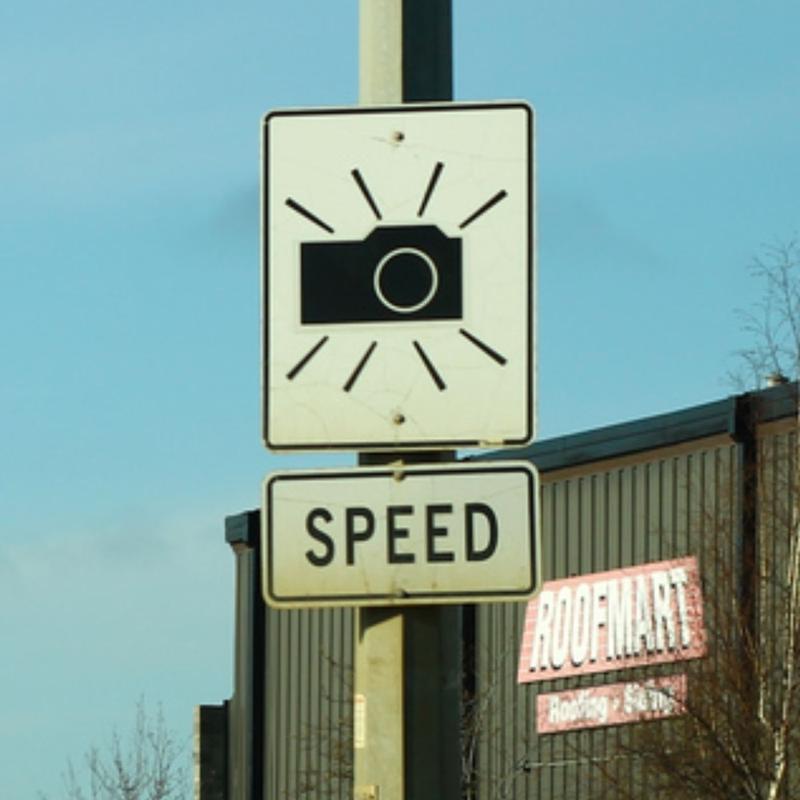
Amina Srna: It's The Brian Lehrer Show. I'm producer Amina Srna filling in for Brian today. What should the city and state do about the so-called "super speeders," the drivers who get more than 16 speeding tickets in a year? It's a small group, to be clear, but within it, some drivers have been caught on camera not dozens but hundreds of times. Governor Kathy Hochul wants to force them to install devices in their cars that physically prevent them from going too fast, but Assembly Speaker Carl Heastie has blocked the bill.
How much of a difference would this legislation actually make, given that this list of super speeders does not include the drivers who figured out how to beat the cameras entirely? J.K. Trotter has been covering all of this for Streetsblog NYC. He has one story which we'll discuss about one of the city's most problematic super speeders, an NYPD cop. J.K., welcome to the show.
J.K. Trotter: Thanks for having me on.
Amina Srna: Listeners, we want to hear from you. What do you think it would actually take to get the worst speeders off New York City streets? Call with your suggestions at 212-433-WNYC, that's 212-433-9692. J.K., how many super speeders are we actually talking about, and how much of the city's total speeding problem do they account for?
J.K. Trotter: I think the official count is several hundred, I think, super speeders, who I believe the city or state defines as anyone who has received more than 16 camera-based speeding tickets in the past year or so. The question of precisely how many there are is a little bit more difficult to answer because so many drivers deliberately obscure or deface their plates, which frustrates the ability of the city to actually capture them on camera. I would guess that it's probably double the official count.
I think any New Yorker who walks down the street in their neighborhood or Manhattan, basically anywhere in the city, will witness license plates that are clearly messed with in a way that is intended to prevent a camera from reading it. As for the percentage, that's a good question. I haven't personally calculated what percent of all drivers who are super speeders, which is compounded by the difficulty of finding an exact number due to the defaced license plates. I would estimate maybe 5% to 10% of all drivers in the city, and probably the state as well, would qualify as a super speeder.
Amina Srna: You said several hundred, but I think that The New York Times has it as 14,600. Is that consistent with your reporting and what you've seen?
J.K. Trotter: Yes, that's probably--
Amina Srna: Thousands?
J.K. Trotter: Yes.
Amina Srna: Super speeders are people with 16 or more speeding tickets per year, as you were just saying. Why does the city or state even allow drivers with 16 or more speeding tickets to stay on the road in the first place?
J.K. Trotter: This seems to be a flaw of the legislation that instituted traffic cameras, that insofar as there seemed to have been some compromise made in Albany in which the legislators agreed that they would impose fines on super speeders, but it seems that they were reluctant to actually make it so that those speeding tickets added points to a license. There seems to be a constellation of concerns as to why this was.
I've heard there are due process concerns because you don't know precisely who was driving. I've heard that there a lot of legislators, especially upstate and in the outer boroughs, who are just fundamentally reluctant to raise the cost of bad driving, whether that's literally in terms of financial fines or more materially in terms of taking away a license or impounding a car. It seems like this is not just a fun glitch in the system. It seems to be a deliberate policy choice.
Amina Srna: We have a caller who wants to bring up the due process that you were just talking about. Here is Mike in Queens. Hi, Mike. You're on WNYC.
Mike: Good morning. My question was about the due process, because a police officer issues a summons, you get the points, you have your day in court, but a red light camera and a speeding camera is nothing more than less about money-making, and that's why the compromise was made. I don't know how you're going to change due process in order to give people and remove their license from them. Nobody seems to be able to tell me, even the sponsor of the bill.
Amina Srna: Mike, thank you so much for your call. J.K., what were you thinking as you were listening to Mike?
J.K. Trotter: I'm not a constitutional law professor. I know, very surprising. The question about due process, I think it's a complicated question, but I don't think that it is particularly material here, at least in the context of the super speeders bill, which is the pending legislation in Albany that would require a mandatory speed limiter in all cars. I think that is ultimately like a compromise or band-aid solution precisely because the state does not want to, for whatever reason, add points from traffic cameras onto someone's license.
I think it's difficult because, on top of this due process concern, there seems to be this belief that even if we do put in a speed limiter, then a driver will just find someone else's car and speed in that car. The question of how exactly do we stop people from speeding is an extremely complicated one. I think the due process concern is just-- Personally, I'm less concerned about it, and I wish the legislators in Albany were less concerned about it because, at least for this particular bill that would require a mandatory speed limiter, we're not adding licenses or points to a license. We're requiring the installation of a particular device in a particular car that doesn't follow the driver to a rental car. They're not carrying this device around with them.
As for how exactly we get around this issue of due process from traffic-based cameras, I think one possibility is better technology that would be able to identify a driver when they're driving, and that pertains to tinted window legislation. Any New Yorker is well aware that drivers routinely violate the ban on heavily tinted windows in the city. To Mike's point, I think it is a tricky question, but I don't think that it should be a barrier to the passage of the super speeders bill, and I don't think it should be a barrier to advancing technology in terms of actually getting these super speeders off the road.
Amina Srna: J.K., we have listeners calling in with their proposals on how to limit these super speeders. First, let's just define what Governor Hochul has proposed. Her bill would require these drivers to install speed-limiting devices in their cars, as you've been talking about. Are you familiar with those types of devices and how they work?
J.K. Trotter: I'm familiar. I have not done an in-depth study of the technology, but I read the Times article and a few other articles about how they work.
Amina Srna: How do they work, and have they been tried anywhere else?
J.K. Trotter: Yes. I'll answer those in order. They work by installing this device that hooks into the car's acceleration system. It uses a combination of GPS technology and I think one other type of technology that I'm not remembering. It plugs into a database of speed limits for particular roads, and it prevents the driver from exceeding that speed limit on that particular road when they're driving.
To your question of whether it's been used before, the answer is yes, and it has been used in New York City in particular. A couple of years ago, the City of New York, which has a huge fleet of vehicles, began installing them on city-owned vehicles, and it's worked out very well. I believe the number of incidents in terms of crashes has dramatically decreased. We know, at least for city employees, that this appears to work.
Amina Srna: As I said in the intro, Assembly Speaker Carl Heastie has blocked the bill. How come?
J.K. Trotter: This is an open question, in part, because the reporting around Carl Heastie's view of the super speeders bill is conflicted. The website Hell Gate has been covering this pretty in-depth. They wrote, I believe, about a week ago, that Heastie is pushing back on this, in part, because he is reflexively suspicious of any legislation that would impair or constrain the behavior of drivers.
Then Carl Heastie hit back with that by saying that he actually hasn't been talking about this, but then Hell Gate published another story saying that the staff on Albany have been discussing the super speeders bill in depth and repeatedly. It seems to be a rehash of last year, when Heastie defeated the bill and removed it from the annual budget. He seems to be recapitulating his suspicion of any bill that would prevent a driver or impair on their ability to speed.
Amina Srna: This is The Brian Lehrer Show on WNYC. I'm producer Amina Srna filling in for Brian today. My guest is Streetsblog associate editor J.K. Trotter. J.K., you write that the transportation alternatives data Kathy Hochul's bill is based on actually undercounts the problem.
You write, "The most shocking thing about TA's report is that it does not and cannot document the true extent of speeding in New York City. That's because it relies exclusively on violation data generated by fixed speed cameras, which drivers routinely evade by obscuring and defacing their license plates or removing them altogether." We have a couple of callers and texters on this, but we're passing legislation to fix a problem we can't even actually measure? Is that what you're saying?
J.K. Trotter: Yes. The problem persists. With that said, there has been a lot of progress in this domain, both in terms of technology. It seems like the vendor that actually installs the cameras has been really installing better and better cameras that are able to detect whether a plate has been defaced and better see it in better detail. The cameras are making it harder and harder. On top of that, both the city and state in these sort of periodic joints, I think they call them stings, they set up checkpoints around major crossings like the Triborough, and just pull over cars that have obviously defaced plates.
Amina Srna: On those things, here's Mark in Brooklyn, who I think has a question. Hi, Mark. You're on WNYC.
Mark: Hi. I was calling because I'm a bike rider and a parent and a husband. All these cars that have defaced plates, which you talked about, they have defaced plates in the rear for the speed cameras and stoplight cameras, but all in the front to avoid tolls. It can be fixed with technology, but that takes a bit and a lot of money. It can also be fixed by just having traffic agents give out tickets. As I'm walking around, in a three-block radius of my house, I see like 40 cars with defaced plates. I think there's something easier that can be done about this.
J.K. Trotter: I completely agree. It's interesting. One aspect of this that I've been trying to investigate is the precise protocol for traffic enforcement agents with regard to defaced plates. Fairly recently, I was just watching one just walking the beat around Tribeca, and he walked past a visibly defaced plate. I asked him, "What about this plate? Are you going to write a ticket about it?" He said that as long as he can see what the plate is, that it doesn't count as defaced, which, as anyone who has seen these plates has known, the method of defacement is often in such a way that allows a human to read it up close and see what the actual license plate is, but in a manner that a camera from up above would not be able to.
It often means messing with the reflectivity of the license plate, and so on and so forth. He added that he would be able to write that ticket, but only if someone called in from 311 first. He would not be able to just do it himself. There seems to be an evolving protocol that seems to change from day to day in terms of what exactly traffic enforcement agents are allowed to enforce by themselves without a predicate 311 call.
Amina Srna: J.K., we have a longtime driving instructor calling in. Al in Far Rockaway, you're on WNYC. Hi, Al.
Al: Hi. Good morning. A big problem that I have learned from talking to students over the years, and then just my own experience, is nobody goes to jail anymore for anything. In other words, you have right now in New York City about 1 out of 10 people driving without a license or on a suspended or revoked license. If they get pulled over, they get a desk appearance ticket. Nothing really happens. You have people who have multiple DWIs who still drive. They get pulled over a lot of times, nothing happens.
People who get speeding tickets, they wind up going to court, especially in Nassau County, and plea bargain. They take the speeding ticket down to a jaywalking ticket or something. Areas like Lynbrook and Long Beach, they just want to get the revenue. You could get a speeding ticket, go to court, plead not guilty, and just walk away with a thing that doesn't even put points on your license.
When Giuliani was mayor and I was teaching defensive driving classes in the $5 free license class, people were scared to drive without a license because if they got pulled over and they were driving illegally, they went through the system. They spent at least 24 to 36 hours in jail. What I heard in my classes all the time was, "Man, this Giuliani is tough. I'm not going to go out there and drive." That's why they were taking the class with their permits to get their license, pass the road test, and drive legally.
There are no more penalties to anything anymore. People drive, they run people over, they keep driving. There's no respect for anything. People get cynical because they put speed cameras on roads where they put a 25-mile-an-hour speed limit, where you have big highways, 3 or 4 lanes in each direction. They put the speed limit at 25, which is very unrealistic on certain roads, and then people are just saying it's all for the money. Another interesting thing--
Amina Srna: Al, let me just get a take from JK for you there. Thank you so much for your call and for your perspective on this. JK, do you agree with that characterization of Al's, that nothing really happens anymore?
J.K. Trotter: I would agree, yes. I think it's really downstream of the NYPD's own behavior, and not just NYPD, the group of law enforcement bodies, the police New York City. It's not just individual police officers. A lot of it is the built infrastructure. There's precincts in every neighborhood, and everyone who walks by those precincts directly witnesses how it is, in many cases, anarchy when it comes to parking, when it comes to driving: law enforcement vehicles park wherever they want, they have defaced plates.
It's especially acute in Civic Center, the neighborhood in Lower Manhattan that has FBI, NYPD, court officers. It is essentially this autonomous zone in which no laws around parking or driving seem to matter. I think New Yorkers really absorb that, that there are no consequences for parking incorrectly, for speeding, or if there are, they're purely monetary. The wealthier among them can just pay them and be done with it. Yes, I agree. I think that there's been a huge letdown in terms of enforcement of driving and parking laws, and it has turned wide swath of the city into de facto anarchy.
Amina Srna: This is WNYC FM HD and AM New York, WNJT-FM 88.1 Trenton, WNJP 88.5 Sussex, WNJY 89.3 Netcong, and WNJO 90.3 Toms River. This is New York and New Jersey Public Radio. Let's take another call. Mendel in West Hartford, Connecticut, is calling in. Hi, Mendel.
Mendel: Hey, how you doing today?
Amina Srna: Good. What would you like to say?
Mendel: I feel like people have always been speeding in New York for forever, probably, but I feel like it changed drastically during the pandemic when fewer people were on the roads. You're on the FDR, and somebody's going 120 miles an hour, the FDR or whatever. Even Crown Heights, where I lived, it was just outrageous speeds on Eastern Parkway or even on Classon Avenue. It was just people going the wrong way, people going fast. Why can't they just confiscate their cars?
Amina Srna: Thank you so much for your call. JK, did things change during the pandemic, or maybe you want to weigh in on just enforcement, like Mendel is saying, confiscate their cars.
J.K. Trotter: I think there's been a lot of empirical research that there was a surge in speeding and fatalities from cars during the pandemic, or at least relative to the baseline of how many cars were on the road. I think also during the pandemic, a lot of people who had previously not driven that much got cars, and they do whatever they wanted to. In terms of why they can't confiscate them-- In many cases, they do, most frequently for unpaid parking or speeding tickets.
I think the problem there is that there is often such a lag between the multiple violations and the actual act of enforcement. In between, there's often a cat and mouse game, where if you have a car that the police want to confiscate because you shouldn't be driving a car or you have a suspended license or you haven't paid your tickets, they have to go looking for that. That is a labor-intensive job, and we don't yet have a manner of automating that. We don't have the accusations notwithstanding, New York City is not yet a panopticon.
I think the confiscation is happening, but I don't think it's happening at a scale that would really fix the problem. I think something like the super speeders bill, and hopefully other bills coming down the pike, will reduce the amount of labor that is involved in actually enforcing these laws and getting these speeders off the street.
Amina Srna: If the "Stop Super Speeders" bill does pass, what actually happens to a super speeder who refuses to comply or install the device and then removes it, maybe?
J.K. Trotter: I think if they are caught speeding or pulled over, either the car is confiscated, or they actually do get points on their license. The penalty is heightened once they are caught, but unfortunately, it does seem like something of an honor system.
Amina Srna: A listener texts, "Can your guests discuss the power of the AAA lobby? It's difficult to hold people accountable when traffic law is lenient for the economy of driving." The AAA lobby?
J.K. Trotter: The AAA lobby, like the Automobile?
Amina Srna: Yes.
J.K. Trotter: Okay. The listener's asking what about them?
Amina Srna: I guess the listener's saying it's difficult to hold people accountable because the traffic laws are so lenient for the economy of driving.
J.K. Trotter: Yes.
Amina Srna: We opened this segment talking about the worst super speeder, and the single worst super speeder in the city for the second year in a row is a black 2023 Audi A6. We have the license plate. With more than 1,000 speed camera tickets since 2023, that's like 2 to 3 speeding tickets a day on average, I think. How much did that driver rack up in fines, and what do we know about that person?
J.K. Trotter: This driver racked up, I think, $63,000 worth of fines over their lifetime. It's obviously a smaller portion for just last year. I believe their license plate is LCM8254. Correct me if I'm wrong about that. It is a black 2023 Audi that primarily speeds around southern Brooklyn, I think around Coney Island and thereabouts. We are in active pursuit of this driver. We are trying to figure out who they are. It appears to be a leased vehicle. If anyone who's listening to this broadcast has any information about this car, please get in touch with me.
Amina Srna: How can they get in touch?
J.K. Trotter: You can email me. It's jk@streetsblog.org, or you can just Google me, J.K. Trotter, and send me an email. It should be pretty easy to find.
Amina Srna: You did identify 1 of the 10, technically the 6th worst offender. It's a pickup truck that racked up 547 tickets. That driver turned out to be an NYPD officer. How did you find him?
J.K. Trotter: We used a combination of public records and a good old-fashioned stakeout to confirm that it was him. I can't go into exact detail, in part, because we are still in pursuit of the worst driver, and I don't want to reveal all of our techniques before we do so.
Amina Srna: Fair enough.
J.K. Trotter: I think Transportation Alternatives published their list in early March, and it took over a month.
Amina Srna: Last question, what happened to all those tickets, and what has the NYPD said about whether he faces any discipline?
J.K. Trotter: What happened is that he appears to have paid all of them. Most of them were late, so there was an additional, I think, $25 in change fine attached to each of them. I've received hundreds of messages asking if there was something funny going on with the payments, whether someone high above the police officer managed to cancel them out, or he didn't have to pay them. I haven't seen any evidence of that. I'm assuming that he actually did pay them. I'm not sure how exactly he afforded it. It's still a lot of money. It's all post-tax money. You don't get a tax deduction for paying them. It looks like he paid all of them. Then what was your second question? I'm sorry.
Amina Srna: Just the discipline, whether he faces any discipline.
J.K. Trotter: This is an open question. The NYPD told us that these tickets were not incurred while he was on duty, and they just told The New York Times that his tickets are under internal review. I also spoke with an attorney who used to work in internal affairs at Rikers Island, and she said that, at a minimum, there would likely be some sort of investigation. Then I also spoke with the former chief of department, John Chell, who probably many people are aware of an irascible figure in the NYPD. He retired a few years ago. He also said that if he were in the position of being this officer's commander, that he would talk with him and I think "tell him to knock it off" or something like that.
His preference was to keep it at the command level and just a verbal warning of sorts. I think in terms of discipline, it would appear to be that we are in completely new territory. I'm not aware of any other case where an NYPD officer accumulated more than 500 speeding tickets over their lifetime, and this is just in the last 4 years. We don't know what speeding tickets he got in 4 years prior. This is a 33-year-old officer, so presumably he had some tickets before that.
Amina Srna: We'll have to leave it there for today. My guest has been J.K. Trotter, associate editor for the site Streetsblog. J.K., thanks so much for coming on the show today.
J.K. Trotter: Thanks for having me.
