
A 'People's History' of the Mets
[music]
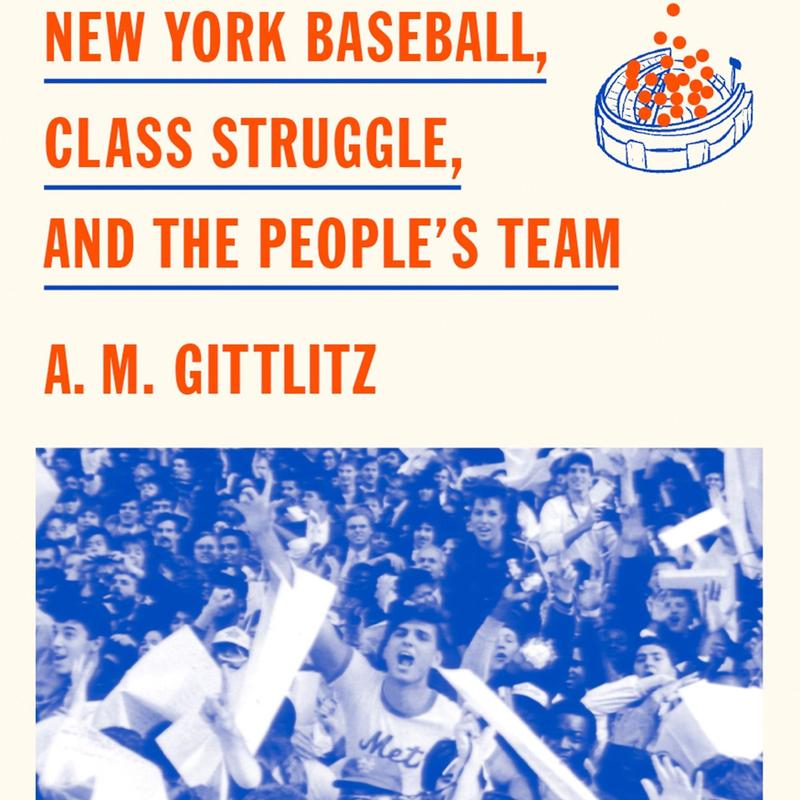
Brian Lehrer: Brian Lehrer on WNYC. There was once a baseball movie called Angels in the Outfield. Well, the New Yorker magazine's review of a new book about the Mets is called Engels in the Outfield. That's Engels, as in Marx & Engels. That's because the book isn't purely about baseball, the sport, maybe call it a people's history of the game and of the Mets as a progressive working class phenomenon. It's called Metropolitans: New York Baseball, Class Struggle, and the People's Team. I'm joined now by its author, Mets fan A.M. Andy Gittlitz, who is also an organizer and writer whose focus is on counterculture and radical politics. Andy Gittlitz, welcome to WNYC.
Andy Gittlitz: Hey, Brian. First time, long time, as they say on WFAN. Thanks so much for having me.
Brian Lehrer: Glad you're on. It's not often we see baseball in class struggle paired in a book title, so we'll unpack that a bit. To be clear, you mean that on several levels, like in their players, their fans, also in their place in the sport, right?
Andy Gittlitz: Yes, absolutely. I tried to write really a thorough class history of baseball that would appeal not only to Mets fans and baseball fans, but to people who are just interested in the history of American class struggle in general. I thought, as a Mets fan, the Mets would be a particularly fun way to tell that story.
Brian Lehrer: Yes. We'll get more specifically to the Mets. I want you to do a little bit of the prehistory and the bigger, bigger, biggest picture, because you cite a historian who saw the origins of professional sports, the origins of professional sports coming from the same revolutionary forces as the mid-19th-century Marx & Engels movement. What?
Andy Gittlitz: Yes. That was CLR James, who was a communist militant. A lot of people in his movement didn't appreciate that he was interested in sports, but he was a Trinidadian cricket player, actually, and he saw in the way that cricket was so popular in Trinidad that there was something about sports that really unified people beyond the spectacular nature of it. I wanted to tell that story a bit with baseball and through studying the origins of the sport to try to get this political backstory of what makes the Mets so special. I found that baseball was actually invented by New York's middle class in the 1830s and '40s.
Following CLR James, I tried to understand baseball as this representation of the middle-class worldview of being stuck in between the worlds of the elite above and the proletariat below. Understanding baseball as a political theater of this, maybe microcosm of the social factory. That became all the more obvious as baseball professionalized after the Civil War, when you start having professional worker athletes taking to the diamond and really it becoming both literally and figuratively a workplace struggle.
Brian Lehrer: Listeners, especially, but not only Mets fans, do you see the class struggle at play with your team? What led you to make them your team? Do you go back to the early 1960s origin of the Mets when young boomers were excited by a young team who were not the corporate Yankees who won every year? Did the orange and blue go with your tie-dye aesthetic for younger fans? Do you still find the same impulse to root for the underdog that somehow aligns with your politics outside of sports? Is there a there there at all for you about this?
212-433-WNYC, 212-433-9692 for A.M. Gittlitz, who has now written Metropolitans: New York Baseball, Class Struggle, and the People's Team. To the Mets. I know from the book, and I didn't realize it before, that this isn't the first iteration of a team called the Mets. There was the Metropolitans. Let's start with the origin of the Mets in 1962 and how their start fits into your analysis. Where would you begin with that?
Andy Gittlitz: Well, the first part of the book, I also talk about the great people's teams that preceded the 62 Mets, the Giants, the Yankees, and the Dodgers. Then, as you mentioned, the 1880 Metropolitans. I argue that there's actually a through line between the two because the 1880 Metropolitans were funded by Tammany Hall as a working-class team against this other team called the Gothams. The two merged and became the Giants, actually. In 1957, you see the Giants and the Dodgers leaving New York for California.
I think this was a really a political crisis in New York because, like many of the runaway factories and the white flight and the vanishing tax base, those teams leaving really revealed that New York City was de-industrializing and entering a social crisis. This is when people like Robert Moses, Mayor Wagner, city lawyer William Shea, and Branch Rickey, the former owner of the Dodgers, sprang into action to desperately try and bring a National League team back to New York. It wasn't an easy task. Major League Baseball didn't necessarily want this to happen, but through the creation of this rogue Continental League or the threat of the creation of this league, they were able to bring the Mets back to New York.
It was also a really important part of Robert Moses's vision of restructuring New York between the city and the suburb. That's why what would be called Shea Stadium, this municipal ballpark, was built in Flushing, Queens.
Brian Lehrer: Who was Shea?
Andy Gittlitz: Shea was a city lawyer. He was something of a fixer. He had worked for Tammany previously, when the Tammany-run bank that owned the Dodgers. He was the guy who understood how the baseball world worked. He, along with Branch Rickey, were able to organize things from the city bureaucratic level within the political machine and also understanding how the major league owners worked and thought to make this scheme come to fruition.
Brian Lehrer: You write in the intro that the Mets debuted in 1962 as one of the sole survivors of a politically progressive war on baseball. What did you mean by a politically progressive war on baseball?
Andy Gittlitz: Well, Branch Rickey, of course, was probably most famous for integrating baseball in 1947 with the signing of Jackie Robinson. Although he was a very conservative figure, economically speaking, he was very progressive. He believed that in 1957, not only the loss of the Dodgers and the Giants to the West Coast, but also the shrinking of the minor leagues and the shrinking of the prestige of baseball in general compared to the more telegenic sport of football, which Branch Rickey didn't particularly like because he thought it was very militaristic, was really harming both baseball's reputation and the reputation of the United States.
He wanted the Continental League, which ended up birthing the Mets, to be international, to be far more diverse, and to make baseball the-- he called it the potential international peacemaker. That actually wars could be settled, or the United States foreign policy interests could be pursued through spreading baseball across the world. When the Mets actually become a National League team again, although his Continental League was defeated, he tried to bring some of those ideas into baseball through the Mets, including a pooled player production system, a communal player production system.
He also wanted the Mets to use a lot of the theatrics and novel attractions that made the Negro Leagues popular, as the Negro Leagues were dying out. Because he knew that the Mets would be a really bad team for their first few years. He knew that they needed to attract fans very quickly.
Brian Lehrer: Let's get to the Mets versus Yankees thing in the class or political context. I guess there is or was, anyway, I don't know about now, with billionaire Steve Cohen owning the team. There was this idea of the Mets as a team for the workers and middle class versus the guy wearing pinstripes of all things. What that uniform design signified pinstripes in the Bronx. Jenny in Brooklyn has the Yankees-Mets call in this context. Jenny, you're on WNYC. Hello.
Jenny: Hi. Yes, thanks for having me on, Brian. I've been on a few times, and I actually have known two of the callers in this today. Glad to be on again. I'm just calling because my father had this exact idea. He's no longer alive. He was a very, well, I wouldn't say a lifetime Met fan because he was actually a Dodgers fan first. He was from Albany, come down to Brooklyn to see games, but then became a Mets fan after they moved to the West Coast. He always said that the Mets were Democrats and the Yankees were Republicans.
We thought, like you said, the Yankees were very corporate. They were spending a lot of money on their players. The Mets now do, but they didn't always. As you also said, they were always the underdogs, and they always said we had to root for the underdogs. I come from a very left-leaning family.
Brian Lehrer: Thank you for calling us. How do you go to Mets-Yankees in a political context in your book?
Andy Gittlitz: I think Jenny really nailed it. When the Mets started in '62, they really replicated the enthusiasm for Kennedy in his early years. Kennedy believed in the youth of America, and Casey Stengel, the first manager of the Mets, also called the young players on the team the youth of America. The '60s Mets really seemed like the team of the moment. They had these pop art-inspired uniforms, these comic book aesthetics. The freewheeling rants of Casey was particularly appealing to the beatniks. The youth energy at the Polo Grounds was really reminiscent of the folk riot in Washington Square Park in 1961.
As the decade went along and that youth movement became more and more political, the so-called new breed of early Mets fans and sports writers, and players themselves really merged with the new left. For example, in 1964, a lot of Mets fans are involved in the civil rights movement, including Mickey Schwerner and Andrew Goodman, who were murdered in Mississippi along with James Chaney. Players themselves were part of the civil rights movement, like Elio Chacón and Cleon Jones. They had a SNC-inspired sit-in at a restaurant in Florida, and moving forward to '68, the Mets were one of the teams that refused to play before the funeral of Dr. King and Robert Kennedy.
That made them really recognized as a political team, which was a curious thing at the time. The peak of this camera in 1969, when, as the Mets were making this miraculous run to the World Series, Tom Seaver actually dedicated their potential World Series victory to stopping the war in Vietnam. That's something that's really incredible to think of any athlete doing. Of course, Muhammad Ali and Kareem Abdul-Jabbar had taken a lot of heat by being outspoken, but in terms of a baseball player or a white athlete, it was really unprecedented. It's hard to even imagine that happening today. With a book like this, I like to think that maybe we can inspire athletes to be more outspoken.
Brian Lehrer: Jesse in Brooklyn is going to continue down that Mets-Yankees road. Jesse, you're on WNYC. Hello.
Jesse: Hi. Thank you for taking my call. I am a huge Mets fan, and I grew up in New York City. My parents were not super into sports, but my brothers' godfathers were, and they're gay men married. They always told us that the Mets was the queer team to support. As a queer person today, I completely agree with that. Still, I feel like there's so many gay and trans people who are Mets fans. Definitely not everyone. There's some conservative Mets fans for sure, but I love that about the team, and specifically Lindor and Katia. Lindor, his wife are, I think, really wonderful, progressive celebrities to follow and support and get inspired by.
Brian Lehrer: Jesse, thank you. She brought up a couple of things worth talking about there. One, didn't you have something on the Mets and Pride Night in the book, right?
Andy Gittlitz: Yes. I actually dedicate a lengthy chapter, the epilogue of the book, to the 2024 Mets, which were known as variations on the OMG Gay Grimace Mets. That's because they really started the season very poorly. It was looking like not a good year. It was supposed to be a rebuilding year anyway. Well, Pride Month is when they really turned it around. This is when Grimace throws out the first pitch. This is when the team starts singing along to Iglesias OMG song. It's also a month when a lot of people are attacking the Mets because they're one of the teams that show the most pride during Pride Month.
Remarkably, the players themselves seem to really enjoy this meme, too. The team turns it around during this month. There's a Lot of reasons besides these kind of mimetic things. It seemed like this energy that was really a communion between the progressive nature of the Mets, appreciation of the queer fans that the caller was talking about, and the idea that, as J.D. Martinez put it after their closed clubhouse meeting, they said, "You know what? We're going to go out there, and we're going to have fun, and if we suck, we suck. We're going to out there, and we're going to have fun sucking."
I think that really summarized the energy of 2024, when in election season, facing down the catastrophe that that could have been, there was this moment when Harris replaces Biden that, okay, maybe something better is possible, maybe whimsy and joy can defeat this disturbing moment that's coming. They made it pretty far. They made it to the NLCS, but they didn't make it all the way.
Brian Lehrer: I'll give you a somewhat contrarian take on dismissing the Yankees in a class-consciousness way. Obviously, everything that you said about the 1960s is true. By the 70s, the Bronx is burning, as they said. For decades after that, if you followed both teams here in the city, it could feel like the Mets were the suburban team out there in eastern Queens with a big Long Island fan base.
The edgier political thing, maybe, was to keep going to the Bronx to see the Yankees walk around the Bronx, even as I do today. I live very close to the Bronx. I do a lot of things in the Bronx, and you see that Yankee hats that the black and Latino local residents are wearing in great numbers. We have the history of Bronx Borough President Fernando Ferrer having to resist the plan by Mayor Giuliani in the '90s to move Yankee Stadium to the west side of Manhattan and abandon the working-class Bronx and the poor, low-income Bronx. I can make a Yankees class consciousness argument, too. Do you buy it?
Andy Gittlitz: Yes, absolutely. Jayson Buford actually wrote a really great piece about this because there's been a lot of discourse over the weekend over Mets and Yankees, in which is the real working-class team. Basically, my book argues that baseball is a middle-class sport. The majority of baseball fans tend to be from the middle class. The Yankees and Mets, as this dialectical foil, point to two different approaches of the baseball fan.
One tends to be more from the perspective of the boss, Steinbrenner, having these roll calls where the players need to acknowledge themselves, and arguing that a player needs to be fired if they're going through a slump or something. I think the Mets tends to be more from the perspective of the worker, and we're all in it together, and we don't really expect the greatness and the glory and the trophies. Of course, realistically, both fan bases, I think, are maybe not so demographically different. It is very interesting the way the aesthetics and cultural lines seem like such a important divider.
I'll just add to that, and this is obviously a much longer discussion that anyone who spent some time over in the last few years, from that strip from South Brooklyn to Astoria that's called the Commie Corridor, this is the bastion of support for Zohran Mamdani. I think you'll see a lot more Mets hats than Yankees hats there. Of course, this doesn't necessarily mean that people in the South Bronx who love the Yankees aren't working class. Zohran is a Mets fan, and he hates the Yankees, so that adds a little flavor to the argument.
Brian Lehrer: In our last 20 seconds or so, do you have anything on this clubhouse drama where one of the Mets' biggest stars, Francisco Lindor, his wife was involved in some way with the Mamdani campaign, and apparently some of the other players didn't like that.
Andy Gittlitz: Well, I don't really know too much about. This is something that Mike Francesa had heard that they're part of the problem of last year. 2025 was a really humiliating season. Something definitely went wrong, and Mike Francesa thinks that might be because some players were Trump supporters and some might have been more to the left. We'll see if maybe that can be corrected this year.
Brian Lehrer: Andy Gittlitz, author of Metropolitans: New York Baseball, Class Struggle, and the People's Team. Good luck this season. Hope you enjoy the ride, no matter who you're rooting for. Thanks for sharing this interesting book with us.
Andy Gittlitz: Thanks, Brian. Let's go, Mets.
Copyright © 2026 New York Public Radio. All rights reserved. Visit our website terms of use at www.wnyc.org for further information.
New York Public Radio transcripts are created on a rush deadline, often by contractors. This text may not be in its final form and may be updated or revised in the future. Accuracy and availability may vary. The authoritative record of New York Public Radio’s programming is the audio record.
