
A History of General Strikes
( Stephen Maturen / Getty Images )
[music]
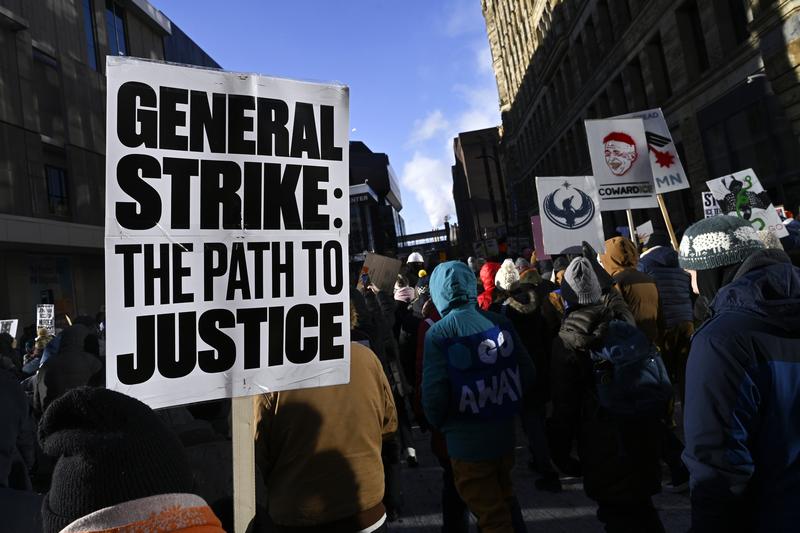
Brigid Bergin: It's The Brian Lehrer Show on WNYC. Good morning again, everyone. I'm Brigid Bergin, senior reporter in the WNYC in Gothamist newsroom, sitting in for Brian today. Did you hear about the national general strike taking place today? Hundreds of organizations across the country have pledged that their members will skip work, school, and keep their wallets shut today in response to ICE's takeover of Minnesota and other American cities and states, as well as the shootings of American citizens, most prominently Alex Pretti and Renee Good. This comes after Minnesotans held their own general strike last week, in which over 700 businesses closed.
An estimated 50 to 100,000 people marched in the streets despite freezing temps. Even if you're hearing the cars honking and your local coffee shop is opening, what's happening today likely won't look like previous general strikes that have shut down cities in the past. What is happening? Why does it fall short? Could actions like this one build towards something bigger in the near future? With me now to give us a general strike 101 is Eric Blanc, assistant professor of labor studies at Rutgers University, authored several books, including We Are the Union: How Worker-to-Worker Organizing Is Revitalizing Labor and Winning Big, and writer of the Substack newsletter Labor Politics. Hey, Eric, welcome back to WNYC.
Eric Blanc: Thanks so much for having me on.
Brigid Bergin: Organizers have said that this is under the umbrella, national shutdown. They've called for a general strike today. What is a general strike? What are they trying to accomplish today?
Eric Blanc: A general strike is basically when a majority of workers in a given geographic area, so a city, state, or country, go out on strike. The intuition behind it is that this whole system, politically, economically, depends on workers going to work. When workers withdraw their labor, the system can't function, so you can press demands very powerfully through a general strike. I think that's why there's been so many calls for general strikes recently, because people are trying to figure out, actually, "How do we stop Trump? How do we stop ICE?
Brigid Bergin: What about the strike that took place last Friday in Minnesota? Do we know anything about the impact it had?
Eric Blanc: Yes, I think that it was extremely important of an action. I would say that same about today. It didn't constitute, I think, a general strike in the sense that a majority of workers in Minneapolis didn't strike, but there were significant numbers of workers that did strike. We saw a lot of small businesses shut down. Certainly the school system struck and the school system was shut down. Then there were walkouts in certain other retail agencies. It was not a general strike in that sense, but I think it aspired in that direction, and it helped get the idea out about a general strike, and it really helped pinpoint the idea that we do have agency. There's things that we can do to push back against what's going on.
Brigid Bergin: We have seen a lot of mass mobilizations over the last 10 years that Trump has been in and out of power. What makes a general strike different from just a protest?
Eric Blanc: Well, the basic difference is that when you are on strike, the institutions that depend on your labor don't function. That's different. If you go to a protest at a rally, no institution, per se, is disrupted. If you are, let's say, a Hilton worker. Hilton is one of the companies that is playing a really central role on a national level, housing ICE agents. If Hilton hotel workers don't go into work, then it makes it very difficult for ICE to use hotels or to rent cars or whatever the different company might be. When you are on strike, you're preventing that company or a public institution from functioning. That's the major difference.
Brigid Bergin: Then, Eric, what value do you see in something like the No Kings protests that we've seen a lot of in recent years? There's another that's expected to come up later this year. Is this a situation where these differing tactics can both have a certain effect, kind of a yes-and situation, or is one approach really better than the other?
Eric Blanc: I think that you definitely need a variety of tactics to win. You can't just call a general strike just like that. I think that part of the importance of the No Kings protest is that particularly early on when there was this idea that Trump was claiming a mandate for all of his policies, the No Kings protests really put a lie to that by showing that there was millions and millions of people across the country who were not only opposed, but were willing to take to the streets.
Protests, I think, are and remain a really crucial way for ordinary people to take a first step towards action. It's unlikely they're going to take more risky steps right at first. You need to have easy entry points for people. I think that that is really the role of these protests. The question then becomes, especially after you've gone to a few of these rallies, "Well, what next? What do we do to scale up and what do we do to escalate, because the protests on their own are not enough?"
Brigid Bergin: Listeners, are you participating in today's general strike? Are you not showing up to work or school, or maybe closing your business for the day? Maybe you're opening your business for organizers and members of the community to congregate. Tell us if and how you're joining in and what effect you hope today's actions will have on the country. We can also take your questions for my guest, Eric Blanc, assistant professor of labor studies at Rutgers University and writer of the substack, Labor Politics. The number is 212433-WNYC. That's 212-433-9692. You can call or text. Already, we have a caller, Julia, in Brooklyn. Julia, you're on WNYC.
Julia: Hi. Thanks for taking me. Eric, I'm in the middle of reading your book right now, and I read it while I'm at work on my union job. I'm getting ready for work right now. Unfortunately, I can't participate in the strike in that way, but I canceled my prime subscription again, which I have to renew sometimes for work. I've been affected by strikes for six months.
I'd probably have double in my bank account right now if it wasn't for the writers' and actors' strike. I think a general strike, a one-day general strike in response to the killings in Minneapolis, is nice, but it's not enough. We need organized demands. We need an organized strike. UAW has been talking about doing this on May Day in 2028, I believe, and I think that's what's really going to be effective. I'm wondering what you think about that. Thank you.
Brigid Bergin: Julia, thanks for that call. Any reaction to that? I mean, May Day, 2028, feels like a long time from now.
Eric Blanc: Yes. I think that one of the lessons from US labor history and world labor history is that general strikes tend to come in an explosive way. It's not normally the case that you just set a date for a general strike and then it happens. It tends to be at moments of very high momentum, high attention, high levels of struggle. Something similar to the feeling that we had and we still have right after Renee Good was murdered and Alex Pretti was murdered. When all of the eyes are watching and when there's a mass outrage at what either the employers or the state are doing, it tends to be in those moments where general strikes become possible.
I don't actually think it's so useful to assume that we can orient towards 2028 as the general strike. I think it's more important to do everything possible at this moment to start getting as many working people into motion, because that's going to be the basis through which you could have a general strike whenever it might be. It's not just that it's too long down the road, but we need far more working people involved in the fight against ICE for something like a general strike to succeed, because even in Minnesota, it didn't go as far as it needed to. That's in a place where they have a huge amount of organization, where there just be heroic action.
I think that should be sobering. We have a lot of work to do, particularly in the private sector, where these companies are so ruthless against their employees, to get those workers to walk out at the Targets, at the McDonald's, at the tech companies, which can put a real hurt on the bottom line of corporate America. That's going to take a lot of organizing. I think it's not going to look like agitating for a strike immediately. It's going to look more like fighting around things that the company could do in the short term, demanding the companies break from ICE. Those types of more intermediary battles, I think, are probably the important stepping stone towards building towards a general strike.
Brigid Bergin: Eric, I want to get a little bit into the history of general strikes here in the United States and elsewhere, but we asked for some calls and texts from listeners. I think, to your point about the challenge of organizing something like a general strike, a listener texted a serious question. "There's a general strike today? I'm signed up for various organizations pertaining to protests and have seen or heard nothing at all about a general strike today." What do you make of that when you talk about this is something that needs to build on momentum? People are on all different social media platforms. Our media landscape is incredibly fractured. This is a real organizing challenge, right?
Eric Blanc: I think part of what happened today is that there's so many people looking for things to do that a call for a general strike that really was not put forward, as far as I know, by sort of major unions or even huge organizations nationally. I think it caught on. It caught the imagination, particularly because, and it's a good thing, there was a lot of celebrities and influencers talking about it. It's caught on, but it's not, I don't think, a real general strike. Everybody who's taking action today, thank you for doing that. Every single thing you can do to show support for Minneapolis and to stop ICE, I think, is important.
On the other hand, it's also important to not lose sight of the fact that we have ways to go towards building a real general strike. There's a potential downside of the boy who cried wolf, where if we always say, "This is a general strike, this is a general strike," then the actual necessity for a real general strike, where we actually shutter the economy and shutter cities from functioning until we get our demands, that's going to be harder, I think, to articulate to people if they think we've already done it.
Then they'll say, "Well, if we had a general strike, why didn't we stop ICE? I think we have to really explain. Well, no, when you shut down a city, when you shut down the country, everybody knows there's no gray area about it. If we're going to talk about ending ICE, and if we're going to talk about saving democracy against Trump's very likely attempts to steal it, then I think we need to have a vision of what a full general strike looks like.
Brigid Bergin: Well, let's talk about what a general strike has looked like in the past in the United States that was successful. What did it look like on the ground, and what did they achieve?
Eric Blanc: The United States has a very rich tradition of general strikes, and so it's certainly part of our political legacy and the labor movement's legacy. Two examples I could think of. I'll give you one. 1934, San Francisco. This is a very famous general strike started with longshore workers. The dock workers were on strike for a union, and the police killed two workers on Bloody Thursday. In response to that killing, which, again, I think you can see some parallels today in Minneapolis, their outrage was so high that workers across the city ended up striking for up to a week.
It was out of that struggle that the longshore union was born, and they won their union. It was really out of that struggle that the New Deal and mass unionization became the norm, struggles like that across the country. Yes, there's a really, really rich tradition, but when you do it, yes, they shut down all of San Francisco. Workers didn't go to work. It was not just the longshore. What makes it a general strike is when other workers who, maybe, weren't first involved also join in. It's across industries.
Brigid Bergin: Sure.
Eric Blanc: I would just point out that one of the crucial lessons from that is it often takes a spark. The question I have today is, who are those first workers who are going to walk out? It's not necessarily going to be everyone decides we're going to have a general strike at first, but we need some workers to take the initiative. To me, that's really the question because most general strikes have come out of snowball effects from specific groups of workers fighting, and then that going on and kind of avalanching to the rest of the working class.
Brigid Bergin: Eric, in that example that you just described, the demands of the workers or the result of that general strike was something that was fairly distinct. The formation of the longshore workers union. Are there other examples of general strikes in history that are more about political power and that we're able to push for policy changes, which seems a little bit more aligned with what we are seeing in this current environment?
Eric Blanc: Yes, you don't have to look very far back or very far away. Just look at Puerto Rico in 2019. In the summer of 2019, there was a huge scandal because the governor, which is the head of Puerto Rico, Rossello, was leaked at a very extremely offensive chat, he was a part of, leaked Telegram chat and it got leaked to the public in which he both was homophobic and racist and said horrible things about various people, but particularly against the Puerto Rican people who had suffered so much under Hurricane Maria. The outrage was so much, and this was in the context not just of this particular scandal, but in decades of neoliberalism and economic inequality and government corruption and inability and unwillingness to meet people's needs after the hurricanes.
There was so much anger erupted in response to these leaked chat that workers called a general strike. There was mass protests. Over the span of two to three weeks, these mass protests combined with workers' strikes, eventually forced the governor to resign. That was the demand, is, renunciar, resign now. They won. I do think that that's a really important example close to home that we can look to because it might take something like that to keep our democracy and to stop ICE.
Brigid Bergin: If you're just joining us listeners, this is The Brian Lehrer Show on WNYC. I'm Brigid Bergin, filling in for Brian today, and I'm speaking with Eric Blanc, assistant professor of labor studies at Rutgers University and author of several books, including We Are the Union: How Worker-to-Worker Organizing Is Revitalizing Labor and Winning Big, and the writer of the Substack newsletter, Labor Politics. We're talking about today's general strike. I want to go to our first caller, Daniel, in San Francisco. Excuse me, our second caller. Daniel, thanks for calling WNYC.
Daniel: Good morning. Just calling. Professor, I appreciate everything you're saying and labor perspective on this. I'm hoping too that you could talk about our power as consumers on a day like today and moving forward with collective action to try to bring about the change that we're looking for. Labor is absolutely an essential element. I think, too, if we withhold our buying power, that we have a lot of power there in sending a message.
I myself am a small business owner. I have literally no employees, and people are asking me if I'm closing today. I would love to, but that's just not the reality of the margins of my business. I think that focusing our economic power on small businesses such as mine, this is a little self-serving, and taking it away from the entrenched economic powers, we can get a lot done that way. I'm interested in hearing your thoughts on that.
Brigid Bergin: Thanks for your call, Daniel.
Eric Blanc: Yes, I agree 100%. I think that consumer boycotts can be extremely powerful. Just look at how Disney was forced to rehire Jimmy Kimmel. Just look at how Elon Musk was forced out of the White House with the Tesla takedown protests. We've seen that consumer boycotts can be extremely effective. I think the question is, "How do you make those boycotts real?" So much of the discourse online is, "Just stop shopping at Amazon, just stop shopping this, that, and the other place." It's very hard to measure, and it's very hard for it to really catch on because no one's sure other people are doing it. Frankly, for most working people, it's not so easy just to stop shopping at the most convenient or cheapest place.
The secret, I think, to an effective boycott is having very targeted demands and really specific time amount that you're asking people to boycott. Not an indefinite stop shopping at Amazon, but maybe one day. Like today, imagine if so many more organizations, the unions, plus indivisible, plus political figures like Bernie Sanders, Zoran, or Elizabeth Warren were calling for a boycott so that it really had that millions of people involved and not just thousands. When you get to that scale, that's really how you get that impact. The question is again, how do you get to the scale necessary in which the bottom line really starts to feel hurt.
Brigid Bergin: A listener texted this question. "What about a mass boycott of social media platforms, Apple, Google, and services like Paramount?" I'm curious what you think of that, Eric? In part because it seems that in our current communication ecosystem, those tools are often organizing tools for something like this.
Eric Blanc: I think that it is urgently necessary for us to move in the direction of a boycott of all of the companies that are collaborating with ICE. That includes many of the big platforms. Microsoft, Facebook, and particularly Amazon have deep connections to ICE. I think that, yes, that's one crucial thing. It's not just the platforms, it's not just the subscriptions that's important, that is. There's companies, as I mentioned, Hilton, that are deeply embedded.
There's so many companies that have contracts with ICE, even though it's not even central to their business model, and that we could be fighting to end their contracts. Things like UPS, FedEx, why are they contracting with ICE? If we have a boycott not just of the platforms but of these companies on a specific day that we can measure and say we are taking a stand, we are not going to allow business as usual, then I think it's that broader fight that's going to be really impactful.
Brigid Bergin: I want to go to James on the Upper West Side. James, you're on WNYC.
James: Yes, hi. I'm horrified by the Trump administration, and I think by what's going on in Minneapolis. I've got a question, though. In New York City a couple nights ago, the Hilton that was renting rooms to ICE agents, although it seemed like the protesters weren't even exactly sure they were there, they not only protested out in front, but they went into the lobby, 60, 70 people, NYPD had to come and remove them. Who knows how much police overtime was needed for that? The idea that the Hilton should not even be renting rooms to ICE.
Let's imagine that Planned Parenthood was having a big conference in Manhattan next week, and the so-called right-to-life people. I'm totally pro-choice, but they decided, "You know what? This is outrageous that Hilton is renting rooms to Planned Parenthood. We're going to go into the lobby of Hilton." I just think some tactics are frankly-- You mentioned UPS and FedEx. Protesting ICE is one thing, but expecting all these companies to have these litmus tests that they're not even going to do business with ICE. I guess I question that at some point.
Brigid Bergin: James, thanks for your call. Any response to that, Eric?
Eric Blanc: Yes. I think it really depends on the extent to which you and we feel that what ICE is doing is just beyond the pale. I don't think that people are calling for boycotts willy-nilly. I certainly don't think that that's the case. I think that when you have a paramilitary force with masked up, with no accountability, murdering people in the streets, that is, I think, something worth disrupting over. People in the civil rights movement in the 1960s, they sat in, they protested, and Jim Crow, and there was a lot of disruption.
At the time, a lot of what they did was seen as very extreme. "Why are you sitting in at these segregated restaurants? Why can't you just work through the process?" What they said was, "We need to force the system to stop treating us like we're not human, and we are going to take the actions necessary to make that happen." Yes, I actually think it's absolutely urgent for people to continue organizing at Hilton's and beyond to put pressure on these companies to break.
I think that any company that says it upholds American values while profiting off of the terrorization of our communities is a company that we should be disrupting as much as possible, nonviolently, of course. Any property destruction or violence just plays into the hands of ICE. Yes, now is the moment. I don't think that we can afford just to continue with business as usual or just protest on weekends.
Brigid Bergin: Eric, I want to bring it back to a text from a listener. This listener writes, "The common theme I'm hearing in this discussion is the opposition movement needs more leadership, more guidance, and more organization." Which kind of brings me to the question, why aren't unions joining in today's protest? Our first caller said she was getting ready for work. She was in a union. This seems like a moment where unions would potentially want to stand up. Why aren't we seeing more of those organizations seizing the day?
Eric Blanc: The first thing I would say is that unions did play a crucial role in the mass strike last Friday in Minneapolis, that the call came from unions like the local SEIU and UNITE HERE, as well as community groups. In Minneapolis, not all of the unions, but at least some of the more progressive unions, have played a central role in the fight-back. The question is well taken. The norm is that most unions are at best continuing with business as usual, and at worst, frankly, some of them are even cozying up to the administration.
The reality is that I think most union leaders understand what ICE is doing is horrifying, and they want to fight back. The level of conservatism, not in the political sense, but in the sort of risk-aversion sense, is extremely high. These are organizations that were built out of struggle a century ago, but in which most of the current leaders are not people with a lot of deep experience in how to fight authoritarianism or to take disruptive action. Frankly, they haven't been up to the challenge. The reality is that the moment of crisis we're in an authoritarian takeover, and has mostly been met with sleepwalking.
That's not, I don't think, true so much in New York City. I think we can be really happy that the Hands off New York City Coalition has a lot of union support. Central Labor Council. I think New York is one of the places that we can show the rest of the country what a labor movement that fights back looks like. It's going to require taking more risks, and it's going to require more than just saying we're going to do another protest after another.
I think that it doesn't require immediately calling for a general strike. I don't think we're at that moment in New York. I would like to see unions really take a step up towards the type of nonviolent disruption that we've seen at the Hiltons. If unions are putting their support towards breaking these companies from ICE, there's a huge amount of leverage there. I'm encouraged that a lot of unions, I think, are going to start moving in that direction, and it's better now than never.
Brigid Bergin: We have a whole bunch of callers, and I want to sneak in as many as we can before we let you go, Eric. We've got Susan in Manhattan with a question for you. Go ahead, Susan.
Susan: Yes, thank you for taking my call. I'm wondering about the potential for retaliation, and perhaps there's a difference between union and non-union members depending on their contracts. I'm thinking there may be many employees in many companies, and I'm thinking particularly of the lower wage ones who would want to participate but are worried about either losing pay or perhaps even being suspended or having some mark on their performance review. What difference might there be there with the union and non-union, if you can also speak to the non-union? I'm wondering how many people are hesitant but would really like to participate, but are worried about their jobs.
Eric Blanc: Yes, it's a great question. I think precisely for that reason, it's why it's not likely that we'll see a general strike just by somebody calling for it, because workers need to go through a process of feeling more empowered and feeling like they're not going to be left alone. The way you overcome fear is by taking baby steps that help people understand that "I am not alone." That, "If I'm taking an action, there's going to be thousands of people, millions of people doing it with me." For instance, just to concretize it, instead of calling for a strike right now in the tech companies, what tech workers are doing is that they've organized an open letter, which folks can check out by going to iceout.tech.
They've had over 1,000 tech workers and even some sort of intermediary, like middle-level manager types, have signed a letter calling on their companies. Google, Meta, Nvidia, OpenAI to break from ICE. That's a risk because we all know what the Trump administration and many of these companies who have allied with them are willing to do. It's a lower-level risk. Just saying, "I'm against this," is not the type of thing that, at least, should result in you getting fired. I think we're going to need a lot of those types of actions. Workers speaking out first, and then when you see, "Oh, actually we have a critical mass," well then that raises the question, "What are we going to do with all these people?
What are we going to do if the companies aren't listening to us?" I think that that's true for anybody out there, whether you're in a union or not. You don't need to be in a union to take action at work or even to strike. The right to strike is actually not contingent on being in a union. I would say for anybody out there who works for a company that is collaborating with ICE, and you can look it up, a lot of companies you might not expect are collaborating with ICE. They have contracts. Folks can check out some of the writings I've done on my Substack, Labor Politics, of listing out these companies.
What I would encourage above all is if you think that you want to fight against ICE, you have the opportunity of doing that at work and as consumers and people can reach out to the Emergency Workplace Organizing Committee, which is a organization that supports any worker in any industry, whether you're a union or not, start fighting back, including against ICE right now. Why not do petitions like the tech workers are doing? If you're working anywhere, if you're working at Target, if you're working at McDonald's, some of these other companies that are collaborating with ICE, and you can go to EWOC to get support, that's organizedworkers.org, that's how you get support anywhere you're at.
Brigid Bergin: Let's get in one more caller, who I think has something that is happening today for people who are interested. Let's go to Jeff in Inwood. You're on WNYC.
Jeff: Hi, good morning. Thanks for taking my call, and thank you for having this conversation. It's an important one. Yes, there's a vigil this afternoon at four o'clock in Foley Square in support of the folks that are out in the cold in Minneapolis. I also want to make a comment that there's a number of organizations that are organizing right now for a future general strike, way before 2028, Rise and Resist Sunrise Movement, Indivisible DSA.
All these organizations are all working together to plan future events. I encourage folks to check those organizations out, and they could potentially get involved. There was a big national call that Sunrise Movement had the other night, where there was thousands of people on the call talking about different planning events that Sunrise Movement is having. I encourage folks to check out these different organizations. Thank you.
Brigid Bergin: Jeff, thanks for that. Eric, just as we wrap up here, I think we've established the difference between some of these smaller-scale strikes and something that would be defined as a general strike. What is the best thing that you think can come out of the efforts and sacrifices people are making across the country today?
Eric Blanc: I think what it shows is that many people are willing to take an extra step to stop the horrors that we're seeing. The fact that people are taking the risk of not going into work today or taking the sacrifice of not shopping, I think that that shows that people understand the gravity of what's going on, and that what we need now is for that inspiration to spread. That's going to take a lot of organizing. It's going to take a lot of agitation.
I think that we're in a moment in which what Trump's administration and ICE are doing is so unpopular that things that we thought were unimaginable, impossible even a few months ago, are now on the agenda because the level of anger of what's going on is so high. I think that today keeps the momentum up, and we need to seize that momentum to have more walkouts, maybe starting with student walkouts, move towards these big campaigns against the companies. It's through that mass activity where we have millions of people involved that things like general strikes will become real.
Brigid Bergin: Eric Blanc is assistant professor of labor studies at Rutgers University, author of several books, including We Are the Union: How Worker-to-Worker Organizing Is Revitalizing Labor and Winning Big, and writer of the Substack newsletter, Labor Politics. Eric, thanks so much for joining us.
Eric Blanc: Thanks for having me on.
Copyright © 2026 New York Public Radio. All rights reserved. Visit our website terms of use at www.wnyc.org for further information.
New York Public Radio transcripts are created on a rush deadline, often by contractors. This text may not be in its final form and may be updated or revised in the future. Accuracy and availability may vary. The authoritative record of New York Public Radio’s programming is the audio record.
