
The Supreme Court's New Term
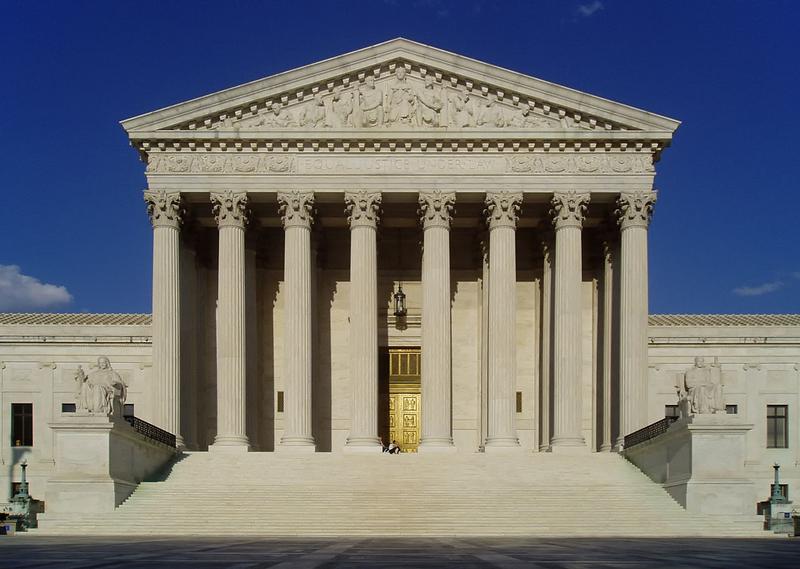
( Wikipedia user Wadester16 )

[theme music]
Brian Lehrer: Brian Lehrer on WNYC. The courts are increasingly the battleground for many of the unprecedented things that President Trump is trying to do to exert executive power in what is widely seen as a hyperpartisan and politicizing way. Sending federal troops to domestic cities, leveling tariffs on other countries for reasons other than trade, deporting people without due process, military attacks now on alleged drug smuggling boats under the premise that we're at war with Venezuela. Also firing federal workers, not just furloughing them, during the government shutdown. I could go on. One big one is pushing Republican-led states to redistrict to box out Democrats, which often means reducing the voting impact of largely Black communities. The Supreme Court heard a related case this week, and a fundamental challenge to the Voting Rights Act. We will talk about that and more now with Emily Bazelon, who writes about the Supreme Court and other legal affairs for The New York Times Magazine. She also teaches at Yale Law School, and is co-host of the Slate Political Gabfest.
She is author of the books, Charged, about the criminal justice system, and Sticks and Stones, about bullying in America. Her recent Times Magazine article is called, Bow to the Emperor: We Asked 50 Legal Experts About the Trump Presidency. Emily, always good of you to come on. Welcome back to WNYC.
Emily Bazelon: Thank you so much for having me, Brian.
Brian Lehrer: Where do we even start? In all your years covering legal affairs, have you ever seen this kind of revolutionary fervor, I think we could call it, at the top and as many high stakes battles in the courts at the same time?
Emily Bazelon: No, I have not. There's a lot happening. What is really striking to me talking to people who used to work at the Justice Department, either long ago for other Republican and Democratic administrations, or who've recently resigned, is just the incredible level of concern and fear and anguish among people who care about rule of law and have really spent their careers trying to serve the country in that capacity.
Brian Lehrer: Can you talk about the Voting Rights Act case the Supreme Court heard this week? Why is this considered so huge?
Emily Bazelon: Yes, it's a really big deal, because the court is hearing this case for the second time, and it's clear this time that along with the actual congressional map in Louisiana, what's at issue here is whether we are going to continue to have the Voting Rights Act as a tool for courts to monitor racial gerrymandering. Since 1965, states have been limited in how much they can gerrymander in the sense that if they take away the voting power of minority groups, especially Blacks and Latinos, to elect the candidate of their choice, then that can run afoul of the Voting Rights Act. States have to be wary of that when they draw the lines.
This matters a lot because there are no federal rules against political gerrymandering. So, racial gerrymandering is the limit on maps in Republican-controlled states. We're looking at a total of between 12 and 19 congressional seats in a lot of states in the south that are currently held by Democrats, many of them Black members of Congress. The maps could be redrawn to effectively wipe out a lot of those seats.
Brian Lehrer: If the argument is political or partisan, gerrymandering is okay, but racial gerrymandering is not, but Black communities tend to vote overwhelmingly for Democrats. How can the courts figure out where the line is, to separate those two things?
Emily Bazelon: That's a great question, and it's one of the things the court is wrestling with. The answer, in the past, has been that you just sort of treat these as two separate inquiries. If you're looking at a state where-- let's take Louisiana. 30%, about, of Louisiana, the electorate is African American. You have 30% Black representation. The question in this latest map is, should there be one or two, out of six congressional seats, where the Black voters in Louisiana have a decent shot at getting the candidate of their choice elected? That's a question you can ask separate from whether there are also Democrats likely to elect a Democrat.
Now, I mean, some people may think that's an unsatisfying answer, because if there's a way in which the relationship is so close between party affiliation and race, then you're effectively looking also at party affiliation. I think a lot of Republicans would argue that in this context. On the other hand, if you worry about gerrymandering, getting rid of our only remaining limit on it might seem like a bad idea.
Brian Lehrer: Let's go down a few of these other battles going on in the legal arena right now. Firing federal workers, not just furloughing them, during the government shutdown. Trump actually saying that he's trying to hit "Democrat agencies." Where does that stand after a court ruling this week?
Emily Bazelon: Well, a judge blocked Trump from those kinds of firings. That's not how shutdowns have worked in the past. Workers get furloughed, workers get back pay. They don't get fired. I think what you're seeing here is one of many instances in which President Trump goes ahead and he does something, whether or not there is any legal precedent for it, and then he waits for the courts to stop him. He kind of dares them. We don't really know how this is going to end, because we don't know if the Trump administration will appeal this particular judge's order, what the appeals court would say, and what the Supreme Court will say if it eventually gets there. It's all kind of a game of chicken.
Brian Lehrer: The latest on this seems to be to enable more housing discrimination, although that might be one of the effects. Bloomberg News reported it this way. Layoffs have hit "hundreds of staffers at the Department of Housing and Urban Development," with the largest cuts concentrated in the agency's Office of Fair Housing and Equal Opportunity. I'm thinking, Emily, about the relationship between this and trying to gerrymander those mostly Black districts out of Black voting majorities. Here we go again, hitting people based, whether they say it or not, on race.
Emily Bazelon: Yes, I think we've seen some instances of this. The New York Times did an analysis last week of all the firings of high level officials in the Trump administration, and a lot of them were Black. So, one notices a pattern. I have to say there's an irony here, because what conservatives, at least in the courts, say is that what they want is formal equality. They want a colorblind society in which there is no race consciousness on the part of the government.
If what you see, though, is that race is used against people, to discriminate against them in housing or to pick them up in supposed immigration stops, the things we're talking about, but that you can never have any kind of benefit based on race, then you have to wonder what's really going on here.
Brian Lehrer: As if stopping housing discrimination was a Democratic partisan thing, right?
Emily Bazelon: Right. Exactly. As I should say, was the Voting Rights Act. I think one thing that's really important to remember is that Congress renewed the Voting Rights Act the last time in 2006, and it was an overwhelming bipartisan vote in favor of doing that. I bring this up partly because a big issue in front of the court this week was whether you can indefinitely have race conscious redistricting, whether the Voting Rights Act, the whole ideal behind it of protecting minority voters is one that can continue with an unlimited time horizon. Well, 2006 is only 19 years ago, and should it be up to Congress to decide what the time horizon is or the Supreme Court?
Brian Lehrer: Right. That Bloomberg article said, "The cuts come after whistleblowers at Housing and Urban Development raised alarms that staff cuts and policy shifts were destroying the agency's ability to investigate discrimination complaints and enforce fair housing laws." From Bloomberg News. Emily, you had a dialogue with your fellow Times columnist, David French, under the headline, "Should They Just Go Ahead and Put Up a Gold Trump Sign on the Supreme Court?" He's more conservative than you, but often a critic of how Trump wields power. What did the two of you discuss?
Emily Bazelon: Well, it's interesting, because David and I have lots of things, lots of social issues we deeply disagree about, but David has been a really strong voice in favor of protecting the rule of law. When we are talking about the expansions of executive power that the Supreme Court has been allowing, and one might say enabling, we are backing each other up and kind of discussing it, thinking through these questions with, like, not very much disagreement. Then when we turn to other issues before the court, like the ban on conversion therapy that we talked about, then we kind of go back to our usual roles as intellectual opponents.
Brian Lehrer: That's a big case at the Supreme Court right now, too. Right? The state of Colorado has a ban on so-called conversion therapy, which is intended to try to convert people who are LGBT or Q to be straight, white-- not white, but straight or cis. Right?
Emily Bazelon: Right. Exactly. Yes. Try to make people not gay or not trans.
Brian Lehrer: Why should the state of Colorado be able to ban that? If people want to enter into that voluntarily, because nobody's forcing them to, I think is the argument. Why should the state of Colorado, the government, ban conversion therapy of that sort that people enter into voluntarily?
Emily Bazelon: Well, this is a ban only on conversion therapy for minors. It doesn't ban adults from doing anything. It also only applies to licensed therapists. If you're a clergy member or somebody else in the community and you want to try to talk to someone about why you think they shouldn't be gay or straight, I mean, gay or trans, you're still allowed to do that. That's your free speech rights. The state doesn't try to prevent anyone from listening to you.
The argument for this ban for licensed therapists is that when you're a licensed therapist licensed by the state, the state is vouching that you are going to uphold a standard of care that the medical community agrees on. There's a lot of evidence that conversion therapy is truly harmful, especially to kids. So, the state is saying, "Conversion therapy falls way below our standard of care, and so we don't want to allow it, because we think it's harmful for children."
Brian Lehrer: We've talked about some of these cases that are at the lower court level still. The redistricting, sending federal troops to domestic cities, leveling tariffs on other countries for reasons other than trade, deporting people without due process, now military attacks on alleged drug smuggling boats under the premise that we're at war with Venezuela. Eventually these things, and of course, the redistricting one already has, bubble up to the Supreme Court, many of them. Is the Supreme Court ultimately just rubber stamping Trump, or have you been able to discern any line that they're drawing?
Emily Bazelon: Last term, most of the Supreme Court decisions involving the Trump administration were in the form of emergency orders. What that meant was that they didn't get fully briefed and argued, and most importantly, when the justices decided the cases, they just said the result. They didn't give any kind of explanation or reasoning, or they gave like, very, very minimal explanation. Also, those are interim orders that could, in theory, be overturned later.
The one generous read of the Supreme Court, in answer to your question, is we don't really know the answer yet, because they haven't ruled on the full merits in a lot of cases. Going forward, there could be different places, birthright citizenship, for example, maybe tariffs, maybe something else, where they actually take a stand against the Trump administration. I think what is difficult about that argument is that these interim orders stay in place, often, for two or three years, as the cases play out in the lower courts, before they come back to the Supreme Court of the merits. So, they create facts on the ground.
Especially when it comes to executive power, the Supreme Court has been very permissive so far. Trump has been allowed to fire the heads of various federal agencies. That's one big example of the way in which executive power has increased. He was allowed to effectively impound funds that Congress had appropriated for foreign aid. $4 billion that had already been owed to different partnerships and contractors around the country that serve people in Africa and other countries involved. You know, USAID funding. The Supreme Court said, "Oh, the president can end all of that."
Even though Congress said this money should be spent because this is abroad. It's the president's power over foreign affairs. That ruling is a really big deal for expanding presidential power. The signs so far are a very permissive court in terms of President Trump.
Brian Lehrer: Emily Bazelon, covering the Supreme Court and other legal affairs for The New York Times Magazine. Emily, thanks a lot.
Emily Bazelon: Thanks for having me.
Copyright © 2025 New York Public Radio. All rights reserved. Visit our website terms of use at www.wnyc.org for further information.
New York Public Radio transcripts are created on a rush deadline, often by contractors. This text may not be in its final form and may be updated or revised in the future. Accuracy and availability may vary. The authoritative record of New York Public Radio’s programming is the audio record.