
Planet Money: The Book
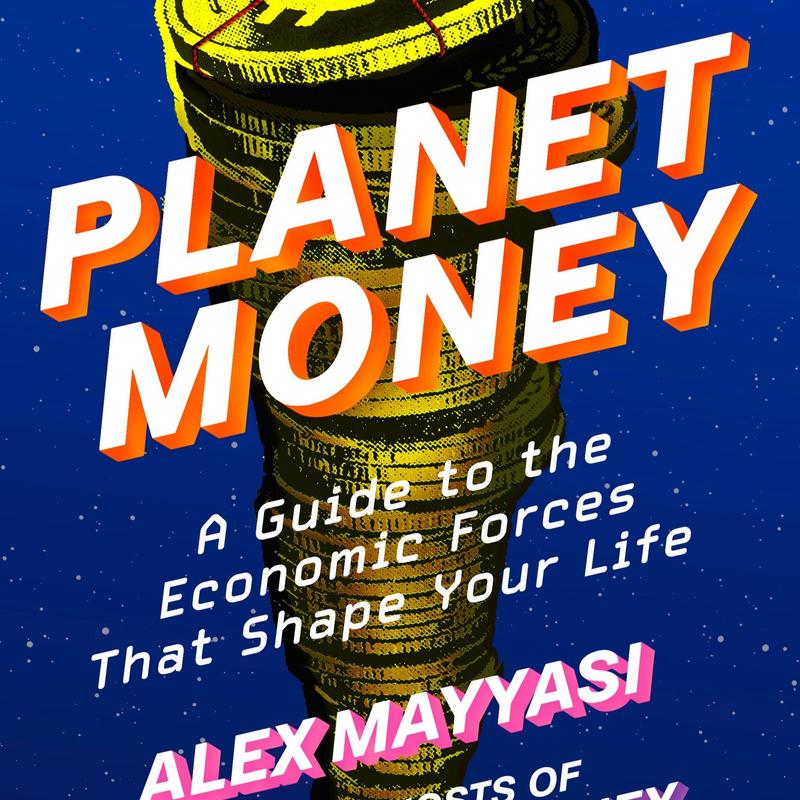
Brian Lehrer: It's The Brian Lehrer Show on WNYC. Good morning again, everyone. Our colleagues at NPR's Planet Money podcast are out with a book. It's a collection of brand-new reporting that centers stories of real people making everyday decisions and how those can help us understand the economics that shape so many aspects of our lives, from work to love, saving money, leisure.
Joining us now to discuss some of what's in the book, as well as an event at the 92nd Street Y, is Alex Mayyasi, a longtime contributor to Planet Money, and Mary Childs, a co-host of NPR's Planet Money. The new book is called Planet Money: A Guide to the Economic Forces That Shape Your Life. Alex and Mary, welcome to the local talk-show side of WNYC. Hi.
Mary Childs: Hi.
Alex Mayyasi: Thanks so much for having us.
Mary Childs: We're honored to be here.
Brian Lehrer: This story in the book that goes right to AI, but brings in this piece of history from the time that ATM machines first started showing up at banks. Probably most people listening think, "Wait, weren't there always ATM machines at banks since the revolution?" What's your ATM angle?
Alex Mayyasi: This comes from some fantastic research from James Bessen, who noted that when ATM machines, automated teller machines, first start getting installed, you would expect-- It's right there in the name, automated teller machines. They're trying to automate the role of bank tellers, but something strange happens. Instead of the number of bank tellers going down as ATMs get installed, the number of bank tellers keeps going up. For decades, the number of bank tellers keeps going up.
There's some really interesting lessons from that. One is this line that many economists use that automation tends to automate tasks, not jobs. We see with bank tellers that teller machines could automate some of what they do, some of the kind of counting cash and handing it to customers. Bank tellers did less of that, but it opened up time for them to do other things. I spoke with a bank teller who had really just started her career as the first ATM was installed.
I was like, "Oh, were you so nervous? Were you so worried?" She's like, "No, not really, because ATMs, they're still finding their footing. They still broke down all the time, but also then, they spent less of their time counting cash and more time doing things like saying, 'Hey, would you like to sign up with a credit card with our bank? Are you interested in financial advice, retirement advice from one of our advisors?'" The role of bank tellers did not disappear because of the ATM. The role of the bank teller changed.
Brian Lehrer: When was the first ATM machine? I'm guessing maybe 1970s?
Alex Mayyasi: I believe so. The very first might have been the '60s. When you really start seeing them getting installed in big numbers, we're talking '70s and then '80s.
Brian Lehrer: Yes, and another example you give to refute the common notion that a common view of automation is that it reduces skilled artisans to unskilled laborers comes from the textile industry, and when they brought in power looms. What happened is that the new technology upskilled workers, as you put it, instead of deskilling them. People don't walk around much thinking about power looms and jobs these days. What happened there?
Alex Mayyasi: Well, you do if you grew up in Massachusetts like I did, because a required field trip is going to see the mills in Lowell, Massachusetts. There's a lot of cases where, yes, like you said, I think we think automation often means a machine does the job, and then maybe you're just pushing a few buttons or doing the same repetitive motion every day. In fact, working with these new power looms that were automating and increasing the productivity of creating cloth and textiles, it was hard work. It was intimidating.
In fact, they need to attract these really smart workers who could learn how to manage this type of work. That's why in places like Lowell, where I used to go on field trips, to recruit young, well-educated women who could pick up this work, they were trying to do a version of a nice college campus. They said, "We have quarterly magazines. There are literary aspects of the environment."
They were trying to make it an attractive place so that they could get talent, get these talented young women who could pick up these very intimidating machines. There are great accounts that some of them wrote about what it was like to face this tempestuous beast of these power looms for the very first time, but then they would pick it up, and their productivity would increase and increase.
One of those points, too, that I think James Bessen makes in his work, others have noted, is that it's not like all the productivity was in the machine. The machine made people much more productive. A worker's first day on the job, they were not very productive, but then they learned how to work with these machines. They got more skilled, and productivity increased. Then, over time, people also learned how to improve those machines as well. It wasn't this one time only, install the magic machine, workers stop being skilled. We need fewer of them. It can look very different in practice.
Brian Lehrer: On this idea of upskilling workers rather than deskilling them when automation comes in, I see from the book that it's such a famous misconception, Mary, that economists gave it the name, "the lump of labor fallacy." Is there any more than what Alex was just saying about what the lump of labor fallacy is?
Mary Childs: Well, I think that one thing that is relevant and painfully salient at this moment, too, is if you think about the transition from getting through that adaptation period can be really difficult and painful, because those are not necessarily similar tasks that you're doing. You went from using your hands to create this fabric, and then now, you're suddenly in charge of a machine. That's just a different part of your brain. It's not clear that those are easy substitutes. That reskilling is crucial. That transition in the aggregate, in the economy, can be pretty painful for workers, too. You do see this, too.
I think there's new research coming out about the adaptation in our economy now with AI, and work from Erik Brynjolfsson and others that was presented at AEA in January, showed that you actually take a productivity hit when you adopt AI as a company, like a substantial hit for the first full year of being, "Oh, we have this great new tech. We're integrating AI into our systems," da, da, da, and then everything falls apart for a little bit. The ones that make it through, the companies that actually do adapt to this AI integration and train their workers to use it properly, they get to experience pretty big productivity gains, and then some of the companies just don't do great.
Brian Lehrer: That's a little bit of the lump of labor fallacy, and then you have this other related thing that's called Jevons paradox. Am I even saying that right?
Alex Mayyasi: This is one of those funny moments where I thought about it so many times and written it so many times, and I'm like, "Oh, I need to start saying this aloud when the book comes out," but I believe you've got it right, so kudos.
Brian Lehrer: And it is?
Alex Mayyasi: This paradox was first formulated in Britain when the Industrial Revolution was in full steam. Politicians were concerned that our economy is really, really reliant on coal. What if we run out of coal? Maybe we should come up with ways to conserve coal, technology that require less use of coal, think about the use of it. Jevons paradox is this idea from William Jevons, if I'm remembering his first name correctly, that that could actually backfire.
Counterintuitively, if you come up with new technologies that use less coal, that means it's cheaper to power those machines with coal. Therefore, demand for those machines and coal could increase, and then you'd be using more coal. The same way that electricity is much, much cheaper now than it used to be. I grew up with my mother, reminding me to turn off the lights, like, "Turn off the light bulb. Save electricity." I can't think of the last time someone told me to--
Mary Childs: Bro, I do that all the time.
Alex Mayyasi: Okay, Mary. [laughs]
Mary Childs: You're not spending enough time with me.
Alex Mayyasi: [laughs] Mary still does it, apparently. People are much less concerned about saving money by turning off the lights. That's an example of Jevons paradox. I think people are really talking about it with AI, because I think people are afraid that, "Oh, if AI can do a lot of the software engineering and coding that I as a worker do, or if AI can do a lot of the-- creating PowerPoint presentations I do," or whatever it is that you might do as a worker, you're worried-- just back to the lump of labor fallacy, there's this point like, "Well, what will be left for me to do?"
Jevons Paradox says, "Well, if the work you're doing gets much cheaper, thanks to AI, you could do more of it. There might be a lot more demand for it now that the price has gone down." I think this is a great hope with our current AI moment is that if there are industries where automation, AI is making work cheaper and faster, Jevons paradox could mean that instead of that, say, leading to layoffs and job losses, it might mean that you want to hire even more workers because you can get even more done. There's even more demand now that you're able to lower your prices.
Brian Lehrer: Well, Mary, that's the bottom line here, right? This is also, if not counterintuitive, counter to what most people are thinking and fearing. Just last week, Axios reported on new polling that shows nearly half of college students say they've thought at least a fair amount about changing their major because of AI's potential impact. Are you from Planet Money here to say, "No, wait." This may all be get-off-my-lawn paranoia. "Young people, get off my lawn." That's supposed to be associated with old people, but paranoia about AI that's overblown?
Mary Childs: Well, first, I would personally struggle to discount the opinions of people who are more in contact with entry-level job market stuff. I just feel like that is changing so fast right now, and I have not had to grapple with that in ages. I feel like, with respect, absolutely think they're probably onto something. I do think, yes, you're exactly right. There is this fear in the economy. It's not unwarranted, but it is a little bit like, "We're going to be okay. We have skills."
In the past, they fretted in the Industrial Revolution. They were like, "What are we going to do with all this free time? Once the robots do all the work, we're going to just have all this leisure time. That's going to be the big societal harm. The big thing that we have to worry about is people having too much leisure time." I just think that we have really disproved that.
I think we have found that we can make ourselves new work and new ways to work. We are very creative in ways that the LLMs and AI systems just are not. That is our edge, and that will continue. I do think that the realignment is real and probably examining if your college major is going to be something that can be replicated by an LLM really easily or not. Making sure that you have an edge over a robot is probably wise, but I think that the edge will remain.
Brian Lehrer: Listeners, we can take some calls and texts for my guests from NPR's Planet Money, Alex Mayyasi, a longtime contributor, and Mary Childs, a co-host. They are contributors to the new book Planet Money: A Guide to the Economic Forces That Shape Your Life. You can contribute to or ask a question about our conversation so far, based on things in the book about AI and jobs and Jevons paradox and lump of labor fallacy, or anything you always wanted to ask someone from Planet Money. Now, they can't know everything about the economy.
Mary Childs: Thank you.
Brian Lehrer: Even though the show as a whole-
Alex Mayyasi: We do try. We do try.
Brian Lehrer: -absolutely does, but we'll see. You can try to push the envelope if you want, folks. 212-433-WNYC, 212-433-9692. I will also mention, and I'll mention it again at the end of the segment, that my guests, plus their colleagues at Planet Money, Darian Woods and Amanda Aronczyk, used to work here, will be in conversation with Emily Oster tonight at the 92nd Street Y. That'll be at seven o'clock. They sell tickets for in-person or for streaming. Let me stay on the AI section of the book because I never heard this, but I see that back in June of 2023, Planet Money put out a podcast episode made by AI.
Alex Mayyasi: Oh, yes.
Mary Childs: Yes, we did.
Brian Lehrer: Right, so what did you do, and what did you learn? Mary, you were in that, right?
Mary Childs: I was a little bit in that, yes. I was actually a character actor in that, so it's a little--
Brian Lehrer: Because who needed a journalist? Go ahead.
Mary Childs: [laughs] Exactly. I reskilled myself. That's right. It actually was really hard. I basically tried to do the Katharine Hepburn accent. What I found is that I really love doing it, but the quality of my accent degrades quickly. It's like helium. I have to take a hit of a YouTube of Katharine Hepburn quickly, do my impression, and then-- Anyway, so that was my role. It was really good to get new muscles, but we basically just wanted to see, "Okay, how good is this stuff anyway?"
It was a three-part series about AI and just investigating, "Okay, what even is possible? What can we use AI for? What is it actually really good at, and what is it bad at?" What we found was it's really good at faking our voices. They just have that. They can do that fine. That was a little terrifying. We made like a fake Robert Smith, a synthetic Robert Smith, longtime host of Planet Money. It was terrifyingly good, except that it just intoned a little bit wrong sometimes.
People probably think that we're so effortless, and we just do one take. We record the episode and go about our lives in one go. No, we sit there, and we belabor each take. We're like, "By the way, by the way, by the way, by the way." [chuckles] I will say the AI definitely didn't do that. I can tell from the outcome that fake Robert Smith did not practice his intonation and did not really think if he was transmitting the exact right emotion and level of breeziness per word. There was a little degradation there, but it was also nonsensical.
The episode that the AI came up with was just like-- My favorite moment was where it wrote a script for an old-timey radio play. Hence, my Katharine Hepburn accent. One of the plot points involved throwing pancakes across a room. It just randomly generated a moment in which people were getting accosted by pancakes. I just loved that so much because that doesn't happen. The robot doesn't know that. That just doesn't happen.
We don't get in pancake fights. I don't think anyone's ever done that. It was funny, a little creepy, a little gross, but it was super edifying in terms of like, we could rest a little easier after going through this experience of making this episode or watching the creation of this episode, because it was like, "Fine." We had a lot of edit notes for it. We were like, "This isn't our best work. Don't ship this. This isn't ready." It made us feel like we still have purpose.
Brian Lehrer: Here's a text from a listener who wants to push back on your ATMs, origin of ATMs at banks analogy to AI, and how that did not at least immediately result in lower number of tellers. The listener writes, "The actual number of banks has been falling over the last five years." I know one of the things that happened in my neighborhood to the bank that I've used for a long time, it used to be in this big, beautiful Gothic building in the neighborhood. Then it moved around to a little storefront around the corner because nobody was going in anymore. Maybe it wasn't ATMs, Alex, but maybe it was online banking.
Alex Mayyasi: Online banking, yes.
Brian Lehrer: That's just another generation of automation that did take a lot of teller jobs.
Alex Mayyasi: Yes, I think this is a great point and helps us resolve the story is that, yes, automated teller machines, it's right there in the name. It feels like that's the thing that would lead to bank teller becoming this obsolete job, but it wasn't. Our listener is absolutely correct that, now, bank teller jobs have absolutely fallen over the past 10-plus years. That is because how much of banking has moved to laptops, to smartphones.
I think this does also remind us that sometimes we're looking for the very straightforward approach. I think sometimes, with automation, we have a tendency to think we'll match one job or one piece of software or one machine with each human and their job. Sometimes the automation that leads to the biggest change, it's more like a full C change. It's not, "Okay, we created a machine that can do what bank tellers do." It's, "Hey, now, banking is all going to move online, and you don't even need to go to a bank at all."
Often, I think this is why the bank teller story reminds us that automation can often be quite slower than we expect. We didn't invent the automated teller machine and the bank tellers would have a job. The bank teller I spoke to had a full-on career despite being a bank teller when ATMs were being installed by her local bank and employer. It's absolutely the case that, over the decades, you look back. Often, the jobs that were very common 50-plus years ago are uncommon today. That will absolutely be true in the future, too, I think.
Brian Lehrer: Alan in Westchester, you're on WNYC with our guests from Planet Money. Hi, Alan.
Alan: Hello. How are you doing? I just called to say, earlier, they said that the AI may cause the price of certain things to go down. I just think all it will do is increase profit margins for business owners and CEOs. Things will just continue to go up in price as they normally do. That's just my take.
Brian Lehrer: Alan, thank you. This reminds me, and I don't know if you've ever tackled this one on Planet Money, but what to me is the fallacy of baseball player salaries and the price of tickets to the stadiums, right?
Mary Childs: Oh, interesting.
Brian Lehrer: The critique is because baseball players are paid so many millions of dollars now, the teams are charging more to go to the games. If you reduce these salaries, put salary caps and everything, then more people will be able to afford to go to baseball games. In my opinion, the fallacy is, no, the teams are going to charge as much as people are willing to pay to see the entertainment, and then they'll figure out how to divvy up the pie. I don't know. To me, that relates to what Alan is saying, but I don't know if either of you have a take.
Alex Mayyasi: Yes. Well, I think with baseball, there is this element where if more and more people get interested in baseball, you can't really mass-produce the New York Mets or the New York Yankees.
Mary Childs: Not yet, anyway.
Alex Mayyasi: Not yet anyway, right? That's part of why those things are so special that there's only one Mets-Yankees game per day or what have you, and only so many per season. I think that's often a special case where I feel like sometimes we look at prices rising in things like concerts and baseball tickets. That is this very particular case. I do think on the specifics about AI, it's like the cost of having someone produce a certain amount of software could go down. That may or may not mean that prices go down. I think it could mean that companies are able to produce products for a lower price and make more money by selling more. That's the best-case scenario. I'm not sanguine either that efficiency always and productivity gains are better for everyone.
Brian Lehrer: A lot of technology, the first televisions, the first computers, whatever, compared to now.
Alex Mayyasi: Yes, and there was this moment when the Industrial Revolution is in full swing. There are these huge productivity gains and these titans of industry making huge fortunes by running businesses larger than anyone ever really thought possible before, but workers did not benefit in terms of higher salaries for decades. That's called Engels' pause, which is this moment. I really think it helped power Marxist critiques of capitalism and the Industrial Revolution because you saw these huge fortunes being made, but that doesn't always mean that workers will benefit. You have to look as well about worker power, laws around unionization, other things as well, to see whether it will benefit society collectively and workers.
Brian Lehrer: Even more conceptual, maybe with all of these examples from the history of tech and jobs that you've been bringing up, listener writes, "To imagine that the AI revolution is equivalent to previous disruptions may be quite wrong." That, in a way, is one of the biggest thoughts that people could express here, right? We learn from history, but sometimes things happen that really break the mold.
Mary Childs: Yes, totally uncharted. I think that's completely right. Of course, I think there's a big appreciation, too, that we are in a somewhat uncharted moment, and that the Industrial Revolution was enormously disruptive and totally reordered society. We're in another one of those kinds of upheavals. Of course, the last one is not going to be that helpful of a blueprint. It can tell us some of the risks and some of the things that were horribly handled, or that went badly wrong, that people then didn't expect.
Of course, yes, what is it they always say? History doesn't repeat itself, but it does rhyme. You'll be able to extract something from history that might help you guide yourself or have some degree of guardrail on what's happening now based on, "Okay, we've been through something like this before, and we can learn something from that, and we really, really should." No, that's completely right. Of course, it's going to be unimaginably different.
Brian Lehrer: Listeners, here's what we've just done. We took one chapter of the new Planet Money book and had a conversation about the content of it. There are all these other chapters of the book, right? We could have done a little grazing, "Oh, in Chapter 2, you talked about this and discussed that for 45 seconds. In Chapter 3, you did that." No, our approach today was to take that one chapter on AI, Chapter 9, and have what was hopefully a good conversation with these co-authors of the new Planet Money book. There's all this other stuff in the book. Tonight, you'll be in conversation with economist Emily Oster at the 92nd Street Y, seven o'clock. Mary, you want to preview that for our listeners who might be interested?
Mary Childs: Oh, I'd be honored, yes. It's going to be really fun. It's going to be three parts. We have a Q&A with Alex himself, the book author. Hello, Alex. [chuckles] Darian Woods and Amanda Aronczyk are also joining. Darian and I have a little mini-episode that we're doing at the first third of the show. Then Emily Oster is the economist, I think, most famous for her work on pregnancy and parenthood and childhood wellness, health stuff. The book Expecting Better was revolutionary, came out in 2013. I have a ton of questions for her about how to parse information and studies and defray all the chaos of the disinformation of our age. I'm really excited to get to talk to her. She's super interesting and super thoughtful.
Brian Lehrer: What's another chapter in the book?
Alex Mayyasi: Another chapter in the book. One of my favorites is learning lessons for your career and building wealth from Ricky Ricardo, who I suspect many people like me grew up watching him in I Love Lucy. Ricky Ricardo, his name in the show. Desi Arnaz, his real name, because he and Lucille Ball did not just create a famous, wonderful TV show. They really invented the business model of television as we know it. Career lessons from Desi Arnaz. One of my favorites, but it's hard to choose. This book was just, really, a lot of fun.
Mary Childs: There's so much in there. It's crazy.
Brian Lehrer: Pick one of yours, Mary.
Mary Childs: Me? Oh, I should have been prepared for that.
Brian Lehrer: It's so funny because I'm asking you all these detailed questions about obscure things from history.
Alex Mayyasi: I know. That was the closest to the stumpers, "What's your favorite?"
Brian Lehrer: Pick a chapter from your book.
Alex Mayyasi: I was like, "Oh, you can't ask me that."
[laughter]
Mary Childs: Okay. No, thank you for stalling, guys. I'm ready. The Bobby Bonilla chapter. I love compounding interest.
Brian Lehrer: What about baseball?
Mary Childs: Baseball? I know I'm not that much of a baseball girl. I'm working on it, but I support everyone in their sport interest. I just think that there was this interesting illustration of the power of compounding and investing and the time value of money. It all embedded in this story of a baseball guy's contract negotiations and retirement. It's so beautiful and New York-specific. It's the best.
Brian Lehrer: Well, and the Ricky Ricardo I listen to is the one who does the Yankee games in Spanish and then does Yankee podcasts in English.
Mary Childs: Wow.
Brian Lehrer: We leave it there with my guests from Planet Money, Alex Mayyasi and Mary Childs. They, along with the others they mentioned, will be in conversation with Emily Oster tonight at the 92nd Street Y at seven o'clock. Tickets for in-person or streaming at 92y.org, and the new book is called Planet Money: A Guide to the Economic Forces That Shape Your Life. Officially, it's out tomorrow. Thanks for coming on. This was fun.
Mary Childs: Thanks for having us.
Alex Mayyasi: Thanks so much, Brian.
Copyright © 2026 New York Public Radio. All rights reserved. Visit our website terms of use at www.wnyc.org for further information.
New York Public Radio transcripts are created on a rush deadline, often by contractors. This text may not be in its final form and may be updated or revised in the future. Accuracy and availability may vary. The authoritative record of New York Public Radio’s programming is the audio record.
