
30 Issues in 30 Days: ICE in the City
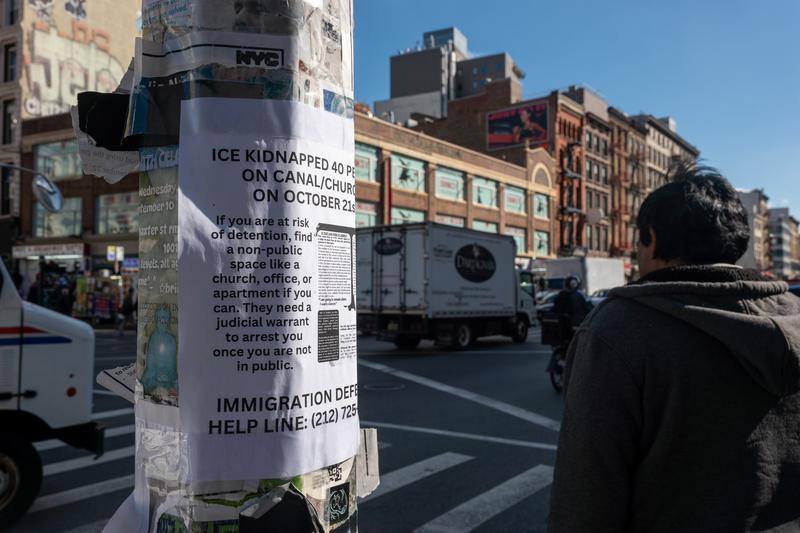
( Spencer Platt / Getty Images )
Title: 30 Issues in 30 Days: ICE in the City
[MUSIC]
Brian Lehrer: Brian Lehrer on WNYC. Now, as we continue with excerpts and analysis from last night's debate, we also continue our 30 Issues in 30 Days Election Series. Let the corporate media focus mostly on the horse race. We continue on New York Public Radio to center the issues that will affect all our lives and compare the candidates on those for mayor of New York and governor of New Jersey. Today, it's Issue 22, the ICE raid on Canal Street on Tuesday to go after street vendors selling counterfeit items and dealing with President Trump generally as an issue in the mayoral race.
We knew all along we would peg today's issue in 30 Issues to something from the WNYC debate, and this is the issue we've chosen. There were three moderators last night from the three sponsoring news organizations. Me from WNYC, Katie Honan from the local news site THE CITY, and Errol Louis, political anchor at Spectrum News NY1, and the master of being the master of ceremonies, Errol joins us now to discuss that opening segment of the debate that he presided over. Errol, I know you're on the air a lot today with your own post-debate stuff, so thanks for giving us some time. Welcome back to WNYC.
Errol Louis: Absolutely. Great to be with you, Brian.
Brian Lehrer: The first excerpt includes Cuomo and Mamdani both rejecting the ICE raid. Cuomo speaks first.
Andrew Cuomo: We don't need ICE to do quality of life crimes. We don't need them to worry about illegal vendors. That's a basic policing function for NYPD, Consumer Affairs, et cetera. I would have called the president, and I would have said, "Look, you're way out of bounds. They're way out of bounds. Call them back, or I'm going to have the NYPD step in and stop them because this is not their jurisdiction. You're in the city of New York."
Errol Louis: Okay. Mr. Mamdani.
Zohran Mamdani: ICE is a reckless entity that cares little for the law and even less for the people that they're supposed to serve. What we need to be doing here in our city is to end the chapter of collaboration between City Hall and the federal government, which we've seen under Mayor Adams. What we need to do is actually pass the street vending reform bills that have been in the City Council, some of which that this mayor has actually overridden. That's an example of how we can both protect street vendors, ensure quality of life, and leave no stone unturned in delivering for the people of the city, as opposed to working with a president who is looking to declare war on those same people.
Brian Lehrer: Cuomo And Mamdani. We'll get to Curtis Sliwa in a minute. Errol, the first thing to notice perhaps, though, is that all three candidates rejected the raid, even the Republican Sliwa, but how did you hear the different emphases there between Cuomo and Mamdani?
Errol Louis: Interesting. The things that Cuomo said were about how he handled sticky relationships with the president back during the first Trump term. It's hard to remember the specifics of it, but it certainly sounded credible. The Sliwa response, though, which was that you've got a bargain with him and that you're coming in with a weak hand, it sounds similar in some respects, but he's really suggesting a much less confrontational initial engagement with the Trump White House. For those of us who have been watching this play out in other cities, that does not sound like a very good advice on some level. There's no amount of cooperation.
We currently have a mayor in the form of Eric Adams who's offered extraordinary levels of coordination and cooperation with the White House, and we still got the ICE raid. It's not clear that the Sliwa approach would work, but he certainly seemed to be suggesting more of the same of the Adams approach.
Brian Lehrer: One of the things about the ICE raid is that the city, meaning the Adams administration, made very clear that the NYPD did not participate in Tuesday's raid. Did you notice in that answer that Cuomo even threatened to have the NYPD step in and stop ICE? I'm curious, with you, and I know you have police background in your family, do you have any sense of what that kind of law enforcement on law enforcement would look like?
Errol Louis: I was dying to follow up with it, and as you know, Brian, everything was about, "Well, if we only had more time, we would have done this, that, or the other." That was one, though, I really did had to let go, and I didn't want to. I think it would be just as blunt and dangerous and fraught as you can imagine. There are 33,000 cops, and if the local precinct commander ordered, I don't know, 200 or 300 of them to block both ends of Canal Street and not let ICE continue its operation, I'm not sure what would happen, but they would certainly be within their rights, that there could be a jurisdictional dispute that is generated or at least played out by the NYPD.
They do it all the time. It's not unheard of. It would, again, be fraught. It would be dangerous. All of these people have guns, and they think they have authority. You'd have to work your way through it very carefully, but you are correct that, really, something along those lines was what Andrew Cuomo was suggesting last night.
Brian Lehrer: Yes, that's worthy of a follow-up. That didn't make much news this morning in the multiple news sites that I read reviewing the debate, but it jumped out at me, like, I guess, it jumped out at you. Mamdani emphasized in the clip a street vending reform bill. Do you know how that would have changed the reason or excuse that ICE had for this aggressive sweep against people who are just working peacefully, not committing violent crimes, which is what they say their mission is. I don't know if you saw the social media post, Errol, from one of the city council members, Justin Brannan, that basically said, "Thank you, ICE, for keeping us safe from fake Louis Vuitton handbags." I didn't know ICE's mission included that, did you?
Errol Louis: Look, there's a New York tradition of kind of ignoring these knockoffs, but it's a little bit more complicated than that. Look, there was a quality-of-life problem. I go down to Canal Street all the time, and if you're just passing by, it's easy to make a joke. "Oh, you can get a fake Rolex down there for $20." If you live there, it's a whole different story. The reality is, I don't know if Canal Street would necessarily be an exception, but every other place where you see this kind of stuff, there's also more serious crime taking place behind the facade of the jokey kind of counterfeiting, right? There's drug sales. There's other things that are going on.
The reality is you have to have some kind of a policy, whatever the policy is going to be. If the policy is we're going to just let it run out of control until there's a violent crime, which seems to be the default mode, unfortunately.
Brian Lehrer: Primarily, that's for the city, though, not-- [crosstalk]
Errol Louis: Oh, yes, absolutely. Absolutely. Because it was a two-part question. There were those who think that the ICE raid was unjustified just because they don't like to see ICE here hassling immigrant New Yorkers. There are others, though, at the local level, where we all come from as journalists, who would say that this was a quality-of-life hassle. That there were people trying to walk up and down Canal Street, trying to do business up and down Canal Street, who are constantly being interfered with by these people who have overrun it and who are committing crime. There's definitely something to that.
Brian Lehrer: Let's play another clip from that part of the debate. This one is longer, about four minutes, as you expanded the topic to dealing with President Trump generally. Listeners, this begins with Errol's question.
Errol Louis: President Trump has been commenting on this race and all of you on a regular basis. He's been less than glowing when talking about each of you, especially you, Mr. Mamdani. I'd like you each to describe whatever combination of defiance, diplomacy, and cooperation you will use as mayor if President Trump continues to increase the federal government's role in the affairs of our city while also threatening to decrease funding. Let's start with you this time, Mr. Sliwa.
Curtis Sliwa: Both my adversaries have decided to bump chests with President Trump to prove who's more macho. You can't beat Trump. He holds most of the cards. He's already cut federal funding for Medicaid, SNAP program, and has threatened to cut funds for NYCHA. If you're all of a sudden going to get adversarial, you're going to lose. Who gets hurt? The people of New York City. With Trump, it's always the art of the deal. You have to go, you have to try to negotiate, whether it's with his minions or himself. He'll want you to give in order to get a little bit, but if you immediately act like you're going to take them on, like it's going to be a one-on-one fight, we're going to lose.
All the people in New York City are going to lose. You have to be able to show respect. I think if you show respect, you'll get respect, and you'll protect the New Yorkers who are so desperately in need of federal funds. What's the good of it? They'll bump chest with Donald Trump, they won't get the money, and then they'll blame Donald Trump. I will negotiate with Donald Trump and try to get the best deal possible for our poor and indigent citizens.
Errol Louis: Okay. Mr. Cuomo?
Andrew Cuomo: Yes. The difference on this question is I've actually lived it and I've done it with President Trump over many years through the most difficult situation that this country has gone through, COVID, plus. You're wrong. You're going to have to confront President Trump. He is hyper-aggressive, and he is going to overstep his bounds, and you are going to have to confront him, and you can beat him. I confronted him and I have beaten him.
He was going to quarantine New York during COVID, and I stopped him. He was going to cut aid to federal programs, and I stopped him, but you also want to be in a place where you can cooperate on good things, because we need federal help if we're going to save our city and rebuild our city. President Trump has to respect you. He sent the National Guard into 20 cities. City he didn't send it into? New York, because I talked to him and I said, "We don't need you here." He has said he'll take over New York if Mamdani wins, and he will, because he has no respect for him. He thinks he's a kid and he's going to knock him on his tuchus.
It is a balance. You're going to have to be adversarial when you need to, but you want to cooperate to get good things done in this city, and you need federal help.
Errol Louis: Okay. Mr. Mamdani.
Zohran Mamdani: We first just heard from the Republican candidate for mayor, and then we heard from Donald Trump's puppet himself, Andrew Cuomo. You could turn on the TV any day of the week, and you will hear Donald Trump share that his pick for mayor is Andrew Cuomo, and he wants Andrew Cuomo to be the mayor, not because it will be good for New Yorkers, but because it will be good for him. Look, Donald Trump ran on three promises. He ran on creating the single largest deportation force in American history. He ran on going after his political enemies, and he ran on lowering the cost of living.
If he wants to talk to me about the third piece of that agenda, I will always be ready and willing, but if he wants to talk about how to pursue the first and second piece of that agenda at the expense of New Yorkers, I will fight him every single step of the way.
Brian Lehrer: All right. For those of you who just joined us, the candidates in the mayoral debate last night with moderator, Errol Louis. Errol, this brought out some major lines of attack between Cuomo and Mamdani, and a way that Sliwa was trying to distinguish himself from either of them. Cuomo argues that Trump wants Mamdani to win so Trump can use him as a foil nationally in the midterm congressional elections next year. Also, that Trump will see Mamdani as a kid and roll over him, and therefore roll over the city. Mamdani argues that Cuomo is "Donald Trump's puppet," as he called him there.
I'm curious if you have a take, and listeners will decide which of those things, voters will decide which of those resonates with them. Do you have a take on whether from Trump's perspective, because you also do national analysis. He ordered this raid, which he knew would inspire protests on the day before the debate to influence the debate?
Errol Louis: I don't know that they have that level of tight control over their various actions. I'd be a little surprised if it was that pinpointed. If they wanted it to definitely impact the debate, it could have been considerably more disruptive, to be honest, or it could have been done in such a high-profile way that it would have been national or even international news, even more so than what we saw. I do think it is telling that we had to, at the very start of the debate, take into account the politics of Donald Trump and what he is trying to do to our city and to other cities.
That in itself tells you how serious this is, that your question could even be raised. Are they plotting it to that degree? We know that they're trying to involve themselves in the outcome of our election, which is really very different than anything we've seen before, and actually using the tools of government to do so, and having people locked up and knocked around in the process. It's a really new and ugly reality that we're going to have to deal with in this and maybe subsequent elections.
Brian Lehrer: Curtis Sliwa's answer there was that he gets how to work with Trump better than Cuomo or Mamdani, that rather than bump chests, as Sliwa put it, better to show Trump some respect as part of the art of the deal. As we start to run out of time, let me get your take on the related big political development of the week. One of the big political developments of the week. Sliwa reaffirmed that he is not dropping out despite pressure from many Republicans who believe his continued presence helps Mamdani split the opposition's votes, and they really want to stop Mamdani. Why isn't Sliwa playing ball with them, as far as you could tell?
He even quit his WABC radio show this week because people there, his colleagues, have been urging him to drop out. He went on the station, their station yesterday, and said, "I'm never coming back. I'm not going to do a show here anymore because of the way you've been haranguing me." How come?
Errol Louis: If you know Curtis, and I do. He used to be a regular on my show. I know he was a colleague of yours, very briefly at WNYC way back when. There's nothing that anybody can offer him that's as interesting as being Curtis Sliwa. He's just such a one-of-a-kind character. He has made a profession out of not doing what people want him to do. In a recent interview with me, he told the story once again about how he got kicked out of one of the most prestigious Catholic private schools when he was the president of the senior class in high school. He's a high school dropout. He was expelled, basically, from Catholic school.
The Jesuits didn't-- he started a protest over wearing suits and ties, which is what the dress code was back then. They told him to knock it off, and he kept doing it in an underground fashion. They caught him and they threw him out of school. That's when he was 18, and he hasn't--
Brian Lehrer: Did he say all the students should have been required to wear berets?
Errol Louis: [laughter] Another perfect example. The guy just does not get with the program. That's his whole thing. He was shot five times on the direct orders of John Gotti, the boss of the Gambino crime family. He still has the bullets in him. That's because he kept talking about-- he had a whole segment on the radio called Mob Talk. He wouldn't just criticize and ridicule the Gambino crime family. He would list who their capos were and what illegal activities they were involved in, and mock them. They tried to kill him, and he still wouldn't shut up after that. This is not somebody who's going to back down because he's going to miss a paycheck or something. He's just a different kind of guy.
Brian Lehrer: Errol Louis, political anchor at NY1. Great job leading the proceeding last night, and thanks for coming on this morning.
Errol Louis: Great working with you once again. We got another one in the books, Brian. Thank you.
Brian Lehrer: Listeners, that's also Issue 22 in our 30 Issues in 30 Days Election Series. The ICE raid on Canal Street on Tuesday and dealing with President Trump generally as an issue in the mayoral race. We also have some breaking news just in the last few minutes. The New York Times is reporting that Eric Adams will endorse Andrew Cuomo. We'll talk about that with our Liz Kim in the next segment of the show, as we also continue with more debate excerpts and analysis. Stay with us. Brian Lehrer on WNYC on the morning after the NY1, WNYC, THE CITY mayoral debate.
Copyright © 2025 New York Public Radio. All rights reserved. Visit our website terms of use at www.wnyc.org for further information.
New York Public Radio transcripts are created on a rush deadline, often by contractors. This text may not be in its final form and may be updated or revised in the future. Accuracy and availability may vary. The authoritative record of New York Public Radio’s programming is the audio record.
