
National Politics with Senator Booker
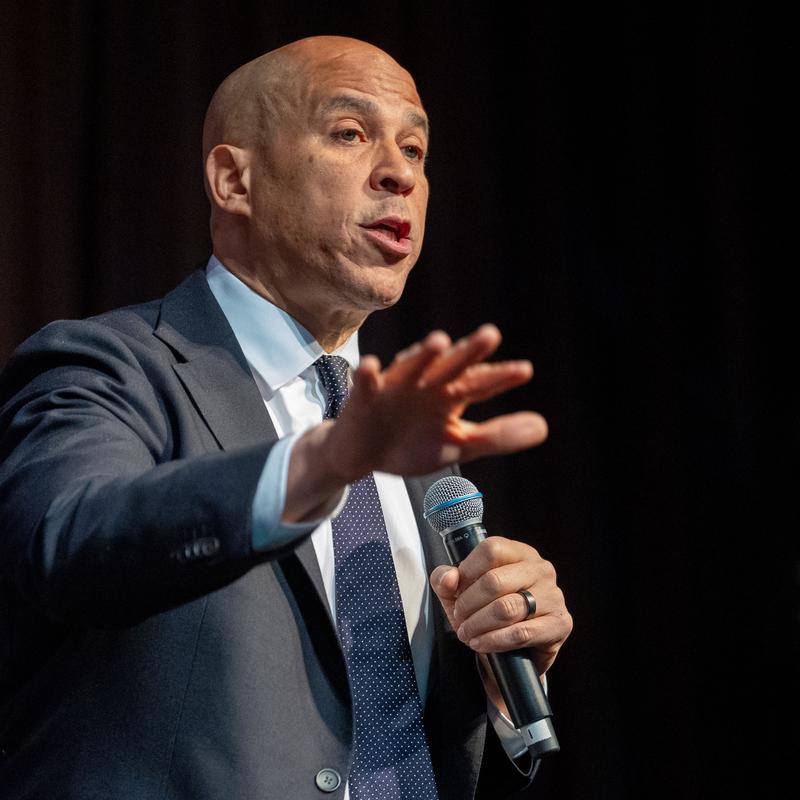
Title: National Politics with Senator Booker
[MUSIC]
Brian Lehrer: Brian Lehrer on WNYC. We're joined now by New Jersey Senator Cory Booker as he looks ahead to a Friday deadline that you may not have heard about. May 1st, Friday, marks the 60th day of the Iran War, the deadline under the 1973 War Powers Resolution for President Trump to either secure congressional authorization for the conflict or wind it down. Senator Booker is one of the lead sponsors of the Senate War Powers Resolution, which "directs the removal of United States armed forces from hostilities with Iran that have not been authorized by Congress."
Senate Republicans have blocked five of these war powers resolutions since the war began, according to Senator Tim Kaine, a Democrat. Democrats are pushing more resolutions before and after May 1st, with three days left on the clock. Will the next vote go any differently? We'll ask Senator Booker in just a moment, but Iran is not the only thing on the Senator's plate. Two weeks ago, he voted for the first time for him to block arms sales to Israel along with 39 other Democrats. He also rolled out his Keep Your Pay Act, a major tax proposal aimed at affordability.
Yesterday, the Senator joined forces with those MAHA moms outside the Supreme Court speaking at a rally on the Roundup pesticide case. Senator Booker, you've been very busy. Thanks for making some time for us this morning. Welcome back to WNYC.
Senator Cory Booker: Brian, I'm grateful to be back on. I'm a fan of your program. I want to say that last segment, I just hope your viewers understand how stunning this moment in American history is, where you have a president with RFK who literally was involved in trying to stop this cancer-linked chemical from saturating our food systems and a powerful chemical company, Monsanto, now Bayer, from hurting people, from farmers and farm workers, all the way to expecting moms and elders. It's just stunning that the Trump administration has sided with the poisoners and the corporations against the people.
It's been an issue I've been fighting on, frankly, since I was a city council person in Newark and saw how much my residents were getting hurt by a broken food system controlled by a narrowing group of corporations who put their profits over public health.
Brian Lehrer: For the moment, the Roundup issue is up to the Supreme Court. Let's say they go Monsanto's way. Is there something that you and others in Congress could do about it?
Senator Cory Booker: Yes, I'm not going to stop fighting this. I moved on to the Ag Committee years ago because I started realizing that all the issues that I've been fighting for in my life, from civil rights and social justice to economic empowerment, were connected to our food system. I've been playing defense on the Ag Committee, trying to stop legislation that was giving big ag and these polluters power. I think we could go to offense on the Ag Committee too and start to really hold these polluters responsible and get us out of this massive monocropping system that really is hurting farmers and benefiting those people who are driving such corporate concentration in the farm industry. I think we can actually see a revolution in American food systems, health, and farmers.
The one thing I will say that I appreciate, and your show is showing that, is a raising consciousness going on in our country where more and more people are seeing how integrated and connected we all are when it comes to our food system and the forces that are undermining that. We may lose at the Supreme Court. This is just one battle in a larger war to take back America's food system and have every family in America have access to healthy, fresh foods that actually empower health and don't, unfortunately, support illness.
Brian Lehrer: All right. Thank you for the spontaneous follow-up to our previous segment. Now take us to Friday. What is the May 1st deadline supposed to mean for the War Powers Resolution, and what do you think will actually happen when that deadline hits?
Senator Cory Booker: We celebrate our 250th anniversary of our country, and we all know the Constitution clearly gives war powers not to the President of the United States, but to Congress. This means that Donald Trump's unilateral war in the Middle East right now that costs us tens of billions of dollars, American lives, is causing a global economic shock that is punishing American workers. Americans all over the country are paying higher prices for fuel and products. All of this is because Congress has failed to do what we're supposed to do, which is check and balance an out-of-control executive. We're supposed to preside oversight and accountability.
Most importantly of all, we're supposed to exercise our powers to decide if our country should go to war or not. I'm leading a group of senators who are saying we're not going to allow business as usual here. We should be debating, discussing, holding open hearings on this war, and by forcing these votes onto the floor, we're doing just that. The 60-day deadline is really being triggered by the War Powers Act, which years ago said that if a president is right in going to war to imminently protect ourselves, which we say that's not the case here, but he still has an obligation, if it's an imminent threat, to come to Congress in 60 days for an authorization for war.
That 60 days is about to be triggered this week, and we're saying fundamentally we should not be in this war. If we continue, it can only go forward if Congress votes to support this war.
Brian Lehrer: Senate Republicans have blocked five war powers resolutions since the start of the Iran war. This 60-day deadline triggers another vote. Do you have any reason to believe that perhaps it's going to come out differently this time because the Iran war has proved to be very unpopular politically, and, even strategically speaking, a lot of the analysts say we're worse off with respect to Iran than before the war started? The Strait of Hormuz wasn't closed, and now it is. We have not made any more progress toward securing the enriched uranium that is, if anything, the US's main concern with respect to Iran.
It would take a ground invasion to do that, most of the military analysts say, which I don't think President Trump is about to order because that would be massively unpopular. Given all of that, do you think it's possible that the Senate Republicans, for their own political reasons, will vote differently this time?
Senator Cory Booker: Let me just add to your list of how this has gone disastrously. One, they still have their highly enriched uranium there in-country. Number two, the regime is more radical than it was before, with the IRGC having more of a control over that country. Number three, they have now been able to realize that with low-cost drones, they may have had to lose their Navy and their Air Force capabilities and had a near-term degradation of their military capabilities, but they have discovered that with low-cost drones, they can still hold off and endure and inflict damage to America and America's allies in the region.
Then, number four, they have realized a superpower that people warned the president to understand, that now they are showing they could choke the Strait of Hormuz and cause that global economic shock. This is a president who has brought us into a war that is going disastrously, and our opponent here is actually getting stronger, including at one point, the president allowing them to get billions of dollars in oil sales to the Chinese. My colleagues on the other side of the aisle know all of this. Some of them are starting to say things like John Curtis from Utah, who did talk about the 60-day deadline. The pressure is building on them as the majority of the American public, including Republicans, are against this war, but again, I think they are showing cowardice right now.
While we have soldiers in that theater showing allegiance to our Constitution and country and doing their job, it is unfortunate that Republicans right now in the majority are not standing up and doing their job and defending the Constitution and taking back war powers to where they belong, to Congress.
Brian Lehrer: Listeners, we have about another 15 minutes with Senator Booker. We can take some of your questions or comments for him at 212-433-WNYC, call or text 212-433-9692. Is this less than a Democrat versus Republican issue, a congressional versus executive power issue that transcends party? Yes, Vice President Vance said in January that the war powers law is "fake and unconstitutional." Looking back a few years, even President Obama pushed forward with the conflict in Libya in 2011 past the 60-day mark. What is this really about?
Senator Cory Booker: I said this yesterday with the Monsanto glyphosate issue. I think we are being failed in America by the simplistic left-right divide, Republican versus Democrat tribalism. It doesn't serve the issues of our day. It really doesn't. Chemicals being sprayed on our food, Republican families and American families don't want our food saturated with chemicals that are completely unnecessary for the foods that we eat. This is another example. Americans do not want this war. They do not want a president who is so connected economically. His family is benefiting to the tune of billions of dollars of unjust wealth that they're getting through their alliances in the Middle East that are contrary to the best interests of the American public.
This is not a left-right issue. It is clearly a right-wrong issue. It is a democracy versus kleptocracy and frankly, corporate strength in our democracy issue. I just love the moments in American history, whether it was McCarthyism or even just the resignation of a corrupt president in Richard Nixon, where you saw people realizing this is not about left or right, it's about right or wrong. I'm looking over at the Republican side and wondering when we are going to have that moment like we did in McCarthyism, like we did with Nixon, like we did with the Vietnam War, like we did with the civil rights movement and the labor rights movement, where people realize that this is about the American people against corporations and ill-gotten interests that are growing in strength in our democracy.
This war is unjust. This war is making us less safe. This war is making every American pay higher prices. This war is destabilizing the Middle East. This war is wrong. Where do you stand as a Congressperson in this? History will be the judge. This is the moment for people to stand up for what's right.
Brian Lehrer: Switching gears here, but somewhat related, I want to ask you about the shift that you and a number of your Democratic colleagues have made on the US Alliance with Israel with respect to the military. Two weeks ago, you voted for the first time ever, for you to block arms sales to Israel, both a $300 million bulldozer sale, as I understand it, and a $150 million sale of 1,000-pound bombs. What do you imagine those bulldozers and bombs would be used for that makes this vote different from others for arming Israel in the past?
Senator Cory Booker: This is all in the context of a disastrous destabilization going on in the Middle East with this war that Donald Trump is leading, and frankly, Bibi Netanyahu is one of the most disastrous leaders in Israel history and in world history at this moment in global politics. These two people are involved in a disastrous war that's making the United States less safe and Israel less safe. In that context, I will not support military aid for our own military or any of our allies in the region.
Brian Lehrer: Just last year, you voted yes to sending almost $9 billion in weapons to Israel, way more than the $450 million total in this vote. What do you say to those who say too little too late?
Senator Cory Booker: I say, again, this is all about the context of a disastrous war that we are involved in, and I will not support any military in that war at all. This is about a destabilizing Middle East right now, where you have Iran gaining more leverage and more power to cause economic shock and pain to Americans, and frankly, making us less safe in that region.
Brian Lehrer: Let's take a call from Stephen in Brooklyn, who I think wants to support the war. Stephen, you're on WNYC. Thank you for calling in.
Stephen: Thank you for taking my call. Yes, I support the war, but the situation is that Iran, which is an avowed enemy of the United States, and it's clearly stating that wants to destroy United States, has weaponry that enable them to destroy United States in a couple of minutes. In 40 minutes, they can push a button, and they can destroy 11 cities in the United States. That's a clear and present danger. The president has to resist it.
Brian Lehrer: Let me just ask you where you get that, because they don't have nuclear weapons now, for example.
Stephen: They have it a long time ago. They have it, and they have enough uranium for 11 bombs. I'm getting from public information, from newspapers, and whatever is available, or TV. I don't remember exactly where did I get this. As far as I know, they have enough material for 11 bombs. A president has a responsibility to prevent that.
Brian Lehrer: Stephen, thank you very much. I don't think that's factual that they have 11 bombs. He says enough material for 11 bombs, maybe if it was further enriched and then developed into actual weapons. The underlying argument, Senator, from supporters of the war, is that after 47 years of Iran trying to develop nuclear weapons, which would allow them to use that as a threat to hang over the head of all the other countries in the region and the United States, something had to be done. They were cheating on the Obama arms deal, according to some reports. They were going forward with trying to make a nuclear weapon and something needed to be done, not to mention with respect to their arming the proxy groups. What do you say to the basic argument on the other side?
Senator Cory Booker: I think there's a real logical failing in an argument that says Iran has highly enriched uranium, which they do, that puts them closer to breaking out and getting a nuclear weapon. There's an amnesia there. Remember, China, Russia, and our European allies joined with us in an effort to stop that highly enrichment process. We succeeded in 2015 in getting them to agree not to enrich to the level that they have now. They agreed not to do that. They agreed to ship out their highly enriched uranium that they had, which they did, and allow snap inspections at Fordow and Natanz, even their mining facilities, which they did.
Iran was stopped in marching towards a nuclear weapon. Donald Trump, in his first term, tore up that deal. What did Iran do? It raced to do the high enrichment that they have right now. Donald Trump is an arsonist who started a fire and now is compounding the problem by saying, "Now that fire I started by allowing them to have highly enriched uranium, I'm going to now go to war with them." What is that war doing? It's killing thousands of innocent people. It has cost the lives of 13 American soldiers. It has injured hundreds of American soldiers.
It's damaged the infrastructure of our allies. It's cost us $50 billion that could have been used to extend healthcare and help with our children feeding school lunch programs. It's created an economic shock that is going to have people in the state of New Jersey spending hundreds, if not thousands, of dollars more this year for gasoline and common basic consumer products. This president has made a tragic blunder, and he has caused us to have a more dangerous Iran than a less one. Anybody who supports the war, I understand. I share with you, Iran is a regime that is not only dangerous, it is the largest sponsor of terrorism, not just in this region around the world.
They need to be stopped. We had them stopped on their march towards a nuclear weapon and had a suite of other levers to pull to stop that regime fundamentally, economically, stop them and their butchering of their own people, but this president didn't do that. He did what past presidents have done and blundered us into a war that has us worse off than when we began.
Brian Lehrer: Mike, on the Upper West Side, you're on WNYC with Senator Booker. Hi, Mike.
Mike: Yes, good morning, Brian, and Senator Booker. I first want to say, Senator Booker, you already had my admiration, and it's gone up to no limits with your conscientious vote on this. I really appreciate it. I'm a Democratic voter, and I'm Jewish, and I fully support you and the other Senator's actions. It's time some human rights standards were imposed on Israel. I do want to know how are you going to withstand the inevitable political blowback from AIPAC and other supposed representative Jewish organizations on this, because it's going to come.
Senator Cory Booker: I will tell you this. 10 years ago, I was one of the first people in Congress to say, "I will not take corporate PAC money." Just a few people had done it, and I said that this money is corrupting our politics. In the recent years, people have been making more and more out of issue-area PAC money. Now I've said at the end of last year that I will take no issue-area PAC money. What I'm trying to show by leadership through example is that you don't need that kind of corrupting PAC money in our politics, that you can win without it. I'm hoping more and more people will give me small-dollar contributions.
It is the way we run our campaign overwhelmingly, and I will continue to do that. I have stood with Israel and peace in that region for my entire time in Congress. Sometimes it's brought me against the views of pro-Israel communities, like when I supported the JCPOA or the Iran deal; I got huge blowback for that, and history is showing that was the right thing to do. I make my decisions about what's best for New Jersey and our nation, and the fundamental guiding principle for me, it's why I was in Israel on October 7th to meet with Palestinian leaders, is that I want a just and lasting peace in that region. Dear God, we have suffering going on there from Israeli families that are still mourning over the savagery of the killing of their children, to the unbelievable, horrific deaths of Palestinians.
One of the reasons why I lead in the efforts to end the settler violence in the West Bank is because I believe the best thing for Israel, the best thing for Palestinians, the best things for that region, and our nation is to be solely focused on peace and not politics. For anybody who's ever questioned me, let me tell you right now, I do not take PAC money from issue-area PACs. I do not take corporate PAC money. I will always stand up and do what I believe is right for the people of our nation and the world, and not the damn politics and the money in our politics that's hurting so many people.
Brian Lehrer: Does this include money that reportedly AIPAC gives not under its own name, under these anodyne names, like I think United Democracy Project is one of them?
Senator Cory Booker: No issue-oriented PAC money, I will not take it. I hope people that are listening to you now say, "Hey, I'll give a dollar. I'll give $5." I've got an election coming up in November. I'm not giving up small-dollar contributions or individual people contributing to me, but I think one of the biggest threats to our democracy, if not the biggest threat to our democracy right now, is the corrupting influence of money in politics. I think I'm one of the only, if not the only, Congressperson who said, "I will not take this kind of money anymore."
Brian Lehrer: Groups like AIPAC and many others with a lot of members or supporters with a lot of money to give might donate as individuals and still have the same effect. How do you prevent that?
Senator Cory Booker: Look, I have very clear rules that I'm setting, and I think that they should be, for everyone, if an individual, I don't care what issue they support, wants to give me $10, that's fine. Thank God that over 80% of my money comes from small-dollar contributors. I want folks to know that that money, especially when it's organized into these issue-area PACs, is not how I make my decisions. I make my decisions based upon what is best for my state, our nation, and my larger goals of seeing peace in our world.
Brian Lehrer: We have only about a minute left. I wonder if you could touch briefly on one other thing that you introduced, the so-called Keep Your Pay Act. The headline is making the first $75,000 of income tax-free for joint filers with proportional relief for everyone else. You say the median American family would see an 85% tax cut. Tell us about it, but also defend against the potential argument that with the tax cuts that already exist under Trump and the Republican Congress, you're further defunding the federal government, and even middle-class people should be paying some tax.
Senator Cory Booker: Everybody should be paying some tax. We all pay federal taxes. When you buy a beer, when you pay for gas, every one of us pays federal taxes. Let's start with the fundamental truth that our tax system is rigged. You had over 80 America's biggest corporations who made billions and billions of dollars of profits last year, paid no taxes whatsoever because they have tax avoidance schemes that allow them to avoid taxes while Americans pay more and more in taxes. The richest of the rich have tax avoidance schemes as well that makes their effective tax rate lower than a firefighter, a cop, or a public school teacher.
What my plan simply does is says, "Enough." We're going to take away all of those tax avoidance schemes that allow people and corporations to pay no or really low taxes, and take that savings and simply raise the standard deduction for families to $75,000. That will mean most American families won't pay income tax. That will mean we cut child poverty under my plan in half. That will mean that American workers keep more of their pay. They'll still be paying federal taxes from our FICA payments that we make into social security through the taxes you pay on goods that you buy.
Why have we had a system that, for years and years and years, allowed the wealthiest of the wealthy to avoid taxes, and nobody says anything about that, and not the average American worker? This flips that on its head. It unrigs our system and gives everybody the chance to keep more of their hard-earned dollars to pay for the rising costs in our country.
Brian Lehrer: Democratic Senator Cory Booker from New Jersey, we always appreciate it when you come on with us. Thank you.
Senator Cory Booker: Thank you very much.
Copyright © 2026 New York Public Radio. All rights reserved. Visit our website terms of use at www.wnyc.org for further information.
New York Public Radio transcripts are created on a rush deadline, often by contractors. This text may not be in its final form and may be updated or revised in the future. Accuracy and availability may vary. The authoritative record of New York Public Radio’s programming is the audio record.