
Ken Burns on The American Revolution
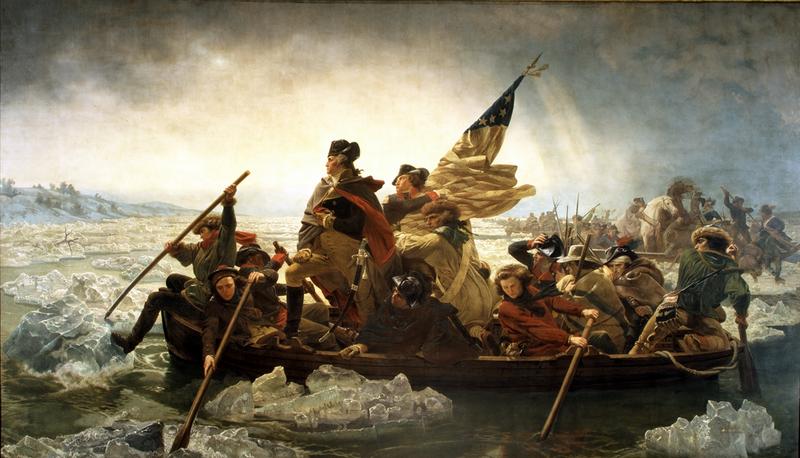
( Emanuel Leutze / Wikimedia Commons )
Brian Lehrer: It's The Brian Lehrer Show on WNYC. Good morning again, everyone. Well, the legendary documentary filmmaker Ken Burns has another ambitious project ready to roll out. It's called The American Revolution, and it's pegged to the fact that we are now in the 250th anniversary year of the founding of the United States. Think about it. July 4th, 1776, to July 4th, 2026, is 250 years, a quarter of a millennium.
We've already passed the 200th anniversary of the start of the war, which was April 1775, and just in time for Thanksgiving, when people think more than usual about the colonial era. The six episodes will air on consecutive nights beginning Sunday night, November 16th. Now, Ken and Sarah also have an Atlantic magazine story in the November issue called "What We Learned From Filming The American Revolution." Ken Burns joins us now, along with a co-director and longtime collaborator, Sarah Botstein, will talk, and we'll listen to a few audio clips from Episode 1. Sarah, welcome. Ken, welcome back to WNYC.
Ken Burns: Thank you, Brian.
Sarah Botstein: Thank you so much.
Brian Lehrer: You didn't try to tell the story of the last 250 years, Ken, just of the period of the American Revolution. Why did you choose that as your frame for six episodes of two hours each?
Ken Burns: Well, first of all, I take issue with your word "peg" in the introduction, because we began this in December of 2015. Barack Obama still had 13 months to go in his presidency. Nobody was talking 250. We weren't thinking 250. We just realized, after the Civil War, World War II, and Vietnam, we had this big, glaring hole in our resume, which had to do with our founding story.
Brian Lehrer: Those films that you had done. Go ahead. Yes, go ahead. Just so people know you're referencing films.
Ken Burns: Yes, films that we had done. It was daunting, of course, because there are no photographs or newsreels from this period, but we really felt strongly that we had to dive in and know about it. It was only halfway through that we began to realize, "Hmm, we might be done in '25, which means it's the 250th anniversary of Lexington and Concord." Then all of a sudden, people said, "Oh, you've planned it this way."
Suffice to say, I think the American Revolution, I believe Sarah agrees with me, is one of the most consequential events in all of world history, and that we know very little of it. It kind of suffers from a glossed-over sentimental view of it that is both bloodless and gallant, but short on the facts that this was a bloody revolution superimposed over a bloody civil war and a big global war, the fourth global war for the prize of North America.
Just that alone, and the sense that we normally think of it as just guys in Philadelphia thinking great thoughts, it needed to have, I thought, a deep dive into it. That's what we've spent the last nearly 10 years doing.
Brian Lehrer: Let me play for our listeners the very first words of the film. Listeners, see if you can guess whose words are being read here before they identify them at the end.
Matthew Reese: From a small spark kindled in America, a flame has arisen, not to be extinguished. Without consuming, it winds its progress from nation to nation and conquers by a sight operation. Man finds himself changed and discovers that the strength and powers of despotism consist wholly in the fear of resisting it, and that in order to be free, it is sufficient that he wills it. Thomas Paine.
Brian Lehrer: Sarah, why'd you open the docu-series with that?
Sarah Botstein: What a wonderful question. I think we wrestled, as we often do, with how to start the film and, of course, how to end the film. Who should have the first word and who should have the last? It took us a while to figure out exactly what to put in that important position. I think over the course of making the series, Thomas Paine's influence, his words, his writings, became essential.
We know that it's essential to the history, but we hadn't quite understood how essential. Ken had the idea about halfway through editing that each episode would be named for or taken from a Thomas Paine piece of writing. I think we wanted everyone to sit down on November 16th and get a sense that we were going to take a big bite out of this apple. For me, it's a beautiful quote that kind of casts forward how important the American Revolution is, as Ken was just saying, in terms of world history, but that something very new was going to happen here.
That quote sort of does that for me. It took a while for us to order the first few elements of the show, and it was really one of the more fun things to figure out. We love that quote, and it's so beautifully read by Matthew Reese, the wonderful actor.
Brian Lehrer: I don't know if you want this question, but I couldn't help but be struck by that opening clip, that there is so much talk these days about the will to resist tyranny and not giving into it voluntarily. You don't make that explicit connection to the politics of today, but maybe you don't have to. Did you drop that in there as your lead because you thought people would relate?
Sarah Botstein: I think I will say very-
Ken Burns: Not at all. Not at all.
Sarah Botstein: -unequivocally, no. I think actually Ken and I will both talk about this a lot, is my guess, in the next few minutes, but I think the echoes and resonances that people will find seem so relevant to today, but as Ken was just saying, we've been working on this project for 10 years, and some of these things are just themes of human history, of the history of the American experience, the history of the American Revolution. In fact, that's a really interesting point you just made, but that really had nothing to do with why it got that position.
Brian Lehrer: All right, so let's go right on. Go ahead. You want to add something, Ken? Go ahead.
Ken Burns: No, I think Sarah's hiding her light under the bushel. Is her genius to move that quote from the middle of the introduction just a few minutes later to the opening as a way to sort of set it up, but one of the disciplines we've had, not just for this film, but for every film we've worked on for, for me, for the past 50 years, has been that discipline of not sort of erecting these neon signs, sort of pointing and saying, "Isn't this so like today?"
There's a moment later on in our fourth episode when a wife of a German general is coming to join the Battle of Saratoga, and she's worried that Americans eat cats. Now, if our film had come out last fall, everyone would be saying, "Oh my goodness, you must have put that in." I think it will just pass over and will just be a funny anxiety on the part of Baroness Riedesel. We consciously make sure we know that every film will always rhyme, as Mark Twain suggested, in the present, because, as Sarah said, human nature doesn't change.
The American experience is we're fraught right now, almost in a Chicken Little moment, about how the sky is falling and how divided we are. Well, we're way more divided during the American Revolution, where Loyalists are killing patriots and Patriots are killing Loyalists and British soldiers, and they're hired guns. The Germans are killing us, and Native Americans are trying to figure out which side to ally with.
Enslaved and Black, and free Black Americans are trying to do the same thing. Women are involved. Spain and the Netherlands joined France in the effort against Britain. Their effort is sort of half-hearted when it comes to trying to establish a Republican government, but very committed to the defeat of the other monarchy in Britain. It has got so many moving parts that if you spend any time focusing on these temporal things, you've done your audience and yourself as filmmakers a disservice.
Brian Lehrer: Let's go right on to another clip. This is just two minutes into Episode 1, as, in a way, the timeline of the story begins.
Speaker E: In the spring of 1754, the celebrated scientist and writer Benjamin Franklin proposed that the British colonies form a similar union. He printed a cartoon of a snake cut into pieces above the dire warning, "Join, or Die." A few weeks later, at Albany, New York, Franklin and other delegates from seven colonies agreed to his plan of union and then went home to try and sell it, but when the plan was presented at the colonial capitals, each of the individual legislatures rejected it because they did not want to give up their autonomy. The plan died, but the idea would survive. 20 years later, "Join, or Die" would be a rallying cry in the most consequential revolution in history.
Brian Lehrer: Sarah, you want to talk a little bit more about what that sets up? What put the colonies so resistant to a union in 1754 on the path to "Join, or Die," as they called it, by 1776? Because I think when the American Revolution is taught, at least basically, to school kids these days, it's as if there was always a glide path to that inevitability.
Sarah Botstein: Right. Well, I think one of the things that you learn in studying the American Revolution and certainly the lead up to the shots being fired at Lexington and Concord, is that like any big, important war, that becomes a world war, that changes the course, as we say in the introduction, of human events, there's a big runway. It doesn't just happen overnight. I think there are a few things in that beautiful scene, which, again, is just an essential element to kind of setting the stage for the whole war, which is a few things.
One, to your point, the states are not a monolith, never have been, I don't think ever will be, and we have constantly, through our whole history, wrestled with states versus a federal government. That's at the heart of the American experience. I think after, it's also important to remember the Native American experience, the Native American history is so intertwined with what we think of as the American Revolution.
You have the French and Indian War, the Seven Years' War. You have the founders thinking about what we need to do, how the 13 colonies might unite. What's happening with the mother country? There are seeds of revolution that happen for 20 years before those shots are fired at Lexington and Concord. One of the most important is, actually, when Britain unleashes a standing army in Boston in 1768, and the colonists, when you have a standing army, things change. I think Benjamin Franklin, looking to the Haudenosaunee, to the Native Americans, as a form of democracy, and then understanding the seeds of war and how much the American Revolution was, at its heart, a civil war, are all in that.
Brian Lehrer: Listeners, any questions? We can take a few phone calls or questions via text message or thoughts for Ken Burns and Sarah Botstein about their new PBS documentary, The American Revolution, which will premiere on PBS on November 16th, or we can indulge a little bit, I think, of anything you always wanted to ask Ken Burns but never had him over to dinner, or Sarah Botstein.
212-433-WNYC call or text, 212-433-9692. Ken, I do want to note that you wrote, you both wrote the article, but in The Atlantic magazine, that the true protagonists of your series are, of course, the people who experience the war. Would you like to give everybody a preview of the breadth of experiences you document?
Ken Burns: Yes. That, Brian, is a really good thing, and it speaks to the clip that you just played because the keyword in the first sentence in 1754, Benjamin Franklin, wanted to adopt a similar union. The similar union is to the Iroquois Confederacy, as Sarah referenced the Haudenosaunee. the whole model, the idea of a democracy, one that had been functioning for centuries, or a version of it, of individual states, individual nations, figuring that they had both individual interests and identities and also common ones, it didn't fly right away, but gradually Americans from Georgia to New Hampshire got themselves acquainted with the idea and saw the strength in that union.
It's entirely inspired by Native Americans. Instead of just having the familiar cast of characters, the Founding Fathers, the bold-faced names, they're there, but we've tried to remove the stigma of their opacity or their one dimensionality by giving them kind of full lives and complications and undertows. At the same time, we want to introduce you to literally scores of other people, a 14-year-old kid, John Greenwood from Boston, who enlists at age 14, and down in Connecticut, Joseph Plumb Martin, the ripe old age of 15, joins the Patriot cause.
We follow the exploits of Loyalists, one of whom, John Peters, ends up killing his best friend in the Battle of Bennington, who's on the other side, a best friend who has run him almost through with a bayonet. He is, as Peters says, chillingly obliged to destroy him. We have a little girl, Betsy Ambler, who's 10 years old when the war begins, a refugee for most of the war. She lives in Yorktown, and you can understand why she can never go back to her hometown, but it's unusual to think of Americans as refugees within, in this case, the colony and then the state of Virginia, but we also have many Black characters, both free and enslaved.
We have many Native Americans. It's not of them. These are distinct nations that have as much separate identity as France might have from Prussia. We want to honor the sort of singularity of each of those nations and the complicated choices they have to make, not just in a local scene. Then we have French soldiers and generals and statesmen and kings and an English king and his ministers and his generals and soldiers from Ireland and Scotland and Wales and England trying to do his bidding, and German troops that I mentioned before at both the grunt level and others.
Then you have myriad citizens who are disaffected and want to stay out of it. That chorus of voices, we have more than 400 first-person voices. Of course, George Washington is there, but we also have Betsy Ambler. They're read, we're fortunate, in addition to Matthew Reese, by probably the greatest off-camera cast that's ever been assembled for any movie or television series, because of the quality of the acting, to help make a period that seems so distant to us come alive.
They do so, I think, magnificently. Tom Hanks and Meryl Streep and Liev Schreiber and Jeff Daniels and Paul Giamatti and Morgan Freeman and Samuel L. Jackson and Laura Linney and Claire Danes and Sir Kenneth Branagh and Damian Lewis. I've maybe gone through a fifth of the folks who have read over the last decade for us.
Brian Lehrer: Yes, and I guess this is something in a number of your historical documentaries that you've had to figure out how to do. How do you approach a documentary about a time before there was film? Right?
Ken Burns: Well, in the beginning, Brian, is the word, and that's what we get back to. Not only does it begin with the extraordinary script that our longtime collaborator, Geoffrey C. Ward, has written, but it's all those first-person voices in many cases assembled by us and by Jeff or by our third co-director, David Schmidt, that we find in the course. We follow footnotes, and we discover Betsy Ambler by following a trail of footnotes and discover John Greenwood.
Some people have been familiar or generally known at least to the scholarly community. Then, again, we have 2 dozen scholars that advised us, and nearly 20 are in the film, all of whom represent different expertise, Native Americans. Kathleen DuVal, who recently run the Pulitzer Prize for extraordinary book Native Nations, or it might be their teacher, Alan Taylor, or the great Gordon Wood, now retired from Brown, and his teacher, the late Bernard Bailyn, who, because we've been working on this for so long, we had the chance to interview and then filming all across this beautiful territory.
The biggest star, as Sarah likes to say, is the landscape itself, beset by weather no one knew was coming, by the distance the British could never appreciate, by the sheer beauty and variety of it that permits people to disappear and reappear, if you're a patriot guerrilla waging war in New Jersey or in South Carolina, the real guerrilla actions of the war.
Brian Lehrer: Listeners, if you read their Atlantic piece about the making of this documentary series, The American Revolution, you'll see that it begins with a meditation on the weather, the weather of that time in the Revolutionary War years, and the weather while they were making the film. It's a good read, which I recommend. Monk in Brooklyn, you're on WNYC with Ken Burns and Sarah Botstein. Hi, Monk.
Monk: Hi. Thank you for having me. I've been watching your documentaries since I was a child, and it's always struck me how amazing it is that you can compile so much information to get the whole picture. I was just curious as to what that process is like. Where do you have a team? What's the extent of the process of gathering all this information and then organizing it and applying it to the documentary?
Brian Lehrer: Sarah, would you take that?
Ken Burns: I'll let Sarah answer this, but the first thing I'd say, though, on top of that, is that you would presume, Monk, that this is an additive process. It's subtractive. We have 40 times the material we collect as what's used. Sarah can describe what's a fairly handmade film is and the team that puts together, and why it takes a decade.
Sarah Botstein: Yes, I love a few things about your question. One is that central to the work we do is collaboration. We are a team in the truest sense of the word. At our smallest, we're really a group of about four. It's Ken and Jeff Ward and David Schmidt, and me. Then we blossom out to 25 or 30, and then at the end, about 40 amazing people over the course of that decade.
One of the things that people, I think, like to hear about is that part of our process is very fluid. We're always researching. We're always writing. We're editing until the very last second. We're always, always researching. Part of our production team and part of our production office is actually an old-fashioned library archive. There are those producers and researchers that are, for this film, totally immersed in the paintings.
How has the American Revolution been represented in art for the last 250 years? Some of our researchers do only maps. They study the maps of the time. Then we spent about two or three years really fastidiously making new maps for the series, two-dimensional and in CGI form, to recreate a true landscape and topography of 18th-century America. Rivers were different.
There were not dams the way we know today. There weren't the roads that we have today. We wanted to really give viewers a sense of what the country was like because the land is so essential both to the story of the American Revolution and to the war, which are the same thing, actually, but we often forget that. Then there are documents and music, so all of the elements that go into our films.
If you're making a film about the Vietnam War, that would be photographs and newsreels. If you're making a film about the American Revolution, that's paintings and documents, and maps. We bring material in, as Ken was just saying, usually about 40 to 1, but then we have to know everything about those images, those documents, that archival material. We are fastidious fact-checkers, but also fastidious archivists.
We handle material really carefully. We log it really carefully. We're responsible for understanding where it came from. Then, in the last year of production, we do a lot of technical work on the film, whether that's sound design and sound effects, and making the film look and sound beautiful, but we have to clear and get rights for everything. We become a-- It's a copyright puzzle.
You think making a film about the 18th century is simple when it comes to copyright; it's unbelievably complicated. We're also dealing with archival material from literally around the world. Yes, we have a great office in New York City that does a huge amount of that, and an enormous, beautiful editing house in Walpole, New Hampshire, where Ken is. It's an incredible team, and we're lucky to get up and go to work with them every day.
Brian Lehrer: Now, you can't make an honest film about the nation's origin story without dealing with slavery, so here's about a one-minute excerpt in which, listeners, you will hear the reading of two quotes. They are the bookends in this clip with a short narration in between them.
Samuel L. Jackson: I need not point out the absurdity of your exertions for liberty while you have slaves in your houses. If you are sensible that slavery is in itself and in its consequences a great evil, why will you not pity and relieve the poor, distressed, enslaved Africans? Caesar Sarter.
[MUSIC]
Jane Kamensky: Slavery as a metaphor is in the conversation from the beginning. Everywhere there's slavery, there are people thinking about freedom. Nothing shows the desire for freedom like the struggles of subject peoples.
[MUSIC]
Amanda Gorman: I, young in life, by seeming cruel fate
Was snatch'd from Afric's fancy'd happy seat:
What pangs excruciating must molest,
What sorrows labor in my parent's breast?
Steel'd was that soul and by no misery mov'd
That from a father seiz'd his babe belov'd:
Such, such my case.
And can I then but pray
Others may never feel tyrannic sway?
Phillis Wheatley.
Brian Lehrer: Ken, would you talk about that stretch that's from about one hour into Episode 1, those quotes, or anything you learned that maybe was new to even you about slavery and its place during the revolution?
Ken Burns: Yes, it's all new to us, Brian. We have our own cursory sense of the revolution, and then it's exploded by the deep dive that the decade at PBS, and that's the key player here, permits us to have at the end. You heard Amanda Gorman, who delivered the inauguration poem at the inauguration of Joseph Biden as president. She is reading Phyllis Wheatley, who is the first published African American and enslaved girl, that is named Phyllis, after the ship that brought her, and Wheatley, after the family that bought her.
We are in the midst of a revolutionary moment. As Jane Kamensky, the scholar you hear in the middle, formerly of Harvard University and now the head of Monticello, where she has to wrestle with the essential tensions and questions of slavery. You have people talking and using, as she referred to, the metaphor of slavery, to describe what the British are doing. The hypocrisy is not lost on Caesar Sarter and many, many others who comment in this case, read by Samuel L. Jackson, expertly on that irony and that hypocrisy.
What you have is between 2.5 and 3 million people living in what we call the 13 original colonies. 500,000 of them are enslaved or free Africans who have an immense stake, as do women and many others, as Jane says, subject people to the ideas that are floating around, and we can, in our unforgiving revisionism, throw out or cancel those who participate in it, but they open the door with the language of their understanding.
What begins as a quarrel over British rights becomes transcendent rights, as the scholar Christopher Brown in our film says. Those transcendent rights are best embodied by the phrase "All men are created equal." Of course, the man who wrote that, Thomas Jefferson, meant all white men of property, but the word "all," as the scholar Yuval Levin reminds us, is the thing that breaks down the door.
Slavery's dead. The second those words are written, it's going to take four score and nine years. Women are going to have the vote. It's going to take, I'm sorry to say, 144 years, but this is the great story of the revolution, and you cannot tell it unless you have the ballast and counterweight of all of those. I haven't even mentioned the Native Americans, some of whom are assimilated, some of whom are coexisting within the footprint of the 13 colonies, once their land.
Then there are these nations, as I said to the west, who are trying to figure out, "Do we go with the British? Do we go with these new people?" It divides them in very important ways, but none of them are free of the hunger for the ideas. We could say the Enlightenment ideas. They may just be in the human breath from the very beginning, ideas of freedom and liberty. Nowhere, another African American says in the film, nowhere does God say that somebody that has a different skin color is less free than another, and that is true. God does not say that.
Brian Lehrer: One more call. Lorinda in Park Slope. You're on WNYC with Sarah Botstein and Ken Burns on their new PBS docu-series, The American Revolution. Hi, Lorinda.
Lorinda: Hi. Thanks for taking my call. I am an LTL, FTC as well. I just had a question as to whether the filmmakers are concerned that given the times we're in right now, when people are in fact calling for a revolution, are committing violent acts, did stage an insurrection at the Capitol on January 6th, that the film might, in some ways, give people permission or encouragement or feel it gives them a justification for taking these kinds of actions in the current time.
Brian Lehrer: What a question, Ken?
Ken Burns: It's a wonderful question. Maybe Sarah, too, would respond. I think when someone is in crisis, you reach out to a pastor or a professional who wants to know, "Who are your parents? What was the circumstances of your childhood?" You begin to go and sort of reassemble a productive narrative by going into the past. There is nothing scary. There's no permission given in the film, but there's nothing scary about investigating where you began in order to know where you are and potentially where you're going.
Your question could have easily gone in another direction. This is the original No Kings movement, right? We have, at the end of our Battle of Yorktown, a German soldier we've been following throughout the series who is openly contemptuous of these rebels. That's all the Brits and the Hessians call the Americans, and he says, "Who would have thought 100 years ago that out of this multitude of rabble could arise a people capable of defying kings?" There's many things [crosstalk]
Brian Lehrer: In our last minute, Sarah, if you want to get in on this, too, to Lorinda's point, does studying the American Revolution make you wonder about the thorny moral question of when armed revolution in the name of justice is justifiable? Because it seems Americans accept our own revolution casually, certainly by now, but would scrutinize most others very carefully and be reluctant to endorse.
Sarah Botstein: Yes, really beautifully said, and I think an essential question in studying this history. My hope, actually, is that viewers will not take away an inspiration or a sense of violence, but a sense of real citizenship, that the founders wanted us to be engaged citizens and to be involved in our communities, small, medium, and large, as we've often been saying.
I hope citizenship is actually the takeaway of the film, that our responsibility to a democracy is to have civilized debate, to exercise our rights to vote, to debate our neighbors, to figure out what is best for all the citizens of the land, and to peel back the layers of the onion, to really understand what freedoms, liberties, and ideals are central to the American experiment? We can debate those, but some of them are quite inspirational and very clear.
Brian Lehrer: The American Revolution, a six-part PBS docu-series, runs six consecutive nights beginning November 16th. We only sampled from Episode 1 so we don't spoil the ending, so you don't know who won the war, but there you go. Ken Burns and Sarah Botstein, big congratulations on this project, and thank you so much for giving us some time today.
Ken Burns: Thank you, Brian.
Sarah Botstein: Thank you.