
1776's No Kings
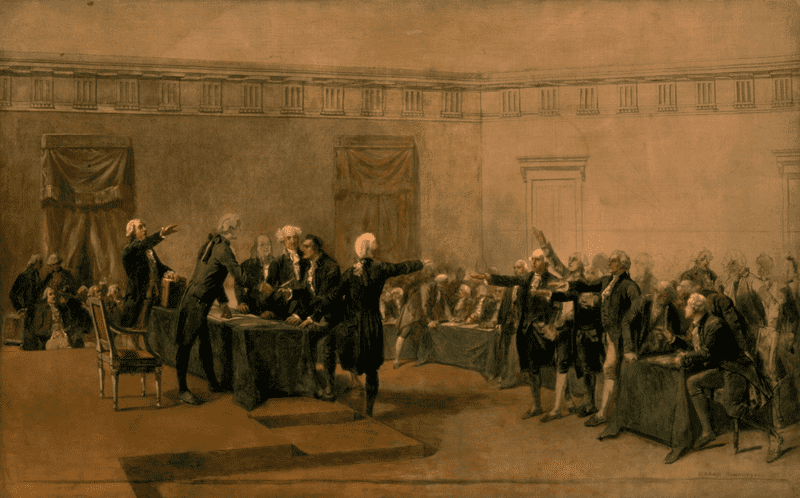
( The White House Historical Association (White House Collection) / Wikipedia Commons )

Brian Lehrer: It's the Brian Lehrer Show on WNYC. Good morning again, everyone. As we anticipate the 250th birthday of the United States next year, have you ever wondered why we place so much emphasis on the year 1776? After all, the Revolutionary War began the prior year, 1775, and the United States actually gained independence from Britain officially in 1783 when the war ended. One might even argue that the implementation of the Constitution on March 4th, 1789, is a more accurate birthday for the United States government. Why is 1776 the year we observe as the founding of this country?
Pulitzer Prize-winning historian and Pepperdine University professor Edward J. Larson has a new book on this very question. In Declaring Independence: Why 1776 Matters, Larson guides readers through the pivotal events that transformed British subjects into Americans, created a framework for today's republican, that's small r republican, states, turned the tide of the war effort, birthed American values, and fueled later quests for racial and gender equality. He joins us now to make the case that 1776 still matters. Professor Larson, great to have you. Welcome back to WNYC.
Edward J. Larson: Thank you for having me back, Brian.
Brian Lehrer: Your retelling of 1776 begins right on New Year's Day with a cataclysmic event in Virginia, the Burning of Norfolk. What led to this incident, and why did it become a pretext for independence, as you call it?
Edward J. Larson: Thank you. Your introduction captured exactly my thesis, as it were, why 1776 matters, because we always talk about the spirit of 1776. We really don't talk about the spirit of other dates you gave, like '83 or 1775, even though they're important, too. I'd like that you focus on the bombardment of Norfolk and the burning, the destruction of Norfolk. Norfolk, then, was the second largest town in the American South, the key to the entire Chesapeake.
Three things happened in January, and I guess to set it up, before that, yes, we were fighting. The Americans had been fighting-- They weren't Americans yet, but the Patriots were fighting the British over taxation without representation, really, since 1765 in the Stamp Act Crisis, but even before, even in 1775, when the Congress adopted the army besieging Boston, the British troops in Boston. They wrote in the Declaration of the Causes and Necessity of Taking Up Arms, "We have not raised armies with the ambitious design of separating from Great Britain, but in defense of the freedom that is our birthright as subjects of the king."
Then, in the Olive Branch Petition a month later, they declared their fidelity to your Majesty's person, family, and government. What changed in 1771? It begins with that bombardment you talk about. What I did for my book, I wanted to find out why 1776 mattered. I went back and read all the newspapers, at least all I could get a hold of throughout the whole year, the American newspapers. I read the letters of the leaders, which are published like Washington and Adams, and Jefferson, and on and on, and then also of soldiers in the field. A lot of those are available.
The soldiers in the field from 1775 and 1776. What I found that three things happened in January that upended everything. One was in January, the King's speech from the throne of the previous October was finally published in America. You see it in all the newspapers. In it, the King declares the Americans, the Patriots, in revolution, and he vows to send 20,000 more troops and the largest navy ever assembled by the British to that date. These ships were just countless. They so filled New York harbor that they joked that you could walk from one side to the other on the decks of the ship.
Then thousands and thousands of British German mercenaries. Americans heard that. They no longer could trust the King. As for them, they received word of the bombardment of Norfolk. Norfolk was, as I said, one of the most important ports in America, and it was just destroyed by what the Americans described as a British bombardment and the resulting fire. Now, the previous year, the British had done that to Falmouth up in Massachusetts, or what's now Maine, Portland, and Charlestown in Massachusetts.
Those could be seen as the activities of a rogue captain. Not so Norfolk. That was British government policy. Then finally comes out on January 17, Thomas Paine's Common Sense.
Brian Lehrer: Hang on to Common Sense. I want to talk about that with you in detail. Everybody hears about Thomas Paine's Common Sense briefly, I think, in middle school history class. I'm so glad you wrote more about it in the book. I want to get into that, but I want you to back up just a little bit. If the Americans had not declared independence in 1775, why were the Brits bombing here? What were the Americans fighting for?
Edward J. Larson: The Americans said they were fighting for their wealth, to put it right in their language, "In defense of the freedoms that is our birthright as subjects of the King." They were fighting taxation without representation. They were fighting Parliament. They were fighting the Declaratory Act, but they were declaring their submission to the British Empire, and being subjects to the king, they just wanted their assemblies in each of the various colonies, like Virginia or New York, or Massachusetts, to be their representative assembly, and then that would pass bills, but they would all be subject to the royal governors and to the king and they would view themselves as entities like Scotland had been before the Acts of Union.
Now, after it, what they decided was they no longer could trust authoritarian rule. They turned against the authoritarian rule or the absolute rule of a monarch. They turned against monarchy, and they thought their freedoms, their life, liberty, and their pursuit of happiness could only be based on republican or representative government, which was something new under the sun, and they recognized it because there were no popular republican governments in the world at that time. They opted for, as Thomas Paine said, "We have it in our power to begin the world over again." They were creating something new under the sun.
Brian Lehrer: Listeners, if you're just joining us, we're speaking with Pulitzer Prize-winning historian and Pepperdine University professor Edward J. Larson, who has a new book, Declaring Independence: Why 1776 Matters. I see we have one call from a listener who wants to ask you a question. Lawrence in Brooklyn, we'll get to you in a couple of minutes. Anybody else wants to raise your hand in history class, 212-433-WNYC, call or text, 212-433-9692.
Thomas Paine's pamphlet Common Sense, published on January 10th, 1776, and it immediately goes viral on social media. No, wait. Seriously, what was basically in Common Sense, and how did it spread in the media ecosystem of that day to become influential far and wide?
Edward J. Larson: There's never been anything like it before, certainly in American history in the colonies. This pamphlet comes out carefully drafted. Paine was an incredible writer, working closely with Benjamin Rush. Designed both for reading and for speaking. It was often spoken. Becomes the best-selling pamphlet to that date in American history. Amazing circulation. Republished in New York within the end of the month and elsewhere throughout the colonies.
What it did is it took a lot of pieces, as again, before taxation without representation, Parliamentary overreach with the Declaratory Act was the problem. He recasts it. He begins with a totally fictional origin story, very similar to what was in Locke's Thoughts on Government from the century before. People are out there, in free, with their liberties, and they decide through social contract to form unions with representative government, they give away some of their rights to protect their security and help promote their happiness.
That's what we need to get back to. The problem, he now says, is not the Parliament. He gives a new light to it. The taxation without representation, as he posited, was just a symptom. The real problem was authoritarian rule by a king. He goes through page after page of how, as he puts it, the will of the king is as much of the law of the land in Britain, it is in France. In America, the law is king, for as an absolute governments, the king has lost, so in free countries, the law ought to become king.
That's picked up by Washington, by Adams, by Jefferson, by everyone. Suddenly, the problem becomes authoritarian rule, and the solution becomes representative popular republican government.
Brian Lehrer: Lawrence in Brooklyn, you're on WNYC with Professor Larson. Hello, Lawrence.
Lawrence: Hey. Hi. I'm interested to hear what Professor Larson would have to say about this. My understanding, I'm not a professor of history, is that what you might call the Loyalist movement in the United States, what was the east coast of what became the United States at that time, was not insignificant and not non-trivial. A fair number of people ended up in Canada because of that. That seems to be what seems to me to be a fact that is now omitted from the standard high school and even intro to history college curriculum these days. It just seems really interesting to me. This was not an unimportant thing. I'm wondering if Professor Larson has any thoughts on that.
Edward J. Larson: Absolutely, I agree with you. I was just in Brooklyn speaking at the Center for Brooklyn History last week. Wonderful place. You make a very important point. Before 1776, the loyalist movement definitely was the majority movement. It included not just John Dickinson, who stayed with it, but it included Adams, it included Jefferson. They were Loyalists. They wanted their rights as subjects of the king. What happens is the balance shifts during 1776, so that by the end of 1776, certainly the majority of Patriots had shifted over and were for independence and republican government as their means to secure their life, liberty, and pursuit of happiness, but Loyalists remain.
There were significant number of Loyalists in your area in both Staten Island, which was filled with Loyalists. When the British sent the armada over, starting in June of 1776, they were welcomed to Staten Island. There were also many Loyalists not in Brooklyn, but across that ridge that went down there, the Heights of Guan, as they called them, east of Prospect Park in Long Island. There were certainly a large number of Loyalists. When they try to estimate it, I think the best estimate is by the end of 1776, maybe 2/5 of Americans were Patriots. 2/5 didn't really care, like the Quakers, and another 1/5 were Loyalists.
When Boston is evacuated by the British in March of 1776, the Loyalists go off in great numbers, and they tend to go up to New Brunswick and Nova Scotia at that time. In the south, the Loyalists from Savannah and Charleston will be moved down to British Florida and the Bahamas. A significant number do leave, and indeed in some ways, I mention this in the book, but don't emphasize it, 1776 was in some ways both the birth date of the American republics and British and later Canada because Canada during the beginning of 1776 defeats the invading American troops and sends them back and becomes a center for Loyalists and a center for British loyalty. Canada can claim the same birthday if it wants to.
Brian Lehrer: It was also in 1776, your book reminds us, that the 13 colonies became individual states with separate political entities. Why did John Adams push the colonies to come up with their own constitutions?
Edward J. Larson: It was central to the whole thing because-- Central to his whole enterprise of independence. Indeed, he pushed Congress to adopt the Resolution on Independent Governments, urging every colony to adopt its own constitution. All the states that needed to adopted new constitutions in 1776. New York, because it was in the middle of the war, it wasn't concluded until the following year. The issue was, the original charters were all granted by the king and included, they were subject to the king.
They had their own assemblies, but they were subject to the king. Adams believed, and Congress agreed, that each of the former colonies, now states, needed a republican constitution that moved sovereignty-- I can't say it better than North Carolina did in its Constitution of 1776, which was modeled on the writings of Adams in Thoughts on Government, in my opinion, his most important pamphlet that came out in May of 1776. It begins with, "All political power is vested in and derived from the people only." Now that's new.
All the charters, sovereignty is based on the king. Think back then. You can read Shakespeare when he writes Henry IV or all the other wonderful historical plays. When they refer to the king of France or the king of England, they don't say the name Henry IV, they say England, they say France. "The state is me," Louis XIV says. That's the way they thought. Now in America, in these 13 republics, all political power is vested in the people only. The people become sovereign. That more than anything else was the American experiment.
Brian Lehrer: Can you explain the term as it was used then, Republicanism? Today, we hear that word, and we imagine the political party and what it represents in the 21st century. Listener asks in a text, "Why republican government and not democratic government?"
Edward J. Larson: Republican government was representative government. The party later borrowed the term. Democracy was then connected in Greek theory with total, more like New England town meetings, and you couldn't do that at a colony level. Everyone directly involved. Representative government, which is what is described in Locke's Second Treatise on Government, which was an important document and also described in Thomas Paine's Common Sense, is where the people are sovereign and choose their representatives to rule. Power is primarily vested not in an executive. The power is primarily vested in an elected assembly or Congress, an elected body that is truly representative.
They stress free, frequent-- in this case, all the states had annual elections of legislators. Free, frequent elections where the people rule through elected representatives. That was their idea of what republican government was. My book usually uses the sentence representative government because that captures it better, but both John Adams in Thoughts on Government and Thomas Paine in Common Sense, and then in their writing of the new constitutions, Jefferson and Mason in Virginia, Benjamin Franklin in Pennsylvania, you follow all of these.
They were in the middle of a war, and they devoted enormous time to writing these states' constitutions as well. I think Jefferson said it best. When he was spending time in June, when we thought he was writing the Declaration of Independence, which he ended up turning out in a day or two, when he spent most his time working on the Constitution of Virginia, he wrote, "In truth, it," meaning the Constitution of the state of Virginia. "In truth, it is the whole object of the present controversy. For should a bad government be instituted for us, in future, it would have been well that we'd accepted the first bad one offered from beyond the waters," that's England, "Without the risk and expense of contest. That says it all. That's what 1776 was about. New state constitutions, republican government, and the rule of law.
Brian Lehrer: My guest is Edward J. Larson, Pulitzer Prize-winning historian. His new book is Declaring Independence: Why 1776 Matters. Wendy in Springfield, New Jersey, you're on WNYC. Hi, Wendy.
Wendy: Hi. I just have two questions and one shameless plug. Number one. I want to know what the professor thought about what I read, that one of the other reasons that the Patriots went to war with England was that they heard they were going to end enslavement of Africans, and they didn't want slavery to end because it was an economic engine of the whole country. Two, that they also heard that the British were going to stop them from pushing west of the Mississippi River and continuing to genocide the Indians.
Three, the shameless plug, Springfield, New Jersey Public Library, on its website has a video of the Battle of Springfield, which was June 23rd, 1780, and is considered by some to be pivotal in the winning of the war. Full disclosure, I was one of the people who helped make the video.
Brian Lehrer: That's great. You want to plug it again, and then we'll get a response, just so it lands with people, and then the professor will talk.
Wendy: Springfield, New Jersey, the one in Union County. Go to the website of the public library, Springfield Free Public Library and you will see a banner and you can click on it and there's an 18-minute video of the Battle of Springfield, June 23rd, 1780, which some say was pivotal in forcing the British to say, "Okay, we lost that battle, 1500 Patriots against 5000 British and their Haitian missionaries. We have to go South, and we're never going to go North again," and that was, some say, a pivotal battle in the revolution.
Brian Lehrer: Wendy, thank you so much for your call. What about the continuing slavery as one reason for the revolution, Professor?
Edward J. Larson: Why don't I just take her questions backwards so I remember them?
Brian Lehrer: Sure.
Edward J. Larson: On the first one, I totally agree with what she's saying. The war was very important. My question was why 1776 matters, not why 1780 and 1781 don't matter. I think they matter too. What I find over the whole period, over the whole revolution, acts inspire words, deeds inspire actions. They go back and forth. If the Americans hadn't won the battle of Saratoga and the Battle of Yorktown, if they hadn't fought to a draw in the Battle of Bunker Hill in 1775, the outcome would have been different.
What I'm talking about in my book is not the importance or unimportance of Springfield and the other battles. They were important, but it was the ideas of 1776, in my opinion, the ideas of republican rule, that is representative rule, that the people are sovereign, that the authoritarian rule is wrong, that the rule of law, those ideas is what drove those battles and drove the fight. That's my point, but it took the fight too. I agree with her on that point. Second, she talks about the West, and that's an easy one.
She's absolutely right. One, it was the overreach of Parliament, and it was taxation without representation. Certainly, it was the Declaratory Act, but the Quebec Act, where the frontier was ceded to the now British-- After the French and Indian War, the now British Canada, when they got the Ohio country, when the colonists thought they had won it by fighting, Colonists contributed an enormous number of troops to the French and Indian War. They were fighting for the frontier because Americans in general felt that their future, what made them different, their economic opportunity, lied on the frontier, and that was taken away. The West is true.
Now, let's get back to our first point that you wanted to raise, Brian, and that's the role of slavery. I just recently published a book, American Inheritance: Liberty and Slavery in the Birth of a Nation, where I discuss that point in great depth, and I do discuss it in this book as well, that slavery had always been illegal in Britain. It was okay in their colonies if the colonies adopted a law. All 13 colonies did by law have chattel slavery, and as did the even richer British colonies in Barbados. That's actually where it began.
Chattel slavery began in Barbados and then was carried up first to South Carolina late in the 1600s and on to Virginia early in the 1700s when they adopted the Virginia Slave Code. What had happened was in the Somerset Decision early in the 1770s, the British courts, led by Lord Mansfield, had ruled that if a British subject in the New World, such as Charleston-- The case actually involved an important British official who was from Virginia and went back to England. He was a tax collector, and he was being attacked under the attacks of the Stamp Act.
He went to England with his enslaved house servants. The English courts freed them. They said slavery is illegal in England, and therefore, you can't own your enslaved people. That case was not an isolated case. The case was defended. The rights of Stuart, the fellow from Virginia. He was defended by a consortium that put a lot of money behind it, of Carolina and Virginia planters who now were incredibly wealthy, and they were often going to England. Often, they sent their sons to England to become lawyers, and they wanted to take their house enslaved people, and England ruled you couldn't.
As soon as that enslaved person steps foot on England, they're free. The Americans thought that was rallied against it. It says, "Wait, you're treating us as second-class citizens. We're just as much British subjects as somebody in England. If we properly own an enslaved person under the laws of South Carolina or Virginia, or Massachusetts, we should be able to take it to England. Therefore, we're being looked down upon. We're being treated as second-class citizens." That added to the view that the British people, British parliament, the British king, the British people in general will never treat the colonists as equal subjects.
What the colonists who were getting rich, of course, and prospering in the New World found that attack on them as one of the aspects that gets thrown into. That's mentioned by Jefferson in his arguments, that's mentioned by Paine, that's mentioned by others as part of this story.
Brian Lehrer: There's a difference between being able to take an enslaved person with you to Britain, and Britain, while it still ruled the colonies, was going to outlaw the slavery of Africans here. Were they going to do that?
Edward J. Larson: No. Britain was making too much money. The king was directly involved. He had enslaving stations in Africa. The British ships were carrying most of the enslaved people, and they were getting rich on the products of enslaved labor, the sugar in the Caribbean. Don't just think of the 13 American colonies. You've got to think of Barbados and Jamaica, and the enormous resources, the wealth. An enormous percentage of the British Empire's foreign trade was sugar from the Caribbean.
They didn't have any realistic -- With my earlier book, I have read every document, every argument, every letter. They weren't afraid that Britain would end slavery in the colonies. They were afraid we're being treated as second-class citizens by the British.
Brian Lehrer: As slavers. How ironic. One more call, Edith in Manhattan. We just have a minute left in the segment. Edith, we have 30 seconds for you. Go right for your question. Hi.
Edith: Oh, hi. I'll be fast. Thank you for the segment. It's wonderful. I'm going to re-listen to it on the WNYC app. I just don't think we can go out without talking about something that I finally finished, Monday through Friday, two hours nonstop a night, the PBS Ken Burns new doc, The American Revolution. It was fantastic, and it was not in my opinion, and it would be interesting to historians aspect-- Guest, you're fantastic. I'm sorry I forgot your name, but it did not whitewash things. It really went into all of the stuff with the Black folk and the Native Americans, as well as how the Loyalists were treated, how the Patriots-- It was a brutal war.
Brian Lehrer: Edith, I'm going to leave it there for time. 30 seconds. Have you watched the Ken Burns American Revolution documentary? He was on the show the other week to talk about that. Now you're here on something related. Of course, you're focusing on 1776 in particular and his about the war that went on for years later. You'd be a good person to do a Ken Burns documentary review. Do you have a 20-second blurb? Did you see it?
Edward J. Larson: Of course. I do think he borrows heavily on Rich Atkinson's magnificent, two parts are out, a third's coming, Military History of the Revolutionary War, and you've nailed it. That story was about the Revolutionary War, and I'm talking about 1776. I think they complement each other beautifully, but his is technically accurate. I teach that area. He does a good job of putting the war in context. What I'm trying to put on is the war of ideas in 1776.
Brian Lehrer: Edward J. Larson, chaired professor of history and law at Pepperdine University, author now of Declaring Independence: Why 1776 Matters. Thank you so much for sharing it with us.
Copyright © 2025 New York Public Radio. All rights reserved. Visit our website terms of use at www.wnyc.org for further information.
New York Public Radio transcripts are created on a rush deadline, often by contractors. This text may not be in its final form and may be updated or revised in the future. Accuracy and availability may vary. The authoritative record of New York Public Radio’s programming is the audio record.