Brian Lehrer: It's The Brian Lehrer Show on WNYC. Good morning, everyone. Thank you for your donations during the first hour of the show. We have a goal of 100 donations to do our show's part for the second hour of the show. Keep them coming, but we're not going to dwell on it right now. Instead, again, this drive we're doing a 10-question quiz each day, breaking it up a little bit during a membership drive to have a little fun. A different theme each day.
Get two in a row right, and you'll be able to choose today between a Brian Lehrer Show baseball hat or those WNYC socks that we were talking about before. Our theme here for today is broadcast news history, so who wants to play? You can call 212-433-WNYC. We'll have 10 questions, mostly chronological, starting in 1945. Some of them will be name-that-voice questions. Some will just be facts about broadcast news history. Who wants to play? Dan in Hartsdale wants to play. Hey, Dan, ready to go?
Dan: I am.
Brian Lehrer: Okay. Probably the first real broadcast news icon became well-known during and just after World War II. It happened to be on the radio, not TV. Here's the beginning of one of his most dramatic broadcasts as he reported from a German concentration camp after it was liberated in 1945. Who is speaking here?
Mystery Voice 1: Permit me to tell you what you would have seen and heard had you been with me on Thursday. It will not be pleasant listening. If you're at lunch or if you have no appetite to hear what Germans have done, now is a good time to switch off the radio, for I propose to tell you of Buchenwald.
Brian Lehrer: Do you know who that was?
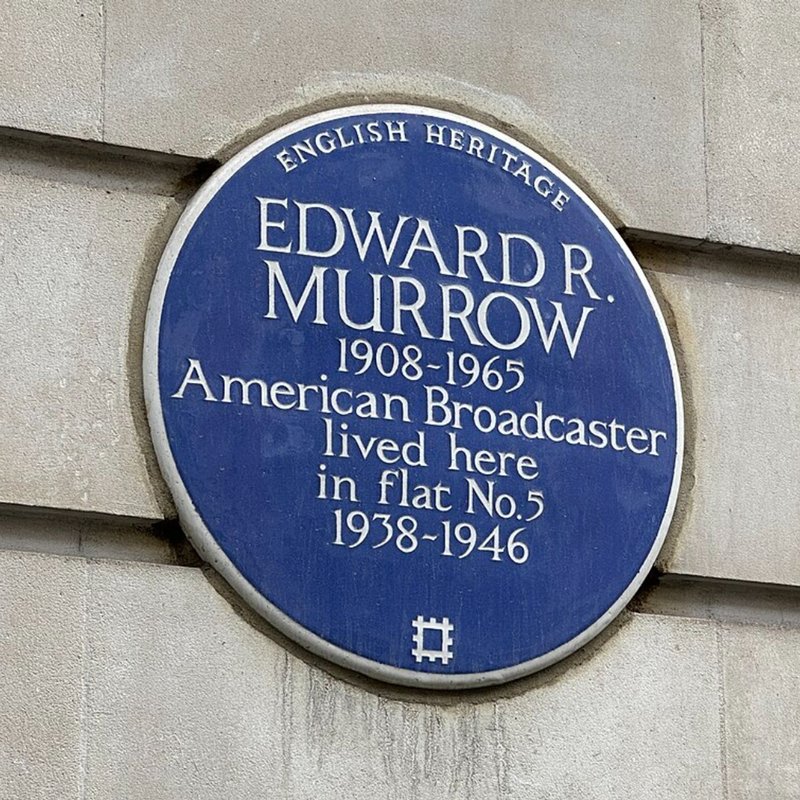
Dan: I'm going to guess it's Ed Murrow.
Brian Lehrer: Absolutely. Edward R. Murrow, first broadcast news icon, I think it's safe to say. That is some archive tape that we have from 1945. Question 2 for the hat or the socks. The first regularly scheduled nightly network TV newscast, first regularly scheduled nightly network TV newscast, began in 1948. Was the first anchor Walter Cronkite, Harry Reasoner, David Brinkley, or Douglas Edwards? Multiple choice.
Dan: Wow, that's a tough one. I'm just taking a stab at it. Did you say what network it was?
Brian Lehrer: I did not. It was CBS, so Walter Cronkite, Harry Reasoner, David Brinkley, or Douglas Edwards.
Dan: Well, then I'm going to guess Walter Cronkite. It's a guess.
Brian Lehrer: Well, sorry to say that this is the answer.
Announcer: CBS News presents Douglas Edwards with up-to-the-minute developments from all parts of the world.
Brian Lehrer: Sorry, Dan, you didn't get two in a row right, but thanks for playing. We're going to go next to Leslie in Farmingdale. Hi, Leslie. Ready to play?
Leslie: Yes, a bit trepidatious.
Brian Lehrer: Question 3. In 1976, ABC introduced the first woman to host a nightly TV network news program. They wouldn't put her on alone, however. They teamed her with an established male co-anchor who was already well-known. Can you name either the woman or the man who anchored the ABC evening news starting in 1976?
Leslie: Barbara Walters?
Brian Lehrer: That is right. She did it with Harry Reasoner. Question 4 for the hat or the. The first woman to host nightly newscast of any kind on regular nightly basis was actually on radio, not television, starting four years earlier, 1972. Can you identify this voice?
Mystery Voice 2: There were no role models then for women. I had nobody to listen to and imitate. There was Walter Cronkite, and there were a lot of men doing it, but no women. I figured I had to sound like them. When I started on the air, "[lowered voice] I spoke like this, and I lowered my voice and tried to sound as authoritative as possible," and sounded exactly that ridiculous.
Brian Lehrer: Do you know who that was?
Leslie: Not really. Hint?
Brian Lehrer: Oh, gosh. Hint is she was one of the people who became known as NPR's founding mothers.
Leslie: Oh, gosh. When you'll tell me, I know who it is.
Brian Lehrer: Aw, sorry, Leslie. It was Susan Stamberg, was hosting All Things Considered as the first nightly anchor, meaning regular Monday through Friday anchor of a network newscast in the United States. All right, let's head to the west a little bit and talk to Patty in Mount Pocono, Pennsylvania. Hi, Patty. Ready to play?
Patty: Oh, yes. Hi.
Brian Lehrer: Hi. Okay, so after that Susan Stamberg clip, four of NPR's early female journalists became known collectively as the "Founding Mothers." Susan Stamberg was one of them. Can you name any two of the other three?
Patty: Oh, there was Nina.
Brian Lehrer: Correct.
Patty: And-- ugh.
Brian Lehrer: Think about a name that might remind you of a popular soft drink that's not Pepsi. I'm trying to help.
Patty: Cokie?
Brian Lehrer: Yes, you got it. Do you remember her last name, though?
Patty: Roberts?
Brian Lehrer: Cokie Roberts. Okay, that's one. The founding mothers: Susan, Cokie, Nina, and Linda Wertheimer is the other one. For the hat or the socks, Question 6. In 1979, after the US-Iran hostage crisis began, ABC News started airing a nightly half-hour special on the story called America Held Hostage. In March of the next year, 1980, that became a permanent show, not just about the hostages. A very famous late-night TV news show. Do you know what it was called?
Patty: Nightline.
Brian Lehrer: Yay.
[fanfare music]
Brian Lehrer: Congratulations, Patty. Would you like The Brian Lehrer Show baseball cap or the WNYC socks?
Patty: I'll take a cap. Thank you.
Brian Lehrer: We'll take your mailing address off the air often. Okay. Well, we headed a little west for that caller. Let's head further west and talk to Kevin in Denver. Kevin, you're on WNYC. Ready to play?
Kevin: Absolutely.
Brian Lehrer: Okay, Question 7. Jumping ahead, both Fox News and MSNBC went on the air in 1996. At the time, the MS in MSNBC was because of a collaboration between NBC and another company. That collaboration seemed very forward-looking at the time, 1996. What was that other company?
Kevin: Oh, geez.
Brian Lehrer: The MS in MSNBC.
Kevin: I know, I know, I know. Gee, I wish I was there for the Edward R. Murrow stuff.
Brian Lehrer: [laughs]
Kevin: Microsoft?
Brian Lehrer: Microsoft is right. The two companies aimed for an early broadcast and internet collaboration. It sort of, kind of a little worked for a while. Continuing up the timeline, once the Iraq War started in the Bush administration, an increasing number of people found a deeper level of truth on some late-night political comedy shows than in conventional TV news programs. This clip is from Episode 1 of one of those shows in 2005. Who is this, and what was the show called?
Mystery Voice 3: You're the folks who say something's got to be done. Well, you're doing something right now. You're watching TV.
[laughter]
Brian Lehrer: All right. Who was that?
Kevin: Oh, my goodness.
Brian Lehrer: Do you know what the show was called?
Kevin: I was anticipating the guy from Livingston, but I don't think it's him. I'll go with the guy from Montclair. Stephen Colbert?
Brian Lehrer: That's right.
Kevin: Woo, and his voice was much different back then. A lot less Scotch. The name of the show was-- Oh, God. Oh, man. It still has the same name today, and does he--
Brian Lehrer: No, no, I'll give it to you for Colbert. I'll give it to you for Colbert. It's not The Daily Show that Jon Stewart hosted and still hosts once a week, but it was The Colbert Report.
Kevin: Report, okay.
Brian Lehrer: It was a joke on the way they pronounced the ERT in Colbert's name, so The Colbert Report. Okay, but we'll give you for identifying the voice that credit. For the hat or the socks, Question 9. One of the most-watched episodes of 60 Minutes on CBS was the interview with Barack Obama, just after he was elected president in 2008, along with the woman in his life, his wife, Michelle Obama. The most-watched 60 Minutes episode since that show was 10 years later, 2018, when someone else was president. It was an interview with a woman in that president's life, not named Melania. Who was that woman?
[silence] [crosstalk]
Brian Lehrer: I'll give you--
Kevin: No, no, no, no. Okay.
Brian Lehrer: Here's the hint. Hush money.
[silence]
Kevin: Oh, her stage name, Stormy Daniels?
Brian Lehrer: Stormy Daniels is right.
[fanfare music]
Brian Lehrer: Would you like a Brian Lehrer Show baseball cap or WNYC socks?
Kevin: I'll go with the socks.
Brian Lehrer: Oh, I'm sorry. We already put you on hold. We'll get your address off the air. Your feet will be covered in WNYC glory. Okay, we have time for one more. How about Karen in New Rochelle? Hi, Karen. You're on WNYC. Ready to play?
Karen: I hope so.
Brian Lehrer: Since we are up to Question 10 in our 10-question quiz, you get the privilege of only having to get one in a row right to win the prize. The question is, in 2024-- Remember, this is broadcast news history. In 2024, WNYC celebrated our centennial with live events and special programming. In what year was WNYC founded?
Karen: Oh, well, it would have to have been 1924.
Brian Lehrer: [laughs] Yes, that was a question just to see if you were awake.
Karen: That was your question? I wanted a real question.
Brian Lehrer: Oh, well, I'm out of real questions. Karen, would you like a pair of WNYC socks or The Brian Lehrer Show baseball cap?
Karen: I would like the baseball cap, please. I'm a huge fan of yours.
Brian Lehrer: Thank you so much, and we're going to take your address off the air. That's our 10-question quiz for today. We'll keep doing them to have some fun, to break things up during the membership drive through the duration of the drive, but much more to come today as well. Brian Lehrer on WNYC.
Copyright © 2026 New York Public Radio. All rights reserved. Visit our website terms of use at www.wnyc.org for further information.
New York Public Radio transcripts are created on a rush deadline, often by contractors. This text may not be in its final form and may be updated or revised in the future. Accuracy and availability may vary. The authoritative record of New York Public Radio’s programming is the audio record.