Brigid Bergin: It's The Brian Lehrer Show on WNYC. Good morning again, everyone. I'm Brigid Bergin, senior reporter in the WNYC and Gothamist newsroom, sitting in for Brian today who is in debate prep mode. This is the membership drive and we're doing a 10 question quiz each day at around this time during the eleven o' clock hour. To get right to today's quiz, you can either win either a you can't defund the truth tote bag or a Brian Lehrer show baseball cap. That's if you get two in a row correct. Excuse me. I want to see who wants to play. We have a really fun one today. It's a history quiz called, who said that? It's mostly built around sound bites. Who wants to play who said that? The number 212-433-WNYC. That's 212-433-9692. Here we go. I think we are starting off with Pam in Cliffside Park. Pam, welcome to WNYC.
Pam: Hi, good morning.
Brigid Bergin: Okay, Pam, this first question, this first one is among the most famous lines in American political history. Let's take a listen.
John F. Kennedy: And so, my fellow Americans, ask not what your country can do for you, ask what you can do for your country.
Brigid Bergin: Okay, Pam, who said that?
Pam: John F. Kennedy.
Brigid Bergin: That is-- Oh, two in a row. Okay, Pam, you have to give me a little grace. This is my first quiz. Here comes number two.
Pam: Mine too. [laughter]
Brigid Bergin: I'm glad we're in it together. This became a rallying cry for labor rights, civil rights, and immigrant rights. To this day, it can be heard on picket lines, in protests, and at campaign rallies. The phrase is sí, se puede. Who is credited with coining or popularizing the phrase sí, se puede for United Farm Workers of America?
Pam: Cesar Chavez.
Brigid Bergin: There are the horns we were waiting for. All right, Pam, would you like a baseball cap or a tote bag?
Pam: Oh, definitely the tote bag. Thank you so much.
Brigid Bergin: Oh, Pam, thank you so much for calling. Thanks for listening. I think they'll take your information off the air to get that tote. Let's go next to Nikki in Harlem. Nikki, you're on WNYC.
Nikki: Hi, can you hear me? I have the earpiece in.
Brigid Bergin: We can hear you loud and clear. Now, question for you. It's another clip. This comes from the civil rights era. Let's take a listen.
Malcolm X: And 1964 looks like it might be the year of the ballot or the bullet.
Brigid Bergin: Okay, Nikki, who spoke those words?
Nikki: Malcolm X.
Brigid Bergin: That's Right. Now let's go for our second question. This is for the baseball cap or tote bag. Here's a piece of advice that sounds like a riddle, but it's actually from one of baseball's great philosophers. Who said this? When you come to a fork in the road, take it.
[laughter]
Nikki: Oh my God. It's-- Oh my God. I can't believe I'm drawing a blank. He's so funny. Yogi Berra. [laughs]
Brigid Bergin: All right, Nikki, excellent work. Would you like a baseball cap or tote bag?
Nikki: Tote bag.
Brigid Bergin: Tote bag. All right. Next up, let's go to Ernie in Montrose. Ernie, welcome to WNYC.
Ernie: Thank you.
Brigid Bergin: Okay, here we go. These words became synonymous with one of America's great political scandals.
Richard Nixon: People have got to know whether or not their president is a crook. Well, I'm not a crook.
Brigid Bergin: All right, Ernie, who said it?
Ernie: Richard Nixon.
Brigid Bergin: Very good. The next one comes from one of the icons of the women's movement.
Gloria Steinem: After two centuries of a constitution written by, for, and about white males, with people of color and women in various conditions of servitude and childlike status and inequality, the majority of women and men, and white men too, are finally rising up and saying women of all races are citizens.
Brigid Bergin: Okay, Ernie, who was speaking there?
Ernie: Oh, her name is out of my head right now.
Brigid Bergin: I'll give you a little hint. I know Brian gives a hint. I'll give you a little hint. She co-founded Ms. magazine and has been a voice for women's rights for over half a century.
Ernie: All I can think of is the woman-- Her face is on a dollar coin.
Brigid Bergin: Oh, three.
Ernie: She had a-- I don't know.
Brigid Bergin: Oh, Ernie, I'm sorry. Thank you so much. The answer was Gloria Steinem, but thank you for calling. Let's next go to Charles in Manhattan. Charles, are you ready?
Charles: Yes. Can you hear me?
Brigid Bergin: I can hear you loud and clear. Let's take a listen to the next one.
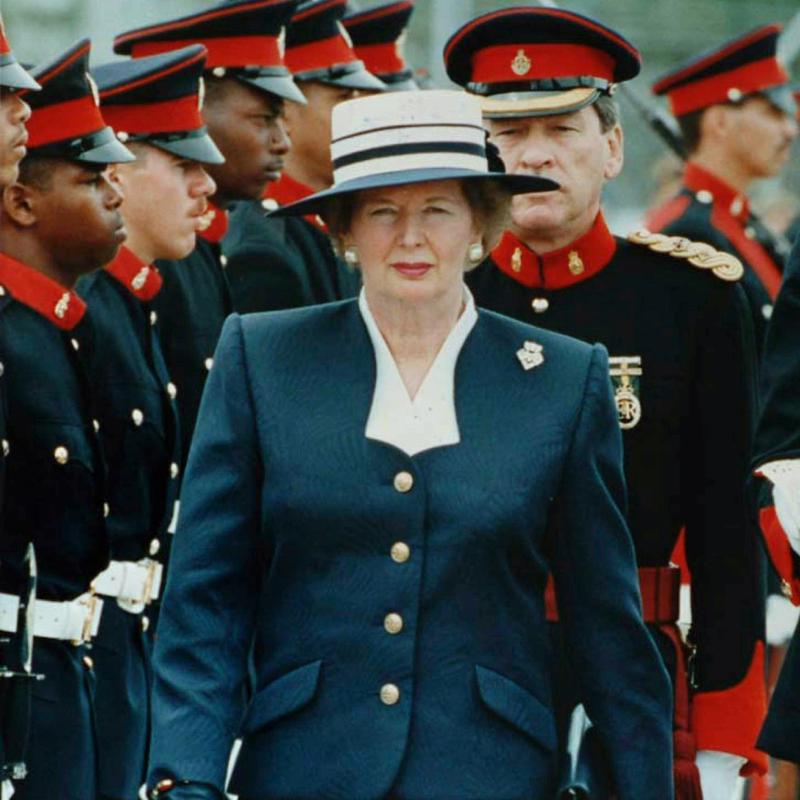
Margaret Thatcher: He would rather the poor were poorer, provided the rich were less rich. That way you will never create the wealth for better social services as we have, and what a policy. Yes, he would rather have the poor poorer provided the rich were less rich. That is a liberal policy.
Brigid Bergin: Charles, who was that?
Charles: Oh my word. I'm sorry. I could use a clue.
Brigid Bergin: A hint. The UK's version of Reagan, some people might say. A former prime minister.
Charles: Oh, oh, Margaret Thatcher.
Brigid Bergin: Okay, there, we've got one. Now, the next one-
Charles: Thank you.
Brigid Bergin: -came from the campaign trail. An instant political sound bite that stuck with its speaker for years. Let's take a listen.
Mitt Romney: Corporations are people, my friend. We can raise taxes on-- Of course they are. Everything corporations earn ultimately goes to people.
Brigid Bergin: All right, Charles, who said that?
Charles: Right. He was the presidential candidate in 2010, and oh, God. His father was governor of Michigan.
Brigid Bergin: Something about a dog on a roof at some point, I think.
Charles: Yes, yes, yes. No, it's funny how I endeavored to put this man out of my mind. Just give me a few seconds, please.
Brigid Bergin: Five, four.
Charles: Three. Thank you. That was so charitable. Oh, no, no. Oh, well, I'm sorry. Too bad. Okay.
Brigid Bergin: Charles, thank you so much for playing. That answer was Mitt Romney. Let's see. We've got Maura in the Bronx. Maura, you ready?
Maura: I am. I'm so excited to play.
Brigid Bergin: Oh, we are excited to have you. Here we go. Instead of asking who said this next one, I want to see if you can tell us when these words were spoken, because I know you're going to know the voice.
Donald Trump: This American carnage stops right here and stops right now.
Brigid Bergin: Okay, Maura, when did Donald Trump make that remark?
Maura: Regrettably, in his first inaugural address.
Brigid Bergin: Very good. Excellent. Let's move to the next. This last one is notable because it is also quite newsworthy. You might have heard it here on WNYC in the newscast just last week. Let's hear the clip.
Leticia James: I will not bow. I will not break. I will not bend. I will not capitulate. I will not give in. I will not give up.
Brigid Bergin: All right, Maura, who said it?
Maura: Leticia James.
Brigid Bergin: Maura, congratulations. You are our final winner of today. Would you like a tote bag or a baseball cap?
Maura: Well, I am a big admirer of Brian Lehrer's work, but I'm gonna go for the tote bag because that is such a clear message from WNYC and I appreciate all of the important work of the radio station. Thanks to everybody.
Brigid Bergin: Well, thank you, Maura. We really appreciate it. That has been our 10 question quiz for today. Thank you to all who played or who wanted to play. We will have another one for you tomorrow.
Copyright © 2025 New York Public Radio. All rights reserved. Visit our website terms of use at www.wnyc.org for further information.
New York Public Radio transcripts are created on a rush deadline, often by contractors. This text may not be in its final form and may be updated or revised in the future. Accuracy and availability may vary. The authoritative record of New York Public Radio’s programming is the audio record.

![By White House Photo Office [Public domain], via Wikimedia Commons](http://commons.wikimedia.org/wiki/File:Thatcher_reviews_troops.jpg)
