
10-Question Quiz: Black History Month
Brian Lehrer: It's the Brian Lehrer Show on WNYC. Good morning again, everyone. Again, this membership drive, we're doing a 10-question quiz each day to break things up and have a little fun. If we're going to be doing all this fundraising, we at least could do a little fun-raising along the way. We'll have a different theme each day. Get two in a row right. Today, you can choose between a Brian Lehrer Show baseball hat or that new WNYC vintage van T-shirt we've been talking about. Your choice.
Today it's a 10-question Black History Month quiz. Were you paying attention in our three-part series on the history of acknowledging Black History with Marc Morial and Karsonya Wise Whitehead? Who wants to play? You can call 212-433-WNYC. 212-433-9692. I'll say, if you don't feel confident about your knowledge of history, give it a shot anyway. Most of these will be multiple-choice questions. Who wants to play? 212-433-9692. We'll start with Sybil in Montclair. Hey, Sybil, you're on WNYC. Ready to play?
Sybil: I'm ready to play.
Brian Lehrer: All right. This is the centennial year of the precursor to Black History Month, originally known as Negro History Week, in the language of that era. In what year was it founded?
Sybil: 1926.
Brian Lehrer: Yes. That was to see if you're awake because this is the centennial year that it was founded in 1926.
Sybil: [laughs]
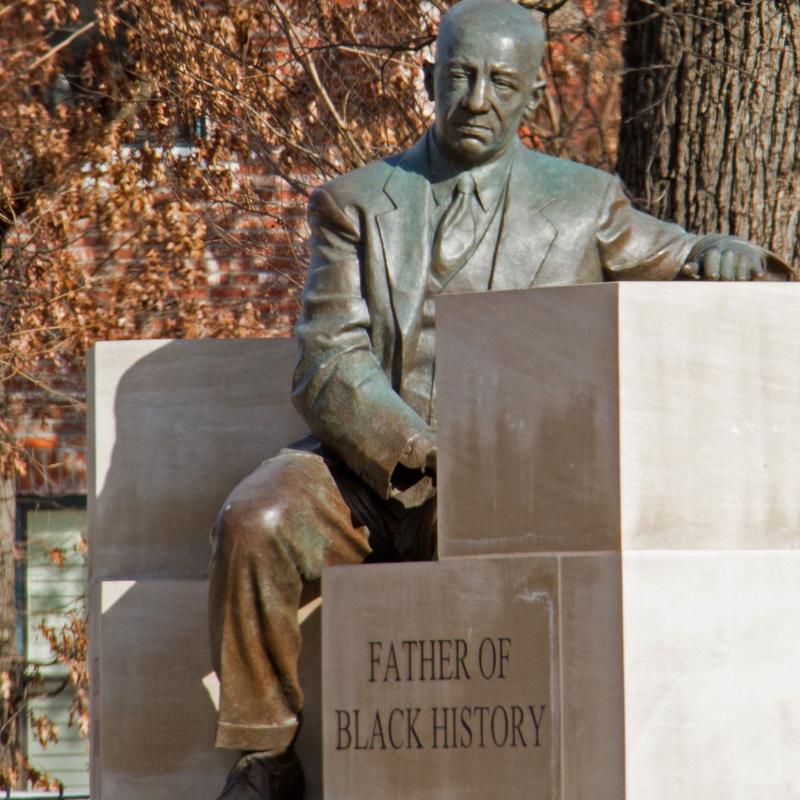
Brian Lehrer: Question 2, and for the hat or the T-shirt. Known as the Father of Black History, this person was only the second Black man to obtain a PhD from Harvard. He's the one who founded what they called Negro History Week in February of 1926. Is he W.E.B. Du Bois, Dr. Carter G. Woodson, or Booker T. Washington?
Sybil: Du Bois.
Brian Lehrer: Oh, I'm sorry, Sybil. It was not Du Bois. It was Carter Woodson who started the tradition that has now become Black History Month. Thank you for giving it a shot. We're going to go on to our next contestant, Kelly, in South Orange. Hi, Kelly. Ready to play?
Kelly: Yes. Hi, Brian.
Brian Lehrer: Question 3 in this 10-question quiz, what they called Negro History Week, was originally celebrated the second week of February to encompass the birthdays of two important figures in Black History. Which one of these was not one of those figures? Abraham Lincoln, Harriet Tubman, or Frederick Douglass? Which one was not the motivation for putting the week in February?
Kelly: Oh, my gosh, I'm going to say-- It's a toss-up between Harriet and Frederick. I'm going to say Frederick Douglass.
Brian Lehrer: Oh, I'm sorry, Kelly. It was Harriet Tubman who was not. Abraham Lincoln has a February 12th birthday. Frederick Douglass, a February 14th birthday. Those were the two for whom the week in February, which now has become the month of February, were originally established the holiday for. Mark in Brooklyn. Ready to play?
Mark: I am.
Brian Lehrer: All right, another multiple-choice question. Question 4 in this 10-question quiz. In our history segment with Dr. Karsonya Wise Whitehead, president of the Association for the Study of African American Life and History, she noted that Black History Week was first expanded to Black History Month in 1970 at one college campus, which was much in the news in 1970 for a very different reason. Which university students were the first to celebrate Black History Month? They really created it. Kent State, Jackson State, or the University of Southern California?
Mark: Oh, wow. I'm just going to have to take a guess because I don't know. I'm going to say Jackson State.
Brian Lehrer: It wasn't Jackson State, but here's Dr. Whitehead with the answer.
Dr. Karsonya Wise Whitehead: It was college students who actually began to push it from one week to a month. We have a documented celebration that happened at Kent State, which is what we look at the first time that Black History Month was celebrated in the country. That's what was used when we had the proclamation coming out from President Gerald Ford in 1976, during the year of the bicentennial.
Brian Lehrer: There's the origin story. It was college students who actually began to push it from a week to a month. That first documented celebration, as she said, happened at Kent State, which was very much in the news in 1970 for the shootings that killed four students there during the anti-Vietnam War protests. There were also people shot at Jackson State that year. Kent State was the one that got a lot more press. That's part of that origin story. We move on to Laura in Brooklyn. Laura, ready to play?
Laura: Yes, I am. Hi, Brian.
Brian Lehrer: All right, another multiple-choice question. Question 5. Students and faculty at this college went on a five-month strike in 1968 to create the first Black studies program in the United States as a way to acknowledge Black History. Which school was it? San Francisco State, City College, here in New York, or Boston College?
Laura: Oh, San Francisco.
Brian Lehrer: It was San Francisco State. That's right.
Laura: Woo-hoo.
Brian Lehrer: For the hat or the T-shirt, question 6. In which year did President Gerald Ford grant official federal recognition to Black History Month? 1974, 1976, or 1977?
Laura: 1976.
Brian Lehrer: Yay.
[sound effect]
Laura: Woo-hoo.
Brian Lehrer: Would you like a Brian Lehrer Show baseball cap or the vintage van T-shirt?
Laura: T-shirt.
Brian Lehrer: All right, Laura, hang on. We will take your mailing address off the air. Congratulations. Thank you for doing it. Brian in lower Manhattan. Ready to play?
Brian: I thought I was. [chuckles]
Brian Lehrer: Maybe you will be. I know this has turned out to be fairly hard. Which president, question 7, signed the Martin Luther King Jr. Federal holiday into law? President Jimmy Carter, President Ronald Reagan, or President George H.W. Bush? Which of those three signed the King Jr. Federal holiday into law?
Brian: See, and I thought I was listening closely. I guess I'll try Carter.
Brian Lehrer: It was not Carter. I'm sorry. It was President Reagan who signed that into law after it was passed by an act of Congress. I think he, from the history I've read and that we discussed in the series, was not, let's say, extremely enthusiastic about it, but he didn't want to buck Congress and have that kind of publicity. All right, Lorraine in North Jersey, ready to play?
Lorraine: Yes, ready to play.
Brian Lehrer: Question 8 in this 10-question quiz. On June 17, 2020, President Biden made-- not 2020, I'm sorry. It was during the Biden administration. He made Juneteenth a federal holiday. Juneteenth, also known as Freedom Day, which marks the date that over 250,000 enslaved Black people were freed in 1865, over two years after the Emancipation Proclamation was signed. They were kind of the last to get the word, and that's what Juneteenth acknowledges. What state did the events of Juneteenth take place in, in 1865? Mississippi, Texas, or Louisiana? Mississippi, Texas, or Louisiana.
Lorraine: Texas.
Brian Lehrer: Yes, it was Texas. That's right. The Biden proclamation was in 2021, to be precise about that. All right, question 9 for the hat or the T-shirt. The Smithsonian National Museum of African American History and Culture, colloquially known as the Blacksonian, first opened its doors to its permanent home on September 24, 2016. As we get to the present and the third part in our series of the history of acknowledging Black History, getting to what's going on right now. After being elected president in 2016, Donald Trump praised the new museum as beautiful.
Now in his second term, he's a critic, saying it emphasizes a particular thing too much. What is that thing? He says the Smithsonian emphasizes something too much.
Lorraine: DEI.
Brian Lehrer: Not DEI, which is more of a hiring policy. Something from history. I'll give you that clue. What is the thing--?
Lorraine: What's negative of that is the clue?
Brian Lehrer: Yes. Too much negative is. I'm going to take that because the way Trump puts it is they emphasize too much how bad slavery was.
[sound effect]
Brian Lehrer: You did it. Two in a raw right.
Lorraine: Yay.
Brian Lehrer: Would you like the Brian Lehrer Show baseball cap or the vintage van T-shirt?
Lorraine: The van T-shirt.
Brian Lehrer: One coming to you in North Jersey, Lorraine. Hang on. We're going to take your mailing address off the air, and we'll do one more because there's only one more question in the 10-question quiz. Gabriel on the Upper West Side, ready to play?
Gabriel: I'm ready, Brian.
Brian Lehrer: All right. You get the privilege because we run out of questions. If you get one in a row right, you can take the hat or the vintage van T-shirt. Here's the question. While President Trump does not have the power to cancel federal holidays altogether, he did remove two from the list of free entry days at national parks and replace them with Flag Day, AKA his birthday. Which holidays were removed from free entry at national parks? Name either one.
Gabriel: Wow. Which holidays were removed from free entry to-- Man, I was thinking this is going to be a multiple-choice.
Brian Lehrer: Realize this is in the context of Black History.
Gabriel: Oh, Black History Month.
Brian Lehrer: Yes.
Gabriel: All right. I'm going to say Martin Luther King Jr. birthday.
Brian Lehrer: Yes. [laughs]
[sound effect]
Brian Lehrer: That and Juneteenth.
Gabriel: I hate to have gotten it right.
Brian Lehrer: I hear you. Would you like a Brian Lehrer Show baseball cap or the new WNYC vintage van T-shirt?
Gabriel: Brian, I gotta say, I'm so curious to know the actual color of this so-called moss green you guys have been talking about. I'm going to have to go with the T-shirt.
Brian Lehrer: Nice.
Gabriel: There's been a lot of hype this morning about it, and that's my final answer.
Brian Lehrer: I think you will like it. Hang on. We'll take your mailing address off the air. That's our 10-question quiz for today. Tomorrow we're going to do another one on a different topic. At the same time, we're doing one every day to break it up and have a little fun during the membership drive. Much more to come today. Stay with us.
Copyright © 2026 New York Public Radio. All rights reserved. Visit our website terms of use at www.wnyc.org for further information.
New York Public Radio transcripts are created on a rush deadline, often by contractors. This text may not be in its final form and may be updated or revised in the future. Accuracy and availability may vary. The authoritative record of New York Public Radio’s programming is the audio record.
