
They Made a Promise in Prison. It Took 30 Years to Keep It.
[music]
Janae Pierre: From WNYC, this is NYC NOW. I'm Janae Pierre.
[music]
Janae Pierre: After more than three decades in prison, a Queens man's double-murder conviction was tossed out with help from a friend he made while locked up. On today's episode, we share the journey to freedom for Allen Porter and Jabbar Collins. First, here's what's happening in New York City.
[music]
Janae Pierre: Prosecutors say the Long Island architect accused of killing women and hiding their remains in Suffolk County is pleading guilty to seven murders and admitting to killing an eighth woman. The admissions bring to a close one of the most chilling serial murder cases in New York history. 62-year-old Rex Heuermann had previously pleaded not guilty to murder charges. Prosecutors say he killed seven women, many of them sex workers, and buried their remains near Gilgo Beach over a period of nearly two decades. His attorneys were not immediately reachable for comment.
[music]
Janae Pierre: Mayor Zohran Mamdani says he may keep the NYPD's gang database, pointing to reforms made before he took office. The database tracks thousands of people police say are gang members or associates. About 98% are Black or Latino. As a candidate, Mamdani called the database a vast dragnet and pushed to abolish it. Now, he says changes already made by the NYPD are part of an ongoing review.
Mayor Zohran Mamdani: The NYPD has also implemented a number of reforms as per the recommendation that came through, and the implementation of those reforms and the results of that are part of the active discussion that we're having.
Janae Pierre: An NYPD spokesperson says the changes stem from a Department of Investigation report that found progress, but more reforms are needed.
[music]
Janae Pierre: The New York Transit Museum is marking 50 years with several events across the city. The museum is based in a decommissioned subway station in Brooklyn. It opened back in 1976 as a temporary exhibit. Since then, it's grown into the largest museum in North America dedicated to mass transit. Organizers say the anniversary celebration will include vintage train rides, a citywide scavenger hunt, and a new exhibit on transit history. Events kick off later this month with a nostalgia ride, featuring century-old subway cars. Museum leaders say the goal is to highlight the people and stories behind New York's transit system.
[music]
Janae Pierre: The Green Haven Correctional Facility is where Jabbar Collins would meet Allen Porter. The two men would play remarkable roles in each other's lives behind bars and on their roads to freedom. That's ahead after a quick break.
[music]
Janae Pierre: 30 years ago, Allen Porter was convicted of two murders tied to drug crew violence in Queens. He was sentenced to 48 years to life and sent to Green Haven Correctional Facility, where he would spend nearly three decades. About a year into that sentence, he met Jabbar Collins in the prison chapel. The two men, they had a lot in common. Porter was from the Woodside Houses. Collins was from Williamsburg, Brooklyn. They were both devout Christians. Collins said he was also locked up for a murder he didn't commit. The two became close friends. Collins was spending hours in the law library, becoming a self-taught expert in public records requests.
Jabbar Collins: I had been railroaded so thoroughly during my trial, and I said I would never trust anyone else to be my savior. I would have to do it myself.
Janae Pierre: In 2010, Collins's conviction was overturned. Before Collins was released, he made a promise to Porter. Collins said he'd try to help Porter clear his own name, too.
Jabbar Collins: I said, "Al, I promise you, I'm not going to forget you, that I'm going to go ahead, and I'm going to bring you home.
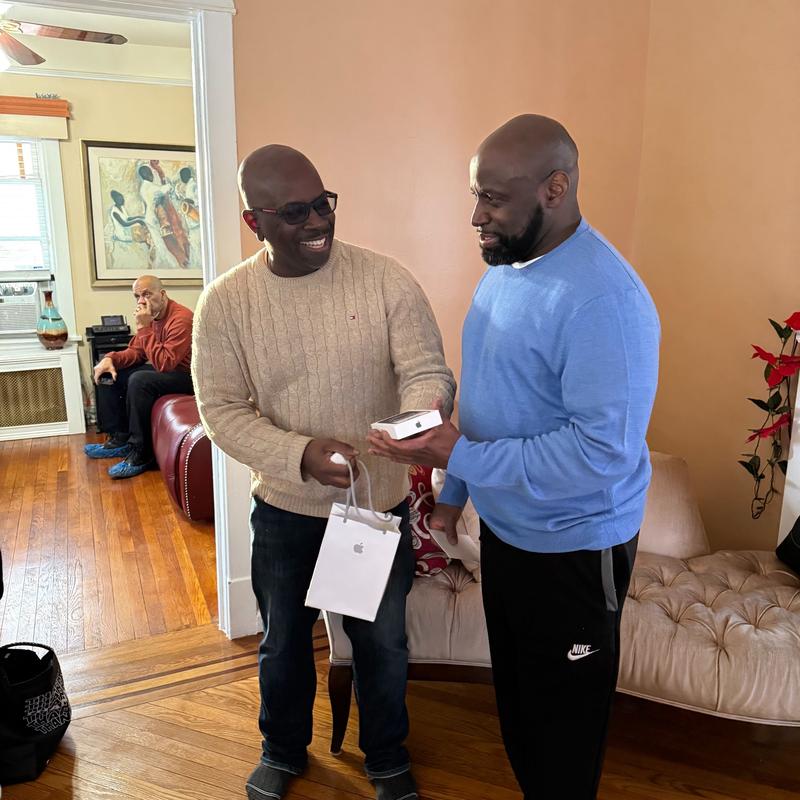
Janae Pierre: For the next 15 years, Collins followed through on that promise. He filed records requests, sued agencies for evidence, and pushed for documents that had never been turned over. In January, a judge vacated Porter's conviction, ruling that prosecutors withheld material that could have changed the outcome of the case. Porter had spent nearly three decades in prison. When he was released from court, Collins was there to greet him. Allen Porter and Jabbar Collins are here with me in studio now to talk about how that promise survived nearly 30 years inside prison, and what it took to turn that into freedom. Welcome, gentlemen.
Jabbar Collins: Thank you.
Allen Porter: Thank you.
Janae Pierre: Take me back to 1997. Allen, you're about a year into a 48-year-to-life sentence. What was Green Haven like for you?
Allen Porter: Green Haven was like a totally different world for me because I had spent nearly four years on Rikers Island. Rikers Island was a madhouse. It wasn't as much of a control environment as the upstate prisons were. Once you get upstate, you know that the atmosphere is different. The seriousness, the level of the violence, can be a little bit more exponential. It can be a little bit more severe. It was a different experience for me in terms of understanding that my life is now seriously altered. Rikers Island, it was altered. Once you get upstate and you're in a prison setting, you know that there's a distinct difference between being in the county jail and being in, now, a maximum-security prison.
Janae Pierre: Let's go back even further, before 1997. What was life like for you as a free man before then?
Allen Porter: Life for me as a free man before then, it was filled with church and church experiences. My mom is a devout Christian. She was an ordained minister and an evangelist. I grew up going to the church choir and church services, sometimes revivals, et cetera, et cetera. I had an extensive church experience. Unfortunately, there came a time when, in my teens, I began selling weed. After that, there was a guy that came home from prison from upstate. He took me under his wing. Unfortunately, I began to deal under him. It really was the worst decision I could have made in my life.
Janae Pierre: The church boy goes left, ends up at Rikers Island, then Green Haven Correctional Facility, where you met Jabbar. Can you tell me about that meeting?
Allen Porter: Yes, I can tell you a lot about that meeting. I met Jabbar in the chapel services. There are two types of services. You have the big service where you're in the auditorium. It's an auditorium-style environment, where there's maybe 200 chairs. Guest speakers come in to speak to us, to minister to us, and then there's a chapel area. It's a much smaller area. It's in that area that many of us congregate. We talk more and get to know each other a little bit better because it's a more intimate area.
It was there that Jabbar and I began to talk and to share our different experiences that he's from the Borinquen Houses in Brooklyn, and I'm from Woodside Houses. We're both from project areas. We just began sharing our different experiences growing up in New York City. As each week went by and we saw each other in different services, we began talking more, began communicating more, revealing a little bit more about ourselves to each other. The friendship, it blossomed into what it is today.
Janae Pierre: Allen, your mom was a true prayer warrior throughout all of this, even before you met Jabbar. In fact, your mom started a prison ministry at Rikers Island. Can you talk briefly about that?
Allen Porter: Yes, I can. I was on Rikers Island. It was 1995, the summer of 1995. I used to attend services regularly in the facility, this facility called OBCC, commonly known as North Facility. I approached the volunteer services coordinator one day after service, and I said, "Listen, my mom is a minister. Do you think maybe she can come in and probably do some ministry here, minister to the men here?"
He said, "Well, give me her information, and I'll look into it. I'll see if she can come in." Sure enough, I give him the information. My mom begins coming into the facility and ministering to the men there. After my conviction, she was allowed to come back into the facility. She began ministering to the men in this facility. She started a not-for-profit prison ministry called Reach Out and Touch Prison Ministry, where they also have a correspondence course.
To my understanding, thousands of men have went through the correspondence course throughout the years. The ministry has been running for 30 years now since this time. She expanded from that one facility and went to, I believe, four or five different facilities on Rikers Island. Thousands of men and families have been impacted by the ministry. In that respect, God used a bad situation to create something that was really good and something that impacted thousands and thousands of lives.
Janae Pierre: Jabbar, I understand that you two are close in age.
Jabbar Collins: He's older than me. That's true.
[laughter]
Janae Pierre: Can you tell me what life was like for you before you entered Green Haven Correctional Facility?
Jabbar Collins: Sure. Similar to Al, I had grew up in the church. After my dad died, we had moved into a housing project in Brooklyn. My mom put herself through school and became a nurse. With a lot of free time, I ended up hanging out around the way. I began to smoke weed like Allen. By the time I was convicted, I was a father. I had three young children.
Janae Pierre: How old were you around this time?
Jabbar Collins: I was 21 years old at the time, and I was traumatized. I was still shell-shocked when I got to Green Haven because Green Haven was an absolutely bleak, dilapidated environment. If you could imagine a dirty, beat-up, old college campus with bars everywhere and guards at every gate, and the misery. I remember looking at these old men and thinking to myself, "These old men here, they came in when they were young men." I saw men's lives wasting away. I was terrified that this was going to be my life.
I said, "No, this can't be it." Between the trauma of what I had gone through, hearing my mom screaming when I was convicted in court, and my kids crying, I was absolutely focused on finding a way out. I looked around, and I saw that there was no one there to help me. I had to do this on my own. I knew that it would only be through the grace of God that I would ever come home. I was a man on a mission.
There was such a burning fury for not only what had happened to me, but what happened to my family, and the prospect of leaving my children without their father. When I fought, I didn't only fight for me. I fought for my mother, but I fought for my children, too. I had been railroaded so thoroughly during my trial because I saw how my trial attorney was ineffective, how he was reading through paperwork while witnesses were on the stand, how the prosecutor had suppressed mountains of evidence, how the judge went along with all this. I said I would never trust anyone else to be my savior. I would have to do it myself, so that was the difference.
Janae Pierre: While you were locked up, you began teaching yourself the law, working on your own case. What did you see in Allen when you met him?
Jabbar Collins: Allen was different from the rest of the prison population, and that's something that always stands out. There are some people who glory in being in prison, glory in what they did. Allen was always the weird one. I was the weird one. Not to say weird one, but we were both out of place. It was evident that Allen wasn't supposed to be there. It was evident between his background and everything else. Then, when I would speak to Allen, we would have private conversations when Allen had no reason to lie to me.
I'd accepted him. He was a friend. We had been transparent with each other. He would tell me with tears in his eyes about how this girl lied on him and how he didn't commit this crime. What's so shocking about these cases is everyone I spoke to who were from the same area, they came in, and they said the same thing, "Allen didn't commit this crime." This was an open secret with everyone who came from that neighborhood. I knew that he was wrongfully convicted, and I knew that there was no way that I can leave him there.
Janae Pierre: Allen, in 1998, your first appeal got denied. You've described that as sending you into some sort of tailspin. Can you describe that feeling?
Allen Porter: Yes, I was immensely disheartened because I thought that once the appeal took effect that I would be vindicated, that the conviction would be overturned. I thought that my life would begin to change in a direction that was more favorable to me. When it didn't happen, I was very disheartened. I was very saddened by that. As Jabbar explained, I was really hurt by the false testimony that took place in my case.
I was paralyzed. Unfortunately, I didn't have the emotional energy or the emotional fortitude to really dig in really hard and double-down on my case in fighting my case. Jabbar saw that there was an insufficiency there for me to be able to tackle it myself. He was willing to come on board and help me navigate the legal system and try to do something to vindicate me and move towards my exoneration.
Janae Pierre: There are tears in your eyes right now. Can you just describe the emotion you're feeling right now?
[silence]
Allen Porter: It's very difficult for me to do that. The amount of time that I spent incarcerated was very traumatic for me. It's something that I deal with to this day. It's very difficult to navigate those emotions and to even express it. As Jabbar said, there's really no words in the English language that can capture what it feels like to spend 34 years in prison. I spent more than two-thirds of my life incarcerated in prison. There were times when security guards would retire, and then their children would come and work in the prison.
Now, it's not this guard telling me to lock in, but it's his son telling me to lock in. This was literally the case. I don't mean in one instance. I mean in several instances, where the children of the parents that were security guards and correction officers in Green Haven would come to the prison now. I'm under their authority. I'm under their control. Some of them wasn't born when I got to Green Haven. Now, they're there, and they're the ones giving me the order. It was very traumatizing for me. Very traumatizing experience.
Janae Pierre: Jabbar, you're working on your own case, but when Allen's appeal was denied in 1998, you went to him. You said that, "Hey, man, I'm going to take on your case." Why did you take that on?
Jabbar Collins: Because by this time, I had loved Al. That was my brother. I knew that if I didn't step in to do this, no one else would. Because the way that New York State works is after a defendant receives a direct appeal, he has no entitlement to counsel or any type of representation from that point on. Unless Allen was able to muster up the time and the ability to pour himself into his case and really be willing to carry that mantle, there was no way he was going to get home. It was one of those situations like, "Look, if I don't do this for him, he's going to die here."
Janae Pierre: You mentioned that you had to take on your own case and that you would never put your life in anyone else's hands, but you did hire a private investigator from inside prison?
Jabbar Collins: I did.
Janae Pierre: Can you tell me how that works?
Jabbar Collins: Sure. Well, there were certain things that I couldn't do, obviously, because I was physically limited. I would have to hire private investigators, for example, to go out to attempt to interview a witness, or maybe to go out and gather documents that I couldn't. I used a number of methods that gave me the ability to gather information from inside. Usually, I would draft a memorandum detailing exactly what I wanted the investigator to do. I would have a telephone conversation with the investigator, and then trust him to go out and to execute that plan.
Janae Pierre: This is very admirable to me to hear you working from inside a prison on your own case, spending so much time in a law library. How much time did you actually spend, and how do you teach yourself to take on your own case?
Jabbar Collins: In terms of time, I went after the study of law in the same way a drowning man goes after air. I would literally read myself to sleep. I had perfect vision. Within six months of being in prison, I needed glasses because I would literally read myself to sleep. It wasn't uncommon that every light in the prison would be off, except my light at three, four o'clock in the morning.
I was fortunate to have a family who helped me. I had to build my own collection of books. One of the things that I did was to employ some of the skills that investigative journalists would use. I bought the Investigative Journalist Handbook and books on skiptracing and locating individuals, because there was this rich body of literature that talked about how to gain access to public records.
We had a New York State Library, where I would get briefs of appeals that had been successful. I could read over the briefs and see how lawyers structure their arguments. I used a wide variety of sources. I had my personal law library, my personal research data bank, in my cell. When I was on Rikers Island, I came by a book by F. Lee Bailey, The Defense Never Rests.
He said something that always stuck with me. He said, "No matter how well-thought-out the strategy, no matter how brilliant the attorney, if the defense is not conducting an adequate factual investigation, then the defense is doomed to failure." That resonated with me because when these witnesses came to testify against me at my trial, I didn't know who they were. I knew that I had to find out what had happened behind the scenes.
Janae Pierre: Essentially, all of that worked out for you. Let's fast-forward to 2010. You find out that you're going home after 16 years. What was that feeling like?
Jabbar Collins: It was surreal, but it felt familiar. This was something that I had been working on. It was like the Olympic athlete training, and then he finally gets a chance, gets a shot. That's what it was for me. It was surreal. It was a vindication that all of the sacrifices I made were worth it, to see the joy in my family's faces, to know that my mom and my children's prayers weren't said in vain, and then the results of my case, which ultimately contributed to a new Conviction Review Unit being created in Brooklyn that would ultimately free 40 men and the misconduct that it exposed.
I remember. I had emailed my attorney. That was the first time I emailed in 16 years. They didn't have emails in the New York State prison system at the time. He said, "Jabbar, I just got a call from the DA's office, and they're reevaluating the case to see if they can retry the case," because we were right at the point in my case where the trial prosecutor, who had suppressed all of this information, was about to take the stand. He would have to testify under oath and be confronted with this evidence.
We knew that they were trying to wiggle out of this, but he said that the DA's office was reevaluating the case. They weren't sure if they could ever retry the case. If they couldn't retry that, they would dismiss all the charges. I would agree to that. A couple of hours later, he wrote me back. He said, "Jabbar, we just got the word. They agreed." I remember. I ran to make that email. I drafted an email to my mom and my sister, and I said, "It's finally over. I'm coming home."
Janae Pierre: You're about to walk out of prison, right?
Jabbar Collins: Yes.
Janae Pierre: What do you tell Allen?
Jabbar Collins: I said, "Al, I promise you. I'm not going to forget you, that I'm going to go ahead, and I'm going to bring you home." The next day, I came home. The next morning, I called his mom. I told his mom, "I wasn't going to forget about Al either."
Janae Pierre: Jabbar, you felt vindicated. Allen, for you, you've created this brotherhood with Jabbar. What was your feeling when you found out that he was going home?
Allen Porter: I was immensely happy that he was going home. I knew from being around Jabbar, and like he said, that he would always help other people, that he would help me, and he would still be there for me. I was never friends with Jabbar for his legal expertise or for his legal mind or for what I can get from his friendship. I was friends with him because I genuinely liked him. We had genuinely similar backgrounds.
I think he was keenly aware of this. I think that this was one of the motivating factors in why he stuck with me throughout all of the years in terms of being steadfast and keeping his promise, because it wasn't a friendship of convenience. It wasn't because this guy is good in the law, he knows his way around the law library, that I'm his friend. I was happy for him. I knew that he was not going to fall on his word and not keep his word, that he would keep his word.
Janae Pierre: Jabbar, you got a quick come-up after you were freed. You told me that you received a $13 million settlement for your own wrongful conviction. Personally, I could think of a bunch of things to do with that kind of money. You could have moved anywhere in the world. You could be eating lobster and snow crabs each and every day on your private island, right? Instead, you decided to stay in New York City. You opened your own investigations firm, Horizon Research Services. What was the thinking behind that?
Jabbar Collins: It's funny. I ended up resigning from my job. I was working with a brilliant attorney, Joel Rudin, and he was kind enough to offer me a job within a week after I was exonerated. I worked for him for four years, and it was an awesome experience. My mom died in 2013. It changed the trajectory of my life because so much of my life had been built around making sure my mom was all right. I said that I was going to take a year off and go ahead and recalibrate. That lasted about six months. I said, "You know what? I love doing this work. There are people who I want to help," so I ended up forming Horizon Research Services because I had built up a skill set that I believe was useful in these cases.
Janae Pierre: You, indeed, helped a lot of people. You contributed to at least 10 dismissals or reductions in prison time, including Allen's. All told, your work has played a role in $48 million in legal settlements. How does that make you feel when you hear that?
Jabbar Collins: I'm in awe. I'm amazed. I would have never thought for a second that something so meaningful can come out of circumstances so horrible. When I began my fight, I was focusing on myself and my family, to be honest, just to make it home. I never realized the extent of the problem. I never realized how God would use me and use my case to have such an impact, so I'm amazed by it.
Janae Pierre: You went from focusing on one fight, your own case, to focusing on another. You sued the NYPD. You sued the Queens District Attorney's Office. I'm just curious. What were those years like for you?
Jabbar Collins: Part of it was vindication because, now, I understood. The first time I hadn't gone through the system, I had gone through as a victim. Now, I was coming back as an advocate. I understood how the system worked, and I didn't need anyone to hold my hand. It gave me a lot more confidence. I had the benefit of meeting many brilliant attorneys along the way, who helped me and who shaped me, and who I had the ability to contribute to their practice as well. It was an incredible experience.
Janae Pierre: What were the differences? As you worked on your case and you worked on Allen's, what were the differences in the two?
Jabbar Collins: I guess with my case, I always felt like I was a baby taking steps for the first time because there was no precedent for what I was doing. There was no one I can turn to to ask if I was doing this right. It was more like I was learning how to do this. Finally, I'm vindicated, and I'm correct. I was right. When I turned to Allen's case, I knew based on my track record that I was competent, that I wasn't deluding myself, that these strategies worked.
I was able to employ them in Allen's case with far more confidence than I did in my case, where this was the first time I was trying and creating these strategies. It wasn't like there was anyone I can turn to and say, "Hey, what do you think about this?" It was really self-taught. It was my first time doing it with myself, so it was different without it. It was a lot more confidence when I went there.
Janae Pierre: In 2021, you brought Allen's case to the Queens DA's Conviction Integrity Unit. Allen, who had been convicted of two murders in Queens, had been inside for over two decades at this point. Initially, it seemed like the case was moving, then something shifted.
Jabbar Collins: Yes.
Janae Pierre: What happened?
Jabbar Collins: Initially, we had a positive reception from the Queens CRU. Then, when we appeared for one particular meeting, there was an individual at the meeting who had never been present before. We found out he was from the Appeals Bureau. It seemed like the tone of the meeting shifted from that point on. It seems like they were being much more defensive as opposed to collaborative. Ultimately, we had a meeting with them where we had the Allen's CRU application before them for two years.
Then, during this meeting, they told us that they would need an additional two years. There was no way that they can tell us whether they would be in a position to answer to say yay or nay after that two-year period. There was no way that we can keep Allen waiting for an additional two years and his family. We made a strategic decision to withdraw his CRU application and to file a motion in court to overturn the conviction.
Janae Pierre: Jabbar, the DA's office files a 175-page brief, arguing there was no failure to disclose evidence. Then late August, one page surfaces, the original prosecutor's notes. It's showing that the DA knew about another suspect and five additional witnesses before trial, and he never said a word. I can't imagine being a friend on the outside knowing this information. How much did you go back and tell Allen? How much in the loop was he?
[laughter]
Jabbar Collins: When we finally obtained that one document that demonstrated the prosecutor knew that Al didn't do it, I remember reading it to Al. He was just silent. He began to cry because I understood that that was the tipping point where we had that conclusive evidence. Al didn't do it. Al wasn't there. We had this written in the prosecutor's handwriting, so I knew that this was a turning point in the case.
Janae Pierre: Allen, you're on the road to exoneration, right? On January 30th of this year, you're sitting in that courtroom, not knowing if you're going to go home or back to that cell. Can you walk me through that day?
Allen Porter: Absolutely. In Green Haven, where I was in prison, they wake you up at five o'clock in the morning to take you to court. It's still dark outside. They woke me up. They take me down to the draft room, where everybody leaves out to go wherever you're going, to court or to another facility. They shackle you up and give you the garments. They call it court clothes that take you to court.
Janae Pierre: What's court clothes? You had a suit?
Allen Porter: I had a white collared shirt, brown khaki pants. Normally, you would wear your state shoes out. In this particular time, this was the first time I'm going to court, and I know that the ruling is going to come down today. The judge had already said that January 30th will definitely be the day that I hand out my ruling. I knew that that day would be the day that I'm either going to come back to that prison cell and have to go through a gruesome appeal process, or that I'll be released from prison that day. They take me to court. I have a pair of personal shoes on that I have that I used to wear around the yard to jog in all the time.
Coincidentally, I had literally imagined myself running in these same shoes in the street in home. I said, "I'm going to wear these shoes home today." When I went to the draft room, I told the officer, "Listen, I know that we normally wear state shoes out here, but I'm wearing these down the court today." He said, "Yes, sure, Porter, no problem. You can wear that. You can wear those down. Just know this that when you come back, you only can come back with those." My heart sink because he doesn't know what's going on. He doesn't know that today's the day that I anticipate-
Janae Pierre: Not to see him again.
Allen Porter: -not to see him again. Exactly. My heart sinks. I don't say it to him, but I say it to myself, "I hope that you never see me again." They take me down to the courthouse. It's about an hour-and-a-half trip. My lawyers come in to speak to me, just to tell me what to expect today, what's happening, what's going to go on. One of the lawyers come in with the judge's decision, fresh off the press. I believe one of them took it. Jabbar took the motion from the lawyer. He turns to the last page of the motion. This is something that we all did in prison. Whenever you get some type of important court decision, we all go to the very last page of it.
Janae Pierre: Because that's the most important thing, right?
Allen Porter: That's what the judge's findings are. He turns to the last page, and he reads the last paragraph, and that's it. It's the eureka moment that we were waiting for.
Janae Pierre: What did it say?
Allen Porter: I burst out in tears. In essence, it said-- I don't remember it verbatim. Jabbar, why don't you jump in?
Jabbar Collins: I do. As I read it, I got choked up, too. It said that the motion was granted in all respects. I like to add that Allen had spoken about how he came down with those running sneakers. I just wanted to make sure that you understand that they looked like busted orthopedic running shoes. I don't know why he's talking about that, but they were just busted all around. Thank you.
Allen Porter: The shoes were personal to me. They were personal because these were the shoes that I used to run in the yard to not think about prison. It had more meaning to me than just a regular personal shoe because of what it signified. That's how I remember that.
Janae Pierre: After this, you two find each other outside of the courthouse. It's a New York City winter day. It's snowing outside, and you two find each other. You embrace. You're emotional. What did you say to each other? Finally.
Jabbar Collins: Finally, I didn't say one word to him. He didn't say one word to me. There was no need to exchange words. The only thing we can capture that could capture what that was were tears. Now, Allen cried that day. I was holding myself, fighting back because the family was there. I stood back. I saw Allen embrace his mom and everyone else. I didn't break down until I got to the car, and I closed the door, and I was by myself quietly, because it was such a relief.
Not only had I been fighting to get my brother home, but I lived the daily trauma of seeing the anguish of his mother. I'm the one who had all the telephone calls with her. I'm the one who had to explain why there was another delay. To finally thank God this woman is free of that, and I'm free of the burden that I carry, it was release for me, too. I cried more, but I needed to do that personally and privately when I was by myself.
Janae Pierre: I understand that the DA has indicated it may appeal the ruling. Allen, you're out on bail, but the next court date is in October. How do you live with that?
Allen Porter: In some respects, I live with it the way I lived with it when I was in prison. It's a wait-and-see thing. I'm just waiting for the day that I can fully have my life back. I mean, fully and completely. When there's no longer any type of cloud hanging over my head--
Janae Pierre: Or weight.
Allen Porter: Or weight. Exactly. It can be a bit disappointing, but I pray that the day will come when that cloud is fully removed.
Jabbar Collins: We were very disappointed in the DA's decision to appeal. This case had been through the CRU. It had gone through an extensive five-day hearing. The prosecutor himself had made many admissions during this hearing that he suppressed this evidence, that he failed to turn this over. I think that Judge Johnson captured it in her decision when she said that she was alarmed at some of the explanations or the ways that the DA attempted to explain this away. This was such an extraordinary record. We were very disappointed with the DA's decision to appeal because we believe that after this level of review and considering the amount of evidence that was brought forth during the hearing that it compelled only one conclusion. That's the conclusion Judge Johnson reached.
Janae Pierre: Jabbar, you've been appointed twice now to the city's Commission to Combat Police Corruption. What does Allen's case represent to you in the larger context of that work?
Jabbar Collins: Sure. I think that Allen's case represents some of the failed policies of the early 1990s, when the city was overwhelmed with the violence from the crack cocaine epidemic, and many of the local district attorneys essentially implemented get-tough-on-crime policies. They were really scorched-earth policies that just went ahead and prosecuted across the board.
Many of the exonerations you see today, including my case, they were convictions obtained in the early 1990s when judges, prosecutors, and police looked the other way, when many, mostly poor and African American men, were being railroaded. They were deprived of their constitutional rights. This is the fallout you see from those policies. It was the policymakers' response to the conditions at the time. I think that we have to be vigilant, that we never go back to those same times, because Allen is Exhibit A of what happens when a prosecution runs amok.
Janae Pierre: Allen, do you have anything to add? What are your takeaways?
Allen Porter: Yes, my takeaways is that sometimes people are subject to being wrongly accused of things. When there is opportunity to correct that, that mistakes should be corrected. Everyone makes mistakes. Everyone is subject to doing that. Once you realize that a mistake has been made, the right thing to do is to own up to that and say, "Yes, a mistake has been made in this case." That's my takeaway.
Janae Pierre: That was Jabbar Collins and Allen Porter. Thanks, gentlemen, for joining me today.
Jabbar Collins: Thank you.
Allen Porter: Thank you very much for having us.
[music]
Janae Pierre: This story was brought to us by reporter Graham Rayman, who helped produce this episode. He's been following Allen's case on our news site, Gothamist, so check that out when you get a moment. His latest piece is linked in the description. Thanks so much for listening to NYC NOW. I'm Janae Pierre. See you next time.
[music]
Copyright © 2026 New York Public Radio. All rights reserved. Visit our website terms of use at www.wnyc.org for further information.
New York Public Radio transcripts are created on a rush deadline, often by contractors. This text may not be in its final form and may be updated or revised in the future. Accuracy and availability may vary. The authoritative record of New York Public Radio’s programming is the audio record.