
Special Episode : Mayor Mamdani’s Lessons from LaGuardia
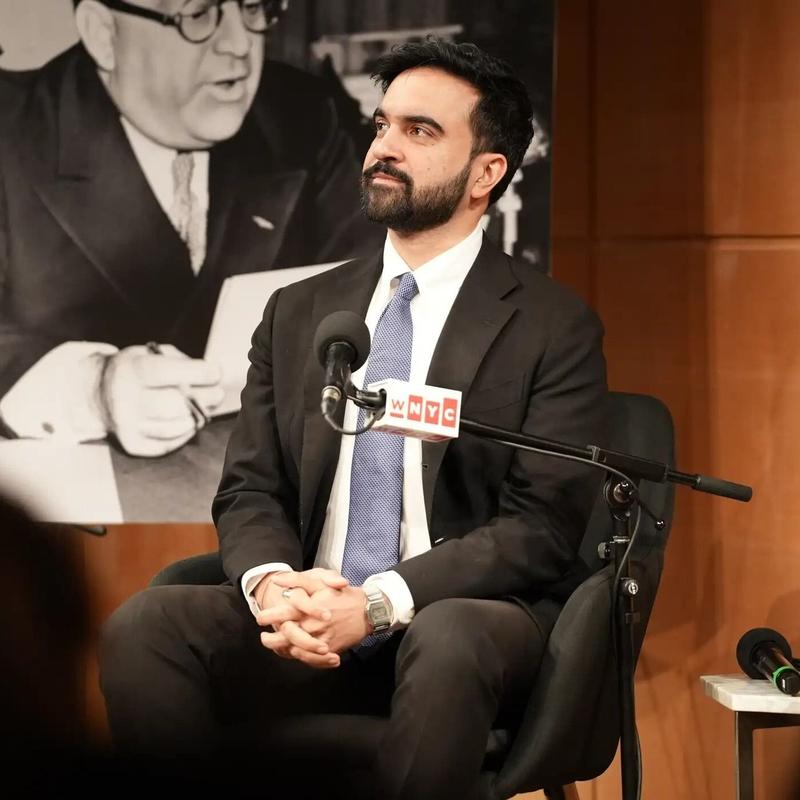
Janae Pierre: From WNYC, this is NYC Now. I'm Janae Pierre. Mayor Zohran Mamdani is 100 days into a historic term with ambitious plans to make New York City more affordable through a dramatic expansion of public services. Mamdani cites Mayor Fiorello La Guardia as an inspiration and proof that it can be accomplished. This week, WNYC's senior politics reporter, Brigid Bergin, talked with the mayor at a live event in the Greene Space, the station's performance venue. The two talked about what he's done so far and what the mayor can learn from his predecessors.
Brigid Bergin: As you know, WNYC has a historic role in New York City. Tonight we're going to talk about Mayor Mamdani's first 100 days, and we're going to talk about Mayor Fiorello La Guardia, who served the city from 1934 to 1945 in the depths of the Depression. He used the most modern communication tool of his day, the once novel and still enduring radio. His distinct communication style is one of the obvious parallels with Mayor Mamdani, but it goes a lot further than that, which is why we are all here tonight. Before we get started, I just want to say that here at WNYC, we pride ourselves on civil conversation and active listening, and that's what we're aiming for here tonight. With that, I'd like to welcome the 112th mayor of New York City, Mayor Zohran Mamdani.
[applause]
Mayor Zohran Mamdani: Hello, everyone.
Attendees: Hello.
Mayor Zohran Mamdani: Such a pleasure to be here.
Brigid Bergin: Mr. Mayor, thank you so much for joining us. Happy 4/20. We appreciate that you're spending it here with us.
Mayor Zohran Mamdani: Yes.
Brigid Bergin: As we talk about the first 100 days, we're also going to listen to some archival sound and see some black and white images of Mayor La Guardia. That's thanks to the New York City Municipal Archives. I want to say a special thanks to the Leon Levy foundation, who have given critical support to our archives. La Guardia's voice and speaking style and the crackle of those archival recordings, it really brings a smile to my face. I hope you will all lean in and listen, starting with this.
Mayor Fiorello La Guardia: This great city, unique in its kind, nothing like it in the whole world. This great city of huge spaces that are too small, of millions of little people who are really big, of people coming from every climbing country of the world, living in peace and happiness here.
Brigid Bergin: Mr. Mayor, you have invoked Mayor La Guardia many times. When did you first learn about Mayor La Guardia?
Mayor Zohran Mamdani: Well, given the fact that I have my high school social studies teacher, Marc Kagan, here in the crowd, I think I might have to say it was a Bronx Science, but I would say that my first knowledge of La Guardia, like many New Yorkers, I don't think came with the understanding of the immense nature of his legacy. There is such a sense in this city of places and names that we know when we consider of the city, but we don't know of what it really speaks of. We all grow up in the city knowing of La Guardia, first and foremost as an airport than as a mayor.
Brigid Bergin: Sure.
Mayor Zohran Mamdani: Then as you grow older in this city, to get the chance to learn of a man whose vision was one that matched the scale of the crisis that New Yorkers were living through, whose ambition was undimmed, no matter the obstacles that he faced, it's truly inspiring, and it continues to be each and every day. I think about some of his words. He has said, "If fighting existing evils is radical, I am content with the name." So much of what he faced is a part of politics even today. When you look back, you find not only the willingness to believe, but frankly, to deliver.
Brigid Bergin: Well, I want to talk about some of the parallels between what you are trying to do and what he did. I think in that first clip that we were listening to, really what Mayor La Guardia is talking about is the ability for people to live here in the city with dignity, for families to live here. On day eight of your administration, you stood with Governor Kathy Hochul to announce a plan to expand childcare. You've called that day the best of your 100 days.
Although, I don't know, Saturday was pretty good as well. I think a lot of parents would agree, though, that that was a really important day, but then this past Saturday, you were in the Bronx with President Obama at a child care center. What did you talk about with the president?
Mayor Zohran Mamdani: Much of what we spoke about was, in fact, the reading of a book to New York's cutest, as our chancellor, Kamar Samuels, calls children across our system. This was a book sharing the fact that together we are stronger, together we are so much more creative, and together we find that inspiration. Before the President and I went out to read that book, we spoke about vision for this city, we spoke about the challenges that we face and the importance of universal childcare amidst all of it.
I think part and parcel of that is in our politics, there's often a condescension towards people, a sense of more people should settle down and raise kids in the city without reckoning with why they are not doing so. Here in New York City, it costs upwards of $20,000 a year to have childcare for a single child. We know that in delivering universal childcare for the first time in New York City history for two-year-olds, it can quite literally be the factor in a family deciding whether or not they want to have a child or another one. I had a New Yorker by the name of Mallory tell me that she dreamed of another child and she always told herself she couldn't afford it and now she's allowing herself to dream once again.
Brigid Bergin: When I think about this past week, when you celebrated your 100 days with that address at the Knockdown center, you were with Vermont senator, Bernie Sanders. Then this past weekend you were with President Obama. Some would say that they are on different ends, maybe, of the Democratic spectrum, but they saw in you something that was common. What does that say to you about where the party's headed?
Mayor Zohran Mamdani: I think that there's a hope in our city for what politics could actually deliver to people. So often we've discussed politics as if it is an intellectual debate. For working people, there is very little time for that kind of a debate. Working people want to know, what will you deliver? How will you make it easier to afford rent on the 1st of the month? How will you make it easier to go to the grocery store? How will you make it easier to live in this city?
La Guardia would say we need imagination at City Hall, imagination for the other fellow. He expounded on that, that, "In this matter, I've been called an idealist. I propose to go right on with my idealism." I look back at those words, I look back at that legacy and I see so much of a reflection of a similar scale of crisis that we are living through and the need for a similar scale of ambition and vision and how we get out of it.
Brigid Bergin: Before we move on from childcare, I just want to talk for a moment about the other side of the equation.
Mayor Zohran Mamdani: Please.
Brigid Bergin: So many childcare workers are extremely low paid women of color. What are you doing to grow this workforce?
Mayor Zohran Mamdani: This is part and parcel of our vision of universal childcare. In order to deliver childcare to the working families who've been priced out of it, we also need to do more than just recognize the immense work that so many working-class women have been putting in to this very system. We know that childcare is not a one-size-fits-all approach. You have childcare that is offered at schools, childcare that's offered at centers.
I was quite taken aback to find that I was the first mayor to visit a home-based childcare provider, which for many New Yorkers is how they prefer to find childcare. As we build this out, it's not just to build out a new system, it's also to address the inadequacies of the old system. I'll give you one example. We've had 3k here in New York City, and it's been immensely impactful. We've also heard from many parents that the worth of 3k is diminished when a family in Astoria is told that they have a seat, but when they ask where, they're told it's in Bed-Stuy.
One of our first focuses was not just on delivering universal 2K, but also on adding a thousand seats to 3K in the very zip codes where demand has outstripped the city's capacity. To me, I see all of this as part of the same plan that we have. At the core of it also is ensuring that this is a job that so many can continue to do, and it's a part of exactly the compass of where we're headed.
Brigid Bergin: As part of your plan, you also want to address the pay inequities?
Mayor Zohran Mamdani: Yes.
Brigid Bergin: Let's talk for a moment about another major element of your first 100 days, something we all endured, frankly. It was the winter that just did not want to quit. You are not the only mayor who has had to endure winters. Here's what Mayor La Guardia said about winter.
Mayor Fiorello La Guardia: All right, now that brings us up to snow. I dread snow. I don't know, I just dread snow, and I pray every night, "Please keep snow away. We haven't got the equipment and we can't get the personnel."
Brigid Bergin: Mr. Mayor, do you dread the snow as well?
Mayor Zohran Mamdani: I've never dreaded it as much as I do now.
Brigid Bergin: The winter was awful, right? It was cold for so long. We lost 20 New Yorkers. I'm wondering, what lessons did you learn managing those storms that you might apply to the upcoming heat? We are likely to see many heat emergencies this coming summer.
Mayor Zohran Mamdani: I think, first and foremost, that it is not a sufficient answer to say this is how the city has done something. New Yorkers do not care, and nor should they. They want to know how will the city address this. I'll give you an example. When we faced the first storm, because we had a blizzard that came after that, in that first storm, it became very clear to us very quickly that while the city had PlowNYC, a website that New Yorkers could go to see the frequency of New York City plowing and where it was last, at what street, we did not have a system of geotagging. Bus stops, crosswalks, sidewalks. We know that a lot of these are actually the responsibility of private property owners.
Also, issuing a violation does not clean that street immediately. New Yorkers still have to navigate that. One of the lessons we took from that first storm was the need to immediately develop a geotagging system for much of these very parts of New York City's streetscape. Similarly, we found an emergency snow shoveler program, a program which had existed for a number of years, but in terms of eligible New Yorkers who were ready to sign up, it had dwindled down to a number that we hadn't seen in quite some time.
We also made it our mission, especially as we went into the second blizzard, for how we could grow the number of New Yorkers that could actually be a part of this. What we saw is that that work was critical in supplementing the incredible work of the men and women of DSNY because those emergency snow shovelers were able to focus on the very kinds of places, bus stops, sidewalks, crosswalks, that had previously been very hard for city government to be able to address.
Brigid Bergin: Is there something to apply to cooling centers from that, the idea of the geotagging, or is there something that New Yorkers might say, okay, this is something that they're going to build on in this upcoming season?
Mayor Zohran Mamdani: I think one of the things is needing to ensure that the city is prepared for every eventuality. What we saw, as you described it, is it was not just cold after that first storm. It was among the coldest stretch that New York City had ever seen in its history. The other part of this is, in heading into the summer, we have something we didn't have in heading into that first storm, which is time. What that allows us to do is the work of ensuring that so many more of our buildings across the city are up to code.
One of the many reasons that the work of HPD inspectors is so critical is that they go into New Yorkers homes and they can actually spot each and every violation that in that moment may not be a danger to that New Yorker, but if allowed to fester, would become one. I was recently with a number of those HPD inspectors, and we were testing for lead in a New Yorker's home. As we were doing so, the inspector also pointed out that, "These are the kinds of things," pointing across this bedroom where there was a young mother, her daughter and her father all there together, "That if left unaddressed, these could become significant issues."
We left that building. He had issued, I think, about six violations. Ensuring that we actually enforce our housing laws are also critical to ensuring that New Yorkers can survive through the kind of heat that is now a normal part of the climate crisis.
Brigid Bergin: I want to talk some about building, but one of the keys to how Mayor La Guardia was able to leave a legacy on the city's built environment was, of course, his partnership with President Roosevelt. As you mentioned, we think of La Guardia Airport, we think of the FDR Drive, which you can see in that photo up there with some classic cars. We think of public housing, which was sprawling, albeit segregated at the time, it would not have been possible without President Roosevelt, who was a partner and, in fact, a benefactor for New York City. La Guardia was a progressive Republican. FDR was a Democrat. I'm going to bring up a couple of photos. You probably know where I'm going with this. Here is La Guardia and FDR. Look at those smiles. Look at that. This is how La Guardia described FDR.
Mayor Fiorello La Guardia: He's a great president. Even those who are politically opposed to him concede his greatness and admire his qualities.
Brigid Bergin: Now, I'm going to bring up another photo. Mr. Mayor, that is you in the Oval Office in February. Slightly different expression. I'm just wondering, how can you build in the city like a La Guardia? Can you do that with President Trump? Can he be your FDR?
Mayor Zohran Mamdani: The first time that I met with President Trump, it was November of last year, and he showed me a portrait of FDR. I told the President that my favorite mayor in the history of New York City was Fiorello La Guardia, and that so much of what he was able to achieve, as you said, was because of his partnership with FDR, because of how the New Deal infused the city with a real sense of possibility.
In the second meeting, as you have in the photo here, my proposal to the President was to build the greatest amount of housing we'd seen in a single housing development since the early 1970s. Sunnyside Yard would yield 12,000 homes, 30,000 jobs, and is impossible to complete without the work and the assistance and the approval of the federal administration.
I shared with the President directly what my hopes would be. I think the President and I have many more disagreements than Mayor La Guardia had with FDR. However, what we do have in common is the fact that, like La Guardia and FDR, we are also both from New York City. This city holds an outsized sense of not just importance, but also love for all of us. After that first meeting, the President shared with the press that the better New York City does, the happier he is. That is one thing that I think do have in common with the President. I think that's One thing that La Guardia and FDR also felt.
Brigid Bergin: Is that project, the Sunnyside Yards development, is that real?
Mayor Zohran Mamdani: What do you mean?
Brigid Bergin: Is that something that New Yorkers will see happen during your administration? It's something that has been talked about for a long time, but there are a lot of questions. What's happened since that meeting? Have you spoken to the administration again?
Mayor Zohran Mamdani: I am in conversation with the President around this proposal as well as around anything that, frankly, will help New Yorkers. The same meeting where I spoke to him about this potential to build, as you said, a project that has long been thought of, has long been imagined, but has yet to be constructed. I also went into that meeting to share with the President that just that morning, ICE agents had detained a Columbia student. I shared with the President a list of five who had been detained in or around Columbia university. About 30 minutes after the meeting, he called me and said, "I've made the decision to release her."
It is by no means an exclusive focus. However, it is one of importance. I won't ever tell New Yorkers that anything of this scale will be easy or will be quick, but we cannot stand to win it if we don't stand to try. That is exactly at the heart of this proposal to the President, and I'll be sure to keep New Yorkers up to date as there are any developments on it.
Brigid Bergin: At this point, are you open to-- The President has a reputation for being somewhat transactional. Would you name it after him if that would persuade him to send some money our way?
Mayor Zohran Mamdani: The President has not asked me that.
Brigid Bergin: Maybe we planted a seed.
Mayor Zohran Mamdani: I will tell you the most important thing for me is that we build housing and that we deliver it to working-class New Yorkers, because for far too many, New York has become a memory. They live elsewhere. Even for those who work here, they commute. I am in the midst of getting two allergy shots a week to get two cats. I was in the elevator maybe about a month or so ago, and the nurse across from me let out this deep sigh. I asked her, "Have you had a long day?" She said, "Yes, but I'm about to have an even longer one." I asked her why, and she said, because she's going to commute another two hours because she lives out of the state.
There are so many New Yorkers who are keeping this city running, and they can't even afford to live here. They live in Jersey City, they live in Connecticut, they live in Pennsylvania, they live Upstate, they live on Long Island. That is not the city that we want. La Guardia's first words that you played, it has a reverence for this city, and the people of this city. I don't want this city to become a museum of those people. I want it to be a living, breathing testament to those people. I want us to keep writing and making history, as opposed to just looking around and pointing at buildings that were built more than a century ago and saying, "That's what we have to offer."
Brigid Bergin: Speaking of buildings that are, some people think, a little bit older, the Trump administration will select a new design for Penn Station next month. We've reported that one of the options involves moving Madison Square Garden. What do you think about moving Madison Square Garden across the street?
Mayor Zohran Mamdani: The first thing that comes to mind with Madison Square Garden is just hoping that this is the year that Knicks pull it off. I think, to me, I'm interested in pursuing big things when it comes to the vision for our streetscape, the built environment. I think that there are a lot of proposals that should be considered. I don't have a firm take on any one of them.
Brigid Bergin: Even though I know you talked to the president about midtown zoning-- [crosstalk]
Mayor Zohran Mamdani: I did [unintelligible 00:20:41]
Brigid Bergin: -is this something that comes up, Penn Station?
Mayor Zohran Mamdani: It was more a conversation around ULURP and community boards.
Brigid Bergin: Before we move on from the President FDR and Trump, we had listeners who submitted questions ahead of this. This is a question from Barbara in Queens. She writes, "I'm an emergency housing voucher, Section 8 holder. Trump abruptly ended that program. What will you do to help the more than 5,000 formerly homeless and domestic violence survivors who will be pushed into the streets?"
Mayor Zohran Mamdani: Well, first, I want to just say thank you to Barbara for her question. This goes back to what I was sharing earlier about the many disagreements that I have with the President. One of them is due to the brutality of these cuts that we have seen, not just across our city, but across the country. Cuts which quite literally will take away so much of what New Yorkers rely on to make ends meet.
I think the city, obviously, we have a role in both advocating for New Yorkers, continuing to share that with the President and the Federal Administration, and then also looking to see all of the city services that we can utilize to deliver for New Yorkers like Barbara. Part of this is not just an issue of services and the funding of those services, though that is critically important. Another part of this is also the speed of delivery of those services.
La Guardia would often talk about, if we want working people to believe in government, we have to prove that it's worthy of their trust. A lot of the things that we're looking at in our City Hall is how can we increase the efficiency and the excellence of city services? Because for many New Yorkers, they've come to look at City Hall as if all it could be is a disappointment in their lives.
Even when we talk about potholes, for example, the hard working men and women of DOT filled 102,000 potholes in the first hundred days. They did it at every hour of the day. I personally got to witness them doing it in the afternoon and then seeing them repave a road at midnight. This was more potholes than they'd filled in that time period than they had in over a decade. What we want is to bring our city back to the moment where everything felt possible when city government tasked itself with it. For a long time, it hasn't felt that way.
Brigid Bergin: One of the things, Mr. Mayor, that we have seen is that crime has remained relatively low. When Mayor La Guardia came to office, one of his challenges, as he was trying to clean up corruption, was to clean up the NYPD. Commissioner Tisch had to face some of that under the prior mayor, but you two continue to work together, and yet there have been some troubling incidents that have happened just in the past week that I want to give you a chance to talk about.
Last week there was a shooting death of a 15 year-old-boy, Jaden Pierre, at Roy Wilkins Park in Southeast Queens. There were reports that bystanders were watching and filming as he was beaten and then shot. Then former Mayor Adams shared a video of it and criticized you for not being there. What's your response to that?
Mayor Zohran Mamdani: I think, first and foremost, when you see that video, as many New Yorkers have, you feel a sense of heartbreak at the fact that this has happened to a young person in our city. This is something that is unacceptable, and it is something that his family, his entire community now has to bear the loss of. We extend not only our condolences to the family, but, frankly, a necessity of recommitting ourselves to ending the scourge of gun violence in this city.
As you said, we are proud of the work that we are doing to deliver public safety in the city, and we also know that we can never rest on our laurels, because no matter how many statistics I can rattle off to you about what this first quarter has looked like, we still see acts of violence of this nature. They are acts of violence that demand that we do everything that we can. That is exactly what is at the heart of our administration's commitment to New Yorkers.
Brigid Bergin: Do you have any response to Mayor Adams?
Mayor Zohran Mamdani: No.
Brigid Bergin: Similar to what you're describing there, there is this challenge of needing to address some of these sparks of violence that we see, but then on the flip side of that, you take something like what many of us also saw, this incident at a liquor store near the Gowanus Houses in Brooklyn. There was a man who police were attempting to arrest. It was a violent incident both you and the commissioner have condemned, which you've seen. Disciplinary proceedings, investigations will continue, but we've gone out from our newsroom and talked to the residents there who say that this is not a one off. What do you feel like needs to be done to repair the relationship between those residents and the police?
Mayor Zohran Mamdani: I think first and foremost, we have to understand that New Yorkers expect us to deliver safety and justice hand in hand. For a long time they've been told, as if they have to choose between the two. What we saw, as you said in that video, was not only incredibly disturbing, but also unacceptable. There are the immediate actions that we took to reassign these officers to investigate this, and yet, as you've also said, this is what we've heard from a number of constituents, part of something that is larger, something that troubles them. That also means that we as city government have to look deeper than just this as one case, one incident.
As we reflect on that, we will share with New Yorkers the kinds of steps that we're going to take to ensure that not only does this not happen again to this New Yorker, but that it does not happen again, period.
Brigid Bergin: How do you see doing that? You have a new deputy mayor of community safety. Do you send her to talk to residents there or what-- is there anything in the short term that residents there could expect.
Mayor Zohran Mamdani: I think the first is to be clear-eyed about this, and to have an entire investigation that spans, frankly, across many different parts of city government as to what happened, how it happened, and whether it has happened before. That is also how we ensure that it does not happen again. To your point, public safety is something that many different parts of city government are critical to the delivery of. We have created New York City's first ever Office of Community Safety. We have our first ever deputy mayor for community safety, and she is someone who comes with an incredible track record of not just delivering for New Yorkers, but frankly, working with New Yorkers on the question of what does safety look and feel like in the community
When we talk about horrific incidents of gun violence, and we talk about these examples of where New Yorkers are deeply concerned about their city, we have to also ensure we're coming with every single tool that we can, because we know that it is going to take everything. It's going to take the NYPD, it's going to take the crisis management system, it's going to take gun violence interrupters, it's going to take the tapestry of approaches that New York City has taken, but oftentimes disparately and actually bringing them together.
Brigid Bergin: I want to get to questions in the room soon, but I think that this is an important part of understanding what you have done in this city through your campaign and what you're trying to do as you continue working. Similarly, when Mayor La Guardia was elected, his 1933 election triggered a spike in voter turnout and voter registration. He brought new voters to the polls and he had a message to New Yorkers about what he felt was their own responsibility to city government.
Mayor Fiorello La Guardia: The privileges of democracy bring with it responsibility. Part of that responsibility is to understand our form of government, to do our duty as citizens. It requires duty as well as the enjoyment of liberties. That means that we must have understanding for the problem of our neighbor.
Brigid Bergin: Mr. Mayor, you also engaged new voters and really changed what New Yorkers are expecting from their city government. What do you expect from New Yorkers?
Mayor Zohran Mamdani: First, I just want to say thank you for these recordings. They are really beautiful and they are such a glimpse into a different time. Even as we were listening to the former mayor's words, I'm asking myself, is that City Hall?
Brigid Bergin: Yes. He broadcast on WNYC from City Hall-
Mayor Zohran Mamdani: From City Hall.
Brigid Bergin: -from City Hall.
Mayor Zohran Mamdani: I ask that question because it looks very much like my office, which was his office. I can't think of a more eloquent way to say this. One of the incredibly cool things about this job is that I get to use Fiorello La Guardia's desk. It has remained there. I think it was Mayor de Blasio who brought it back into the mayor's office. To see him and hear his words and his hand on that desk, it just reminds not just myself, but I think our team as a whole that we are seeking to do something that is part of a longer legacy than just an individual task or responsibility or dream.
What do I expect of New Yorkers? That they keep telling the truth. One of the many things I love about New Yorkers is New Yorkers will tell you how they feel. Even when they're telling you something good, it sometimes sounds as if it's something bad. I was walking on the street one day and this woman just yelled out, "You're my favorite mayor. Don't ever forget that." I was like, "I will not. I will not forget that." It's such a New York expression of support, where you're both overcome with a real sense of gratitude and a little bit of fear.
Brigid Bergin: Just enough.
Mayor Zohran Mamdani: It's just like, this is what I love about our city. I think that at the heart of it is, more than from New Yorkers, I expect from City Hall to deliver something that is worthy of New Yorkers. There has been a vision of government almost that seems embarrassed of government and its role in people's lives and what it should do, a vision almost of how to narrow government to be as limited as possible.
I am unabashed in my belief that government is a force for good. It can be, it must be, and that it is the most effective tool at delivering for working-class people. Before I ask anything of New Yorkers, I want to show that we are worthy of their time, because in this city, time is money. People are busy, and there is a reason that they don't have as much time for politics, because politics hasn't seem to have had that much time for them. We're looking to show them that, in fact, things can be different.
What's exciting is sometimes when it's so overwhelming, the obstacles we face, I think of La Guardia, I think of others who came before. I think even now, while he's, I would say, generally universally acclaimed as one of the greatest, if not the greatest mayor that our city has ever seen, I sometimes read what the New York Times would write about La Guardia when he was in office. There's one article that really stayed with me, where they described him as forever toying with haphazard proposals that were benevolent in intention, but impossible or dangerous in practice. That he was always fond of socialistic playthings. It's helpful to read those words and then to look around the city and see what he left us.
Brigid Bergin: Do you think there's a way to take a campaign like yours and translate it to a national stage? Do you think Americans are ready for a Democratic Socialist in the White House?
Mayor Zohran Mamdani: I think Americans are ready for a politics that delivers for them. We're looking at photos of FDR. You think about FDR's four freedoms; freedom of speech and expression, freedom of worship, freedom from want, freedom from fear, these are things that today some might say could never reach the White House. Yet we know that to be a Democratic Socialist is to believe that democracy must extend beyond the ballot box to the rest of our lives. It's to make the choice that you fight for working people, that you don't debate whether someone deserves dignity, you figure out how to deliver it for them.
I think that, as much as I am someone who fervently believes that New York City is the greatest city in the world, I also will never kid myself that the struggles of New Yorkers are purely unique to this city. I know that there are people elsewhere in the country who are facing that same struggle to afford their rent, to afford their groceries, to afford public transit or gas, and they too have been fed a politics that has had very little for them.
I think that, yes, there is definitely room across this country for a politics that puts working people right at the heart of its focus. I'm very excited to be here in New York City focusing not on the question of that politics, but rather on the question of how to deliver for these people.
Brigid Bergin: Mr. Mayor, I have a very quick lightning round and then I go to all of you and those of you who are tuning in on the live stream for your questions. Just four, easy.
Mayor Zohran Mamdani: All right. Famous last words.
Brigid Bergin: You can answer in a word or two. I've heard you mention many times that you have recently seen Zootopia 2.
Mayor Zohran Mamdani: Very good point.
Brigid Bergin: -which my seven-year-old absolutely delights in knowing, but she has an important question, which is who was your favorite character?
Mayor Zohran Mamdani: Ooh, my favorite character in Zootopia 2, it might be-- I can't remember his name, but he carries them across the water he goes, "Hey, Bob. Hey, Bob. Hey, Bob."
Brigid Bergin: I didn't see that.
Mayor Zohran Mamdani: You don't remember that? Okay. Someone here-- Was I supposed to deflect that question? I answered it too honestly.
Brigid Bergin: No, I wanted to see where you went with it. We have mentioned that the Knicks are playing a very important game tonight. Who will be the team's MVP?
Mayor Zohran Mamdani: It's hard to look past Jalen Brunson.
Brigid Bergin: I know.
Mayor Zohran Mamdani: Come on. We love them.
Brigid Bergin: Should the Artemis crew have a ticker tape parade in New York?
Mayor Zohran Mamdani: I have learned to not make commitments on a stage before speaking to the people who are in charge of logistics, so I'm going to take that back to the team, but I will say that it's been quite incredible to watch their journey and also the way that they carried themselves along that journey. I think it was a real invitation for people across the world to remember that we are part of something larger and to have this all happen. Also, as many New Yorkers have been watching Project Hail Mary and having a real sense of our place in the world, our place in the universe, I think it's a lovely time for thinking beyond oneself.
Brigid Bergin: This one is easy. You don't need clearance from anyone, except maybe your wife if you're going together, but what is the next Broadway show?
Mayor Zohran Mamdani: Oh, wow. I have to be honest, I don't know the next Broadway show. I do think we have tickets to a play at BAM. Is it Hamlet? I'm not sure. Yes, it's Hamlet. Okay, sounds good.
Brigid Bergin: Okay, no more quiz. We're done.
Janae Pierre: Let's pause for a moment. After a quick break, we'll be back with some Q&A with our live audience members. Welcome back. You've been listening to our live event featuring a discussion with Mayor Zohran Mamdani and WNYC's Brigid Bergin. Now we'll hop back into the event to hear questions from audience members.
Brigid Bergin: Now is the part where you get to ask some questions yourselves. Actually, I want to start with one of our panelists who will be coming up, who's over here, Sean. She's in the front row. This is Historian Kim Phillips-Fein.
Mayor Zohran Mamdani: It's such a pleasure.
Kim Phillips-Fein: Yes, it's great to be here. Really an honor. I work with your dad also. I wanted to ask if you could speak a little bit about La Guardia and his international vision. I don't know if you know this, part of La Guardia's politics, but La Guardia really emerges into an international stage in the late '30s when he's very openly critical of Hitler, and then the German government really comes after him and attacks him. The US Government actually, at that point, was less-- they didn't exactly apologize on his behalf, but they were not really combative. La Guardia did not have it and just continued to throw things at Hitler.
I'm just curious if you can speak at all about the kind of international. I think one of the things about La Guardia is he was very aware of the relationship between the city and the world. In his own politics, he represented, in a lot of ways, many new immigrants. How would you think about New York and the role of the mayor in thinking about world events?
Mayor Zohran Mamdani: I think it is one of the many things I admire about La Guardia, because the pressure that he faced from his own federal government at an international level, it was one that would have pushed him to be silent, that it would be easier to be silent. Yet, part of what makes him remarkable is that oftentimes he was working backwards from the question of what is right as opposed to, politically, what should he do?
I think we are also a city of the world. We have a population of about eight and a half million people. More than three million New Yorkers are immigrants. I'm one of them. New Yorkers have concerns not just about themselves, but also about the world around them, regardless of their own personal connection. We also know that what happens elsewhere, it comes to New York City.
I shared my deep opposition to the Iran war, and an opposition that is not only political or economic, but also, frankly, moral. One of the things in this war, and frankly, in any war, is the dehumanization that takes place. I called a young woman who had been attacked in a hate crime to extend my sympathies. She's a young Muslim woman. She told me that the first thing that the man said to her before he threw her to the ground on the subway platform was, "I wonder how many Iranians we killed today?" She was heartbroken in sharing that to me, and as was I, as I think any of us should be.
The conversation continued, and eventually she said, "I had never thought that I would speak to you in this context. I'd always hoped it would be something else. Now that I have you, let me tell you about what I really care about." I said, "Absolutely." She told me about the importance of CUNY in her life and how deeply she believed in CUNY and how she aspired to become a CUNY professor.
It both showed me the beauty of this city, the importance of our public institutions, and the heartbreak that a young woman whose dream was about the crown jewel of the city's public education system was instead someone I was speaking to because she had been identified by a man as being Muslim and then thrown to the ground as a result of it. I say this to say that it's important as leaders in this city that we tell the truth about the world around us. It's also important to understand that no matter how hard we try, the city is not insulated from the world that is around us.
New Yorkers are looking for someone who can be honest about what they believe in. I found that there are many New Yorkers who may disagree with me on one thing or the other, but at the very least, they know what I actually believe in when it comes to those things.
Brigid Bergin: Thank you, Mr. Mayor. We have, as you mentioned, the shout out to CUNY. You heard a lot of snaps in the room because we have a lot of students from the city's community college system and other local universities in this room. I want to prioritize-
Mayor Zohran Mamdani: Including La Guardia Community College?
[applause]
Brigid Bergin: La Guardia-- All right, all right.
Mayor Zohran Mamdani: Had to be.
Brigid Bergin: Just as a heads-up to those in the room, I'm going to prioritize some of those students first. Let me see some hands for who has a question. It's hard for me to see with the light, but let's go over here, Sean, to-- We're going to give your teacher a question.
Marc Kagan: Mayor Mamdani, it's a pleasure to say that. I have a question for you as a socialist mayor, and you talk about empowering workers. I wanted to ask you about empowering the 400,000 city workers that you supervise. As the employer, can the city move from top-down pattern bargaining, just about money, to continual discussion between agencies and workers and their union reps about how to improve both the provision of public services and fix workplace problems as continual collaborative bargaining and just get away from the top down pattern bargaining?
Mayor Zohran Mamdani: I think this is a fascinating question. It is also incredible to be asked by you, Mr. Kagan. I think this is worthy of consideration. I'm going to take it back because I think, to your point, there is a lot more than just what is typically negotiated that is of importance. Typically, you are negotiating salaries, health care benefits, things of that nature. Workers face far more struggles than just that. It also should be a little bit more regularized than just waiting for those kinds of negotiations.
The team that I'm going to take it back to are the ones who are tasked with those negotiations before I make a pronouncement that then changes their lives as well, but I appreciate you for the question, and also, frankly, for your having taught me and so many others. I would not be seated here with a deep sense of the possible were it not for you and so many other teachers who imbued that within me when I was a New York City public school student. Thank you.
Brigid Bergin: I'm going to take a question from the live stream that was submitted and my producers sent me. This is from Rogue Gomez 13.
Mayor Zohran Mamdani: Oh, no, not a promising first word, rogue.
Brigid Bergin: 'Mayor Mamdani, if you could travel back in time 100 days, what advice would you give to your earlier self?"
Mayor Zohran Mamdani: Oh, wow, that's a good question. You know what? Rogue, I apologize. I was quick to judge you. I was too hasty. What advice would I give myself? Dread the snow?
Brigid Bergin: Yes, I already do. I see this gentleman in the front row, but I want to get one more student in before we get to you, sir. Mary, over here. I see a hand.
Aiden: Hi, Mr. Mayor. I'm a student at Guttman Community College. My name is Aiden. For those of us in the audience who would like to change the world, roughly two years ago, almost none of us in this room knew who you were. You could walk down a street without having your name called out to you, and you could enjoy the snowstorms. I imagine that it's been pretty destructive for your social life, but you have the chance to make your ideas and our ideas real. Can I just ask you, is it worth it?
Mayor Zohran Mamdani: I think so. I think it's an incredibly difficult job. It's also unbelievably fulfilling. It is truly the greatest job I could ever think of. I think because at the end of it, when you win something, it means you can change someone's life. It's not an intellectual victory, it's not some sense of self satisfaction, it's that someone else in this city is living a better tomorrow because you fought for them today.
I think about the first day in office. After the inauguration, I went to an apartment building where tenants had been living with an innumerable number of violations. I was welcomed into an apartment by one of those tenants, and she pointed me to this rust in her bathroom. It was so obvious to see that this clearly was not habitable. I asked her how long she'd been living with it, and she pointed to her son in the other room, and I asked how old he was. She said, more than 20 years.
People have come to accept these things as if they are normal. Just in this, I don't know, 109, 108 days that we've been in office, we've now secured more than $30 million in settlements from bad landlords, including that one. We fixed more than 6,070 apartments. That's what makes the difficulty worth it, because it's not hypothetical, it's not intellectual. It's real, it's material. Thank you for your question.
Brigid Bergin: I see another student over here, Mary, in the white shirt. Over here.
Mary: [inaudible 00:48:55]
Brigid Bergin: Oh, okay. How about that student right back there?
Sophia: Hi, Mr. Mayor.
Mayor Zohran Mamdani: Hi.
Sophia: My name is Sophia. I'm from La Guardia Community College. I'm here with a couple students and my boss, Steven Petras. We're big fans of you, and given your interest in New York City history and housing policy, I wanted to ask you if you would be open to visiting the La Guardia and Wagner Archives located at La Guardia Community College.
Mayor Zohran Mamdani: I would love to. I also have to say that one of my dear friends, who also studied under the tutelage of Mr. Kagan at Bronx Science, his name is Salman Mojowicz, he is someone who has been working with plasma as a means to purify water. He worked out of La Guardia Community College for many, many years. I think it was on the seventh floor. I would visit him in his lab and see these incredible experiments. As I would walk to him from the elevator, I would see these incredible posters on the wall, these glimpses of La Guardia, of history. I would love to come to the archives. We will absolutely follow up and do that.
Brigid Bergin: That's great. I think [unintelligible 00:50:14]
Mayor Zohran Mamdani: It's one thing I don't have to ask my team about.
Brigid Bergin: I want to-- This woman in the brown jacket.
Janay: Thank you. Okay. How you doing? I'm going to record my question.
Mayor Zohran Mamdani: Yes, please feel free.
Brigid Bergin: Introduce yourself.
Janay: Thank you. Mayor, this is Janae, and I'm with Tag Your Neighbor. Wanted to ask you, what do you feel like you've been most successful at within your first 100 days, and what has challenged you to grow and think differently as a leader?
Mayor Zohran Mamdani: Most successful. I think it would come back to how we began this conversation on day eight, when we secured $1.2 billion in partnership with the governor to deliver a path to universal childcare. I think that's the most successful because that is something that has already added 1,000 seats to 3K. It will add 2,000 seats of free childcare for two-year-olds across much of this city, and then 12,000 seats next year, and then a seat for every single two year old by the end of four years. That is going to be transformative for so many families across the city. Your second question, can you repeat that one more time?
Janay: What has challenged you to grow-
Mayor Zohran Mamdani: What has challenged me the most?
Janay: -and think differently as a leader?
Mayor Zohran Mamdani: I think what has challenged me the most is what we have inherited, and looking to chart out a path that doesn't feel sorry for oneself, but says, this is our task, this is what we have to address. We inherited the largest fiscal crisis the city has seen in many years. A $12 billion deficit dwarfed, even that of what we saw in the Great Recession. What's so difficult to explain to New Yorkers is, unlike the Great Recession, no one else is feeling this across the country. This was created purely by City Hall. That means that we have to ensure that the pathway to resolving it is also one that isn't born by working in middle class New Yorkers. They had nothing to do with creating this.
Every day, the largest challenge, really, throughout the course of this 108, 109 days has been how do we balance this budget and do so in a way that is fair? We've brought that 12 billion down to 5.4 billion. We have a few weeks left for the state budget process and we're hopeful and we also know there's a lot of work still to be done. Thank you for your question. Thank you.
Brigid Bergin: I see you, sir. I'm going to give you the last question, but I have had my back to the students on this side of the room, and so I want to make sure that we get at least one. How about the one who's waving? It's a sight line issue.
Saray: Hi, my name is Saray. I'm also a CUNY student at Hostos. I live in the South Bronx. I love my community, but we can't ignore issues like homelessness and substance abuse. I shouldn't be seeing used needles in parks where children play. I'm going to butcher this name, with the proposed pied-à-terre-
Mayor Zohran Mamdani: Pied-à-terre. You did very well.
Saray: -yes, tax, are those funds besides childcare, potentially being directed towards improving conditions for struggling communities like mine?
Mayor Zohran Mamdani: Thank you for your Question.
Saray: Thank you.
Mayor Zohran Mamdani: The $500 million that the pied-à-terre tax would raise, and just to first say that we're all on the same page, the pied-à-terre tax is something that the governor has put forward that we're incredibly excited by, which would tax secondary homes worth more than $5 million that are owned by non-resident New Yorkers. For example, a Saudi prince bought an apartment for more than $90 million, it would be subject to the pied-à-terre tax.
There was actually a moment where the State Senator Liz Krueger, who represents much of the homes that would be subject to this kind of attack, she had a conversation with a local developer, as he was telling her that they were going to build more of this luxury housing that would be bought by buyers of the this nature. He said, "Don't worry, there's not going to be any impact on city services because nobody actually lives here."
This is what we're talking about with that tax. That funding, that half a billion dollars a year, would go towards not just free childcare, but also cleaner streets, also safer neighborhoods. It would go towards the essential functioning of city government. I will also say, just as we're having that conversation, one other thing to mention is the incredible work of institutions like OnPoint that combat overdose prevention in this city. I had the privilege of going and actually visiting myself and seeing what it can look like to take health and safety seriously and keep New Yorkers not just safe, but alive. Thank you for your question. Thank you for your advocacy for your community as well.
Saray: Thank you.
Mayor Zohran Mamdani: Thank you.
Brigid Bergin: Folks, we are coming to the point where the mayor is going to to need to leave us. Sir, do you have time for one question?
Mayor Zohran Mamdani: I do. He's waited quite some time.
Brigid Bergin: Sir, you waited patiently. Really appreciate it.
Mayor Zohran Mamdani: Absolutely, sir.
Speaker 9: Hello, Mr. Mayor. Cranes estimates that 30% of New York City car owners register their cars somewhere else in violation of New York State law and cheating New York City and New York State out of about 150 million a year. If we had resident only parking just at alternate side spots, just like many, many, many other American cities do, we could curb a majority of that violation because people couldn't just park on the street easily if they had Vermont plates or you just name the state. I'm wondering if you would consider doing this. It's a claim by some that we need state-enabled legal legislation, but that's a debatable question.
Mayor Zohran Mamdani: That's what I love about New York City.
Brigid Bergin: That is a WNYC listener.
Mayor Zohran Mamdani: Thank you for your question. I have been asked about resident parking before, although not at this level of depth as you've given it. I think it's an interesting idea. It's been put forward to me both not really as a revenue, but rather as something that would ease the quality of life for New Yorkers who drive cars and can never seem to find a parking space and yet find many a vehicle with plates of out of state. This is going to go back in the things I'm going to talk to the team about. Absolutely [unintelligible 00:56:54]
Brigid Bergin: With that, I think we have-
Mayor Zohran Mamdani: [unintelligible 00:57:00]
Attendee: Yes.
Mayor Zohran Mamdani: Thank you very much, [unintelligible 00:57:02]
Jorge Sanz: I have a request.
Mayor Zohran Mamadani: Oh, I tried. I couldn't get it.
Jorge Sanz: I have a request, not a question.
Mayor Zohran Mamdani: Please. We're taking requests.
Jorge Sanz: Regarding the-- [crosstalk]
Brigid Bergin: If you're going to take. Let's just take a mic. Then this is our last one. Then we now [unintelligible 00:57:19] the mayor head out.
Mayor Zohran Mamdani: WNYC.
Jorge Sanz: That's right. My name is Jorge Sanz. I'm an older student at CUNY Hostos. Regarding the 2K program, Mr. Mayor, I request that when you hire educators, can you ensure that they are qualified in infant and toddler care?
Mayor Zohran Mamdani: Thank you very much. Thank you.
Jorge Sanz: Thank you for your time.
Brigid Bergin: Thanks, Jorge.
Mayor Zohran Mamdani: I appreciate you. Thank you for the-- [crosstalk]
Brigid Bergin: Thank you everyone here in the room. Thank you everyone [unintelligible 00:57:43]. We are not done. We have a great conversation still to come with our panel, but we need to let-
Mayor Zohran Mamdani: I'll say one last thing, which is just, I think you're in for a treat with the panel, because not just the professor who asked the question, but also, and I'm just seeing a steward of our Queens Public Library and a speaker who delivered a vision that is also part and parcel of what we are looking to build on at La Marqueta and the history of Fiorello La Guardia in delivering a city run grocery store. It is a real pleasure to be here in front of all of you and thankful for all of your service to the city. Thank you.
Brigid Bergin: We had such an amazing piece of La Guardia tape talking about the cost of the price of fish. It was hilarious, but we ran out of time, so we will let you go.
Mayor Zohran Mamdani: Thank you, all, so much.
Brigid Bergin: Thank you so much, Mr. Mayor. Go next.
[applause]
Janae Pierre: That's WNYC's Brigid Bergin talking with Mayor Zohran Mamdani. Visit WNYC on YouTube to watch the full event. Thanks for listening to NYC Now. I'm Janae Pierre. See you next time.
Copyright © 2026 New York Public Radio. All rights reserved. Visit our website terms of use at www.wnyc.org for further information.
New York Public Radio transcripts are created on a rush deadline, often by contractors. This text may not be in its final form and may be updated or revised in the future. Accuracy and availability may vary. The authoritative record of New York Public Radio’s programming is the audio record.