
NYC Taxi Scam Exposed: How Travelers Get Hustled By Illegal Cabbies
[music]
Janae Pierre: From WNYC, this is NYC NOW. I'm Janae Pierre. Taxi hustlers, drivers who swindle tourists out of illegally high fares at New York City airports, have been scamming for decades, but now they're running schemes far more sophisticated than ever. On today's episode, we look into these taxi scams, why it's been going on for so long, and what the Port Authority Police are doing to stop it. First, here's what's happening in our region.
The Mamdani administration is relocating the intake center where homeless New Yorkers can ask for a bed to sleep for the night. Beginning May 1st, homeless men and families without minor children will no longer travel to Midtown to ask for a shelter bed. Instead, they'll be rerouted to two new Lower Manhattan locations. The overhaul of the city's intake services comes after Mayor Zohran Mamdani moves to shut down an aging shelter along 30th street, citing its disrepair, but the Coalition for the Homeless says the city is moving too fast.
They say the new men's intake center on 3rd Street isn't accessible to people with mobility issues. The elevator isn't ADA accessible, and there's no ramp to get indoors. City officials didn't answer questions on accessibility. Massive crowds are expected in New York City for the World Cup, which means more people will be on the lookout for restrooms. City Council Majority Leader Shaun Abreu introduced legislation that would require the city to make a plan to expand public bathroom access for the World Cup.
Council Majority Leader Shaun Abreu: This is about dignity, cleanliness, and public health as much as convenience. No one should have to scramble for a bathroom or cut their day short because they can't find one in a global city like New York.
Janae Pierre: The proposed legislation calls for installing temporary restrooms in high traffic areas and increasing the frequency of bathroom maintenance. It also calls for more signage to direct the public toward restrooms. If passed, the city would need to have a bathroom plan ready by June 1st. That's just about a week before the World Cup starts. Air Canada is suspending service to JFK International Airport for several months as jet fuel shortages cause prices to rise. The airline will halt flights from Toronto and Montreal to JFK from June 1st to October 25th.
Air Canada's service to LaGuardia and Newark Airport will continue with 34 daily flights from six Canadian cities. The airline says it's reaching out to customers whose flights will be affected by the change to provide them with backup travel plans. Fuel shortages and rising costs are directly related to the war in Iran. Let's keep it here at JFK International Airport. The major global hub and other area airports are fighting to combat illegal taxi scams. We'll get into that after a quick break.
Ramsey Khalifeh: Janae, I want to tell you about a woman from Kenya named Tabitha Abed.
Janae Pierre: Okay.
Ramsey Khalifeh: She's a tourist visiting New York City with her husband. This was back in January, and she just got off a 14-hour trip.
Tabitha Abed: We like visiting countries, so we've been to different countries so far. It's our first time in the US. We have been longing to be in this country for the longest period, and we were so happy to get the visa to come here.
Ramsey Khalifeh: So they clear customs, they grab their bags, and a man walks up to them at the international arrivals at Terminal 1. He's really friendly, and she actually sent me a video of their interaction. Why don't you check it out?
Man: Wow. How you doing, Miss? You're so pretty. Welcome to [unintelligible 00:03:54].
Janae Pierre: He has to want something here.
Ramsey Khalifeh: Yes, it sounds like he's trying to butter up.
Tabitha Abed: He greeted us. He told me, "You look so beautiful." Then I was like, "Wow, these are the things I want to hear." He said, welcome to the New York. We were so happy.
Ramsey Khalifeh: It worked. He offers to get them a cab. He leads them to another driver. The man asks them where they're going. They say, Times Square, the Intercontinental. They get in the car, and to make a long story short, after the ride, this driver locks Tabitha and her husband in his car and hits them with a crazy price.
Tabitha Abed: He said, "Your bill is $598, plus passing through the bridge, we charge $180." We were like, what? It came to a total of $800.
Ramsey Khalifeh: They actually pay it. They happen to have cash on hand when they converted some currency at the airport, but that charge wiped them out of their entire budget for the trip.
Tabitha Abed: We were so frustrated. At a point, I told my husband, why don't we just cancel everything and go back?
Ramsey Khalifeh: Tabitha assumed that the guy who greeted her maybe worked for the airport because of just how friendly he was and because he also had a walkie talkie.
Tabitha Abed: We trusted him. He had a walkie talkie, so we trusted he's a staff, he's a good man. He misled us.
Janae Pierre: He wasn't staff, right?
Ramsey Khalifeh: No. He was actually a player in a very sophisticated taxi scam that has existed well before you and I were born.
[music]
Janae Pierre: From WNYC, this is NYC NOW. I'm Janae Pierre. When Tabitha Abed landed in New York, she thought she was getting help finding a cab. Instead, she walked straight into a scam designed to take advantage of people like her, first-time visitors coming off of long flights, trying to get where they're going. Despite years of enforcement, people are still being scammed. Port Authority Police issued more than 2,400 summonses for illegal solicitation at JFK in the first 11 months of last year. WNYC's Ramsey Khalifeh takes us inside that world, who these hustlers are, how the operation has evolved,-
Jan Uzo: In the olden days, it was easy-peasy pickings. It wasn't overcharging people. It was just a way of hustling, being a hustler.
Janae Pierre: - and why one of the busiest airports in the world hasn't been able to stop it. Ramsey, tell me about this scam. What is it, and how did this happen to Tabitha?
Ramsey Khalifeh: Well, Janae, it's essentially a scam where unlicensed cab drivers target unsuspecting victims at JFK like Tabitha, and they upcharge them for the cost of a cab ride to the destination, oftentimes hundreds and hundreds of dollars, whether that's to the city, to another airport, or somewhere else in the boroughs.
Janae Pierre: Yes, so tourists.
Ramsey Khalifeh: Essentially, and it's been happening for decades. I want to tell you about this guy. He's been running these kind of scams for almost 50 years. He wanted to show me around Manhattan, so one day he picked me up in his car near the WNYC station. His name is Jan Uzo, but guys like him always used to go by nicknames back in the day.
Jan Uzo: Jimmy Rocco.
Janae Pierre: Cool name. Where's that accent coming from?
Ramsey Khalifeh: Old-school Brooklyn kind of guy.
Janae Pierre: Ah, got it. What did y'all discuss?
Ramsey Khalifeh: I wanted to learn about this taxi scam and really how people fall for it. I told him about Tabitha's story, the $800 cab ride, the locked doors, the dispatcher with the walkie talkie. Rocco was not surprised at all.
Jan Uzo: What took place with the $800 driver is that he drove them. What his M.O. is, I don't know, but to get $800 out of people,-- Now, I read your article-- that's intimidation. An $800 overcharge or robbery has to be an intimidation factor.
Janae Pierre: Sounds like Jimmy Rocco knows a thing or two about this.
Ramsey Khalifeh: Exactly. He's been a player in the scam for a long time, but he's recently retired, and he's seen how the scam has kind of changed to what it is today. He told me he first started driving a legal yellow cab back in 1974.
Jan Uzo: I would drive up and down the streets in New York City like any other normal cab driver working 10-hour shifts and basically making $18 on tips, $19 on those tips, because back in those days, a cab ride from New York City to JFK was like a $13 ride.
Ramsey Khalifeh: Rocco told me that he'd eventually lose his TLC license and started hustling at the airports in his own car.
Janae Pierre: All right, wait. I'm nosy, Ramsey. Why did he lose his license?
Ramsey Khalifeh: Listen, he didn't tell me, and [chuckles] I didn't want to push him on that one.
Janae Pierre: Okay.
Jan Uzo: The TLC, they couldn't wait to get rid of me.
Ramsey Khalifeh: We drove around Manhattan's busiest transit hubs, the Port Authority Bus Terminal, Grand Central, Penn Station. He wanted to show me that this wasn't just a JFK problem. It's all the city's airports, all the biggest transit hubs, but I should say, back in his day, his bread and butter was JFK Airport.
Janae Pierre: I'm going to guess that it's probably because of how hectic JFK can be at times.
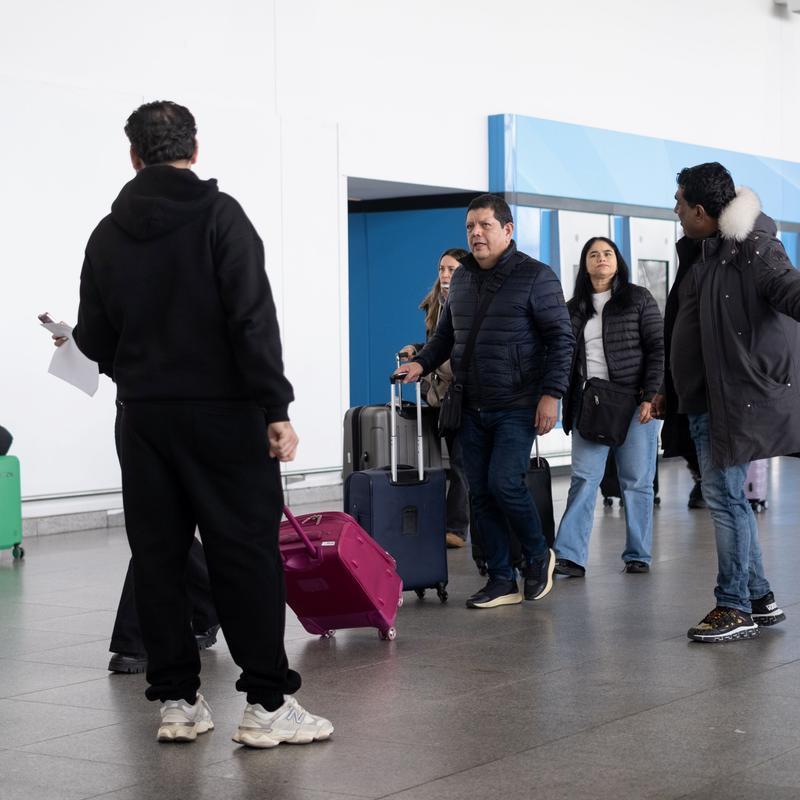
Ramsey Khalifeh: For sure. If you've been there recently, it's chaotic, and a confusing place even for New Yorkers. Terminal 1, that's where Tabitha arrived, it's actually quite cramped. There are signs pointing to the air train, there's a yellow cab stand, but none of it is easy to find if you've never been there before. That confusion is exactly what Rocco looked to exploit.
Jan Uzo: I'd walk into Kennedy Airport like I owned it, because I was there to do one thing and one thing only. Capture my lolly and get the [beep] out.
Janae Pierre: Lolly. Like a lollipop?
Ramsey Khalifeh: Yes, like a lollipop, like a sucker. How would you characterize somebody as a lolly? How would you describe them?
Jan Uzo: Somebody who's never been here before. Somebody who's been on an airplane for 9, 10 hours. They're exhausted. They're in a city of dreams, and you can basically tell them anything you like, and they're not going to disagree with you.
Janae Pierre: He's really preying on these folks, these lollies.
Ramsey Khalifeh: That's how he did it. Rocco and his crew would spot them together. They'd point them out, "Hey, there you go," and they'd call out the targets in real time.
Jan Uzo: "Oh, there's a good lolly. Go get that." You know what I'm saying? That's what we'd say to each other as a group of guys standing together when I was standing with my crew. "Oh, there's a lolly, Rock. Go get that," because we all called each other Rock.
Janae Pierre: Once he had them in the car--
Ramsey Khalifeh: Well, he had a whole system for it.
Jan Uzo: In those days, had what was called the shorty line, and that was for taxi drivers to sit and wait for passengers who were only going within the airport to catch another flight or perhaps to maybe a hotel on the outskirts of the airport. If I took somebody from Pan American Airlines to the other side of the airport because they were transferring to another airline, and it's a $4 shorty ride, I charge them $1,000, and they would pay you.
Ramsey Khalifeh: How'd you get away with that?
Jan Uzo: People didn't know. They were lollies. Now, there was a time when you couldn't get out of my car. If I put you in this car, you would not be able to get out of this car until I wanted you to get out of this car. You would not be able to open your window until I opened that window because I didn't want you being able to get the attention of any bystanders, because I've had people, "Help. Help." Or policemen. Okay.
Janae Pierre: This is getting a little scary.
Ramsey Khalifeh: It's intense. We're talking about the '80s and '90s in New York City, kind of rougher than it is today.
Janae Pierre: Yes, where I can't share my location with anyone. [chuckles]
Ramsey Khalifeh: Exactly. Rocco told me how he'd always point to apartments in nice neighborhoods, make them guess how much the rent was, how expensive the city is, so he could justify the price he was about to charge them. He'd give them waters, give their kids candy, point to shops and restaurants, make recommendations, really show himself to be a nice guy who's just showing them around New York City.
Jan Uzo: I want people to feel that at the end of the ride that even though they know they're overcharged, that they feel that the ride was worth it.
Janae Pierre: Even though what he was ultimately doing was taking a lot of money out of them.
Ramsey Khalifeh: Right, but listen, he agreed to speak with me because he stopped doing this. He has regrets for the people he's hurt, all the people he's scammed, and he believes that this level of scamming that we're seeing today at JFK airport is because of just how the industry has been decimated, specifically the yellow cab industry. When apps like Uber and Lyft came in, it completely decimated a lot of people's incomes who were doing this legally.
Jan Uzo: All hustlers are not thieves. Kennedy Airport has now, in the last several years, become just a reflection of the city, of this country. People are desperate.
Janae Pierre: It's always been bad.
Ramsey Khalifeh: Yes. Enforcement efforts date back to at least the 1980s, but since the pandemic, it has really exploded. I interviewed airport workers, legal cab drivers, and even some other hustlers themselves. Overall, they estimate that there are more than 500 of these people operating across all of JFK's terminals.
[music]
Janae Pierre: For Rocco, who's been in this game for 50 years, has he noticed anything changing?
Ramsey Khalifeh: When Rocco actually coincidentally went back to Terminal 1, he recently said he saw the same thing that we've been talking about. The one major difference is that he says there are now illegal dispatchers and illegal taxi drivers who coordinate with each other. Those are the walkie talkie guys. They spot somebody who might be a lolly in the old-school way, as we described it, and he coordinates with people, "Hey, I got a job for you." They get a cut of it, and both people come home with a lot of money.
Janae Pierre: Before, was it just the drivers themselves?
Ramsey Khalifeh: Pretty much, guys like Rocco who would just wait around outside. You still do see some individual drivers asking for rides, but now this organization, this coordination is a lot stronger.
Janae Pierre: Yes, that's what happened to Tabitha.
Ramsey Khalifeh: Seems so. She got charged almost $800. The man approached her, like we said, with a walkie talkie. He wasn't a driver. He was the dispatcher.
Janae Pierre: You also spoke to someone who sees this thing happen every single day from inside the airport. Can you tell me about that?
Ramsey Khalifeh: That's right. I met a man named Michael Carey, and he's one of those customer service representatives at Terminal 1 at JFK. Michael's worked at JFK for 19 years. He wears their red jackets. You might see him as you walk out the door.
Michael Carey: They need to be stopped. This is bad. This terminal here is bad. I'm telling you, a lot of robbing going on over here.
Janae Pierre: Oh, so he's seen a lot.
Ramsey Khalifeh: He has seen a lot, and he is constantly watching these hustlers. One thing he told me is the second he gets into the terminal, they kind of run away because they know he might get them in trouble. How do you know this, because you're seeing it yourself, or somebody tells you?
Michael Carey: No, I'm seen. I'm here. I am the one that's stopping them from taking people. You see these guy behind me that stand up [unintelligible 00:15:54]? These are illegal drivers. These are the one that's soliciting the passengers. When I'm here, they can't do it in front of me because I opposed to that, so they will leave me and go outside. When the passenger come outside, they try again, and they fall for it.
Ramsey Khalifeh: One thing Carey said throughout me speaking with him is he questioned why these hustlers keep coming back even after, let's say, being arrested or getting a ticket.
Michael Carey: The police can't do nothing about it. They arrest them, but they come back same way.
[music]
Janae Pierre: We've heard from someone who ran this game for nearly 50 years, and we've seen how organized it's become. Now we wanted to find out who's supposed to stop it. Ramsey, you and I decided to go to JFK Airport to meet the people whose job it is to actually stop these taxi scams, and that's the Port Authority Police Department. They oversee the entire security situation at JFK.
Ramsey Khalifeh: While we were there, we met Officer Scott Pomerantz, and he's the commanding officer of the Port Authority Police for JFK Airport. Officer Pomerantz took us to the airport's new operations center. The operations center runs 24/7. Plainclothes and uniform officers patrol the terminals, while a supervisor monitors live camera feeds and directs them in real time.
Officer Scott Pomerantz: I will have a supervisor back here in this room monitor the cameras, and they're able to direct the officers to specific locations based on what they're seeing. This way, the officers could respond there, see it, take action, and then that action could be a summons.
Ramsey Khalifeh: When someone gets stopped, their name gets run through criminal databases, and if there's a warrant, what started as a solicitation ticket can turn into something bigger.
Officer Scott Pomerantz: It would elevate the crime, and they would be removed from that area, brought back to our police building for investigation. It's like a cat-and-mouse game sometimes.
Ramsey Khalifeh: Then, after we saw this operations center, Officer Pomerantz took us to Terminal 8 arrivals, and when we got there, there were already plainclothes officers patrolling the area. This is all happening in the middle of the day.
Officer Scott Pomerantz: Walking over now to a car stop.
Ramsey Khalifeh: A car stop, meaning one of your officers has stopped somebody?
Officer Scott Pomerantz: Yes. The driver of that vehicle was actually soliciting through the window of his vehicle as people were passing by. He tried to enter into an agreement with a female passenger. When my officers stopped him, he was issued a summons for 1220-B, which is a VTL summons.
Janae Pierre: Got to be honest, didn't know what a 1220-B was until you told me, Ramsey. Can you share with our listeners?
Ramsey Khalifeh: A VTL summons is a vehicle and traffic law summons, just like getting a speeding ticket, and a 1220-B is for soliciting, asking for illegal rides, at the airports.
Officer Scott Pomerantz: People are brazen. A lot of these individuals, this is their main source of employment. That's why we have our patrols out from early morning to throughout the day at all the different locations. It's random, so this way, people don't know where we're going to be, when we're going to be, and this way, we're most effective.
Janae Pierre: Port Authority officers have patrols set up through the terminals. Is it working?
Ramsey Khalifeh: Well, it depends on what you consider working. You'd mentioned before that they've issued more than 2,400 summonses through January, November of last year. That's up from 1400 the year before that, so it's almost doubled, but a summons is the same level of penalty as running a red light, parking ticket.
Officer Scott Pomerantz: We had one individual last year that we issued almost 100 summonses to, and that was a combination of parking summonses and B summonses, as well as C summonses based on different violations that occur. Just to show you that that person, of course, they're doing business, is still here operating.
Ramsey Khalifeh: It sounds like from your perspective, running the police department here at JFK, all you can do is give tickets. If somebody gets 100 tickets, there's nothing else you can do?
Officer Scott Pomerantz: Well, we're doing our portion of the work here at the airport, which is the enforcement portion, and now it's up to the courts to do their portion of the work.
Ramsey Khalifeh: Once the courts get a ticket, it's up to a judge to decide what the penalties are, whether it's a fee or, in some cases, the rare jail time. The laws actually changed, and these 1220-B summonses we've been talking about are just the main way that people get in trouble for doing this thing.
Officer Scott Pomerantz: A number of years ago, mostly due to the reform in 2020, it's now a motor vehicle violation. Now you basically get a summons as if you were driving and went through a red light or something similar to that.
Janae Pierre: Guess what, Ramsey? I gotta say, if I was charging someone $800 for a car ride from JFK to Midtown, I'd happily pay my ticket. It's the price to pay.
Ramsey Khalifeh: It's the price of business.
Janae Pierre: We watched someone get a ticket for doing this in broad daylight. Now, if I'm a traveler coming through JFK, how do I protect myself?
[music]
Ramsey Khalifeh: The first and most important rule, which we've been saying a lot now, if anybody approaches you asking you if you need a ride, no matter where you are in New York City, no matter if they're a legal driver or they don't have the right plates, it is illegal. Doesn't matter who they are, how convincing they sound. No licensed driver in New York City can even solicit fares directly.
Yellow cabs have that four-digit medallion number on the roofs, on the sides of the car, the backseat tags, and on the hood. They also have that medallion that's bolted to the hood so you can see it as a sign of an official driver. They have to run the meter every time when there's a trip, and if the meter isn't running, that's your first red flag. What you can do is get out the car, if they let you, and call 311 and tell them about what's going on.
Let's say you want to ride an Uber or Lyft, which is legal. Those plates need to match the plates in the app. They start with a T and end with a C for Taxi and Limousine Commission, but they also have a small T&LC symbol at the bottom center of their license plates. It's only legal to be picked up via the apps. Another thing that the TLC told us, the Taxi and Limousine Commission, when we asked what to look out for is that some hustlers or even yellow cab drivers are using Square, that little tap-to-pay brick, to do payments. They're using that for you to pay instead of a meter.
Those transactions are off the record. They're not official. You need to pay through the official reader if they have a meter. Remember, like we said, hustlers don't just work at airports. They can be at these big train stations, concert venues where there's a lot of people trying to get home, big tourist attractions, and we have a lot of those in New York City, like Broadway shows, and also hotels.
Janae Pierre: You know, Ramsey, I'm thinking of big picture here and what's being done at the higher level to stop this.
Ramsey Khalifeh: The Port Authority actually recently approved $100 million in this initiative called Operation Legal Ride. It's going to expand the use of those license plate readers that we saw, that operations center that we spent time in, including using artificial intelligence to aid surveillance and look at data. It's not really clear what that is yet. I don't think we know what it is yet. At the same time, there's also a new director of the Port Authority. Her name is Kathryn Garcia. She was just sworn in to officially lead the agency in February, and one of her first priorities, what she said, was cracking down on these hustlers.
Kathryn Garcia: I think we need to look at it really much more incredibly holistically. If there are not arrests being made, are they actually identifying something that is an arrestable offense that they will not just get a desk appearance ticket for? Are you going to actually have meaningful consequences from it?
Ramsey Khalifeh: That was at a board meeting in February when she officially became the executive director, and she was directly responding to our reporting that showed all of this and that this problem is still happening. What that means is the Port Authority will start reviewing statutes, maybe redeploying more undercover cops and uniform forces implementing this new technology that we're still trying to find out about. She would also consider pushing state legislators to create a new law that creates tougher penalties if the crackdown maybe doesn't work.
Janae Pierre: $100 million, a new boss at the Port Authority, and a brand new operations center, and hustlers are out of there? Is that how it works?
Ramsey Khalifeh: Well, like Officer Pomerantz said, they're doing their part enforcing it with what the law is, and it's up to the courts now to enforce it, to give penalties, and maybe up to the state legislator to change the way this whole system works.
Janae Pierre: Meanwhile, folks like Tabitha are still out there losing money.
Ramsey Khalifeh: They are, but a good story about Tabitha is after her and her husband were scammed, they decided to go back to JFK airport the next day and look for somebody who could help. That's where they found Michael Carey, that employee we had heard from before who works as a customer service representative, and what he did is because he knows everybody at that airport, he found the hustlers who scammed them. Less than 15 minutes later, he emerges with the cash in hand and gives it back to them.
Tabitha Abed: It took Mike less than 15 minutes. He was so helpful, and he was so pissed off. Within 10 minutes, the money was brought. People here are so good. The country is so lovely, but only these scammers, if they can be withdrawn from that airport.
Janae Pierre: Wow. Michael's a real hero in this one. The irony of this is he's not law enforcement. He's [chuckles] a customer service worker.
Ramsey Khalifeh: The question is, what happens, for example, when he retires? What do you think the city can do? They need to be more strict? How do they enforce [crosstalk]--
Michael Carey: They got to lock up these guys.
Ramsey Khalifeh: Michael is just one guy in one terminal who's just trying to do his best. It means that for the time being, until we can figure this out, there's going to be more people getting the short end of the stick.
Janae Pierre: Man, that sucks. I guess that's why they say if you can make it here, you can make it anywhere.
Ramsey Khalifeh: Yes. I guess if you were to avoid an illegal taxi at JFK Airport, maybe you're one step closer to becoming a real New Yorker.
Janae Pierre: Maybe that's it. That's WNYC's Ramsey Khalifeh. Thanks a lot, Ramsey.
Ramsey Khalifeh: Thanks, Janae.
Janae Pierre: Thanks for listening to NYC NOW. I'm Janae Pierre. See you next time.
Copyright © 2026 New York Public Radio. All rights reserved. Visit our website terms of use at www.wnyc.org for further information.
New York Public Radio transcripts are created on a rush deadline, often by contractors. This text may not be in its final form and may be updated or revised in the future. Accuracy and availability may vary. The authoritative record of New York Public Radio’s programming is the audio record.