
NYC Takes Aim at Catcalling With New Campaign
Title: NYC Takes Aim at Catcalling With New Campaign
[music]
Janae Pierre: From WNYC, this is NYC Now. I'm Janae Pierre. Have you been a victim of street harassment or catcalling? For most people, it doesn't feel good, but a new city campaign is hoping to stop it by encouraging people to step in when they see or hear it happening. On today's episode, we hear from New Yorkers who have experienced street harassment, and a city official shares their plan to combat it.
First, here's what's happening in our region. The Mamdani administration is issuing New York City's first-ever racial equity plan. That's a list of goals for local agencies to combat racial disparities across the city. The mayor talked through some of the details Monday at Medgar Evers College.
Mayor Mamdani: The neighborhoods hit hardest by rent and the rising nature of it, by child care costs and the suffocating manner of it, are the same ones that have been hit for years by institutional neglect and racism. In that way, New York City's affordability crisis and its history of racial inequity are bound together.
Janae Pierre: The plan is required by the city's charter under ballot reforms passed by voters in 2022. A draft of the first plan was due in early 2024 under Mayor Eric Adams, and a version of the plan was completed by the end of his tenure, but it was never released.
The NYPD says it will change how it reports hate crimes in the city after several experts spoke to WNYC and questioned the department's method. Police will now report the number of hate crimes that have been reported to the department, as well as those confirmed by investigators. In March, the NYPD changed its previous policy and began reporting only hate crimes that had been confirmed. WNYC spoke to several experts who said reporting only confirmed hate crimes would be a blow to transparency and could make it appear that hate crimes were dropping in the city when they actually weren't.
The 55th annual New Directors/New Films festival returns this week to Lincoln Center and MoMA. This year's festival includes movies from more than 25 countries. Organizers say standouts include Erupcja, which is set in Poland and stars British pop star Charli XCX. MoMA film department curator La Frances Hui says another is Do You Love Me. That's a Lebanese movie constructed entirely from archival footage.
La Frances Hui: What is really thrilling about the festival is that no one knows much about these new directors. We really want the audience to be as bold and adventurous as the filmmakers themselves.
Janae Pierre: Be bold and check out the festival. It runs through April 19th. City leaders are encouraging New Yorkers to stand up against street harassment and unwanted catcalling. We'll share what that looks like and why it's important after a quick break.
[music]
Janae Pierre: Welcome back. Street harassment is something a lot of New Yorkers have to deal with each and every day. It's the comment on the subway platform: someone following you a little too long, the moment that makes you cross the street or even change your route home. For a lot of people, it's not one incident. It's routine. We're talking to folks about street harassment. Do you have a moment to chat with us?
Brooke Feingold: Do I know a thing or two about street harassment?
Janae Pierre: Tell me if you do. I went out to Washington Square Park to ask New Yorkers about their experiences with street harassment. Brooke Feingold, a poet who makes and sells art in the park, said that most of her interactions are nice, but then there are some real weirdos.
Brooke Feingold: Which time? What day of the week, honey?
Janae Pierre: Most recent.
Brooke Feingold: Most recent. I definitely get a lot of people saying crazy stuff to me because of my hair. They'll be like, "Oh, I love your blue hair." I'm like, "Thank you." And They're like, "I want to [inaudible 00:04:12] you in the [inaudible 00:04:13]," and it's like, "Oh, okay, totally."
Janae Pierre: Ebony T., another seller in the park, told me a man got aggressive with her after she didn't respond good morning back quickly enough, and then no one stepped in to help.
Ebony T.: A lot of people don't do that nowadays. They tend to either turn their eye or act like they didn't see, and then when the situation happen, "Oh, I was there, and I saw you," but you didn't do anything. Why didn't you do anything? You didn't stop.
Janae Pierre: Dan Smith, who was sitting on a park bench, acknowledges that there's a line between flirting and harassment, but he did have some jokes about it. We're talking to folks about street harassment.
Dan Smith: About what?
Janae Pierre: Street harassment.
Dan Smith: I'm an expert. I'm just kidding. [laughs]
Janae Pierre: You don't have any experience?
Dan Smith: As a harassee or a harasser? I'm just kidding. [laughs]
Janae Pierre: No, no, no. Whichever.
Dan Smith: Not really, no. I luckily don't experience it much. Sometimes, as a man, you wish you would experience it a little bit.
Janae Pierre: Why?
[laughter]
Janae Pierre: Why?
Dan Smith: Hey, you want to get hit on a little bit, but that's not harassment.
Janae Pierre: A city survey found more than half of people surveyed said they'd been harassed in just the past six months. Now the city is trying to interrupt that. Starting this month, a new campaign from the mayor's office will show up across subways, ferries, and sidewalks, calling out street harassment and encouraging people to step in when they see it happening. Prince Gregorio, who I also spoke to at the park, says he hasn't had any experience with street harassment or catcalling, but if he did witness it, he says he'd step in.
Prince Gregorio: I've watched this show called What Would You Do? and I just told myself that if that happens to me, I would definitely do something. I would say something to the men, like, "Stop doing that," or "It's not good." I call their attention, I capture their attention, and they veer away from whatever they're doing. I think that's the best strategy, to distract them from doing something that's go bad.
Janae Pierre: Yes, and that's exactly what this city campaign is pushing people to do. The city has this new campaign to stop street harassment. They basically want neighbors to be better neighbors. If you see something, say something. Joining me now to talk more about the city's new campaign is Commissioner Saloni Sethi from the New York City Mayor's Office to End Domestic and Gender-Based Violence. Welcome to the show.
Commissioner Saloni Sethi: Thanks so much for having me. Glad to be here.
Janae Pierre: All right. At the most basic level, what is this campaign trying to accomplish?
Commissioner Saloni Sethi: Sure. I think at the most basic level, I think, even as you opened, we've normalized street harassment as a fact of daily life in our city. I think that at its most basic level, the campaign is trying to get New Yorkers to think about that. Is that really the choice we want to make? Is that really what we want to accept on our subways and in our streets and in our communities, or is this something that maybe we want to think about a little bit deeper and think about the choices people are making when they're engaging in street harassment type behavior?
Janae Pierre: Let's talk about what that actually looks like for a bystander helping to navigate that situation. What are you guys encouraging bystanders to do here?
Commissioner Saloni Sethi: Our Street Harassment Prevention Advisory Board, which we co-chair with the Commission on Gender Equity, includes city agencies, people with lived experience, and an org called Right To Be, which really focuses pretty exclusively on street harassment and bystander intervention. We do offer these bystander intervention trainings. I won't remember all the 5Ds, but there's 5Ds.
They're looking at things like distract. Can you create a direct distraction and direct somebody elsewhere? If you're comfortable, can you de-escalate a situation if that feels safe? It's things like that where in a public space, we're trying to give people tools, we're trying to give folks options in terms of what feels safe in that moment.
Janae Pierre: A lot of people are going to think, "I'm not going to get involved here." That could go left quickly. How do you account for that?
Commissioner Saloni Sethi: I think people are really focused on the incident and the moment, but there's so many other things you could do before or after. Part of this behavior really reflects broader social norms, and so I think encouraging folks to question those norms at times when it is safe. Even when you're talking with a friend, if they say something that seems dismissive, that seems misogynistic, we encourage folks to question that, to be like, how would that make so-and-so feel, or how would that make your partner feel?
I think that there's these other moments that aren't during an incident that we also want to encourage people to think about intervention. It's like if somebody has just experienced something, it can be really meaningful to have the stranger come up to you and say, "Are you okay?" To even acknowledge that something happened that was harmful. Do you need help? Do you need to call somebody? I think it doesn't really have to be when it's heated because we understand that there's safety concerns that might not be for everybody.
Janae Pierre: Have you yourself found yourself on either end of a situation like this?
Commissioner Saloni Sethi: Of course. I didn't grow up in this city, but I grew up in a city. I think, especially as a young person, it was something that was a fact of life, and I think that's something that we think about a lot. I do think I definitely grew up in a world where it was normalized, and have been fortunate later in life, as I raise my own kid, I have a 12-year-old boy, we're talking about it all the time. He games, so every time he's talking to his gamer friends, I'm like, "Wait, that's not a way you'd talk to somebody." He's like, "Yes, I know. I know. It's in the game," or he's like, "My friend used this word." I'm like, "What did you say?"
Janae Pierre: "What was your response?"
Commissioner Saloni Sethi: "What was your response? What did you say when your friend used that word?" Really thinking about words that are focused in misogyny in particular and questioning those.
Janae Pierre: There are people who hear street harassment, and they don't take it seriously. They see it as talking. Some men may see it as flirting, that's their game, that's sad, but it's part of New York City, as I mentioned earlier. What's your response to that?
Commissioner Saloni Sethi: I think about this a lot. Sometimes when I'm walking down the street and I'm experiencing this myself, I'm like, "When has this ever worked for you?" If this is flirting, who has ever said, yes, I'm in, sign me up."
Janae Pierre: I've never seen anyone respond back like, "Oh yes, here's my number."
Commissioner Saloni Sethi: It's bad flirting. If it's flirting-
Janae Pierre: Terrible.
Commissioner Saloni Sethi: -it's just out of baseline.
Janae Pierre: For sure.
Commissioner Saloni Sethi: Try something different. It's not working. I grew up in the '80s. I was raised with sticks and stones will break my bones, but words will never hurt me, and that's just not true.
Janae Pierre: It's not.
Commissioner Saloni Sethi: It's just not true.
Janae Pierre: Mom was full of it when she told me that. A
Commissioner Saloni Sethi: I think we have evolved in a way to think about our words having meanings and language being powerful, and language being used to dehumanize folks. That's really what it's about at the end of the day. It's about dehumanizing people through use of language.
Janae Pierre: I want to talk a bit more about that survey that you guys did that found that more than half of people surveyed said they'd been harassed in the past six months, and about half said it changed how they move through the city. What does that tell you about how routine this actually is in the city?
Commissioner Saloni Sethi: Look, I think it's not surprising, but it's so great that we actually did the survey, because I think when we can quantify something and point to where we got the numbers from, it makes the point stronger, even though for those of us that walk around in certain bodies in this world, that's not a surprise at all. If you're a single woman, if you're a younger person, you're probably avoiding the train at a certain hour. I think that's what they're talking about in terms of how they restrict movement, or thinking about, "Do I go somewhere with a friend or do I take a taxi instead of a train?"
What's great about the survey and this work is this campaign is a direct response to what New Yorkers wanted. Even thinking about that safety of movement, it's like that might inform how we're targeting certain areas. Like transit hubs, for instance. We were like, "Can we do more at placements on transit hubs? Can we do potentially activations around transit hubs? Can we hand out resources?" Just thinking about those movement pieces, we really hope to keep deepening this work. I think, like I said, that this is step one and something that we hope will be ongoing around this issue.
Janae Pierre: As I mentioned, your ads for this street harassment campaign, it's up on subways, ferries, sidewalks. I, in fact, saw one on the C Train just last night. The city has done campaigns like this before. What's different about this one?
Commissioner Saloni Sethi: Unlike previous campaigns we've done around domestic violence, it's been oftentimes people looking sad. It's a kind of images that people often look away from. This looks sad, this looks depressing. I don't want to talk about it, which we have with our issue all the time. I think what's different about this campaign is I think it looks different, it's more engaging, it's brighter, it's supposed to be a little bit more graphic. It's really trying to shift that and be like, "How do we make this something that's a little bit more engaging and colorful and bright and grabs you and grabs your attention in a different way.
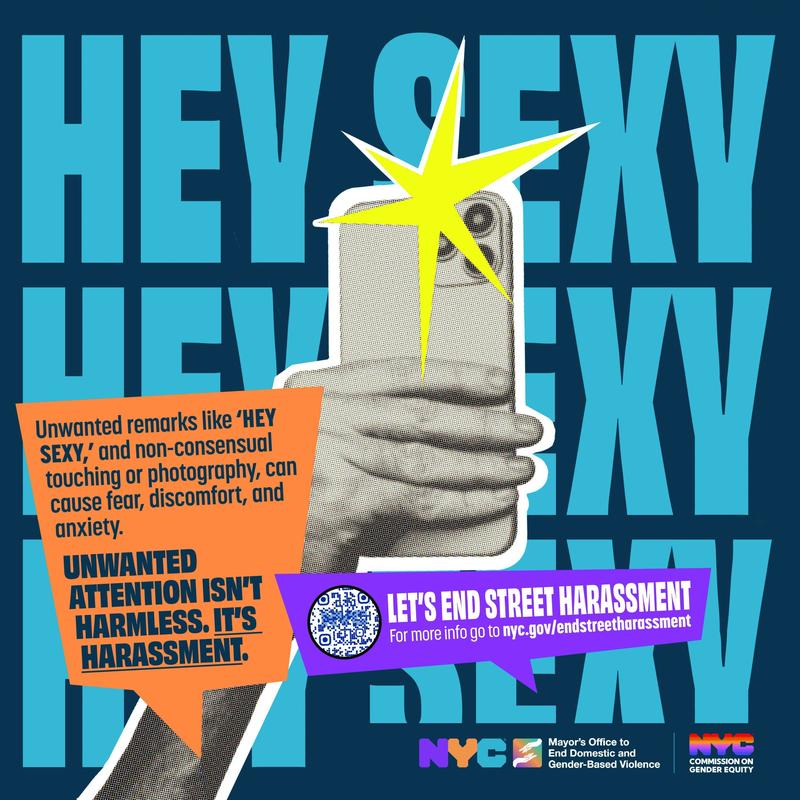
Janae Pierre: Yes, it certainly is bright. The neon green, the big mouth, the hey baby, hey baby, hey baby on there. Can you describe the other ads?
Commissioner Saloni Sethi: Sure. One of them is, as you said, "the hey baby, hey baby, hey baby," and then the other one is a "hey sexy." They repeat the phrase over and over again as like very common catcall phrases that folks hear, and then they describe the behaviors that constitute street harassment. I think the one that folks always think about, the most obvious one, is verbal. Obviously, saying something verbally to folks is street harassment, but also it can be physical gestures.
We also include a camera because unwanted photographs also counts as street harassment, and we see a lot of that. Then it has the word bubble that says that it's not just harmless behavior, that it is street harassment, and it has impact on folks, and then there's a QR code connecting to resources.
Janae Pierre: How are you going to measure if this is working? Not just that people saw it, but that the behavior actually changed. I know you mentioned the QR code, but when we talk about those behaviors changing, what does that actually look like?
Commissioner Saloni Sethi: I think two things. I think obviously that's what makes the prevention work hard is it's long-term behavior change. What's really complicated with our work, too, is most of the violence that people experience, whether it's street harassment, whether it's intimate partner violence or sexual violence, is under-reported. In some ways, we might actually want to see an increase in reporting and people reaching out, even though that sounds counterintuitive.
For us, that includes calling our 24-hour HOPE hotline, which is the 1-800-621-HOPE number, 1-800-4673, which anyone can call if you've been a victim of crime, abuse, and including gender violence, to connect to somebody right away and talk to somebody. We would like to see people coming to our family justice centers. We have one in each borough that are walk-in centers. We also have an online directory of services, which is NYC Hope. We want to see people engaging with that. Whether it's reporting to law enforcement, which I think is always an option, we also want to see engagement in all these other ways of people really understanding that there's resources out there and that this is a problem that we can help support.
Janae Pierre: Here in New York City, people interact with a lot of different communities that they're not a part of, and some conversations might be misunderstood as a result, like when cultural norms are different between groups. Is there any concern that campaigns like this might reinforce stereotypes? Is that something that you try to think through and develop in it?
Commissioner Saloni Sethi: We definitely hope that they don't reinforce any stereotypes. In our work with this campaign, with our broader work on gender-based violence, we really are very careful to not blame culture and cultural norms, but again, really look at this work from the perspective of the victim or survivor, because whatever cultural norms are, they might be okay for everybody, but if that norm is harming one person, I really would like folks to think about that norm a little differently.
You can still have the norm, but if you are somebody within a culture that has certain norms around catcalling-- It could be around education. Let's take something very neutral. There's cultures that have norms around education and who gets educated and who doesn't get educated. I don't want to necessarily challenge that norm as a whole by this, but I want people to start thinking about, "What about the one person who wants to get educated, but the culture is saying, no, how do we help that one person? Will that get us to rethink that norm a little bit?"
[MUSIC - ALHE80: Alegranza]
Janae Pierre: Commissioner Saloni Sethi from the New York City Mayor's Office to End Domestic and Gender-Based Violence. Thanks so much for stopping by.
Commissioner Saloni Sethi: Thank you so much for having me.
[MUSIC - ALHE80: Alegranza]
Janae Pierre: Decades ago, Allen Porter met Jabbar Collins at the Green Haven Correctional Facility, where they'd become best of friends. They both claimed to be innocent of their charges. While locked up, Jabbar educated himself just as a first-year law student would, spending hundreds of hours in the prison's law library.
Jabbar Collins: I had been railroaded so thoroughly during my trial, and I said I would never trust anyone else to be my savior. I would have to do it myself.
Janae Pierre: His conviction was overturned in 2010, and he promised his buddy Allen he'd get him out, too.
Jabbar Collins: Everyone I spoke to who were from the same area, they came in and they said the same thing. Allen didn't commit this crime. This was like an open secret with everyone who came from that neighborhood. I knew that he was wrongfully convicted, and I knew that there was no way that I can leave him there.
Janae Pierre: Next time on NYC Now, we talk with the two men about their journeys to freedom. You don't want to miss the conversation. Look out for the drop this Wednesday on NYC Now. Thanks for listening. I'm Janae Pierre. See you next time.
[MUSIC - ALHE80: Alegranza]
Copyright © 2026 New York Public Radio. All rights reserved. Visit our website terms of use at www.wnyc.org for further information.
New York Public Radio transcripts are created on a rush deadline, often by contractors. This text may not be in its final form and may be updated or revised in the future. Accuracy and availability may vary. The authoritative record of New York Public Radio’s programming is the audio record.