
Magnet Schools Regain Federal Funding in Transgender Rights Dispute and Fight Over $30 Minimum Wage Continues
Title: Magnet Schools Regain Federal Funding in Transgender Rights Dispute and Fight Over $30 Minimum Wage Continues
Janae Pierre: From WNYC, this is NYC Now. I'm Janae Pierre. New York City's minimum wage is $17 an hour, but that could be going up soon. On today's episode, we discuss a bill introduced by the City Council that would raise it to $30 by the year 2030. Plus, New York City recently won a court fight over magnet school funding tied to trans student policies. We'll get into it all, but first, here's what's happening in our area. Governor Kathy Hochul is backing a tax on expensive second homes to help New York City tackle its budget deficit. Hochul says her new proposal would generate $500 million a year for the city. She stressed it won't apply to primary residences, just second homes worth $5 million or more.
Governor Kathy Hochul: If an owner lives there full-time or rents it out to a full-time tenant, the surcharge will not apply.
Janae Pierre: Mayor Zohran Mamdani is embracing the governor's proposal and painting it as a tax on the global elite. The revenue won't be enough to close the city's $5 billion budget gap. The governor says the city will have to find additional savings on its own. Over 5,000 low-income households in New York City are on the verge of losing their federal rental assistance. The Trump administration says the COVID-era emergency housing voucher program is almost out of money.
Brooklyn renter LaShaun Smith says she was stunned to learn she'll be losing the assistance.
LaShaun Smith: I was in shock. I don't understand how our government can take our homes from us.
Janae Pierre: She says she doesn't know yet how she'll afford her rent. The New York City Housing Authority says it will offer empty public housing units to some families, but city officials say they can't guarantee everyone will receive Aid. Another 2,500 housing vouchers managed by the city's housing agency will also expire and will be replaced. Some local favorites are part of this year's class of the Rock and Roll Hall of Fame. The Wu Tang Clan are being inducted under the performers category.
The world-famous rap group has been influencing hip hop culture for decades, and many of its long list of members got their start on Staten Island. New York City native and R&B legend Luther Vandross will also be inducted as a performer. Rappers Queen Latifah and MC Lyte will be inducted as early influencers. Both women are from the Tri-State area. MC Lyte grew up in New York City, and Queen Latifah was born in Newark and raised in Essex County. Brooklyn native and producer Rick Rubin is being honored with the Rock Hall's Musical Excellence Award alongside Jimmy Miller, who's from Long Island. Congrats to everyone representing for the five boroughs and the surrounding area. That's really cool.
The Trump administration won't be able to continue withholding tens of millions of dollars in funding for New York City's magnet schools over the school district's policies regarding transgender students. We'll have more on the judge's ruling in that case after a quick break.
[music]
Janae Pierre: Welcome back. A federal judge ruled last that the Trump administration broke the law when it cut tens of millions of dollars from New York City's magnet schools. This money was tied to a months-long fight over how the city treats transgender students. WNYC's Giulia Heyward has been covering the story, and she joins me now. Hey, Giulia.
Giulia Heyward: Hey.
Janae Pierre: Can you tell us what happened here?
Giulia Heyward: All right. The fight started last September, last school year, when the Trump administration sent New York City public schools a letter giving the district just three days to change its policies surrounding trans students.
Janae Pierre: What exactly are these policies?
Giulia Heyward: They let students access facilities, so think bathrooms or locker rooms, or participate in extracurriculars like sports teams that correspond to their gender identity as opposed to their sex assigned at birth. This is our local law as well. We have a human rights law in New York that protects against discrimination for someone's gender identity. The city decided not to comply. They decided that they weren't going to get rid of our policy concerning trans and gender expansive students.
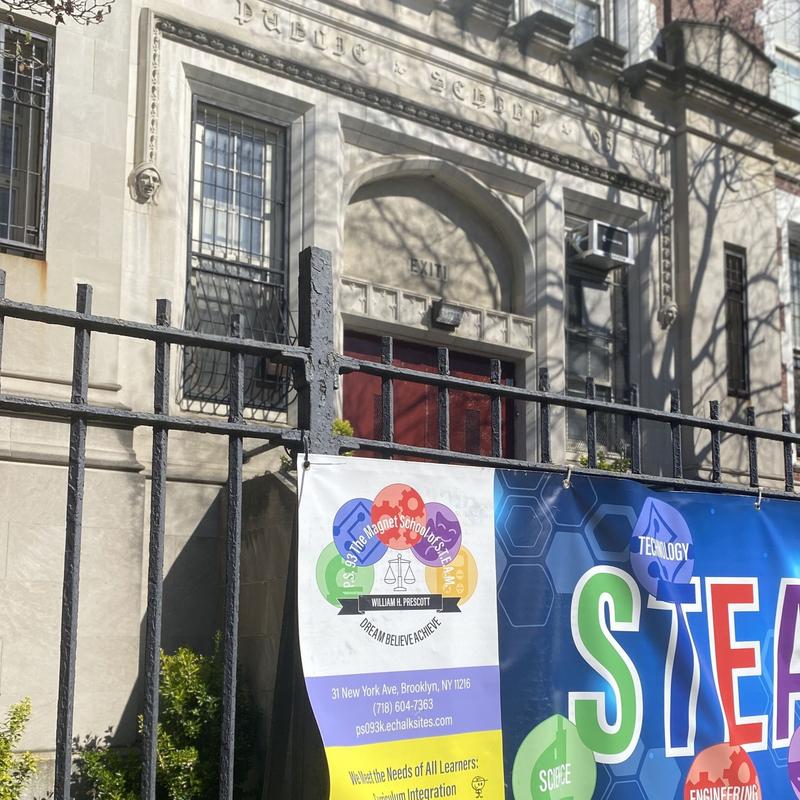
The federal government decided to freeze funding that was allocated for the school district's magnet schools. Tens of thousands of students within the school district actually attend magnet schools. These are specialized programs, think the arts, like acting or dance, language learning, global studies. Essentially, students were going to not have the same standard of education that they could have had last year because the city wasn't willing to change our policy around a certain subset of our students. Now, this was money that had already been awarded that was already in that line item. Schools were essentially told, actually, that money's not going to be there anymore.
Janae Pierre: Wow. They already budgeted to spend this money.
Giulia Heyward: Yes. What ends up happening is the city decides that it'll retaliate by filing a lawsuit, saying that it's unjust for the federal government to remove this federal funding. While this is also going on, what the school district does is it ends up striking a deal with the federal education department so were able to get some of that money back, but not the vast majority of it. Schools were in limbo when this school year started.
Janae Pierre: Can we talk a bit about the legal argument here? Because Title IX is at the center of this. What is the federal government actually claiming here?
Giulia Heyward: Title IX is a guideline that is supposed to protect against sex based discrimination. It's also the same guidelines that protect women and girls who compete in sports. What the federal government essentially argued is this idea that by letting trans students access bathrooms or locker rooms that correspond to their gender identity, it was somehow creating an unsafe environment for other students.
Janae Pierre: How?
Giulia Heyward: The argument that this is some sort of sex based discrimination. We've seen this appear a lot in other states that have also been dealing with the same efforts from the Trump administration to roll back on these rights. There's also something that's primarily known as the trans and gay panic defense, and it's essentially a legal defense. Some folks will describe it as victim-blaming, in which people will argue that queer people create unsafe environments for people. It's been used in lawsuits and legal cases beforehand. It's been largely debunked. Stereotypes around trans or other queer people somehow being unsafe still persist, and this is an example of that.
Janae Pierre: You said last week's ruling somewhat resolves the uncertainty. What did the judge say?
Giulia Heyward: Basically, what ended up happening was a federal judge in Manhattan ruled that the federal government didn't go through the right procedure in order to withhold funding when someone violates Title IX guidelines. There's an entire process, think a hearing, you have to write something up. There's a whole Congress needs to weigh in as well. None of that happened. The funds were just stripped. The federal judge didn't actually rule on whether or not the city's policy actually violated Title IX guidelines. All he said was that the federal government didn't go through the right procedure, and as thus, they have no actual standing to withhold that funding. Basically, what this court decision means is that magnet schools within the city now have access to that funding again.
Janae Pierre: I guess a win is a win.
Giulia Heyward: Yes. I've talked to a lot of civil rights advocates who have essentially expressed that as well, a win is a win. While this doesn't necessarily solve the entire problem, and it does, many people think, still create an opening where the federal government could still continue to fight against giving the school district this funding, it is considered to be a short-term victory.
Janae Pierre: A short-term victory. What's next?
Giulia Heyward: Essentially, the federal education department has 10 days from when the ruling happened to decide if it's going to relinquish this funding or not to magnet schools. If they do so, then should be fine but who knows? This could end up resulting in another lengthy legal battle. Just to put this into context, since Donald Trump resumed office, there's been this federal rollback on protections for different sorts of marginalized groups. A lot of these executive orders are ending up in court where civil rights groups are essentially saying that they're unjust. If this does become a lengthy legal battle, it's not going to be the only one.
Janae Pierre: That's WNYC's Giulia Heyward. Thanks a lot, Giulia.
Giulia Heyward: Thanks for having me.
[music]
Janae Pierre: In another story from our newsroom, New York City's minimum wage is $17 an hour, but a bill introduced by the City Council would raise it to $30 by the year 2030. Supporters say workers just can't afford to live here, but business groups say the cause would be unsustainable, and there's a legal question that could derail all of this. A 1964 court ruling suggests the city may not be able to raise the minimum wage on its own. WNYC reporter Arun Venugopal has been covering this. Arun, walk us through what's being proposed here.
Arun Venugopal: All right. The plan here, Janae, is if this law does pass, bigger businesses, anyone that has more than, say, 500 workers, would have to adopt a $20 hourly wage by next year, 2027, and ramp it up to $30 by the year 2030, while smaller businesses would have until 2030 to phase in that $30 wage. We should remember that the federal minimum wage is just $7.25. That's been pretty much standing still right there since 2009.
Janae Pierre: Council Member Sandy Nurse, she says workers are barely making it, and some are being pushed into the shelter system, even. What's driving this push right now?
Arun Venugopal: The affordability crisis. This is a phrase that everybody invokes. It's almost like nobody even contests the fact that there is this thing we call an affordability crisis. As far as Sandy Nurse goes, she is the council member who's driving this forward. She's pointing to all these working-class New Yorkers who are barely scraping by. They're pushed into overcrowded housing, going into the shelter system, as you say, or just leaving the city altogether because it's impossible. They say it's reached a breaking point. I guess we've been talking about this breaking point for a while now, but now there are people like, who have positions of power in the city council who are driving this forward.
Janae Pierre: I know you just came off of your lunch break, and you went to Chipotle. You got your coffee as well.
Arun Venugopal: I did.
Janae Pierre: I often think about those workers in a time like this. Have you spoken to anyone? What are the workers saying about this?
Arun Venugopal: Mostly, I've been just speaking to people who are representing these workers. Over the course of time, you definitely talk to a lot of workers who are pushed to the breaking point, taking on two or three jobs, who might have that decent-seeming job that gets them by, but at night they're doing something else.
Janae Pierre: It's a gig economy, right?
Arun Venugopal: It is a gig economy. For a lot of people, that means nonstop, and it means there's no breaks. They're one or two paychecks away from a real crisis.
Janae Pierre: A $30 minimum wage could be the break that most of these workers are looking for. If I've done the math right, I think I read this in your reporting, that's about $62,000 annually.
Arun Venugopal: Yes, exactly, which is, for many of them, would be a big jump up. The current minimum wage is $17. The last time we saw a big change was in the 2010s, about a decade ago, when there was this thing called the Fight for 15, which was one of the major victories of the labor movement in recent decades. It was very audacious. They were essentially saying, we're going to take that 7.25 minimum federal wage, and we're going to more than double it.
People who embrace what happened there, they point to data that shows that a lot of boats were lifted at that time because you had a lot of people. There's more than a million New Yorkers, people in New York City, who depend on a minimum wage, so that those gains accrued and resonated beyond those individuals to their families and to their communities.
Janae Pierre: I don't want us to just pass by that. Sometimes we can say numbers, and it doesn't really hit. I want to repeat what you said here. More than a million New Yorkers make minimum wage. That's a huge chunk.
Arun Venugopal: That is about a quarter of the city's workforce. Then you have to think about all the people, all those families and communities that are dependent upon those paychecks. Yes, if we see a $17 minimum wage go up to $30, we're going to see a big change, not just in terms of their ability to pay their rents and afford healthcare [unintelligible 00:13:40]
Janae Pierre: Afford to live here.
Arun Venugopal: Exactly. Also, what's spent at local businesses. That's the argument that supporters are making right now.
Janae Pierre: A $30 minimum wage was actually something that Mayor Mamdani campaigned on. Now that the bill is actually with the city council, where does the mayor stand on this specific legislation now?
Arun Venugopal: He is, I guess you could say, cautiously giving support to this. I reached out to his office, and his spokesperson, Cassio Mendoza, gave us this statement, "To address the affordability crisis, Mayor Mamdani believes every New Yorker deserves a living wage. As the administration reviews his legislation, he remains committed to using every tool available to bring down the cost of living and deliver real relief to working people."
Janae Pierre: You say cautious. Why is he so cautious now?
Arun Venugopal: For that, Janae, we have to read the tea leaves, and it can be a very subjective thing. You can hear this and hear support for this in terms of that he believes every New Yorker deserves a living wage. He didn't say, "I support a $30 minimum wage." He said a living wage. You can read it either way, really.
Janae Pierre: Mayor Mamdani supports a livable wage. Meanwhile, Council Speaker Julie Menin, she hasn't weighed in yet. How significant is that, and what are you hearing from her office?
Arun Venugopal: Right now all they're saying is that they're going to review this and look into it. We can't read too much into that. It's definitely less robust than the mayor's statement was. This is a process that's going to be playing out in the council in the coming months. Again, whether or not it's going to get the support of the whole council is unclear, because in addition to all these workers and labor groups and community organizations that are saying, "We need this new minimum wage at $30 in order to combat the affordability crisis," there are a lot of people who are saying, "No, this is going to be like spelled doom for the city."
Janae Pierre: One of those people is Tom Grech over at the Queen's Chamber of Commerce. He said flat out, "This cannot happen. This cannot stand." He put a number on it as well. More than $75,000 per employee when you factor in benefits. How is the business community organizing against this?
Arun Venugopal: Right now, they're in that early phase where they're trying to organize small businesses. There are a couple of hundred thousand small businesses in the city, according to city data. What they're trying to do right now, groups like the Queen's Chamber of Commerce is go to these small businesses and get their input what would this mean for them. Essentially, organizing the business community and then taking those stories, which are generally, from their perspective, antagonistic towards this bill, and getting media attention on that, to convince lawmakers that this is not something that they should get behind.
Janae Pierre: Okay, Arun. If the city needs Albany to sign off on this, where do state lawmakers stand?
Arun Venugopal: Too early to say, Janae. Right now, they're not weighing in. It would be a whole ’nother fight to get the head of the state Senate and the Assembly, setting aside the fact that Governor Hochul would have to weigh in. They're dealing with all kinds of other fights.
Janae Pierre: Taxing the rich. [chuckles]
Arun Venugopal: Exactly. This is the thing that would definitely add a huge complication to this case.
Janae Pierre: Yes, for sure. The Teamsters showed up in your story saying their members would go to Albany if that's what it takes. How broad is the coalition behind this bill?
Arun Venugopal: You have unions that are behind this bill. You have hotel workers, restaurant workers, a lot of people who are interested in this. Interestingly, it's not just those people, the usual suspects. There's even some businesses who are saying, actually, this makes a lot of sense for us because we're tired of the turnover we've had. People come and go because everybody who's making a minimum wage is looking for something that's a little above a minimum wage.
They're going to jump at the first opportunity they have. These business owners are saying, "If I give more money to a person, there's less likelihood I'm going to lose that person. They might do better work because they're more committed to the work. I don't have to pay thousands of dollars every time I need to advertise the new job listing or interview these people or screen them." One business owner told me that costs like $7,000 every time. They're saying we're actually saving money in this process.
Janae Pierre: It's a headache. Your peace of mind is priceless.
Arun Venugopal: There you go.
Janae Pierre: I want to talk about job losses and job gains because I know that you reported on some research suggesting that minimum wage increases don't necessarily lead to job losses. What does the evidence show?
Arun Venugopal: The Federal Reserve Bank of New York concluded that raising the minimum wage in New York did not have a negative impact on job creation, although it did have a benefit for all those workers who were now earning at that time $15, which is now $17. There's data like that. There's other studies that show that there hasn't been much of a job loss, if at all, across the country. We're in a different climate right now. What you have are conservative think tank and business leaders who are saying, "Listen, we're in an age of automation." I don't know about you, Janae, but I can go to my local supermarket, and where there used to be, say, six or seven checkout aisles, there's now maybe one functioning aisle and half of that section--
Janae Pierre: Self-checkout.
Arun Venugopal: Self-checkout. I often opt to do that myself because it's faster than waiting in that single line.
Janae Pierre: Now you work at the store. [chuckles]
Arun Venugopal: It's a change of reality. This is what business leaders are saying is like, if you want to speed up automation, go ahead. They're saying simply that businesses cannot afford to be paying people $30 an hour, that their costs would go up so much that they'd either have to lay off people or shut down.
Janae Pierre: A moment of uncertainty. Please tell us, what's next? Where does this legislation go from here?
Arun Venugopal: The battle is going to heat up because right now we're in that fairly quiet phase before things start getting pretty real. People are organizing their cases. They're taking their cases to the public. They're trying to get say on one side over here, business leaders to really come out against this, businesses to come out against this, to push the case against elected officials who are on the fence. Meanwhile, working-class New Yorkers are saying like, "No, this is actually the only way that we can afford to remain in the city or to get by." That's a narrative that a lot of people instinctively embrace. They understand it's hard to get by. This is really where the tension lies.
Janae Pierre: Yes, for sure. That's WNYC and Gothamist reporter Arun Venugopal. Arun, thanks a lot for joining me.
Arun Venugopal: Thanks, Janae.
Janae Pierre: Thank you for listening to NYC Now. I'm Janae Pierre. See you next time.
[music]
Copyright © 2026 New York Public Radio. All rights reserved. Visit our website terms of use at www.wnyc.org for further information.
New York Public Radio transcripts are created on a rush deadline, often by contractors. This text may not be in its final form and may be updated or revised in the future. Accuracy and availability may vary. The authoritative record of New York Public Radio’s programming is the audio record.