
Could European Style Trash Bins Clean Up NYC? The City Is Betting Yes
Janae Pierre: From WNYC, this is NYC Now. I'm Janae Pierre. New York City's gone European, at least when it comes to trash. The city is expanding containerized trash pickup with Empire Bins, plus e-bikes are all over the place, some swirling in and out of lanes, speeding on the sidewalks. It's not just annoying, but it's dangerous. On today's episode, we look into a study that finds that a major Manhattan trauma center is treating a growing number of patients with serious injuries from e-bike accidents. We'll get into that, too. First, here's your news headlines.
New York Congressman Jerry Nadler will introduce legislation this week intended to keep President Donald Trump from putting his name on Penn Station and other federal buildings in the city.
Congressman Jerry Nadler: No more pressuring officials to factor in his vanity when making decisions that affect millions of people. Penn Station is a serious public infrastructure project, not a monument to Donald Trump.
Janae Pierre: New York City leaders and advocates gathered at Penn Station over the weekend to tease the legislation and call for more oversight and transparency on the Penn Station overhaul, including how the redesign will be paid for. The president is expected to select one of three proposals for Penn Station's redesign next month.
It's been 10 years since marijuana was legalized for medical use in New York, yet cannabis researchers say there's still a shortage of quality data on the drug's risks and benefits. A new change in federal policy could pave the way for more research. Margaret Haney is a professor at Columbia University who studies cannabis.
Margaret Haney: It's just distressing that the industry is telling us what a medication is, and politicians are telling us what a medication is in lieu of any of the data we so desperately need.
Janae Pierre: Haney says federal restrictions on cannabis research have made it difficult to conduct rigorous studies. Last week, the Trump administration reclassified medical marijuana as a less dangerous drug, which could ease some of those restrictions.
If you were hoping to get discounted tickets to see Gotham FC next month, you're too late. They're already gone. Over the weekend, Mayor Zohran Mamdani partnered with the reigning National Women's Soccer League champions to release 1,000 tickets for $5 to their May 9 home game against the Boston Legacy. The team says the tickets sold out in less than an hour. You can still get regular price tickets, though. Gotham FC play at the Sports Illustrated Stadium in New Jersey. We're going to take a quick break, but when we return, we'll discuss New York City's trash revolution. Stay close.
[music]
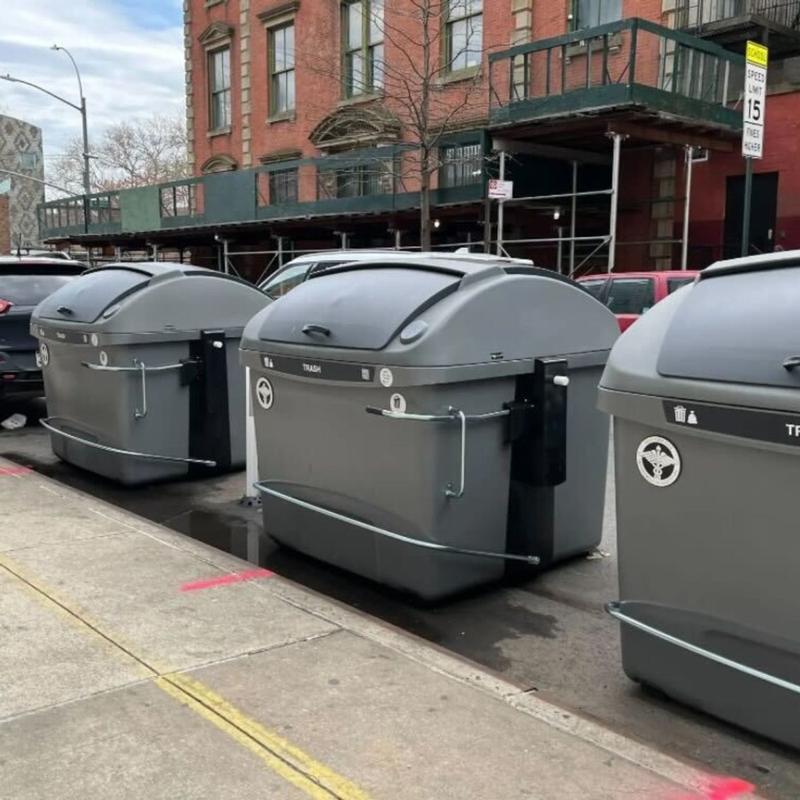
Janae Pierre: Welcome back. New York City says thousands more curbside trash bins are coming to the five boroughs. The plan would add more than 6,500 Empire Bins by the end of 2027, expanding containerized trash pickup to more neighborhoods. The rollout comes with trade-offs. The city says full containerization could eventually require converting hundreds of thousands of parking spaces citywide. Mayor Zohran Mamdani says it's part of a push for cleaner streets and fewer rats. WNYC and Gothamist reporter Liam Quigley has been covering this. Liam, welcome to the show.
Liam Quigley: Hello.
Janae Pierre: What is the city announcing here? Tell me more about this plan.
Liam Quigley: This is the most significant expansion to date of these Empire Bins, which were introduced to us under Mayor Eric Adams uptown in Harlem a couple of years ago.
Janae Pierre: Yes, I remember that.
Liam Quigley: Right now, those are coming to all five boroughs under Zohran Mamdani, who says we're going to use these Empire Bins that sit at the curb in place of those big piles of trash bags that you're probably used to.
Janae Pierre: Oh yes, we see them all over. Everyone's walking past really fast, so a rat doesn't cross your feet. Anyway, let's start with the basics here. What are these Empire Bins? How do they work, and why does the city believe that they're better than leaving trash bags on the curb?
Liam Quigley: Okay, they're made in Spain. A lot of European cities have this system of like no piles of trash bags. They get assigned to specific buildings. Any building with 30 or more units will just get these bins for trash. Buildings with 10 to 30 units will have an opt-in choice. Then one of these big special new garbage trucks will come with an arm that'll come out from the street, and the operator will just lift it up with the hydraulic system, dump the trash in. The bin is locked, so only the super or whoever can throw the trash out during the week. That's what they're calling the trash revolution is introducing this to New York City, basically.
Janae Pierre: Yes. Yes. That's really cool. As you mentioned that this program began under former Mayor Eric Adams. I've actually seen these bins. I've seen them in Harlem. I've seen them in Fort Greene. Now, as you mentioned, Mayor Mamdani is expanding this program. What does that signify about how effective or necessary the city believes this has been?
Liam Quigley: Under Adams, there was data that showed when these bins are in place, rat sightings went down. People I talked to in Harlem say that they're introducing them already. There's some of these bins in Fort Greene. I think the city is expecting to see the same results. It shows that Mamdani's he's fully on board with these. I remember asking him when he was running for mayor about things that he supported that Adams did, and this was one of them. Pretty much everybody running for mayor was like--
Janae Pierre: "Yes, let's do it."
Liam Quigley: "We like these bins." He's embracing this program, for sure.
Janae Pierre: Yes. The obvious trade-off here is parking. This phase brings, as I mentioned, more than 6,500 bins. The city says full containerization could eventually require converting thousands of parking spaces citywide. How is the administration justifying that scale of change?
Liam Quigley: It depends on how you look at this. Is it a replacing of parking? If you talk to people at sanitation department, they're like, "We happen to have been letting New Yorkers store their cars for free at that curb space."
Janae Pierre: It's for the city.
Liam Quigley: It's for the city. Now we're just going to be putting an Empire Bin in a couple of those spots wherever there's a building large enough to warrant it. It fits with this overall rethinking of how we use public space that's been going on for years now. Of course, if you tell somebody who's, it's Sunday night, they just got back from visiting somebody, and it's 9:30, and now they got to spend an extra 20 minutes looking for parking, that will be a change.
Janae Pierre: Liam, people were already complaining about Citi Bikes taking up parking spaces. Now these trash bins will be doing the same. What do you have to say about that?
Liam Quigley: I think it's a good example of some Citi Bikes have been around for 10, 11 years. I remember the lawsuits and the fights over individual Citi Bike docks being placed in the roadway at the curb. This is consistent with a change in how we're using some of that public space.
Janae Pierre: Yes.
Liam Quigley: I think be prepared for fights.
Janae Pierre: The city is definitely reclaiming its space right now.
Liam Quigley: People will fight about it.
Janae Pierre: Then there are restaurants who do outdoor dining, and they put up those sheds to expand their restaurant. What about those restaurants?
Liam Quigley: That's an interesting case because it is a private business. There's plenty of people on both sides of that issue. Though, as you mentioned, it's been scaled back compared to 2020/2021, when we saw a lot more of those.
Janae Pierre: Now there's a process. Right?
Liam Quigley: It's more rigorous. These Empire Bins, this is the city with their authority saying, "We run that space."
Janae Pierre: Yes. Obviously, people without a vehicle, they don't care about that. I know you've been talking to folks. What have you been hearing?
Liam Quigley: The first reporting I did on this was in Harlem, where people said, yes, the parking situation is annoying, but I do see less rats. Sanitation officials say they get some complaints, but same thing, less rats. People mostly seem to be excited about these bins. The supers like them because it's easier for them. They can just continually put the trash in the bin. It reduces, in some cases, the space they need to dedicate to trash in the building. Because the bin's ready to go throughout the week, it doesn't move. It's just it's there. People are getting used to them in some places. Yes.
Janae Pierre: Okay, so which neighborhoods are getting these bins first, and what determined where they would go?
Liam Quigley: Density, where the trucks can be located. There's a lot of municipal factors that go into it. I'm going to read the neighborhoods to you. It's a lot of them. Brooklyn, Crown Heights, Prospect Heights, Bronx, Hunts Point, Longwood, University Heights, Mount Hope, Morris Heights, Fordham Heights, Manhattan, the West Village, SoHo, Little Italy, Greenwich Village, Nolita, Queens, Sunnyside, Hunter's Point, Woodside, and then finally, Staten Island's getting them on the North Shore. This is being rolled out by the end of next year. For the first time, there'll be Empire Bins in every borough. That's what's on the menu.
Janae Pierre: Cool. All right, so bigger picture here. The city is targeting full containerization by 2032. If this rollout succeeds, how different could New York streets actually look by then?
Liam Quigley: It's going to be more European. It'll probably be cleaner. There won't be those big rotting piles of garbage with garbage juice flowing all over the place.
Janae Pierre: Hate garbage juice.
Liam Quigley: There'll still be recycling set out in recycling bags, but the streets are going to look different for sure.
Janae Pierre: I'm looking forward to it. See you in 2032.
Liam Quigley: See you then.
Janae Pierre: That's WNYC's Liam Quigley. Thanks a lot, Liam.
Liam Quigley: Thank you.
[music]
Janae Pierre: E-bikes are all over the city and have become increasingly popular in recent years with both delivery workers and commuters. As they've gotten more common, some local officials have also raised concerns about safety. A new study finds that a major Manhattan trauma center is treating a growing number of patients with serious injuries from bicycle and scooter accidents. More and more of those injuries involve electric vehicles. Are e-bikes really more dangerous than traditional bicycles? WNYC health reporter Caroline Lewis has been reporting on this, and she joins me to talk about what this study reveals about e-bike safety. Hey, Caroline.
Caroline Lewis: Hi, Janae.
Janae Pierre: Where did this study come from? Who decided to take a look at this?
Caroline Lewis: Yes, so this study zooms in on what's happening inside one busy trauma center, Bellevue Hospital. The idea for the study actually came from a neurosurgery resident who was training there, Hannah Weiss.
Hannah Weiss: As a neurosurgery resident, we spend a lot of nights in the hospital.
Caroline Lewis: She was working a lot of night shifts and kept noticing night after night that more patients were coming into the ER after bike and scooter accidents.
Hannah Weiss: Another patient fell off an e-bike. Another patient fell off a scooter. Pedestrian hit by scooter. Pedestrian hit by e-bike.
Caroline Lewis: She went to her mentor and said, "We need to study this."
Janae Pierre: She's noticing this in real time from her shifts overnight.
Caroline Lewis: Yes. Once she did start looking into it, through this study, she found that bicycle and scooter accidents really were becoming more common. The study logged 914 patients injured from these accidents over 5 years, between 2018 and 2023, with the numbers going up throughout that period.
Hannah Weiss: This showed us that this is not just a niche issue, but rather a major urban public health issue that we had identified.
Caroline Lewis: It also showed that electric vehicles, e-bikes, or e-scooters were also making up a bigger and bigger share of these accidents. They went from about 8% of all bike and scooter accidents in 2018 to more than half by 2023.
Janae Pierre: Wow. That's a really big shift there. Are e-bikes just more dangerous in general?
Caroline Lewis: I did ask her this, and her answer was more nuanced than you might expect.
Hannah Weiss: We didn't find that necessarily it's more dangerous to be on an electric bike, but rather it's just becoming more dangerous in general, just because of how busy the streets are.
Caroline Lewis: She said based on this particular study, there was no evidence that e-bikes actually cause worse injuries. Once you are in a crash, whether it's an e-bike or an old-school mechanical bicycle, the injuries tend to look similar. I think that raises the question then, of whether the rise of e-bikes is really driving this overall increase in accidents or if there's something else going on. Weiss said one potential explanation is that there's just more people on bikes and scooters these days in general.
Hannah Weiss: They've become available for share rides throughout the city, and they did not used to be. It's easier than ever to get on an electric bike or a bike with a little bit of a boost and be able to ride.
Caroline Lewis: She said that's just a theory. More research is really needed to understand exactly what's happening here.
Janae Pierre: How serious are these injuries that are being seen at Bellevue Hospital?
Caroline Lewis: A lot of them really are pretty serious. Over the course of the study, more than 2/3 of the patients who came in were admitted to the hospital, and about half needed some surgical intervention. Then, on the more serious end of the spectrum, about a third of the patients had traumatic brain injuries.
Janae Pierre: What makes these injuries as serious as they are? Because we're talking about a third of patients with traumatic brain injury, 2/3 admitted to the hospital.
Caroline Lewis: Yes. One of the biggest factors they found, maybe unsurprisingly, was helmets. Only about a third of the people in the study were wearing one.
Hannah Weiss: If patients did not wear a helmet, they had significantly higher rates of traumatic brain injury and facial trauma.
Janae Pierre: Right. We know that Citi Bikes, they don't come with helmets. Were there any other factors at play?
Caroline Lewis: The other big factor they found was alcohol. About 20% of patients, so that's 1 in 5, were intoxicated. Alcohol use did correlate with more serious injuries and a greater likelihood of ending up in the ICU. People who came in drunk were also less likely to have a helmet on. That could be part of it.
Janae Pierre: Yes, not drunk driving, but drunk riding. With that in mind, what's the role of cars in all of this? Were most of these injuries the result of car crashes?
Caroline Lewis: Yes, so cars were definitely a major factor. About half of all these accidents involved people being hit by cars, and then another third involved people falling off their bikes or scooters. There were also about 70 cases in which pedestrians were hit by bicycles or scooters. I know that's something a lot of people in New York will talk about. It was less than 10% of the accidents that were recorded, but they actually had some of the worst outcomes.
I think these findings raise harder questions that the study surfaces but doesn't necessarily answer about what policy or infrastructure changes are needed to make everyone safer. Weiss was clear that she's a neurosurgeon, not a policy expert. I think her biggest takeaway was that there are clearly some common-sense safety measures people can take. Maybe not riding a bike while drunk, and most importantly, wearing a helmet.
Janae Pierre: Yes. It's getting warmer, Caroline. It may be Citi Bike summer. I'm certain that's the truth for myself. Please wear a helmet. I know it's not always the cutest option.
Caroline Lewis: I think important nonetheless.
Janae Pierre: Yes. That's WNYC health reporter Caroline Lewis. Thanks a lot, Caroline.
Caroline Lewis: Thanks, Janae.
[music]
Janae Pierre: Thank you for listening to NYC Now. I'm Janae Pierre. See you next time.
Copyright © 2026 New York Public Radio. All rights reserved. Visit our website terms of use at www.wnyc.org for further information.
New York Public Radio transcripts are created on a rush deadline, often by contractors. This text may not be in its final form and may be updated or revised in the future. Accuracy and availability may vary. The authoritative record of New York Public Radio’s programming is the audio record.