
100 Days Into Mayor Mamdani’s Term: How Has He Done?
[music]
Janae Pierre: From WNYC, this is NYC NOW. I'm Janae Pierre.
[music]
Janae Pierre: New York City Mayor Zohran Mamdani has hit 100 days on the job. On today's episode, we explore the campaign promises he's been able to deliver and other plans he's had to compromise on. Before we get into that, here's what's happening in our region. Union leaders are focused on building support for organized labor across the city. Unions gathered over the weekend in Midtown Manhattan for a rally headlined by Vermont Senator Bernie Sanders. Mayor Mamdani also spoke. Francisca Gachet is a special education teacher representing the United Federation of Teachers. She spoke about concerns with Tier 6, the state's public employee pension system.
Francisca Gachet: I'm a special-ed teacher. The burnout is actually real, especially here in District 75, which is where I work with students with severe needs, and so just having the option to be able to retire with dignity at a decent age.
Janae Pierre: Tier 6 was created in 2012, and union leaders say it provides lower benefits than earlier pension tiers. The rally also marked the launch of Union Now, a national effort to support organizing campaigns and increase union membership.
[music]
Janae Pierre: City Hall and NYPD officials traveled to Columbus, Ohio, last week to study a protest-policing model built on conversation instead of force. The trip is part of Mayor Mamdani's push to overhaul the NYPD's Strategic Response Group. That's the union that handles both counterterrorism and occasional protests. The protest unit in Columbus has become a national model. It puts dialogue officers at the front line instead of tactical units. Russell Hassan is an Ohio State professor who studied the Columbus model. He says police there drove the change themselves.
Russell Hassan: Any kind of change that is top-down is resisted.
Janae Pierre: NYPD officials say they're also putting an emphasis on dialogue over confrontation, with the Strategic Response Group hanging back during protests, unless things get out of hand. After several spring fake-outs, New Yorkers are ready for the real thing, but this week's weather may be too real for some of us. Either way, get ready for some heat. Forecasters say temperatures will be unseasonably warm. Plus, it'll be pretty windy, too, with wind speeds hitting 30 miles per hour or more.
Tuesday's highs will be around 80 degrees. Meteorologists say temperatures this week will peak at around 86 degrees on Wednesday, when there's also a chance of showers. Put away your coats and grab that portable fan. You might just need it. From universal child care to pothole politics, Mayor Zohran Mamdani has taken it all on during his first 100 days in office. We'll get into that after a quick break.
[music]
Janae Pierre: Welcome back. On January 1st, Zohran Mamdani took the oath of office as New York City's 112th mayor. He's the first Muslim and Asian American to ever hold the job, and at 34 years old, the youngest in over a century.
Mayor Zohran Mamdani: Here is what we stand for, my friends.
Janae Pierre: He stepped into City Hall with promises to freeze rent.
Mayor Zohran Mamdani: We are going to freeze the rent for more than two million rent-stabilized tenants.
Janae Pierre: Provide universal child care-
Mayor Zohran Mamdani: -at no cost to parents.
Janae Pierre: Make every city bus free to ride.
Mayor Zohran Mamdani: Eliminate the fare on every single bus line-
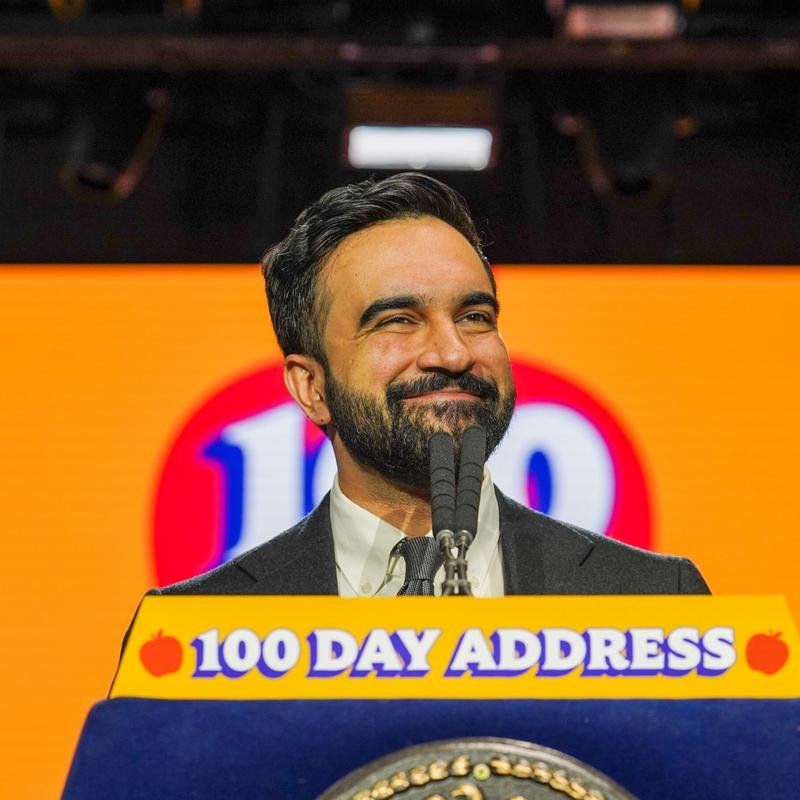
Janae Pierre: -and open city-owned grocery stores in every borough. In his 100th-day address on Sunday, Mayor Mamdani announced that the first of these stores will open next year.
Mayor Zohran Mamdani: We are building a brand-new store on city-owned land currently sitting empty in East Harlem.
[crowd cheers]
Janae Pierre: The mayor emphasized his commitment to democratic socialism and that his governing isn't just about sweeping promises. It's all about the basics, too.
Mayor Zohran Mamdani: This is pothole politics, our 2026 answer to sewer socialism, where government is not too busy, not too self-important, not too mired in paperwork to fix the problems of the city, no matter their size.
Janae Pierre: To keep fixing New York City's problems, big and small, the mayor will first have to navigate a massive $5.4 billion budget deficit. Now that we've hit day 100, I wanted to take a chance to ask questions about how a democratic socialist is actually governing a place like New York City. To answer that, we'll have to look at Mayor Mamdani's early wins and where he's already had to compromise. Dr. Christina Greer is a political scientist and associate professor at Fordham University. She's been tracking every single move of this new administration, and she joins me now. Dr. Greer, welcome to the show.
Dr. Christina Greer: Thanks so much for having me.
Janae Pierre: Absolutely, so let's start with some of the big promises that got candidate Mamdani elected in the first place. Honestly, you can sum it up with what we've seen written on those campaign posters in people's windows or the ones being held up at campaign rallies. I can think of a few. Freeze the rent, fast and free buses, child care for all. Am I missing any, Doc?
Dr. Christina Greer: Maybe homelessness and city rent groceries. Those are two other campaign promises that weren't as prominent as the top three, but definitely circling around.
Janae Pierre: Definitely. Cheaper groceries and also build affordable housing, so let's go through them one by one, shall we?
Dr. Christina Greer: Sure.
Janae Pierre: All right, let's start with a fan favorite or a voter's favorite, freeze the rent. The mayor has appointed six of the nine members of the independent Rent Guidelines Board. The board is scheduled for a preliminary vote on increases in May, with the final vote coming up in June. How important is this board when it comes to this plan?
Dr. Christina Greer: Well, definitely having the mayor appoint his six individuals is helpful, but he's coming up against a few realities. The mayor's budget is quite limited in the amount of discretionary money that he has to play around with. As he opened up the books, he's got a $5.4 billion deficit. Not only is he working with Albany and Washington, DC, he's also coming up against real-world realities of his own city council and Julie Menin in trying to make these progressive policies a reality. Candidate Mamdani and Mayor Mamdani are seeing some real harsh realities in a very short span of time.
Janae Pierre: Yes, for sure. That's Julie Menin, the City Council speaker. Let's move on to fast and free buses. Mamdani told Politico recently that he's absolutely committed to making buses free while acknowledging that it won't happen this year. It seems like this is easier said than done. Who does the mayor need to actually make this plan happen?
Dr. Christina Greer: Again, he needs to work with not just the MTA, but also his city council. The keyword here will be "compromise." We know that we've seen pilot programs, especially during COVID, but there are three tensions that he has going on. One, will the buses actually be faster? Some of the data that's come out is that the buses didn't necessarily improve speeds. Two, whether or not they can be free, and the tensions with the deficit and the financials. Then, three, is he going to be able to expand bus lines?
We're one of the few municipalities that has to go to Albany with our tin can to ask them to help us with transportation issues. As we're trying to do something within New York City, the mayor is actually seeing that it's easier said than done in expanding these bus routes and making them free for affordable New Yorkers. We also know that many of these bus routes aren't in neighborhoods where, whether they're high-voting neighborhoods, they're oftentimes in underserved neighborhoods. They tend to get pushed to the back burner in many of these politics and policy discussions.
Janae Pierre: Right, but we know that this is absolutely possible because this is something that happened during the COVID pandemic, right?
Dr. Christina Greer: Absolutely. As my grandmother said, "If we can put a man on the moon, we can figure this out." We have done it in a much smaller scale. The real question and the tension will be, can we expand it throughout the city, and especially in key neighborhoods that he made part of his campaign promises?
Janae Pierre: Let's move on to another favorite campaign promise for many of Mamdani's supporters. That's free child care. The Mamdani administration announced 2,000 new 2K seats and 1,000 additional 3K slots. This happened early on. This plan was actually announced in January, maybe a week after the inauguration. It was a big collaboration between Mamdani and Governor Hochul. I'm wondering, would you say that this one was easier because he had Governor Hochul's support?
Dr. Christina Greer: Absolutely. Anytime you have not just the support, but also the financial backing of the governor makes your life exponentially easier. We know the expansion of 3K and 2K programs helps keep quite a few New Yorkers in the city. We don't want people leaving because they just can't afford child care. I think, though, the mayor is also up against the clock because Governor Hochul is in the middle of a campaign. She knows that she needs to deliver New York City. Mamdani will be a key piece of that puzzle. It looks great for her right now. Obviously, she's got a non-existent primary, but New York State did have three terms of a Republican governor. It's a much more purple state than people like to imagine.
Janae Pierre: Right.
Dr. Christina Greer: After she crosses the finish line in November, which many assume she will, her willingness to possibly compromise with this mayor will drastically decrease. Obviously, the campaign phase for Governor Hochul, it behooves her to work very closely with Mamdani because he has such widespread support amongst New York City. We've seen that his supporters turn out to vote in droves. Once Governor Hochul has passed reelection, I'm not exactly sure how willing she will be to give the mayor some of the policy positions that he's asked for. He's had some great successes, obviously, with 2k, but we'll see what the financials look like once Kathy Hochul is across her own finish line in November.
Janae Pierre: Yes, it's interesting that you point that out. A little later, we'll talk about the importance of that relationship, but let's move on to some other plans that candidate Mamdani had, and that's build affordable housing and expand rental vouchers program. Former Mayor Eric Adams refused to implement laws from 2023 that were aiming to expand eligibility for vouchers. While on the campaign trail, candidate Mamdani said that if he was elected, he'd drop the legal challenges on day one. Guess what? He didn't, and he cited the city's budget deficit there. Where do things stand right now?
Dr. Christina Greer: Well, with housing, it gets incredibly complicated because, now, we have a conversation with the federal government as well. This is where somehow Mayor Mamdani has wowed and enamored the President, who used to call him his little communist. When he's gone to Washington, DC, to talk about several issues, one of the issues that's come up is housing and building housing on existing land, some of that the federal government has purview over.
It's easier said than done in a campaign phase again to say, "We're going to build, build, build." We're coming up against tensions with landlords. We're coming up against tensions with property owners and buildings and land that's owned by the city versus the federal government. The Sunnyside Yard in Queens and that development plan, we always have NIMBY issues that come in whenever we talk about affordable housing and building, which is "not in my backyard."
Lots of New Yorkers like things in theory, right? We want to build smaller jails in theory. We want to close Rikers in theory, but where will we put these small jails in our communities? Well, that's where you get tensions with other city council members. The same goes with homeless shelters. Of course, we don't want massive warehouses for unhoused people. Again, what city council member is raising their hand to say, "Yes, please give me more."
When we think about mixed-use housing, affordable housing, and that range can go quite large, I think the mayor is on a learning curve to recognize that some of these promises that were made all throughout 2025 are much harder to actually make a reality when he comes up against some real-world micro-tensions with 51 other city council members, even though the vast majority are within his Democratic Party.
Janae Pierre: The mayor's relationships have been the key to his first 100 days. I want to talk about four key ones. We mentioned briefly Governor Hochul, and you just mentioned President Trump. As I mentioned, his relationship with Albany was key to delivering on free child care. Governor Hochul provided state money for that pilot. How would you describe their relationship that it may take a turn after Hochul's election in November? What do you make of it right now?
Dr. Christina Greer: I think right now, it's great. They're both of the Democratic Party. They both need one another for various reasons. Whether it's transactional or a true, genuine friendship, in the words of LBJ, does that really matter? As long as you were delivering for New York City residents and New York State residents, I do think that the mayor's short period of time, but significant nonetheless.
He's not coming out of City Council. He's actually coming out of Albany. There are certain policy maneuverings that he's had to negotiate while he was in Albany for those short four years. That actually helps us when the mayor needs to go and work with the governor and work with the state legislature to deliver for New York City residents. I think the larger tension is working with city council members who range in varying shades of blue within the Democratic Party when he's trying to make some of these policy proposals a reality.
Janae Pierre: Can you do a little name-dropping for me there within the City Council? I know earlier, you mentioned Julie Menin, the City Council speaker.
Dr. Christina Greer: Well, I think that my analysis starts and ends with her right there. We've seen that she's able to really coalesce quite a few of her colleagues. We have progressive Democratic caucuses, we've got more moderate Democrats, and we also have aspirational Democrats. There are so many people that are thinking about not just their districts, which, obviously, is the reason why they're in office. They're also thinking about their lives after City Council. There are not a lot of citywide offices that they can run for. There are not a lot of leadership offices.
People are thinking about how their votes and how their behavior will affect them moving on. Julie Menin has proven already that she's a political force and essentially campaigned on being a foil to the mayor, even though they're of the same party, to not just be a rubber stamp. We might see a lot more tension between the two of them grow. I would argue that the mayor's larger issues might not necessarily be with Kathy Hochul. They might be with Julie Menin and even members of his own DSA party as he moves more to the center to govern, because the vast majority of New Yorkers are not far, far, far left, socialist Democrats.
Janae Pierre: I want to circle back and talk about his relationship with President Donald Trump. He's met with him twice. The first time they met was briefly after the election. I guess I can say that that was the start of a bromance there or something. It was not the greeting that I expected for sure. It seems like Mamdani really has Trump's ear. Would you agree?
Dr. Christina Greer: Well, Donald Trump is from New York City. He's also from Queens, and he has this attachment to the city, even though he hasn't lived here in quite some time, but Donald Trump also likes winners. He's looked at the numbers, and he sees the momentum that Mamdani can garner. He sees how Mamdani can garner media attention, which matters deeply to the President. He knows that he's very popular, and so he wants to be with the popular kid.
I think also, if anyone's ever spent any time with the mayor, he's a listener. He makes you feel heard and appreciated. I think Donald Trump, with his void and his desperate needs for attention, I think Mamdani is able to really tap into some of his Achilles heels in the best of ways and bring it back to New York. Some of the critiques that Republicans have had, I'm thinking of his fun video that he did with Curtis Sliwa. It's like part of the magic that is Mamdani is that he finds these minor points of commonality and then can slowly but surely expand them to larger points.
With Donald Trump, that's what he did. "You may have talked about me during the campaign. You may have called me all types of names, but I'm here. We both love New York. We both want to build in New York. We both want what's best for New Yorkers. We want them to make money. We want rich people to stay. We want all of these things." Even though Mamdani has quite a few other issues that are the antithesis of what Donald Trump believes in, when he has gone to Washington, DC, he stays on message. He's very disciplined to bring it back to New York City and away from personal politics and areas that the two of them just fundamentally will never agree on.
Janae Pierre: Then there's also this relationship that Mayor Mamdani has with NYPD Police Commissioner Jessica Tisch. Before he was even in office, Mamdani announced that he'd be keeping her on from the Adams administration. How important was that decision early on?
Dr. Christina Greer: I think it's an incredibly important decision. Obviously, many of his far-left supporters did not like that choice. For a lot of moderate Democrats, of which there are many in this city, it made them feel at ease that he wasn't going to come in and be a "radical Democrat." Jessica Tisch has not just respect within the NYPD, but obviously also within the business and economic community, which assuaged some of the concerns that that community had.
She had been in the job. Even though there's going to be a lot of turnover, there was a certain level of continuity that a lot of people felt very comfortable with, with seeing Jessica Tisch still at the helm. Don't forget, we had, what, three commissioners before Jessica Tisch? That level of instability with the country's largest paramilitary force made a lot of folks very nervous.
We know with the larger economic downturns that we're seeing because of the federal policies based on Donald Trump, there is a certain level of concern that people have. When economics are tight, crime tends to go up. Having her as a consistent force who will not always agree with the mayor, and he's been very clear about that, but she made a lot of folks in the very beginning feel much more comfortable with the concept of a Mayor Mamdani.
Janae Pierre: Let's stick with the NYPD for a second. We're still seeing the Strategic Response Group in action. That's the specialized unit designed for counterterrorism. They are deployed for riots and protests and major incidents. Mayor Mamdani is signaling openness to the NYPD continuing to use the gang database despite its campaign promise to abolish it. What do you make of these promises not coming to fruition?
Dr. Christina Greer: I think that this is a classic case of a candidate meeting the governance phase and seeing that it's easier said than done. I think that it's going to make a large swath of New Yorkers very uncomfortable with what seems to be a moderate-to-conservative bent when it comes to this particular issue. The mayor, again, is saying, "As the leader of 8.5-plus million people, I have to think about what makes all of them safer." If that's the route that he's going, he also has to recognize that many people are going to see that either, A, as a betrayal or, B, a walk back, whatever it may be, because I think a lot of New Yorkers are going to want a lot more detail as to not just what the policy is, but his rationale behind keeping it.
Janae Pierre: The last relationship I'd like to talk about is probably the most important one, and that's his relationship with the public. Mamdani is a millennial, and we certainly know that he uses social media like one, right? He uses these well-produced, fun-to-watch videos to share information in emergency situations like the snowstorm or the blizzard we had earlier this year, but also to share the administration's wins, like pothole repairs.
Dr. Christina Greer: Right. It's not just videos for videos' sake. They actually all have a policy slant to them. In the campaign, the video that I loved was Make Halal Cart $8 Again. Yes, it's about halal cart that so many of us love and enjoy, but it was really a larger conversation about economics and the tension that we feel whenever we're spending money, and the costs that small business owners have to pass on to their loyal customers because they're just trying to make ends meet. I do think that these videos, albeit fun and some people are just like, "Ugh, what is the point of them?" they're disseminating information. Also, they're actually educating the public about quite a bit. 8,000 potholes in one day, it's low-hanging fruit, but people still want to see their government in action.
Janae Pierre: Right.
Dr. Christina Greer: I think it also is trying to get people involved in their own government and what government can do for you and educate--
Janae Pierre: Meeting people where they are.
Dr. Christina Greer: Meeting people where they are and helping them understand this is the role of government, these minor things that make your life much better, right? A few potholes. Trust and believe. When I've had a car, it's like fixing a tire because of a pothole is actually a much more expensive endeavor.
Janae Pierre: For sure.
Dr. Christina Greer: Having my government do something on the front end so I don't have to deal with the cost of the back end makes a huge difference.
Janae Pierre: At the same time, some demographics feel left out of his messaging, and I'm thinking specifically of Black New Yorkers here. Can you describe the tension between Mamdani and New York City's Black residents?
Dr. Christina Greer: When it comes to Black New Yorkers, I talk about it all the time. Mamdani did not come into the primary with a significant Black base. That's not where he's from. That's not who he represented. He's also a millennial with no deep ties to the Black community. His support now, and based on Afua Atta-Mensah, who was his political director, who's now his commissioner for economic and racial justice, she did a lot of the heavy lifting, introducing him to communities across all five boroughs, and not just churches, but small groups to make sure they understood where the points of commonality are when it comes to a lot of his policy positions.
There's work that has been done, but, obviously, there's a lot more work that needs to be done because part of it is age. Part of it, he's not from. He didn't represent a predominantly Black community. There are particular issues that Black homeowners have that he has to be cognizant of. Obviously, he's making strides with hiring Renita Francois as his deputy mayor. My critique was, do you think you can govern New York City without a Black deputy mayor giving you advice on certain issues that will specifically and disproportionately affect Black New Yorkers?
I think that there's going to be a learning curve for sure, but I'm very excited about the hires that he's made. A mixture of the old guard and the new guard. What we can't have is a bunch of leadership that's from the Dinkins, Koch, Beame, and Lindsay era without passing a baton to people who actually need to learn how city government works, so we can have a future in the next 5, 10, 20-plus years who understand how the levers of power work when it comes to City Hall and beyond.
Janae Pierre: How does Mayor Mamdani's first 100 days compare to past mayors in terms of success and failure?
Dr. Christina Greer: Well, I think the 100 days is such an arbitrary number. It's a good marker just to make sure, I guess, they're still on the job. I see it as when I have to do a mid-semester evaluation. One, I think a lot of New Yorkers are excited because he's trying, right? They're seeing that he's doing these small things to make their lives better. I think there are some missteps, essentially saying, "I'm going to raise taxes on homeowners," which would, again, disproportionately affect Black New Yorkers. That's a misstep.
I think his hiring has been fantastic. Again, mixing some old guard and some fresh ideas, but this is someone who doesn't come from city government. This is someone who hasn't been an executive. He wasn't citywide-elected. He is young, to be very honest. I'm trying to lean towards optimism since the federal government has so many people stressed out, which is we've got someone with boundless energy who's making sure that he's not just the mayor for Manhattan and six neighborhoods in Brooklyn.
I think it behooves us to think about electing non-Manhattan and Brooklyn mayors sometimes, because he's thinking about Queens. He's actually thinking about the Bronx. He's thinking about Staten Island. Even if so many voters in Staten Island didn't vote for him, he still is very clear, "I'm the mayor for all five boroughs." Having said someone who can walk from the tip of Manhattan all the way down or spend his first 100 days walking through the streets of New York, a la John Lindsay, I think, makes a lot of people feel a lot more comfortable knowing that they've got a mayor who sees them, especially since so many people in New York feel unseen on the federal government.
Janae Pierre: For sure. Dr. Greer, I totally agree with you. The first 100 days are often about setting a tone, but the next 100 days are almost always about math. We're heading straight into a massive budget battle with the City Council and a June deadline to plug up that $5.4 billion budget deficit. As we look toward the summer, what's the one specific headline that you're watching for to see if Mamdani can make the numbers actually match the message?
Dr. Christina Greer: Well, it's always, "We want to make sure crime stays down." We know that summer is a hotbed of sometimes really terrible things that can happen in a city. I think trying to get New Yorkers employed, right? Some of these job numbers are not where they could and should be, but making sure youth employment or summer camps, things that he's been working on and he's announcing, he had that video with him and the beach towel, like it's time to start applying for summer jobs and thinking about summer.
It's not too early. Making sure that young people have someplace to go, which obviously takes a strain off of parents. I'll be looking at that. How we close this deficit. Obviously, again, not have tons of discretionary funds. Is it doing what Eric Adams had to do, which is close libraries, which never makes people happy? Is it expanding parks the best you can to make sure New Yorkers feel safe to even use parks? How is he going to use this next 100 days?
It's also campaign season for Kathy Hochul, so this is the time to make sure that they work together and in conjunction to get as much out of Albany as possible, and also the federal government. Donald Trump's polling numbers are in the toilet, so he needs some wins, too. It might actually work in New York's favor for New York to come out on top because the President needs to show that he's doing something. He needs to make some people happy, so we'll see how that shakes out.
Janae Pierre: Yes, we'll be watching closely. That's for sure. That's Dr. Christina Greer, political scientist and associate professor at Fordham University. Thanks so much for joining us.
Dr. Christina Greer: Thank you for having me.
Janae Pierre: Thanks for listening to NYC NOW. A quick heads-up. On April 20th, WNYC will be talking with Mayor Mamdani at The Greene Space. It's already a packed house, but you can sign up for the live stream at wnyc.org/mayor. The event starts at 7:00 PM. Thanks again for joining us. I'm Janae Pierre. See you next time.
[music]
Copyright © 2026 New York Public Radio. All rights reserved. Visit our website terms of use at www.wnyc.org for further information.
New York Public Radio transcripts are created on a rush deadline, often by contractors. This text may not be in its final form and may be updated or revised in the future. Accuracy and availability may vary. The authoritative record of New York Public Radio’s programming is the audio record.