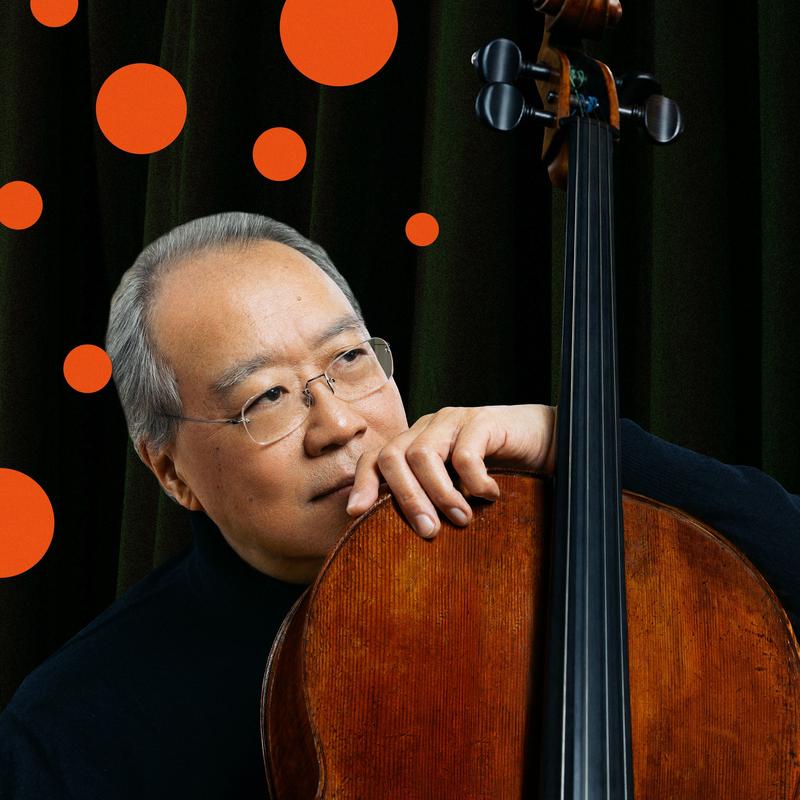
Yo-Yo Ma - 53 years of friendship and duets
Manny Ax: From WQXR and Carnegie Hall, this is Classical Music Happy Hour, hosted by me, pianist Manny Ax. This episode is a little different than our usual format. It was taped in front of a live audience at the Tanglewood Music Center, where I was joined by my longtime friend and musical partner, Yo-Yo Ma. We chat a bit about our lives, play a few bars of music, and answer questions live from our listeners. [applause] We hope you'll enjoy this special episode.
Was that okay?
[applause]
[MUSIC - Mendelssohn: Song Without Words]
[applause]
Just a little music by Mendelssohn to get us going, his Song Without Words.
Yo-Yo Ma: Manny, I don't know how many times we've played this piece. We've actually not played this many.
Manny Ax: Not so much. No.
Yo-Yo Ma: We've known each other for, we just determined backstage, 53 years.
[applause]
We played through this a little bit before, but I feel like I'm having a conversation with you. We didn't look at one another. We didn't have to give signals to one another. There was a pause. We didn't know how long, and then we just started again. We did it by feel.
Manny Ax: Or by luck.
[laughter]
Yo-Yo Ma: Yes. I didn't want to go there.
Manny Ax: No, we did it by feel. You are right. You are right.
Yo-Yo Ma: I'm right, of course. Of course. We count on luck.
Manny Ax: Yes.
Yo-Yo Ma: He often says, before we play a concert, he says, "Now let's leave it in the lap of the God."
Manny Ax: That's right. Yes. Now, so you mentioned 53 years.
Yo-Yo Ma: Yes. Count them.
Manny Ax: We're still happy to see each other, which is great.
Yo-Yo Ma: Which is unbelievable.
Manny Ax: Tell me, what are the questions that you get asked most frequently? Where to next?
Yo-Yo Ma: Yes.
Manny Ax: That's something that people ask all the time, what's the next thing you're doing?
Yo-Yo Ma: Or you've played this piece hundreds of times, how can you make it interesting?
Manny Ax: Yes. That does get asked a lot. Yes.
Yo-Yo Ma: It's as if the piece of music is a product that is-- It's all wrapped up in a particular way. I think that music, when we're playing as if we were talking to one another is a conversation. It's a living thing. If you meet a friend for the 757th time, you don't think your friend is boring, do you?
Manny Ax: Yes. No. No.
Yo-Yo Ma: Maybe sometimes you do.
[laughter]
Manny Ax: Depends. Depends, but I'm sure, like you, I think we probably both react the same way. Let's say you play with an orchestra and you play on Thursday, Friday, Saturday, the same piece at the same hour, each concert, eight o'clock, same conductor, same orchestra, but each performance is actually a different experience.
Yo-Yo Ma: Absolutely.
Manny Ax: For all of us, I think.
Yo-Yo Ma: Yes. That's why often I don't like to play the same piece with the same group four nights in a row unless I know that people are not going to say, "Let's do like last night." Because that to me is death.
Manny Ax: Death is a little strong.
Yo-Yo Ma: Death is just about right for me.
Manny Ax: Yes. Okay. [laughs]
Yo-Yo Ma: No death, it's over. It's not alive.
Manny Ax: Oh, okay.
Yo-Yo Ma: One of the things that, that I love about our playing together is that we play the same program--
Manny Ax: A number of times.
Yo-Yo Ma: Yes. We will say to another, "Okay, how do you want to do it differently tonight? Why should tonight be different from last night?"
Manny Ax: From last night.
Yo-Yo Ma: Just as an experiment. We started this Mendelssohn Song Without Words, a nice, beautiful, rhythmic thing that I follow and we play together. Let's start, and we haven't prepared for this, the beginning of Beethoven's first Sonata.
Manny Ax: Uh-oh.
Yo-Yo Ma: Now. You'll see.
Manny Ax: Give me a minute. [chuckles]
[music]
Not so bad.
Yo-Yo Ma: Okay. Again, we didn't look at one another. There were these long silences. How do we know? It's luck?
Manny Ax: It's luck. Because my question is, how come we never did that when we were playing concerts? [laughs]
Yo-Yo Ma: Ah. That's because we're really relaxed.
Manny Ax: You're probably right.
Yo-Yo Ma: No, seriously, I find that being able to talk to an audience, to talk to you, and then play, that takes us to the closest moment of intimacy of making music as if we were in our living room. There's no pressure that, "Oh, we must be perfect," which I think has become an industrial aesthetic in the maker space of making things. Everything has to be perfect.
That pressure is silly, because what we're trying to do is to say, "Okay, we just took a risk." I just tried that on you, and there was no pressure, but it was just when we're actually open to one another and feeling safe, in spite of the fact this is being recorded, we actually come out with the right answer. Think about that. That's incredible. We're not under pressure to do something perfectly. We're just open. I'm sure some people have questions, or is this something that--
Manny Ax: We actually have some people who have been patiently sitting through all this. Many have left--
Yo-Yo Ma: Do you see the [crosstalk].
Manny Ax: But people online.
Yo-Yo Ma: Oh, online.
Manny Ax: They are actually, I think waiting to ask some questions of us.
Yo-Yo Ma: All right.
Manny Ax: Here's our caller, Harriet McCarter.
Yo-Yo Ma: Hey.
Manny Ax: Hi, Harriet.
Harriet McCarter: Hi there, Manny. Hello Yo-Yo. Thank you so much for taking my call.
Manny Ax: It's, it's a pleasure. I see that you're from North Carolina. Whereabouts?
Harriet McCarter: Oh, no, I'm originally from New York, but I'm living in North Carolina right now in Raleigh.
Manny Ax: Oh, okay. We'll just leave you there to work and hope you come back to New York soon.
[laughter]
Harriet McCarter: I miss it. I really do miss it. I'll start out by saying, with apologies in advance, this is my silly and irreverent question. I love most classical music for its beauty and the way it keeps me centered, except for Bach. Can you help me understand what I'm missing so that even if I can't like Bach, at least I can appreciate him and not be embarrassed by my lack of good musical taste?
[laughter]
Yo-Yo Ma: Wow, that's a great question. We love that question. We love it so much that I'm going to ask Manny, [laughter] can you play the beginning of like the Air on the G String in whatever key that you want.
[music]
Manny Ax: Is that right?
[music]
You are going to have to stop at some point.
[music]
What a wonderful answer that is.
[applause]
Yo-Yo Ma: Harriet, how does that music make you feel?
Harriet McCarter: I would say that's one of the ones in the middle for me. The cello suite number two would probably be right up there. On the other hand, the keyboard concerto number five, not so much. I'm not sure why I am missing what everyone else would get it.
Yo-Yo Ma: I think for me, when you talk about a composer, it's like you're looking at a friend. That friend-- Well, look at Manny.
Manny Ax: Look at all my faults. Yes, that's right.
Yo-Yo Ma: Manny and I have known each other for 53 years, and I love everything about him except--
Manny Ax: I'm afraid we don't have time for the whole list.
Yo-Yo Ma: The thing is, what's funny about during those 53 years, we have gotten to know each other's strengths and weaknesses. In fact, sometimes our weaknesses, our quirks, have become sources of murph.
Manny Ax: Just to connect it up, what you're saying is maybe if you listen to more examples of this particular composer, you'll find that it gets to you somehow.
Yo-Yo Ma: I'll add to this and say that I think that Bach has two characteristics, and maybe this can be helpful. I think one, he thinks like a scientist, he's objective, and two, he is like your favorite uncle who will be totally sympathetic to you, be empathetic to everything that you are. When I'm playing Bach, I'm thinking, all of this is in one person. You're talking to someone who's at once totally objective and totally on your side.
Sometimes when we look at something objectively, we get nervous because we think, "Oh, okay, maybe we're found wanting, or maybe we're inadequate, or maybe whatever." When you put that in oscillation with someone who is totally on your side, nothing can go wrong. You actually get clarity. I think that's what Bach gives to me. It's a friend whom I can rely on to actually give me perspective when I am in need of a little bit of clarity.
Manny Ax: We should also say, we should also say that not liking something doesn't make you a bad person.
Yo-Yo Ma: Manny often tells me he doesn't like many things I do, and after several weeks of therapy, I then--
[laughter]
Manny Ax: A complete and utter lie, but that's okay. I'm used to that too. [laughter] Anyway, all I was saying, Harriet, was that I'll give you an example. Ravel used to say that he didn't understand why excellent musicians played Beethoven. This is terrible music. You never know.
Harriet McCarter: No.
Manny Ax: It's okay.
Yo-Yo Ma: Harriet, does that help that or does that make things more confusing?
Harriet McCarter: No, that's a beautiful way to look at it, and as I continue to listen to more of Bach, I will keep that in mind, and I have a feeling it will probably change things a little bit.
Manny Ax: That's great to hear. Thank you.
Harriet McCarter: Thanks so much.
Manny Ax: Thank you.
Yo-Yo Ma: Thank you.
Manny Ax: Thank you very much for calling in.
Yo-Yo Ma: Take good care.
[music]
Manny Ax: I just know we will convert Harriet to this amazing music sooner or later. You're listening to Classical Music Happy Hour, and I'm Many Ax. Stick around for more fun with my dear friend, Yo-Yo Ma. We'll be back in a moment.
[music]
I am Manny Ax, and this is Classical Music Happy Hour. Let's return to our live episode featuring the one and only Yo-Yo Ma. We're going to go to Ann Ann Kelly in Long Island, who is-- Oh, Ann. Hi. Can you hear me?
Yo-Yo Ma: Hello, is this Ann?
Ann: Yes.
Manny Ax: Hi. Will you just introduce yourself?
Ann: Okay. I'm Ann, I'm from Long Island, from Seacliff. I'm in seventh grade, and the only music I really listen to is classical, much to the surprise of my friends. My question is, why do you think classical music has such a profound emotional and inspirational impact that transcends centuries?
Manny Ax: Yes, I think it's hard to put into words. What I've always thought was-- Of course, I'm someone who grew up listening to music, so I guess I'm attuned to it at some level. I think one of the things about music that is different from basically all other art forms is that there's a story in what you're going through, but it's always your own story. You're not dependent on anybody else's story. It's not like opera. It's not like a book. It's not like a play. It's not even like a painting. It's just a chance to experience your own story. That's why I think it makes an impact to people who somehow let that in.
Yo-Yo Ma: Thank you for your question. I think first of all, hooray for you for finding something that is meaningful. That is the most important part. Being in seventh grade means that if you like something, that means you're going to grow with it. The deeper you go into anything, you will find the world in it. The other thing is, like just about a year ago, we were going to record this piece.
[music]
Manny Ax: We don't have to play it.
[music]
Yo-Yo Ma: This is an extraordinarily beautiful piece of music. Manny comes to me and says the following, "I looked at something, and this is what it said."
Manny Ax: You mean that Beethoven wrote this piece, which is one of the most positive pieces of music that we know. It's all about beauty, hope, positivity, and it was written while he was sitting in a basement in Vienna, and the French were bombarding the city. He was going crazy between losing his hearing and parts of the hearing that made the bombs even louder. Everything around was chaos, and yet this is what he came up with. When he sent the manuscript to his friend, who was a lawyer who looked after his things, he wrote on the manuscript, "amid tears and sorrow."
Ann: Wow.
Manny Ax: He must have been talking about what was going on around him and not the piece of music, because the piece of music is totally positive.
Yo-Yo Ma: From that, we intuit it, because here is something that's so beautiful, but sometimes beauty is squeezed out of something horrible. It's not about classical music, it's about humans. Every piece of music has a history. Everything that anybody does has a history. You look deeply enough into it, you find the deep human element that makes something be invented. Does that make sense?
Ann: Yes. Thank you.
Manny Ax: Great.
Yo-Yo Ma: Good luck.
Manny Ax: Thank you so much for calling.
Ann: Thank you.
[applause]
You're welcome. Thank you for having me.
Manny Ax: Now, audience--
Yo-Yo Ma: Okay, let's go to-- Yes.
Manny Ax: I guess now we are going to get some questions from the audience.
Yo-Yo Ma: Okay. Good.
Manny Ax: Oh, here they are.
Yo-Yo Ma: Okay.
Manny Ax: This is a question from Erin A.
Yo-Yo Ma: Erin-
Manny Ax: Erin-
Yo-Yo Ma: -come on out.
Manny Ax: -come on. Yes.
Yo-Yo Ma: All right.
[applause]
Manny Ax: Yes.
Erin A.: Yes. One thing I think a lot of musicians in the room wonder, and just in general, is how do you deal with performance anxiety, and do you have performance anxiety?
Manny Ax: What are you talking [crosstalk].
[laughter]
Yo-Yo Ma: I don't--
Manny Ax: We're fine.
Yo-Yo Ma: Everything is fine.
Manny Ax: We're fine.
Yo-Yo Ma: No.
Manny Ax: I get very nervous before playing, but I do think that in many ways, Yo-Yo has been a model for me. I think what he seems to do is to get excited for a concert, but not nervous for a concert. It's like that sweet spot where you're, "Yes, I'm excited about doing this, and I'm up, but I'm not freaking out." I think back in 1992, I had one day like that.
Yo-Yo Ma: It was a Tuesday,
Manny Ax: I think a Tuesday, yes.
Yo-Yo Ma: That's right.
Manny Ax: I wasn't playing, so that was fine. I will say that if you do have--
Yo-Yo Ma: Nerves.
Manny Ax: After a certain amount of time, you'll learn to accept that as part of performing. It's something that I accept, and I suppose I'll stop being nervous when I stop doing concerts.
Yo-Yo Ma: Also, I think the other thing is that some people say it's good to realize it's okay to be comfortable with the uncomfortable. Since we're always changing from one thing to another, any process of change gives us discomfort, but yet we desire the change. In fact, you want something, it's going to make you uncomfortable. That, as Manny says, that's okay.
Manny Ax: Well said, old being, that was great.
Yo-Yo Ma: I read that someplace.
Manny Ax: [laughs] We have an interesting piano question from Barbara R.
Yo-Yo Ma: Oh, okay.
Manny Ax: The question is, is it true that the middle pedal of the piano is there to keep the other two apart?
[laughter]
Yo-Yo Ma: Wow.
Manny Ax: The answer is no. It's used to make the pianist who has three legs comfortable. Shall I show people how the middle pedal works?
Yo-Yo Ma: Yes.
Manny Ax: Okay. The middle pedal works in the following way. Let's say you want to change harmonies in a piece on top of a long note. Now Yo-Yo can hold a long note. I can't hold a long note except by doing this [music] and putting down the pedal. If I then want to play, [music] I get a mess. Now if I use the middle pedal to hold this note down. [music] It allows you to have an organ tone. I think it's only been used in very few pieces that I know. I think people are mistrustful of it. One of the reasons is that when you play it, you have to play the note first and then press it down, otherwise it won't work.
Yo-Yo Ma: The middle pedal is like the middle child.
[laughter]
Manny Ax: I think you have suffered long enough.
[laughter]
Just in conclusion, if I may, in conclusion, I would like to say quite seriously, I cannot imagine a more wonderful person to spend time talking to-
Yo-Yo Ma: Than your wife.
Manny Ax: -than my--
Yo-Yo Ma: Yoko.
Manny Ax: Do I get to say anything?
Yo-Yo Ma: Yes. It's your show
Manny Ax: Than my friend Yo-Yo. I'm so grateful to you. Thank you.
[applause]
And of course, I would like to thank this wonderful audience that's been incredibly tolerant.
[applause]
Yo-Yo Ma: [inaudible 00:27:45]
Manny Ax: What?
Yo-Yo Ma: [inaudible 00:27:47]
Manny Ax: Do we? Okay. For those who have time to stay and would like to, we're going to play a piece.
Yo-Yo Ma: This is something that Manny and I did, and thanks to many people here in the room and also at the BSO, Manny and I had the luxury of being on a flatbed truck during the pandemic, and he was playing on a keyboard. Right?
Manny Ax: Right. At Club Nova.
Yo-Yo Ma: Yes. We played this piece of music as a show of gratitude for a lot of the people who were frontline workers and health workers, and people who helped us get through the pandemic.
[music]
[applause]
Thank you.
Manny Ax: Thank you.
[music]
Classical Music Happy Hour is supported in part by the Robert and Mercedes Eichholz Foundation and by Linda Nelson. Our production team includes Lauren Purcell-Joiner, Eileen Delahunty, Laura Boyman, Elizabeth Nonemaker, David Norville, Christine Herskovits, and Ed Yim. Our engineering team includes George Wellington, Irene Trudel, and Chase Culpon. Classical Music Happy Hour is produced by WQXR in partnership with Carnegie Hall.
[music]
Copyright © 2026 New York Public Radio. All rights reserved. Visit our website terms of use at www.wnyc.org for further information.
New York Public Radio transcripts are created on a rush deadline, often by contractors. This text may not be in its final form and may be updated or revised in the future. Accuracy and availability may vary. The authoritative record of New York Public Radio’s programming is the audio record.