Nicholas Britell - more than that one viral theme song!
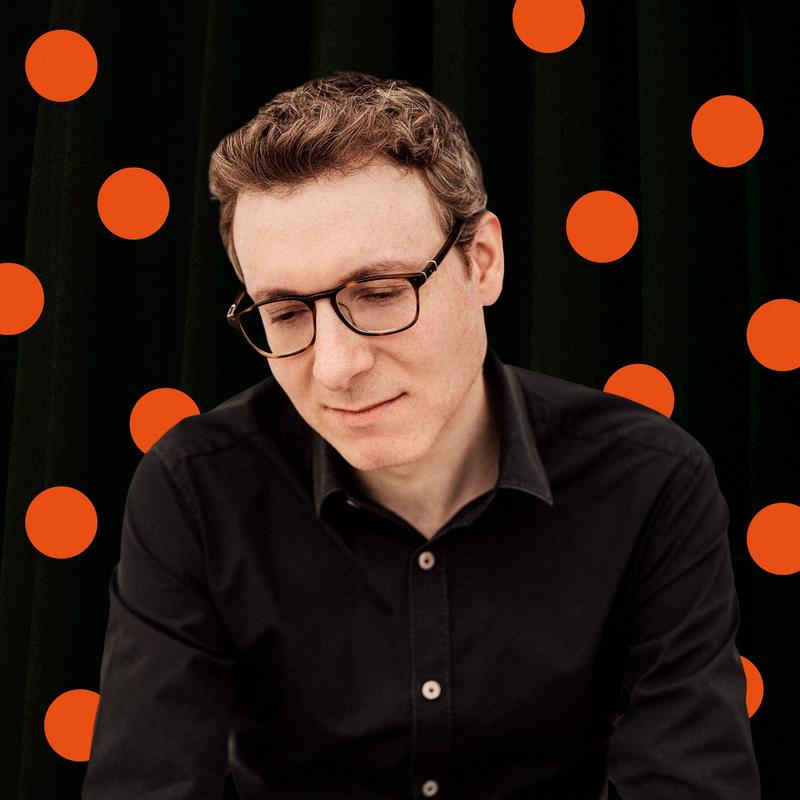
Nicholas Britell: There's a scene that doesn't have music, let's say, and you sit there and you say to yourself, "Okay, maybe I'm okay with it not having music here," but then you say to yourself, "Well, what if there were music here? What would I want to feel from it?"
[music]
Manny Ax: From WQXR and Carnegie Hall, this is Classical Music Happy Hour hosted by me pianist, Manny Ax. Each episode, we'll speak with a special guest about their lives, listen to some of their favorite musical gems, play music-inspired games, and answer questions from you, our listeners.
The New York Times has called today's guest, the composer at the frontier of film music. Nicholas Britell has written scores of scores for Hollywood movies, including The Big Short, Moonlight, and If Beale Street Could Talk. Listeners might best recognize his work from the theme of the HBO series Succession for which he's won the Emmy for the iconic theme song. He's also been nominated three times for an Academy Award and also for Grammys. Nicholas Britell, it is so nice to have you here and it's a thrill for me to learn more about your work and life.
Nicholas Britell: I'm so honored to be here, Manny, and I am such a longtime fan of yours as well, so it's really fantastic to be here talking to you.
Manny Ax: You started just learning the piano?
Nicholas Britell: Yes.
Manny Ax: Right. At Juilliard Prep. You were what? A young man?
Nicholas Britell: I first started playing the piano in New York. We were living on the Upper West side. I was five. We had a little upright-- I remember seeing the movie, Chariots of Fire, and I was so in love with that Vangelis theme. I tried to figure it out, and then I asked for piano lessons. Then I thought for a long time. I considered, "Would I want to be a concert pianist?" I was getting pretty serious with that.
Manny Ax: Chariots of Fire made you go into this?
Nicholas Britell: That was the first thing. Exactly. The irony that it was really movies that-
Manny Ax: How did you translate. You're practicing the piano and you're learning Beethoven, Bach, Brahms, whatever.
Nicholas Britell: Sure. I never really knew that it was even possible to do this for a living. I think when I was in high school, I was very focused on the piano. I started doing other styles of music outside of classical music. I started playing jazz. I was listening to a lot of hip hop. Over the years, I used to be a cocktail pianist, so I used to play in like piano bars and hotel lobbies and things like that.
Then it was actually in college, that friends of ours, we started a hip hop band. I was playing a lot with our band, and then at the same time, a very dear friend of mine who tragically passed away about nine years ago, my friend Nick Lavell, he was an aspiring director. In college, he asked me one day, "Hey, I'm making this feature film. Do you want to score it?" I had no idea how to do that. I was 20 years old. I didn't know any better, and I said, "Sure, let's figure it out."
I had a keyboard that had a sequencer in it. Basically with the sequencer, you could record in and layer instrumentation. Just with that really rudimentary set of technology, he would shoot scenes and cut them and I would go to his little editing area. I would bring my keyboard and we would just try to put music to picture. Had no idea what we were doing, but in a way, I think it was the best experience because just by simply doing it, we learned so much. We started discovering our own tastes, our own instincts.
In hindsight, I really loved so much what I worked on with Nick and I wrote about three and a half hours of orchestral music for that movie, which unfortunately never really came out, but that experience was transformative for me.
[music]
Manny Ax: We're going to take some listener questions, which I hope we can answer. If we can't, we'll just make something up. It's fine.
Nicholas Britell: We'll do our best.
Manny Ax: Here's a question from Michael from Haydenville, Massachusetts.
Michael: Here's my question. If I love John Williams' music and I do, what would be some concert pieces that I might enjoy?
Nicholas Britell: That's a great question. There are so many things. I think John, he's one of the greatest composers of our time and his music represents a synthesis of so much of the orchestral tradition, but also mixed with feeling, I think, of modernity and America in the 20th century.
I think there's so many different things you could probably listen to. Not saying that these are his inspirations, but I think there are definitely pieces that have a scope and a feeling historically that might match with his sound. Elgar.
[music]
Nicholas Britell: Holst.
[music]
Nicholas Britell: I think The Planets is an incredible piece of music.
Manny Ax: Probably a lot of Strauss.
Nicholas Britell: Strauss.
[music]
Manny Ax: Dvořák.
Nicholas Britell: Dvořák. Oh my goodness. Totally.
Manny Ax: You might look at those composers. John also writes concert pieces that are not connected to his movie scores, which are actually quite different, and in a way, very thorny, but I think also very rewarding. I think his concert music is also worth listening to. Thank you for that question.
[music]
Manny Ax: Do you ever see yourself as an opera composer because you compose for drama?
Nicholas Britell: Yes.
Manny Ax: Do you ever think about writing an opera to a libretto?
Nicholas Britell: Interestingly, right now, I'm working on music for a play, a Eugene O'Neill play, Anna Christie. It's not a musical and it's also not opera. but-
Manny Ax: You're getting closer all the time.
Nicholas Britell: Yes, I was going to say perhaps I'm getting a little closer. I'm very fascinated with the idea of live drama, of figuring out how music can function in that world. Film does bring all of these different art forms together from production design to music, to drama, to storytelling, et cetera.
Manny Ax: I was pretty bowled over with the music for Succession. I think it was the first time I was aware that Nicholas Britell was a fabulous artist.
Nicholas Britell: Oh, thank you.
Manny Ax: Generally, I'm actually not separating the music from the visual. This music was incredibly striking on its own, and of course, I was drawn to it because of two things. I thought it was the Pathetique Sonata that I was hearing because it was in C minor, and there were a lot of runs that were like it. You said there's a Schubert influence there.
Nicholas Britell: It's also Mozart. It was funny because when I first was exploring the potential sounds for Succession, I remember playing for Jesse this chord progression. I could play the progression.
Manny Ax: Why don't you play it for us?
Nicholas Britell: Let's see if you can hear this. Am I coming through okay here? Yes, this is good? Okay. The chords themselves, the minor 1 and C minor is.
[music]
Nicholas Britell: We feel this, and then you go to the major 6.
[music]
Nicholas Britell: Then the half diminished with the first inversion is-
[music]
Nicholas Britell: -that. Then what I would do, I would keep a little suspension there.
[music]
Nicholas Britell: Then it resolves like that. This little rhythm.
[music]
Manny Ax: It's quite amazing. The little run on top is kind of the Pathetique music.
Nicholas Britell: Curlicue. Little curlicue.
[music]
Manny Ax: Under that curlicue, those are also the chords in the Beethoven.
Nicholas Britell: Those chords are in-- you feel the same C minor in, actually, the Mozart Fantasy, for example.
[music]
Nicholas Britell: In C minor, you feel this exactly.
Manny Ax: It's probably somewhere in the C minor concerto too.
Nicholas Britell: Yes, absolutely.
Manny Ax: There must be.
Nicholas Britell: They're doing it in the C minor concerto.
Manny Ax: He had no imagination.
Nicholas Britell: Oh my God.
Manny Ax: He kept repeating himself all the time.
Nicholas Britell: What was interesting was, I think, the first ideas I had for Succession were really very much about, what was the music that the Roy family would imagine for themselves if someone said, "Hey, what's your music?" I imagined this very dark, courtly classical sound. I felt like there was a period of time, late 1700s, early 1800s, and one of the beautiful things about that moment in classical music there, there was really this very beautiful grammar in the music where there were certain-- You've recently been playing a lot of Mozart piano concertos, for example.
Manny Ax: There were things that were expected that were expected, and every time that the great composer deviated from what was expected for that audience, it would've been, "Wow, that's different."
Nicholas Britell: Exactly. There were core progressions that seemed to almost mean something with pieces. You feel the way that they would push you.
Manny Ax: I think everyone will feel you want to go to a home key, and how you approach that key depends on the nature of the composer.
Nicholas Britell: Exactly. The inventiveness and the imagination. Sometimes it's almost like a culminating moment in a piece of music. You'd feel it. Right towards the end of a movement, you'd hear this chord progression, that exact chord progression.
Then Beethoven would do the exact same thing in his own way. For example, Schubert would use it too. I was very drawn to that progression because I was thinking to myself, "That progression itself felt like it represented something about that moment in time, but it had a darkness, had a culminating kind of darkness."
Manny Ax: This is so nice because now when you watch the show, you feel like, "Gee, I know all these different composers" [inaudible 00:12:02]
Nicholas Britell: In a sense, there's a love letter to classical music in that sense, where it's-- I was saying to myself, "what is the style of this dark courtly classical?" Then what was fun was each season, as a music theory nerd, I would bring in a new classical chord sometimes. There was a real wonder at, "What are the ways to do that?" and then to bring it into today where I'm incorporating 808s, hip hop beats, electronics, weird strange bells, and out-of-tune pianos, et cetera. There's a whole funny juxtaposition, which to me match the juxtaposition of the absurdity and the seriousness of the show itself. The show itself is so serious, but it's also so ridiculous.
[music]
Manny Ax: We have Eric from Long Island who is now teaching in Germany. He's got a question about film music.
Eric: I recently had a student ask me what music I enjoy listening to. I explained that when I was younger, I actually alternated between tuning into classical great names like Schubert and Haydn and more contemporary film composers like Hans Zimmer.
I grew up listening to the Score at 4, and I figured this would be the perfect opportunity to ask a question that I've long held, which is whether we might be able to situate film scores in the context of classical music and where we draw the line in intellectualizing the works of composers like Hans Zimmer, alongside those whom we might otherwise hold enshrined in the canon of classical artists.
I would be grateful if I could relay any of your thoughts to my students as well. Thank you so much.
Nicholas Britell: It's a good question because I think over the years sometimes, there has been a bit of a division perhaps between music that has to do with storytelling or drama and music that is considered more abstract or pure music that has no overt story if you think about the program music of the 19th century.
[music]
Nicholas Britell: You think about opera music and then you think about a piece of music that's a symphony that doesn't necessarily have a story.
[music]
Nicholas Britell: Those divisions, over time, are changing and getting more blurred, and people are appreciating the music for the music. Today, I think the biggest thing is figuring out the right ways to perform this music live. John Williams's music is amazing music. For example, they're incredible suites from his scores.
Manny Ax: You can perform them without the visual.
Nicholas Britell: Absolutely. Without the picture.
Manny Ax: Of course. In a way the analogy would be ballet score where you have The Rite of Spring.
Nicholas Britell: Totally.
[music]
Manny Ax: Which is the story of the rite of spring, but certainly, is much more well-known and and popular-
Nicholas Britell: That's great point.
Manny Ax: -as a piece of music rather than a ballet.
Nicholas Britell: Exactly. It's incredible to see it, but also just the music itself. Sometimes I think there has been this dichotomy, but ultimately music is music.
Manny Ax: I completely agree. Thank you for the great question.
Manny Ax: This is Classical Music Happy Hour. I'm Manny Ax. We'll return in just a moment.
[music]
Manny Ax: This is Classical Music Happy Hour. I'm Manny Ax. Let's return to our conversation with Nicholas Britell. What is your favorite drink after a long day?
Nicholas Britell: I usually drink red wine.
Manny Ax: Any specific grape?
Nicholas Britell: What am I drawn towards? I like French reds. I like Italian reds like a Barolo or a bit of Bordeaux.
Manny Ax: What is the best book that you've ever read about music?
Nicholas Britell: I would say there's two that have really influenced me. One is the Poetics of music, the Stravinsky lectures. Actually, they're both Norton lectures at Harvard. There's the Poetics of music and also The Unanswered Question that Bernstein did up at Harvard as well.
Manny Ax: These were a series of six lectures I think, that were then combined?
Nicholas Britell: That were combined and put together. I remember I first read the Poetics of music at Harvard, actually. It was in our freshman year. He just had such a fascinating lens on music, on what music is, and how to think about music. Then the Bernstein lectures, I'm not even sure when I first came across those, but they were so influential for me in just the way of thinking about why music affects us.
I'd always been very fascinated with those questions of like, "Why are minor chords sad?" He was very fascinated with that question as well.
Manny Ax: Here's a question from John in Queens.
John: I'm a big opera fan, and I've started to broaden my horizons listening to orchestral and symphonic music, and I thought I'd give Bruckner a try, but I got to tell you, I'm having a hard time with the music. I'm finding it heavy and repetitive. Any tips, anything I should look for?
Nicholas Britell: Interestingly, and I'll pass this over to Manny in a sec, but I was going to say Bruckner is actually an area that I-- I've always wanted to know Bruckner's music better and understand it better, so I am going to throw this one over to Manny and see what your advice is.
Manny Ax: The fact is, I was for many years with you. I've been listening to a lot of Bruckner symphonies for the past 30 years, because a lot of the time I play in the first half of a concert, and then I'll go out and hear the second half, which, very often these days, is a Bruckner symphony. Conductors love to do them. I've begun to realize I've started actually loving them.
[music]
Manny Ax: The Seventh is a good starting point. There's something about the fact that it's okay just to relax and not expect things to happen too quickly.
Nicholas Britell: Beautiful.
Manny Ax: I think maybe that's the thing, because the drama unfolds in a very, very slow way. Without knowing anything about it, I have a feeling it might be like the Japanese Noh drama, where things happen very slowly. I think if you let yourself just lean back and be prepared for that, it is very beautiful in fact. I wish you luck with it and if it doesn't happen, no tragedy. There's a lot of other great music. Thank you for the question.
[music]
Manny Ax: You do, in your music, have a certain amount of connection of motif to character. Is this a Wagner continuation where they say, "Oh, that's the Hunding motive," and they say, "What possible motive could the dog have had?"
Nicholas Britell: Right. It's a really deep question about music and film in some sense. I think with music and storytelling, I find that I don't often write character concepts. I write ideas that are relationships between characters often. It's less that when you see something, you hear it. It's more that when there's a dynamic happening, perhaps you hear it. It could be one character with another character. It could be a storyline element.
I just worked on a film called Jay Kelly, Noah Baumbach directed it. Stars George Clooney and Adam Sandler and Laura Dern. There are different ideas. For example, there is something I was almost calling a shadow motif. When there are certain memory sequences, a main theme, actually, you start hearing it in reverse, for example. It's almost a concept, if that makes sense.
Manny Ax: The one experience I had with that was that there was a wonderful movie called Once Upon A Time in America with music done by Ennio Morricone,
Nicholas Britell: Legendary score.
Manny Ax: Whenever Elizabeth McGovern appears on the screen, there's this particular beautiful, musical theme.
Nicholas Britell: Amazing theme.
Manny Ax: I connect that music to that picture.
Nicholas Britell: 100%. That's one of the most fascinating parts about film scoring to me, is that it's less about me being me on a particular film, and it's more about me responding to the material. Some films, the grammar of the film itself just feels like it needs a certain conversation with music that is different than other movies. For example, every movie has its own kind of DNA is what I would say. Part of the job isn't just writing music, it's actually figuring out how my music exists with this set of story and ideas.
Manny Ax: Now that you're saying that, you actually have your computer here.
Nicholas Britell: Yes, I do.
Manny Ax: I am able to see, although the listeners will not see, but I'll try and describe what is going on. You're going to show me some of-- I think it's Moonlight that you did music for. You're going to show me something without music., and then you're going to show me music that you did for it.
Nicholas Britell: Yes, exactly. I'll set this up a little bit for us here. This is actually a sequence from Barry Jenkins' film Moonlight. What I thought would be interesting is to look at the scene, and this can give you a sense of what I first see when I'm given the film. Basically when a composer is first presented with a film that they need to work on, there are a lot of early conversations that happen with the director to talk about what is their vision for the film, for example.
Oftentimes, directors have pretty good instincts, or at least a sense of, what kind of music might they want? It's a conversation and it's an exploration, and there's a lot of experimentation where you look at scenes and you say, "What if we did this?" Here's an example. This is a scene where the little boy named Little, he is being taught how to swim by a father figure, Juan, in the film. This is a sequence that I'm going to show you here.
Manny Ax: Okay.
Nicholas Britell: Here we go. We're watching little boy looking out at the sea, and then sound drops away, which is interesting. You can imagine there's almost an impressionistic feeling here where-
Manny Ax: He's in the water?
Nicholas Britell: He's in the water. Watch him go in the water. He's feeling around.
Juan [MOONLIGHT]: Give me your hand.
Nicholas Britell: Then Juan played by Mahershala Ali.
Juan [MOONLIGHT]: Let your head rest in my hand. Relax. I got you. I promise you, I'm not going to let you go. Hey man, I got you. There you go. Come on. 10 seconds. Do that right there. You in the middle of the world, man. That's good. Do it like this. I got chicken more athletic. There you go.
Nicholas Britell: It's a full swimming lesson you see.
Manny Ax: They're actually swimming together.
Nicholas Britell: They're swimming.
Manny Ax: He's learning how to move his arms.
Nicholas Britell: We're seeing this.
Juan [MOONLIGHT]: Go.
Nicholas Britell: Look at that. He's gotten the motion.
Manny Ax: He's doing it himself.
Nicholas Britell: Exactly. Now he's doing it himself. Exactly.
Juan [MOONLIGHT]: Yes.
Nicholas Britell: That's a sequence where, imagine you are a film composer here, and this sequence comes in the film. You look at it and you say to yourself, "What do I do?" When you see a scene like that, what sort of emotion do you take from that where you say, "This is a feeling I have, and perhaps I want to do something with that feeling"?
Manny Ax: This is why I don't compose.
Nicholas Britell: Those are the questions that I-
Manny Ax: Okay. What was your reaction? Do you remember what your reaction was?
Nicholas Britell: The reason I brought this as an example is because my initial idea was actually not at all what the director was looking for. When we were talking about different theme ideas, at this point, when I was starting to score this sequence, I already had a theme that was little in the world, in this chapter 1 of the movie. Actually, I can play what that theme is here if we want to hear that theme. Here, I'm pulling it up right now.
[music]
Manny Ax: That's not what you put in that scene?
Nicholas Britell: No. My idea was to imagine, "What if I took that theme--" This is a beautiful moment in little's childhood. He's learning to swim. He's got Juan here as a guide showing him how this works. Over the course of the film, we learn a lot about all the challenges and trials and tribulations in his life. I felt perhaps we feel this as a beautiful memory.
I remember doing a demo of it where I-- that was in D Major, I wrote a piece where I put it in F Major. Instead of a violin playing that melody, it was a clarinet. Instead of a piano, it was strings holding the chords. I thought this felt really, really nice.
I remember showing that to Barry Jenkins, and he immediately said, "This is not at all what I'm thinking for this." That was something that I pretty much threw away.
Manny Ax: Cutting room floor,
Nicholas Britell: That was cutting room floor. That was not the piece. That was the concept. What's interesting certainly with film music, but I think with any creative collaboration is that sometimes it's when things go in maybe the "wrong direction" or the direction you don't expect, sometimes you actually find things that are much more interesting and take you in a much more both unexpected and beautiful place.
Manny Ax: Play us what winds up in the movie.
Nicholas Britell: Okay. I'm pulling this up now. What Barry said to me, he didn't want this as something that felt the way that I was showing you before. He wanted something that felt much more like this is the first day of the rest of Little's life. This is actually more of a spiritual baptism in the water.
Manny Ax: I see.
Nicholas Britell: It's a much more deep and resonant moment. I wrote this piece of music that you can hear. We got to start back where we were here. This is the same start as before.
Manny Ax: He's walking toward-- He's in the water now.
[music]
Juan [MOONLIGHT]: Give me your hand. Let your head rest in my hand. Relax. I got you, I promise. I'm not going to let you go. Hey man, I got you. There you go. 10 seconds. Do that right there. You in the middle of the world, man. That's good. Do it like this.
Manny Ax: Now they're together, doing motion together.
Juan [MOONLIGHT]: More athletic. There you go. I think you're ready. We got a swimmer. You want to try? Ready to swim? Go.
Manny Ax: Now he's on his own.
Juan [MOONLIGHT]: Yes, man.
Manny Ax: I see
Nicholas Britell: A totally different feeling.
Manny Ax: What's wonderful about that is that you actually combined because you got the anticipatory stuff at the beginning and then as he goes on his own, the long chords come in.
Nicholas Britell: It comes in. What's interesting, there's still an orchestral accompaniment, totally. There's still a sense of scope and it is bigger. One of the interesting things is, and this is something that I'm sure we both think about often, the specific emotions that these harmonies generate. That to me, is a much more inward, thoughtful, profound kind of a sense of emotion.
Manny Ax: This is fascinating because it's a very small picture of the kind of thing you do.
Nicholas Britell: It's a microcosm. Exactly. What's interesting is there's this sense of the blank canvas for us is actually a picture which is this set of stories and characters. What's amazing is that the music you choose completely changes the emotional course engagement that you have. It's both your own take on what that is, and then it's a combination with the director saying, "I really want it to feel like this."
Manny Ax: That's the thing. You also have a lot of self examination because you're watching the screen and you think, "What do I feel about this?"
Nicholas Britell: "What do I feel?" It's both, "What do I feel?" and then "What do I want to feel?" One of the interesting things that I find sometimes is when you're working on a project, it's a really complex set of questions where there's a scene that doesn't have music, let's say, and you sit there and you say to yourself, "Maybe I'm okay with it not having music here."
Then you say to yourself, "What if there were music here? What would I want to feel from it?" Every single scene in a movie is this kind of conversation with a director where you're saying, "We could feel this. Do we want to feel that?" Then the amazing thing with movies is that you can look at one scene on its own and it can feel fantastic to you. You can think, "Here it is. This is really the way to do it." Then you watch the movie from the beginning and it comes to that scene, you're like, "This is horrible. This is totally wrong," because it's actually the long form of it that matters. Your experience in the context completely changes when you've started from the beginning,
Manny Ax: Now I have a favor to ask you.
Nicholas Britell: Okay.
Manny Ax: On my phone I have a three-minute video of my granddaughter learning to ride a bike. Her mother goes crazy.
Nicholas Britell: Do you want to hear that…
Manny Ax: I would like you to orchestrate that particular--
Nicholas Britell: It's all doable.
[music]
Manny Ax: Nicholas Britell, thank you so very much for your time today. Thanks for being here.
Nicholas Britell: I'm so honored to be here. Thank you again for having me here.
[music]
Manny Ax: I'm Manny Ax and this is Classical Music Happy Hour. Classical Music Happy Hour is supported in part by the Robert and Mercedes Eichholz Foundation and by Linda Nelson. Our production team includes Lauren Purcell-Joiner, Eileen Delahunty, Laura Boyman, Elizabeth Nonemaker, David Norville, Christine Herskovits, and Ed Yim. Our engineering team includes George Wellington, Irene Trudel, and Chase Culpon. Classical Music Happy Hour is produced by WQXR in partnership with Carnegie Hall.
Copyright © 2026 New York Public Radio. All rights reserved. Visit our website terms of use at www.wnyc.org for further information.
New York Public Radio transcripts are created on a rush deadline, often by contractors. This text may not be in its final form and may be updated or revised in the future. Accuracy and availability may vary. The authoritative record of New York Public Radio’s programming is the audio record.