John McWhorter - Lover of Language
John McWhorter: That part to me sounds either like going to hell, or it just sounds like really, really good pot roast.
Manny Ax: From WQXR at Carnegie Hall, this is Classical Music Happy Hour hosted by me, pianist Manny Ax. Each episode, we'll speak with a special guest about their lives, listen to some of their favorite musical gems, play music-inspired games, and answer questions from you, our listeners.
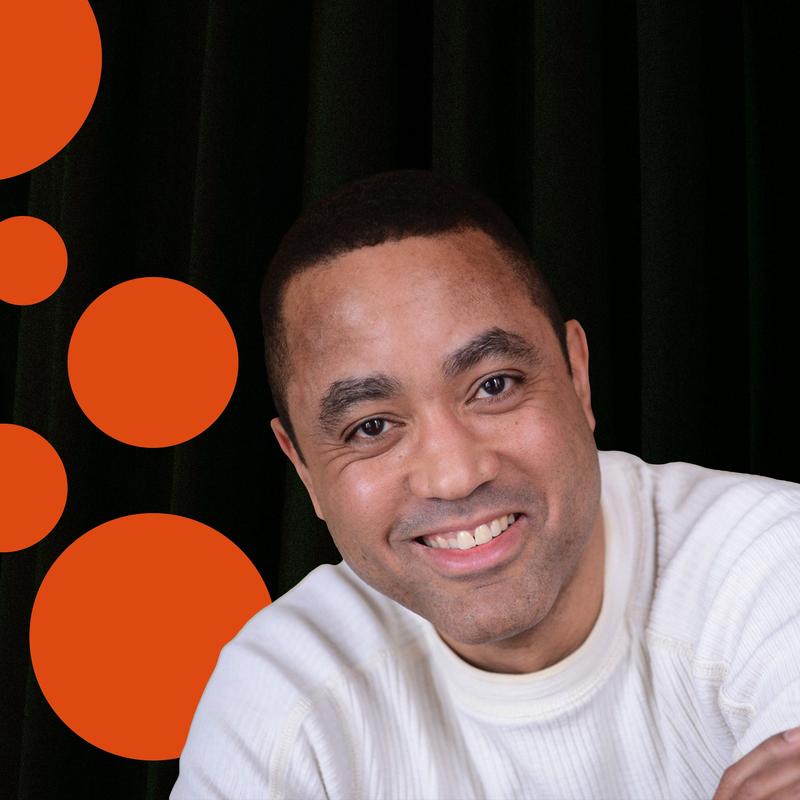
My guest today is a professor of linguistics at Columbia University, but you might know him better for his writings on language, race, and music in publications like The New York Times, The Wall Street Journal, and The Atlantic. Host of the language podcast, Lexicon Valley, he is also the inexhaustible author of over 20 books, John McWhorter, great privilege to have you here.
John McWhorter: It's a privilege to be here, Emanuel.
Manny Ax: How did you get involved with music in the first place?
John McWhorter: I come from a very musical family on both sides. My mother sang with the Fisk Jubilee Singers when she was in college. My father just, he had a gift. Well, we had a piano from when I was very young, and he could mess around on it. He could do Boogie-woogie and some pop things.
For reasons he never completely explained, around the house, I will never know why there was a cello, just because. I'd ask why as I got a little older, and I wouldn't get a real answer. There were several harmonicas in different keys. There were recorders. There was a little xylophone. There were little wooden flutes. It was just around. That was part of it. Then my father would play music in the house a lot, and there was a lot of jazz. There was a good amount of classical and maybe a good lee amount of funk and soul. It was a rich musical diet that I think me and my sister, both of us originally grew up in, and so we took it into our ears.
Manny Ax: You play the piano
John McWhorter: More or less, yes.
Manny Ax: Do you play everything from soup to nuts, or do you practice any particular stuff?
John McWhorter: I am self-taught and I'm obsessive, and so I got to the point when I was a lad of being able to do Beethoven's Sonata Pathetique. That's as far as I got.
Manny Ax: That's difficult
John McWhorter: It is, except I didn't know, because I didn't listen to it until long, long after I started playing it. I didn't know how fast it was supposed to be, so I had it relatively slowly. That means that you're practicing up for being able to do it quickly, and it's not a virtuoso piece. That one, it's just hard. That's as far as I got. I did one Chopin waltz, not very well. I'm a pretty decent cabaret pianist. I play piano in that way, but I was never taught anything. My runs are terrible and my scales are non-existent, but I do my best.
Manny Ax: Join the club.
[laughter]
We all suffer from the same problems.
John McWhorter: The runs are the worst. That's why I don't do classical anymore, because you have to be able to do that.
Manny Ax: I know that you love Broadway musicals. I'm just wondering why that particular area attracts you maybe a little more than others.
John McWhorter: Actually, it might surprise many people to know that I did not grow up with theater music. That was not what my parents played in the house. I didn't see my first Broadway show until sometime when I was in college. I made friends with somebody who was a Sondheim head, and he dragged me to see a community production of a little night music, and I was just blown away.
Of course, that musical vocabulary was one that I was ready for because of all the classical and all of the jazz, et cetera. I thought it was really beautiful. Then also the lyrical brilliance. I wasn't raised with a whole lot of written poetry, but this just blew me away. Then I'm obsessive. After I had learned all of Sondheim, I realized he was taking a page from previous composers. I thought, "Well, who are they? What is Kiss me, Kate? How does something called On the Town sound?"
I just listened to all this and started collecting and making cassette copies, and then it just becomes, I'm collecting musicals. Pretty soon, I had taught myself the subject, and I realized that there's a lot of rich music. You're not supposed to say this, I like musical theater because I like the scores. The books are okay and it depends, but what I'm really interested in is what's going on down there in the pit and what the album is going to sound like.
Manny Ax: Do you feel that musical theater is American opera?
John McWhorter: Yes. I think it is the equivalent in terms of artistic depth and sophistication to opera. The excellent musicals are "as good as" the excellent operas. I truly believe that.
Manny Ax: Bohème by Puccini.
John McWhorter: Yes, and that.
Manny Ax: Rent by--
John McWhorter: Frankly, no. What a snob that makes me sound. If it's, say, Most Happy Fella by Loesser or Bohème, and I'm not being facetious, both Show Boat, Jerome Kern, or Kiss me, Kate by Cole Porter. Even though he didn't arrange it, he didn't orchestrate it, but the people who did it made those songs into God. I would put those things on all the same level. Musical theater is more collaborative, but the result is something that deserves very careful preservation and complete curtain to finale recordings. Kiss me, Kate is a very rich work if you just listen to the score for two and a half hours.
[MUSIC - The Richard Hayman Orchestra: Strike Up the Band: The Man I Love]
Manny Ax: John, I'm hoping you can help me answer some questions about classical music from our WQXR listeners. We've invited them to submit their queries, and we're going to do our best to answer them, and if we can't, we'll make something up.
John McWhorter: [chuckles] That works for me.
Manny Ax: Here's a question I really wanted to ask. A listener writes, "Why do we call classical music classical?" Oh, you've stumped him. This is is great
John McWhorter: Emanuel, I don't know the etymological reason for that, as in there is the classical period, but then we're also going to call Hindemith classical music.
Manny Ax: The Classical period being Mozart, Haydn, Beethoven chiefly, but I'm talking about classical music as opposed to other music.
John McWhorter: The next thing is, when did people start calling Mozart classical music, and I don't know. Classical, of course, is a synonym for us for what used to be called highbrow, or oddly enough, long hair music, as in a kind of music that probably takes some practice to listen to and that many people only pretend to like. When Beethoven started being called classical music instead of just music, I genuinely don't know. I'd like to look that up myself.
Manny Ax: Do you feel that when we say classical music, that there's a kind of automatic and an unfortunate segregation for people that may be open to listening to Beethoven, Schoenberg, Shostakovich, Chopin?
John McWhorter: I honestly think, and I don't think there's anything wrong with this, that the music that we call classical is a kind that one probably needs a little bit of instruction to be able to-- I'm not going to use the word appreciate, but to enjoy. Music that is based primarily on easy melody, basic harmonies, and often a lot of rhythm and kind of raw, authentic, vocal emotion.
That's easy. That's what all human beings can love and should. Then there's this thing where you've got the layered instrumentation, you've got the extended format, you can't dance to it. That is something where, just like with "high art", you need a little help. For me, that can be Palestrina, but then that is also Hindemith. That is Boulez, and that's a lot of music being written. Now, my sense of it is the challenge that is worth tackling. That's classical music.
Manny Ax: I would say it may be slightly differently in that I feel it's a little bit like football. I'm a big football fan, and I think you can watch a football game and enjoy aspects of it, but the more you know, the more you appreciate and the more you enjoy. I think you can start from nothing and enjoy it anyway. I don't feel that you need a priori information before you take it in, but that's just my feeling. I think especially pieces with energy, like let's say parts of The Rite of Spring of Stravinsky.
John McWhorter: It's a good example.
Manny Ax: I think anybody would go crazy for that. Of course, as you get to know the thing more, you will like it more and you'll get more layers of it.
John McWhorter: Sure. That's a good analogy. I would say that very few people would listen to the opening of a symphony and be put off. It's stirring. The question for me is, how will I keep them from being bored? Are you going to like it in eight minutes? Then you need to know a little more.
Football is a good example, because to me, because I'm not a sports person at all, football is opaque. I've never quite understood what the downs were, where they running, why? I could be instructed, and I'm sure I could be as excited watching a game as everybody else, but just nobody ever tells me.
Manny Ax: Well, we'll take care of that.
[laughter]
John McWhorter: Teach me what a down is.
Manny Ax: By the time the next Super Bowl comes around, you'll be an expert.
[MUSIC - Johannes Brahms: Intermezzo in A Major, Op. 118]
There's a piece that you really, really like that you think needs to be listened to more, which is the Brahms Clarinet Quintet.
John McWhorter: Yes much.
[MUSIC - Johannes Brahms: Clarinet Quintet]
I associate it with something which is completely random. I played cello a lot when I was a kid. My mother kind of made me play cello. If I may, I was very good at it. I never really liked it because I didn't like the physical feeling. I didn't like the finger calluses. I didn't like how much time you had to spend up on the A string, because that wasn't as pretty as the lower strings. I let it go as soon as I could and kind of kept teaching myself piano. I played this piece in college, and it's hard. It was very gloomy. This piece is the quintessence of autumn, and this was in the autumn. The fun part about it is that it starts out in-- what is it? D Major, the the little prelude part.
[MUSIC - Johannes Brahms: Clarinet Quintet]
Then it goes into the B Minor. I always liked that because when they do the repeat, they go right back to the B Minor and you realize, "Oh, that strengthening the beginning was just a prelude. I love that."
[MUSIC - Johannes Brahms: Clarinet Quintet]
Then just listening to the viola and the cello working together near the beginning.
[MUSIC - Johannes Brahms: Clarinet Quintet]
Then before they get to the transition, so there's the A and there's the B and there's the transition. Before they get to the transition, it goes down into these luscious minor key coffee ground depths.
[MUSIC - Johannes Brahms: Clarinet Quintet]
That part to me sounds either like going to hell, or it just sounds like really, really good pot roast, and then you come out into the B section and they're in a canoe on the water.
[MUSIC - Johannes Brahms: Clarinet Quintet]
It's autumn on the water. It's cold with the way the harmonies go. The whole thing is like that. It leaves me breathless.
[MUSIC - Johannes Brahms: Clarinet Quintet]
Manny Ax: People do say that music is an international language. Do you feel that's true, first of all?
John McWhorter: No. I feel that all humans can be made to appreciate a wide variety of musics. I would think music is a universal language, but when I teach students, and actually just when I experience other people, including people who are very artistically sensitive, depending on your experience and how you're wired.
This is something I get from actually the composer, Alec Wilder, something that he says in his book, American Popular Song up to 1950. He says that those of us who happen to savor harmony would be surprised at how many thoroughly brilliant people don't hear it. He's right. It's a weird genetic thing, and also probably you have to be steeped in it.
What you and I probably think of is, "Oh, listen to that chord." That's about as meaningful to a great many people as for me the brush strokes in some painting are where I can listen to it being talked about, but frankly, it does not make me cry the way it makes them cry. Then you may have experienced this, major and minor. More to the point, especially these days, because so much hip hop is in minor and yet is very up music. The idea that major is happy and minor is sad. I would say for somebody under 35 these days, increasingly less, is that obvious, which means that this is not a universal language, it's just what we're taught.
Manny Ax: Maybe we get accustomed to it if we're put in that environment.
John McWhorter: I hope. I want it to be that way.
Manny Ax: I'm Manny Ax, and this is Classical Music Happy Hour. We'll return in just a moment.
This is Classical Music Happy Hour. I'm Manny Ax. Before the break, we were speaking with linguist and Columbia University Professor John McWhorter. Let's go back to that conversation. What's your favorite swear word, or what's the euphemism you would use for it?
John McWhorter: Well, the four letter word that begins with F is a lot of fun. It's just amazingly versatile. It's got an interesting history, so I would say that one.
Manny Ax: Firetruck was fine
John McWhorter: Exactly. I say it all the time.
Manny Ax: What is your least favorite swear word?
John McWhorter: I like them all. I mean, part of the reason that I wrote the book about them is because I enjoy profanity and I find it interesting. I don't like the euphemisms. For example, frigging, I always kind of feel like, "Oh, come on, it's after 1965. Just say it." That sort of thing.
Manny Ax: What for you was the most difficult language to learn?
John McWhorter: Russian is impossible. I don't believe that any human being genuinely speaks Russian or Polish, not to get too personal, because the Slavic languages are really some of the hundred most difficult in the world.
Manny Ax: Well, that's what I was born with.
John McWhorter: You're so lucky.
Manny Ax: Well, only if you need to use Polish, I guess. You have Beethoven's Sonata No. 18. Which is number 18? I don't even know.
[MUSIC - Beethoven: Sonata No. 18]
Manny Ax: Oh, 31, number 3.
John McWhorter: I think. How do you do that?
Manny Ax: That's how I know them.
John McWhorter: Wow.
[MUSIC - Beethoven: Sonata No. 18]
John McWhorter: I know them with my own little names.
Manny Ax: I don't know them by the number. I just know them by the opus and thing.
John McWhorter: That was good. Wow. That was amazing. I don't think anybody cares about this one. There are deeper Beethoven sonatas, and I get them completely. This one has always had a special place in my heart, especially the first movement.
Manny Ax: I think it's called very often, The Hunt, and I think probably because the last movement has these little horn calls.
[MUSIC - Beethoven: Sonata No. 18]
It's an E flat, which would be Natural horn.
John McWhorter: That's why it's called that.
Manny Ax: Is it the first movement that you love so much?
John McWhorter: I love it deeply the first time I heard it.
Manny Ax: What attracts you? What in particular? Do you have specific ideas on why you love it?
John McWhorter: The opening statement is not what you would expect the opening statement of a sonata to be. It sounds like a little conversation.
[MUSIC - Beethoven: Sonata No. 18]
It's like someone asking someone a gentle question, or come to me, and I find that so sweet. Nothing bombastic. It doesn't start out sounding like a whole bunch of birds flying through the sky. It's these two people probably in a glade, and then there's nice touches. There's bum, bu-bum, and then bum, bum, bum, bum. I don't mean to stereotype, but it sounds like a woman saying something like, "Henry dear," and then he says something like, "What do you want?"
Manny Ax: It's actually great.
John McWhorter: It's very pretty, and then it gets deeper.
[MUSIC - Beethoven: Sonata No. 18]
It's soprano, alto, and then bum, bum, bum, bum. I love pedal point. When you've got that bum, bum, bum, bum, bum, bum, bum. That, to me, always sounds timeless. It's like somebody reflecting on their life. It's unchanging on the bottom and changing on the top. Whenever there's a pedal point, I'm transported. In this, he has a descending cord where it's bum, bum, bum, and that's in E-flat, and then you have a chord that has a D in it for a second. There's this beautiful kind of slight dissonance there. All of that is just on that first page. The first time I encountered it, I thought, “This is my sonata." It's a little piece of drama, and it just never quits.
[MUSIC - Beethoven: Sonata No. 18]
Manny Ax: I love that description. My feeling about it is much more prosaic, [laughs] and that is that he starts out and he's in the wrong key and he doesn't know where he's going. He's looking.
John McWhorter: He's looking for it.
Manny Ax: Then how is he going to start a real piece? He goes a little bit higher. Then he finds the actual harmony. He crawls up there. Then after all this stops, "Okay, I'm finally there. Let's get going. Now, I'm home." That's just another--
John McWhorter: I get that.
Manny Ax: Much more prosaic than your feeling about it. [chuckles]
John McWhorter: Yours actually teaches me something about mine, because I never thought about it because I'm not inclined to play it.
Manny Ax: One of the nice things is here we are making up totally different stories to the same music, which is nice because-
John McWhorter: I like it.
Manny Ax: -if we had words, like if it said chicken salad, that's what you'd think.
John McWhorter: You would be hemmed in, but I can listen to that first movement, all of it, but that first movement to me is just joy.
[MUSIC - Beethoven: Sonata No. 18]
Manny Ax: Is there such a thing as music that shocks and insults like taboo words?
John McWhorter: I think people were genuinely put off by dissonance, and that's not only, say, listening to Schoenberg, but I know that people were put off by the more challenging chords in, say, Beethoven. It sounded like noise. You're waiting for the chocolate box, Mozart. I would say there's that. We're more used to dissonance now, and I think a lot of people prefer it. Allen Shawn, Wallace Shawn's brother has this wonderful book about Schoenberg, where he's teaching you how to appreciate it. I learned to get Schoenberg by reading this book.
Manny Ax: It's interesting that the first name you brought up was Schoenberg, because I happen to be a great Schoenberg fan-
John McWhorter: I get it.
Manny Ax: -and have played a lot of the music, but he's still kind of a figurehead for that kind of unpleasantness.
John McWhorter: That acidity. Bartók, too. You learn to listen in a different way.
Manny Ax: Very rarely do you mention Bartók, or nobody mentions Boulez.
John McWhorter: Frankly they should in this vein. That's right.
Manny Ax: Schoenberg is a real leader in this.
John McWhorter: Partly I think because of his personality. Although apparently, he was very nice in real life, but how pushy he was.
Manny Ax: Was certainly a wonderful tennis player.
John McWhorter: That's what I hear. He played tennis with Gershwin.
Manny Ax: Exactly.
John McWhorter: Apparently, he was a warm father, but the music is quite a challenge. It's a worthy challenge.
Manny Ax: We have another question from one of our listeners. A listener writes in and asks, "When I see the title of a classical piece, there are sometimes random letters and numbers. For example, Mozart's Symphony No. 40 in G Minor, K.550, Bach's Cello Suite No. 1 in G major, BWV 1007. What do those letters and numbers mean?
John McWhorter: [chuckles] Well, there are these bibliographical traditions that settle in randomly, and you're supposed to understand what they mean, and maybe for that reason, so many of the pieces that are better known have more evocative titles because nobody is going to walk around thinking about that sort of thing.
Manny Ax: Just to be absolutely straightforward, those are boxed Social Security numbers.
John McWhorter: Oh, of course. I should have mentioned that.
Manny Ax: For example, K.550 refers to a gentleman named Köchel. That was his name.
John McWhorter: Oh, the Köchel number. Right.
Manny Ax: He cataloged all of Mozart's music. He delved into every possible source and found all the pieces and numbered them-
John McWhorter: In his way.
Manny Ax: -in his way, but approximately according to when Mozart wrote them, more or less. If you look at K.550, that's really near the end of Mozart's life. He wrote over 550 pieces. A lot of pieces.
John McWhorter: Is the Beethoven system chronological? I often find it a little bit confusing.
Manny Ax: Pretty much chronological.
John McWhorter: Pretty much?
Manny Ax: Pretty much, yes. It's hard to tell sometimes because Beethoven worked pretty long on certain things. He would start, like the third symphony started quite a while before it was played. Same with the fifth symphony. You don't know exactly.
John McWhorter: This is why it's sometimes a little off.
Manny Ax: The Bach BWV, I actually can say that, is the Bach-Werke-Verzeichnis, which is the Bach catalog of works, and 1007, so the guy worked like a dog.
John McWhorter: There's a lot.
Manny Ax: There's a lot. When he was engaged in Leipzig for the St. Thomas Church, I think he basically wrote a cantata every Sunday.
John McWhorter: What Cantatas?
Manny Ax: There's 360 of them or something. It's unbelievable. That's what the numbers are for. Most composers that we know have someone who cataloged them and it's named after them or what they call opus numbers. If you have the composer himself, Beethoven, very much so would write down, "This is my work number 27. There are two sonatas in it, number one and number two. I'm dedicating them to Prince so and so." That's what the catalogs are.
John McWhorter: Opus means work.
Manny Ax: Opus means work. Number means number. One means one. [laughs]
John McWhorter: Tose labels are part of what makes the music seem a little forbidding to many people, I think.
Manny Ax: Yeah. It absolutely shouldn't. It's like a--
John McWhorter: Dewy decimals.
Manny Ax: It's nothing more than that.
John McWhorter: It doesn't mean that it's not good music.
Manny Ax: Yes, or bad, either way.
[MUSIC - Lucas Kai Melody: Harmonie Brune]
With us today is WQXR's morning host, Jeff Spurgeon. He's going to tell us about the game we'll play right now.
Jeff Spurgeon: Everyone's had a bad review at one point or another, including famous composers. We're going to read a bad review of a piece by a famous composer, and we'll see if we can identify who wrote it. Here's the first review. I've been to the theater a few times and heard Wagner's Walküre, from which I carried away memories of two or three glorious minutes and a whole ocean of boredom and utter emptiness. Is it Richard Strauss, Pyotr Ilyich Tchaikovsky, or Edward I. Koch?
John McWhorter: I can't imagine either Strauss or Tchaikovsky saying that in that way. That sounds like something Ed Koch would've said.
Manny Ax: Oh, I think it's Tchaikovsky.
John McWhorter: Really?
Manny Ax: That's my opinion. I don't know what the answer is.
John McWhorter: Actually, phrasing it as a whole ocean of boredom and utter empty. Koch wouldn't have said that. You're right. Let's make it Tchaikovsky, because Strauss definitely wouldn't have said that.
Manny Ax: Let's go with Tchaikovsky.
John McWhorter: Tchaikovsky, yes.
Jeff Spurgeon: The answer is Tchaikovsky.
John McWhorter: Good catch.
Jeff Spurgeon: Not a great fan of Wagner's operatic run times. Number two, listening to the Fifth Symphony of Ralph Vaughan Williams is like staring at a cow for 45 minutes. Is it Aaron Copland, Anthony Tommasini, or Roy Rogers?
John McWhorter: All right. Roy Rogers wouldn't have listened, so I don't think we need to worry with that. Tommasini wouldn't think that, or if he did think it, he wouldn't say it.
Manny Ax: No, it's got to be Copland.
Jeff Spurgeon: The answer is Aaron Copland, who seemed to be incredibly bored by Vaughan Williams's Fifth Symphony.
John McWhorter: It's Vaughan.
[laughter]
Jeff Spurgeon: The third review is of Liszt's B Minor Piano Sonata. That is just meaningless noise. Not a single healthy idea anymore. Everything confused. A clear harmonic progression is not to be found here any longer. Is it Antonio Salieri, Clara Schumann, John Cage?
Manny Ax: This is about the B Minor Sonata of Liszt.
John McWhorter: Salieri is too early, right?
Manny Ax: Yes. He wouldn't have heard the B Minor Sonata.
John McWhorter: Cage would not be one to talk about meaningless noise.
Manny Ax: Yes, and he wouldn't have heard the B Minor Sonata either probably.
John McWhorter: Would not.
Manny Ax: It's gotta be Clara Schumann.
John McWhorter: She was alive, and that's what she would've thought.
Jeff Spurgeon: The answer is Clara Schumann. Unfortunate because Liszt's Piano Sonata in B Minor was dedicated to her husband, Robert Schumann.
Manny Ax: They exchanged dedications. The fantasie by Schumann was dedicated to Liszt, and the sonata by Liszt was dedicated to Schumann.
John McWhorter: I haven't heard the B Minor sonata or actually much Liszt, actually. I need to fix that.
Jeff Spurgeon: Our final review is of the Dvorak Violin Concerto. Although the work proves that you know the violin well, certain details make it clear that you have not played it yourself for some time. Was it Joseph Joachim, Joshua Bell, or Jack Benny?
[laughter]
Manny Ax: I'd love it. I would so love it if it were Jack Benny.
John McWhorter: If there was a recording.
Manny Ax: Wouldn't that be great?
John McWhorter: Well, that's what she said, Mary.
Manny Ax: should we say Jack Benny, just to be? [laughs]
John McWhorter: Let's make it him. Let's make it Jack Benny.
Jeff Spurgeon: The answer is Joseph Joachim, the star violinist of Dvorak's day, who wasn't a fan of the concerto that Dvorak sent him.
Manny Ax: No. It's Joachim. Of course. Of course, it's Joachim.
John McWhorter: Which is the only person who actually makes sense.
Jeff Spurgeon: That's all for our game today. Thank you, John and Manny, for playing.
Manny Ax: John McWhorter, thank you so much for joining us today. It's been a pleasure and a privilege.
John McWhorter: It couldn't have pleased me more.
Manny Ax: I'm Manny Ax, and this is Classical Music Happy Hour. Classical Music Happy Hour is supported in part by the Robert and Mercedes Eichholz Foundation and by Linda Nelson. Our production team includes Lauren Purcell-Joiner, Eileen Delahunty, Laura Boyman, Elizabeth Nonamaker, David Norville, Christine Herskovits, and Ed Yim. Our engineering team includes George Wellington, Irene Trudel, and Chase Culpon. Classical Music Happy Hour is produced by WQXR in partnership with Carnegie Hall.
[MUSIC - Arthur Rubinstein: Arabeske, Op. 18]
Copyright © 2026 New York Public Radio. All rights reserved. Visit our website terms of use at www.wnyc.org for further information.
New York Public Radio transcripts are created on a rush deadline, often by contractors. This text may not be in its final form and may be updated or revised in the future. Accuracy and availability may vary. The authoritative record of New York Public Radio’s programming is the audio record.