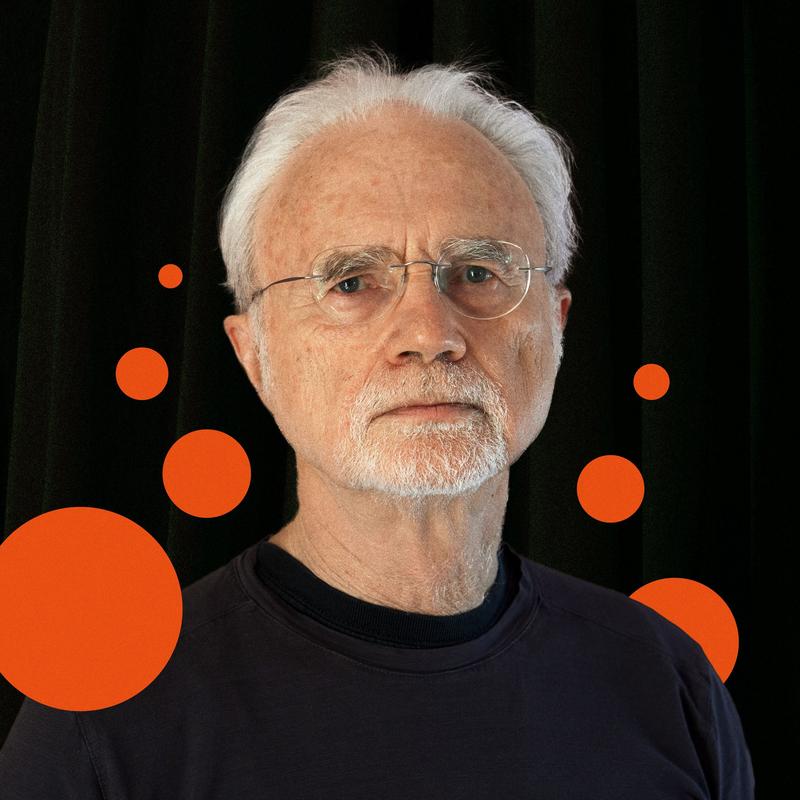
John Adams - not the President
Announcer: Classical Music Happy Hour is supported by Viking, committed to exploring the world in comfort, offering destination-focused small ship experiences on all seven continents with a shore excursion included in every port and programs designed for cultural enrichment, and every Viking voyage is all-inclusive with no children and no casinos. Learn more at viking.com.
John Adams: I thought that phrase came from Chuck Berry, but it turns out that it originated with Martin Luther.
[laughter]
[MUSIC - Theme song, Schumann’s Arabeske in C Major, Op. 18, performed by Manny (Emanuel) Ax]
Manny Ax: From WQXR and Carnegie Hall, this is Classical Music Happy Hour, hosted by me, pianist Manny Ax. Each episode, we'll speak with a special guest about their lives, listen to some of their favorite musical gems, play music-inspired games, and answer questions from you, our listeners.
My next guest shares a name with not one but two US presidents. He also just happens to be one of the preeminent composers of the 20th and now 21st centuries. Nixon in China, Doctor Atomic, Short Ride in a Fast Machine. His catalog of works reads like a top 10 list of contemporary classical music. He's a conductor, a writer, a champion of young composers, a frequent contributor to The New York Times Book Review, and he has millions of fans of whom I am one. John Adams, welcome to the show.
John Adams: Thank you. It's great to be here, Manny.
Manny Ax: It's a great pleasure. I had the privilege of doing a piano concerto by you, I think maybe your first piano concerto.
John Adams: That's right, yes. Century Rolls.
Manny Ax: Century Rolls. Very exciting. With fabulous titles too. I have Manny's Gym in the second movement. I still think the third movement of that concerto is one of the great stories. You should tell it because you overheard a couple of professors at Berkeley. Is that what it was?
John Adams: Yes, this was back in the mid-'90s, and I did not know that there was a comet that was passing Earth once every 10 centuries or [crosstalk]--
Manny Ax: If I may say so. Probably one of the few things that you didn't know, because you seem to know everything else.
John Adams: [laughs] I heard a couple of, I assume they were professors, University of California in Berkeley where I live, talking about the term Hale–Bopp, and of course, I thought it was H-A-I-L, like, you know,-
Manny Ax: Yes.
John Adams: -and bop kind of music. Then I learned later that it was the name of the comet. Anyway, that phrase stuck to me, and since there was a sort of jazzy feel to the last movement of the concerto that I wrote for you, I named it Hail Bop!, only in my spelling.
Manny Ax: Fabulous. It's a wonderful title. You've now written three piano concertos.
John Adams: I have. Which is quite remarkable given that I can't play the piano. I never took a piano lesson.
Manny Ax: Well, actually, that's one of the questions I wanted to ask, was, you played clarinet.
John Adams: That's right.
Manny Ax: That was your first real instrument or your last real instrument?
John Adams: My only one, yes.
Manny Ax: How do you deal with doing a concerto for another instrument? You've written violin concertos. You've written a clarinet concerto.
John Adams: I have, yes.
Manny Ax: That you probably know about.
John Adams: Yes.
Manny Ax: I think you write wonderfully for the piano. I wondered how that came about.
John Adams: It's kind of a miraculous thing that I can't play the piano, and when I sit down, strange things come out. Here I have the greatest pianists alive.
Manny Ax: Whoa.
John Adams: You and Víkingur Ólafsson and Yuja Wang playing my concertos. I think it's possible that because I don't-- My hands don't go down on the keyboard in the conventional way. Perhaps I come up with ideas that somebody who is a pianist wouldn't dream of.
Manny Ax: Yes, I see what you mean. Sometimes the best teachers actually are ones that don't play the instrument that they're teaching because they don't worry about how to do it. They just talk about what they want to come out.
John Adams: That's a strange concept, but I'll try to get my head around that one.
Manny Ax: I do think very true. I've had a lot of lessons with chamber music things from violinists and cellists, and they would say, "This is what I want to hear. I don't know how you do it, but that's what I want." I think that's actually helpful because you can then try and figure out your own stuff.
[classical music]
Manny Ax: If you're composing a piano concerto, violin concerto, is there a subject?
John Adams: In some cases, there are. I'm thinking of the concerto. Well, I call it a dramatic symphony, which is a term from Berlioz that I wrote for Leila Josefowicz, a wonderful violinist.
Manny Ax: Violin, yes.
John Adams: That's called Scheherazade.2. It does have a bit of an imaginary narrative. A modern woman who is-- it's kind of a feminist concerto, if there is such a thing,-
Manny Ax: Nice.
John Adams: -with a little bit of an imagined scenario. There's one movement called Scheherazade and the Men with Beards, and I imagine her being scolded. I'm trying to think, well, I have a clarinet concerto called Gnarly Buttons.
Manny Ax: Gnarly Buttons, but I think that's not just you. I think in our time, there seem to be very few people that say Symphony No. 3 or Piano Concerto No. 2.
John Adams: This is true, yes.
Manny Ax: It's always some kind of title. Why do you think that is?
John Adams: Well, I have to hand it to my good friend Steve Reich. His titles are as clean and as pure as his music is. Music for 18 Instruments, Music for Mallets and Percussions, like that.
Manny Ax: Yes.
John Adams: I don't know. I just love titling my pieces. I have several. I suppose you could call them symphonies, but one of them I call Naive and Sentimental Music, which is a term that comes from Schiller. I have Harmonielehre.
Manny Ax: Harmonielehre. Isn't Harmonielehre a book by Arnold Schoenberg?
John Adams: Yes. It's about tonal harmony.
Manny Ax: About tonal.
John Adams: In a way, this piece of mine is an affirmation of my embrace of tonality, and the piano concerto I wrote for Yuja Wang. The title of that is--
Manny Ax: Why Does the Devil Have--
John Adams: No. You keep messing my titles up, Manny. [laughs]
Manny Ax: I'm really sorry. Why don't you tell me?
John Adams: Must the Devil Have All the Good Tunes?
Manny Ax: Oh, well, that makes it so much better.
[laughter]
Manny Ax: "Must the Devil," I will remember that.
John Adams: I thought that phrase came from Chuck Berry, but it turns out that it originated with Martin Luther.
Manny Ax: Really?
John Adams: Yes.
Manny Ax: Well, that's way back. What year was that?
John Adams: Well, it was before the invention of the electric guitar.
[music]
Manny Ax: I'm hoping you can help me answer some questions about classical music from our listeners. We've invited them to submit their questions, and we're going to do our best to answer them. If we don't know the answer, especially me, I'll be happy to make something up.
John Adams: Absolutely.
Manny Ax: Here's a question from Mary in New Jersey.
Mary: Hello, my name is Mary. I'm from Scotch Plains, New Jersey. My question is, what types of music like symphonies or Gregorian chants have changed the most or evolved the most over about the last 400 years? When I hear medieval pieces, King's Consort kind of things, and I hear contemporary concertos with horns, for example, I'm wondering what the connection is through history, if certain types of music have retained their construction the same way, or others have evolved quite a bit. Thanks for taking this question.
John Adams: That's a really good question, because I've long felt that music evolves in response to technological inventions. If you listen to the very famous Goldberg Variations by Bach, which originally we assume were played on the harpsichord.
[MUSIC - Bach: Harpsichord, Goldberg Variations, BWV 988: Var. 25]
John Adams: Then you hear the same piece on the piano. It's just a different universe altogether.
[MUSIC - Bach: Piano, Goldberg Variations, BWV 988: Var. 25]
John Adams: The piano kind of reached its ideal evolutionary point sometime in the 19th century, but before the piano was invented, Beethoven would never have written the kind of music he did. Likewise, look at the electric guitar, what that brought about, the whole genre of rock. That's one way of answering your question, but also, music responds to societal changes. Renaissance music, of course, that was all done within the court or within the church. Today we have recordings and radio and amplified music. You can have a concert with an audience of 30,000 people, whereas in the time of Haydn, it might have been, at the most 50 or 60. Music evolves just like life does.
Manny Ax: Do you think that there have been times of more and more complexity, and then the reaction to it, that music becomes, again, simple because people are tired of the complicated stuff, and then it gets complicated again, and it becomes simpler again?
John Adams: I do. We see this in literature where you get something like Henry James with his very florid sentences, and then you follow that with Ernest Hemingway, and likewise, the Baroque period, things were very, very ornate and complex.
[music]
John Adams: Then Mozart.
Manny Ax: Yes. You say, "I just want to tune with a nice accompaniment."
John Adams: Yes.
[music]
John Adams: I think that happened in the 20th century in classical music, because you had Schoenberg and Webern, very complex music. Then turn the page and it's Steve Reich.
Manny Ax: Yes, so there you are. Thank you so much for the question.
[music]
Manny Ax: I was asked once, I was on a talk radio show, and I said I was playing the John Adams' Century Rolls. He said, "Really? The former president?"
[laughter]
John Adams: Well, I remember waiting for my son in a big crowd at a baseball game, and this woman kept looking at me, and finally, she came up and she stabbed me, she said, "Excuse me, but are you John Cage?" [laughs]
Manny Ax: Well, your son's name is Sam.
John Adams: That's right, yes.
Manny Ax: He's got it worse than you do, because he's got the beer issue.
John Adams: He does, but he has managed to deal with that.
Manny Ax: He's a wonderful composer as well.
John Adams: That's right, yes.
Manny Ax: Your whole family is involved in music. Not your wife, I think.
John Adams: Well, actually, my wife Debbie does have a master's degree in composition from UCSD.
Manny Ax: I take it all back. Sorry.
John Adams: But she has devoted her life to photography, particularly landscape photography. Our daughter Emily started out as a violinist.
Manny Ax: That I knew, yes.
John Adams: She's now really quite a wonderful painter. The only thing we're missing in our family is somebody in finance to pay for it all.
Manny Ax: Yes. What you really need, actually, is a dentist.
John Adams: I think we need a really gifted stockbroker.
Manny Ax: [laughs] Okay. Well, there's nothing I can arrange for you. I'm sorry. I feel like the way your music works, at least from the point of view of the performer, it's a bit like a Mosaic, that things fit together in small increments. I certainly found that with Century Rolls, that we're constantly putting it together in little pieces and it makes a big picture. Do you do puzzles?
John Adams: I don't. I'm just not smart enough. My eight-year-old granddaughter, when I'm driving her to her lessons, she's in the backseat doing Wordle. Some people just have that. I know that Leonard Bernstein loved to do puzzles, and Stephen Sondheim. I'm just intellectually feeble.
Manny Ax: I was just curious, because it strikes me that a lot of the time, at least for me, putting a piece together involved puzzles.
John Adams: That's interesting. I try not to think too much in depth about how I compose for fear that I might--, as John Cade said this wonderful thing, about psychiatry. He stopped doing it because he might get rid of his devils, but he might also offend his angels. I think that I liken my creative process more to Magellan, just knowing that there's something out there, but not knowing exactly what it is or where it is.
Manny Ax: What did he write? He didn't write any piano concertos, did he?
John Adams: No. I am using what's called an analogy.
Manny Ax: Oh, it's an analogy. I'm sorry. Excuse me. This was the composer, right? Or was this the explorer?
John Adams: I'm talking about the explorer.
Manny Ax: The explorer, okay.
John Adams: Yes. It's what's known as a figure of speech.
Manny Ax: I wonder, he wouldn't have known the original John Adams, would he?
John Adams: No.
Manny Ax: He was long before that. You don't really analyze that aspect of things?
John Adams: No, I-- I remember one of my teachers, when I was in college, was a very gifted composer, David Del Tredici. This was back in the late '60s at the time when composers were like Milton Babbitt and Boulez, everything was systems, systems, systems. You couldn't make a decision without it following.
Manny Ax: Yes.
John Adams: David said, somebody like Brahms, he had all this gift. He had intuition, he had technique, and he could just let it flow. He didn't have to depend on systems or intellectually analyzing everything. That kind of fits me. Each composer is different. Some composers are very, very methodical, and others are like jazz musicians.
Manny Ax: What do you read for fun?
John Adams: I've always been interested in other languages, so I often punish myself by deciding to read. When I was studying German, I was reading or I was trying to read Thomas Mann.
Manny Ax: Wow.
John Adams: Lately, I've been reading, almost through the Neapolitan Quartet by Elena Ferrante. That's been a--
Manny Ax: In Italian?
John Adams: In Italian.
Manny Ax: Oh, fabulous.
John Adams: It's taken me a whole year to do that.
Manny Ax: I think I saw a German edition once of the Thomas Mann book Doctor Faustus.
John Adams: You can't read that. [laughs]
Manny Ax: Well, what impressed me was that I think the first word of it is the whole line, is one word.
John Adams: [laughs] It's one of those--
Manny Ax: They seem to put all their verbs and subject things all in one word.
John Adams: That's right.
Manny Ax: Which is fantastic.
John Adams: You have to unpack it. Our good friend Reinbert de Leeuw, wonderful Dutch conductor, had great command of German. He said, "I picked up Doctor Faustus, and no, I cannot read this in German."
[music]
Manny Ax: Well, I tried reading it in English.
John Adams: [laughs] That's hard enough.
Manny Ax: Hard enough.
[MUSIC - Theme song, Schumann’s Arabeske in C Major, Op. 18, performed by Manny (Emanuel) Ax]
Manny Ax: This is Classical Music Happy Hour. I'm Manny Ax. We'll return in just a moment.
[MUSIC - Theme song, Schumann’s Arabeske in C Major, Op. 18, performed by Manny (Emanuel) Ax]
Announcer: Classical Music Happy Hour is supported by Viking, committed to exploring the world in comfort. For over 25 years, Viking has been connecting the thinking person with the world, first on the great rivers, then on all five oceans, now on all seven continents.
Whether you choose to journey through the heart of Europe on an elegant Viking longship, explore the ancient cities of the Mediterranean on a small ocean ship, or venture to the white shores of Antarctica on a purpose-built expedition ship, you will always experience thoughtful service, destination-focused dining, and cultural enrichment on board and onshore, and every Viking voyage is all-inclusive with no children and no casinos. Learn more at viking.com.
[music]
Emmanuel Dzotsi: On Big Lives, we take a single cultural icon.
Kai Wright: People like Jane Fonda, George Michael, Little Richard.
Emmanuel Dzotsi: And we pull apart the story behind the image.
Kai Wright: We do this by digging through the BBC's vast archives.
Emmanuel Dzotsi: Discovering forgotten interviews that change exactly how we see these giants of our culture.
Kai Wright: We're here for the messy, the brilliant, the human version of our heroes.
Emmanuel Dzotsi: I'm Emmanuel Dzotsi.
Kai Wright: I'm Kai Wright.
Emmanuel Dzotsi: This is Big Lives.
Kai Wright: Listen to Big Lives wherever you get your podcasts.
[music]
[MUSIC - Theme song, Schumann’s Arabeske in C Major, Op. 18, performed by Manny (Emanuel) Ax]
Manny Ax: I'm Manny Ax, and this is Classical Music Happy Hour. Let's return to our conversation with John Adams. What's your favorite drink after a long day of composing or conducting?
John Adams: Well, I live in Northern California, where I think the IPA rage began, and I can't end the day without an IPA.
Manny Ax: You grin and beer it?
John Adams: Indeed. Of course, half of the fun of these beers is their names, like dogs, birds, and "You'll Regret This."
Manny Ax: [laughs] This is all news to me. Wow.
John Adams: Let's see. One of my favorites is a beer called Nuclear Sandwich.
Manny Ax: [laughs] What's the first album that you bought with your own money?
John Adams: I suspect it was the Mozart Clarinet Concerto, because I did play the clarinet, but I also remember buying Sibelius Symphony. Those are back in the days when there was a label called Angel Records. The covers all look the same. I do also remember buying the score to Copland's Appalachian Spring with the money that I earned from my paper route.
Manny Ax: Oh. Which composers would you like to have to dinner? From now or from way back.
John Adams: Well, needless to say, Stravinsky was always interesting, although a lot of what we learn about him has been filtered through Robert Craft, but he was a very intellectually curious guy.
Manny Ax: What about for fun?
John Adams: For fun, not Debussy. I can go through all my favorite composers, and I wouldn't want to have dinner with any of them. I think--
Manny Ax: Not Mozart?
John Adams: I think if it were Mahler, the food would be very, very spartan. Mozart would be a lot of fun. Probably Haydn too.
Manny Ax: I think those guys would be good dinner guests. This is a question from a listener who wants to know about minor keys.
Barbara: This is Barbara from Knoxville, and my question is, what composers do you think use the minor keys most effectively? I love the music, the depth, the bit of mystery, and perhaps the darker emotions that come from those. I'm wondering what your experience of it is. Thank you.
John Adams: We have in Western music, major and minor keys. We think of the major key as the happy one and the minor key as the melancholy one. Every good song, every good piece of music has both. If you had nothing but major keys, it wouldn't be very interesting, but I think that there is a great repertoire of music that is essentially on the dark side of human experience, and those are the ones that are in the minor keys.
Manny Ax: One of the interesting questions that a friend of mine, Leonard Slatkin, used to ask, is just to go, what pieces begin in major and end in minor? There are not many.
John Adams: Yes.
Manny Ax: In fact, there are not so many pieces in minor keys that end in minor either.
John Adams: Well, this is true, yes.
Manny Ax: A lot of them end in major. I think if I were to pick composers that use minor keys very well, from my point of view, first of all, Brahms.
[MUSIC - Brahms: Cello Sonata No. 1 in E minor, Op. 38, I. Allegro non troppo]
Manny Ax: I love Brahms very deeply, but you couldn't call him a Happy-Go-Lucky composer.
John Adams: I agree. When Mahler really wanted to lay it on, like the Fifth Symphony.
[MUSIC - Mahler: Symphony No. 5, I. Trauermarsch]
John Adams: That is really--
Manny Ax: Yes. Well, a lot of funeral marches are in minor keys.
John Adams: True. Tchaikovsky, Pathétique Symphony.
Manny Ax: Yes.
[MUSIC - Tchaikovsky: Symphony No. 6 in B minor, Op. 74, IV. Finale–Adagio lamentoso]
Manny Ax: Yes, that's basically it. Thanks for the question.
[MUSIC - Tchaikovsky: Symphony No. 6 in B minor, Op. 74, IV. Finale–Adagio lamentoso]
Manny Ax: When you pick a subject for an opera, does the subject come first or the text. What was the first thing? Or was the music the first thing?
John Adams: No, the music was never the first thing. Each opera has a different story. In the case of Nixon in China, it was suggested by my longtime collaborator, Peter Sellars, who also suggested The Death of Klinghoffer. Doctor Atomic, which is about Robert Oppenheimer and the creation of the atomic bomb and predates the film by 20 years or so. That was suggested by Pamela Rosenberg, who was general director of the San Francisco Opera, and she had an idea of it being an American Faust story.
There was some deal with the devil that Oppenheimer made. In the case of Antony and Cleopatra, that's an interesting story, because the previous opera was about the California Gold Rush, Girls of the Golden West. One of the things we discovered in research was that a popular form of entertainment in California during the 1850s was reciting Shakespeare. In that libretto, there were a couple of passages from Macbeth, and I just loved setting Shakespeare. When I got a request from the San Francisco Opera to compose another opera, I suggested Antony and Cleopatra, which was a play that has always meant a great deal to me.
Manny Ax: You brought some music for us to listen to, and I'd love to know what you think about this Handel aria, which I have just heard and flipped over.
John Adams: Well, if we'd been doing this conversation a year ago, I never would have chosen a piece by Handel, but I wrote an article for The New York Times Book Review, which is a review of a new book called Every Valley by Charles King, which is a wonderful book, not only about the creation of the Messiah but also of Handel and of London during the first couple of decades of the 18th century. Part of the reason I chose the assignment was that I didn't know anything about Handel, so I took a deep dive into his music, and I just was absolutely floored by how beautiful it was. I'm not surprised that many times if you ask a singer who their favorite composer is, they'll say Handel even before Schubert or Mozart.
Manny Ax: Wow.
John Adams: This aria called Tu Del Ciel [foreign language].
Manny Ax: I looked it up, and I couldn't believe the title.
John Adams: Right. It comes from a very early oratorio. Handel was, like, 22 years old. He obviously was born in Germany, but he was living in Rome at the time, and he was in the company of cardinals who adored him. This oratorio, which has an Italian title, Il Trionfo Del Tempo E Del Disinganno, which means the triumph of time and disillusionment. It's an allegorical text written by a cardinal who I think had a crush on Handel. Among the characters, a deceit and time and pleasure and beauty.
[MUSIC - Handel: Tu Del Ciel, Il Trionfo Del Tempo E Del Disinganno]
John Adams: I chose this aria because it's so sublime and beautiful, and it also speaks to me.
[MUSIC - Handel: Tu Del Ciel, Il Trionfo Del Tempo E Del Disinganno]
John Adams: Because I need to be reminded when I'm setting a text about the shape of a melody, that it rises and then it has to come down.
[MUSIC - Handel: Tu Del Ciel, Il Trionfo Del Tempo E Del Disinganno]
John Adams: The way that a beautiful melodic phrase is supported by harmony.
[MUSIC - Handel: Tu Del Ciel, Il Trionfo Del Tempo E Del Disinganno]
John Adams: There are just these moments of dissonance which create a kind of tension and a conversation between the voice and the accompaniment.
[MUSIC - Handel: Tu Del Ciel, Il Trionfo Del Tempo E Del Disinganno]
Manny Ax: This particular aria is quite far-ranging.
John Adams: It is.
Manny Ax: There are lots of leaps for the soprano.
John Adams: Yes. If you're a really good vocal composer, you save those leaps. You know where to put them. You just don't toss them anywhere. This particular aria is incredible.
[MUSIC - Handel: Tu Del Ciel, Il Trionfo Del Tempo E Del Disinganno]
Manny Ax: I always do think of you as an opera composer. Does any verbal stuff transmit itself to the nonverbal music?
John Adams: No, I don't think so. I mean, when I set texts, first of all, I need really great words to set. One of the things that troubles me about a lot of contemporary American opera is that the composers are just not very discriminating about their texts. A lot of libretti, they're very prosaic. They get the message over, but there's such great music within a great text.
I've set John Donne and Emily Dickinson and Walt Whitman, and then my librettist for Nixon in China and The Death of Klinghoffer, Alice Goodman was a great poet. I think those are among the best libretti of our time. When I'm setting the text, I'm hearing in my head the rhythm,-
Manny Ax: The rhythm of the words.
John Adams: -and it's very much an American rhythm. I always just feel slightly uncomfortable listening to Benjamin Britten's vocal settings. They work within the context of his culture, but I grew up listening to American popular music.
Manny Ax: Yes, maybe it's the name, Benjamin Britten.
John Adams: [laughs]
Manny Ax: Maybe if it were Benjamin, I don't know, Benjamin New Jersey or something. Just asking.
John Adams: With my name, it's got to be American, I guess.
Manny Ax: You obviously want people to respond to your music and to listen to it as much as possible and to enjoy it in one way or another. I would think the most difficult thing in the world for any art form is to do something that is at the same time immediately engaging and yet interesting enough to come back to. Do you think about that aspect of things?
John Adams: I do. The thing is that I come from a generation, when I was in school, those were really the hardcore bad old days when composers had reputations for being indifferent to their audience, even arrogant. It always struck me as kind of ridiculous, because art, and particularly music, above and beyond all, music is really about communicating feeling. I care deeply about communicating what I feel to my audiences.
Manny Ax: I think what's terribly difficult for an audience sometimes is to engage with a piece enough that you say, "This was interesting enough for me to get to know it better," or even for a performer, to practice something a lot and find it interesting to play over and over and over. Is that something that doesn't enter your mind, or should it at all?
John Adams: Of course, it enters my mind. It's funny, I was having a conversation with a wonderful pianist, Orli Shaham, and she used the term "living composer."
[laughter]
John Adams: I thought, "Well, that's a really strange category." We don't talk about a living basketball player or a living mayor, but I think that what that term, where it comes from, is the fact that people just really associate great music with the past.
Manny Ax: Well, a lot of us, a lot of the people that play that music have especially, in my youth, the idea of playing a piece by someone alive was a real rarity.
John Adams: It's always interesting. You go to MoMA here in New York. You have to wait in line to get into the museum. People can't get enough of contemporary art.
Manny Ax: Absolutely. Or theater.
John Adams: Or theater. Exactly.
Manny Ax: Absolutely.
John Adams: Contemporary music, there's always a danger that people feel intimidated, but I think if they hear my music, hopefully they want to hear it a second time.
Manny Ax: Well, I do think you've managed to find that road where you hear a piece for the first time and you say either "I love this" or "I'm intrigued by it," and then you come back to it.
John Adams: Well, I said to a young composer, a good friend of mine, Timo Andres, I said, "There aren't enough earworms being written today. Write some earworms."
Manny Ax: [laughs] What are earworms? Tell me.
John Adams: Earworm is just a melody that gets stuck in your head.
Manny Ax: Oh, I see. I see.
John Adams: It's so good, you can't stop hearing it.
Manny Ax: I see.
[MUSIC - Satie: Gnossienne No. 3]
Manny Ax: Here's a question about tempo markings.
Lewis: My name is Lewis from Paoli, PA. My question is about composer's notations. For instance, Allegro ma non troppo, says who? The composer isn't around. Is this the conductor? Is it [unintelligible 00:32:44]? Is it some machine metric? What determines what is allegro and whether it's ma non troppo?
John Adams: What you're asking is the story of my life as a composer, because I really have very specific notions of tempe in my piece. If somebody plays a piece of mine too slow or too fast, I get really freaked out. There were composers who cared. We all know the story of Beethoven, who was the first composer to use metronome markings because the metronome was invented during his lifetime.
Manny Ax: Yes. The metronome being the gadget that you set it to a certain beats per minute, and it clicks and it tells you how fast it should be.
John Adams: Right. There were composers who just absolutely disdained the idea of a metronome. Debussy never would use it, and Brahms, as you mentioned, whereas a composer like Stravinsky or Bartók were like me, very specific about what they wanted. I think it's really in part the composers' wishes, but some music invites what we call interpretation, and it makes life interesting. If you listen to Leonard Bernstein, especially towards the end of his life, he really liked slow tempe. If you listen to Toscanini, he always went to the other end. Everything was brisk and tight and fast.
Manny Ax: I once heard Daniel Barenboim talk about, "What is a tempo?" He said tempo is a little bit like a suitcase, when you're packing for a trip. If you're someone that's very involved with bringing out specific details and you want things heard a certain way, that's like packing a suitcase for a two-week trip. Then other times, when you want things to flow, he said that's like packing for a weekend. The suitcase is what fits the particular music that you want to make. I thought it was a nice image. Obviously, one of the most important differences between performances is how fast or slow it goes.
John Adams: Of course.
Manny Ax: That's the interesting thing. It changes according to the hall you're playing in,-
John Adams: Very much so.
Manny Ax: -according to the instrument you're playing. If the piano has a very heavy action, maybe you can't play fast enough for what's demanded. You have to slow down. It's a great, great question, and something we deal with all the time.
[music]
Manny Ax: We just heard a question about tempo, and we have a little game that we'd like to play. These are performance directions in a score, and you're supposed to answer which ones are real and which ones are fake. Here's the first one. Eric Satie, French composer, is often known for his unusual humorous score markings. Out of these four options, which is the real Satie performance direction? A, arm yourself with clairvoyance. B, as if wild animals were gnawing on your liver. C, radiantly joyful despite the itching. D, as if in tune.
John Adams: I would say probably B.
Manny Ax: The wild animals gnawing on your liver?
John Adams: Yes.
Manny Ax: Well, I'm sorry to tell you, it's actually A, arm yourself with clairvoyance, and it's from a piece called Gnossienne by Satie.
[MUSIC - Satie: Gnossienne]
Manny Ax: Question 2. Mozart might not be known for wacky score markings, but he occasionally showed his wit and humor. Which of these directions can actually be found in one of Mozart's original handwritten scores, "For you, Mr. Ass," "Are you finished yet?," "A sheep could trill like that," or all of the above?
[music]
John Adams: Knowing Mozart, it's probably all of the above.
Manny Ax: It's all of the above. That's correct. That's the correct answer. It's all of the above.
John Adams: That's why we would like to have dinner with Mozart.
Manny Ax: Exactly.
[music]
Manny Ax: Some score markings are more complicated than others, but which of these directions is actually found in a score for timpani and orchestra? A, fill the timpani with hot water, and during the third movement, steep strong builder's tea, drink during the fourth movement. B, strike with the utmost force on the paper membrane of the timpani, in the process disappearing down to the waist in the body of the instrument. Freeze. C, step onto the timpani. Proceed to tap dance for the entirety of the second movement. D, ignore the marking tacit, which means quiet. Play something that will horrify the conductor.
John Adams: Having gone through-- I've done a lot of avant-garde concerts. I probably did all of those pieces. However, the second one sounds to me like it's been translated from the German, so I'm going to go with that one.
Manny Ax: That's absolutely correct. It was translated from the German, and it's from Mauricio Kagel's Konzertstück for Timpani Orchestra.
[MUSIC - Mauricio Kagel: Konzertstück]
John Adams: We have to put this complete conversation in the Library of Congress. Okay?
Manny Ax: I hope I didn't annoy you too much, and it was wonderful to hear you pontificate on everything.
[MUSIC - Theme song, Schumann’s Arabeske in C Major, Op. 18, performed by Manny (Emanuel) Ax]
Manny Ax: John Adams, thank you so much for joining us today.
John Adams: Thank you. It's been terrific to be here.
Manny Ax: I am Manny Ax, and this is Classical Music Happy Hour.
[MUSIC - Theme song, Schumann’s Arabeske in C Major, Op. 18, performed by Manny (Emanuel) Ax]
Manny Ax: Classical Music Happy Hour is supported in part by the Robert and Mercedes Eichholz Foundation and by Linda Nelson.
Our production team includes Lauren Purcell-Joiner, Eileen Delahunty, Laura Boyman, Elizabeth Nonamaker, David Norville, Christine Herskovits, and Ed Yim.
Our engineering team includes George Wellington, Irene Trudel, and Chase Culpon.
Classical Music Happy Hour is produced by WQXR in partnership with Carnegie Hall.
Copyright © 2026 New York Public Radio. All rights reserved. Visit our website terms of use at www.wnyc.org for further information.
New York Public Radio transcripts are created on a rush deadline, often by contractors. This text may not be in its final form and may be updated or revised in the future. Accuracy and availability may vary. The authoritative record of New York Public Radio’s programming is the audio record.