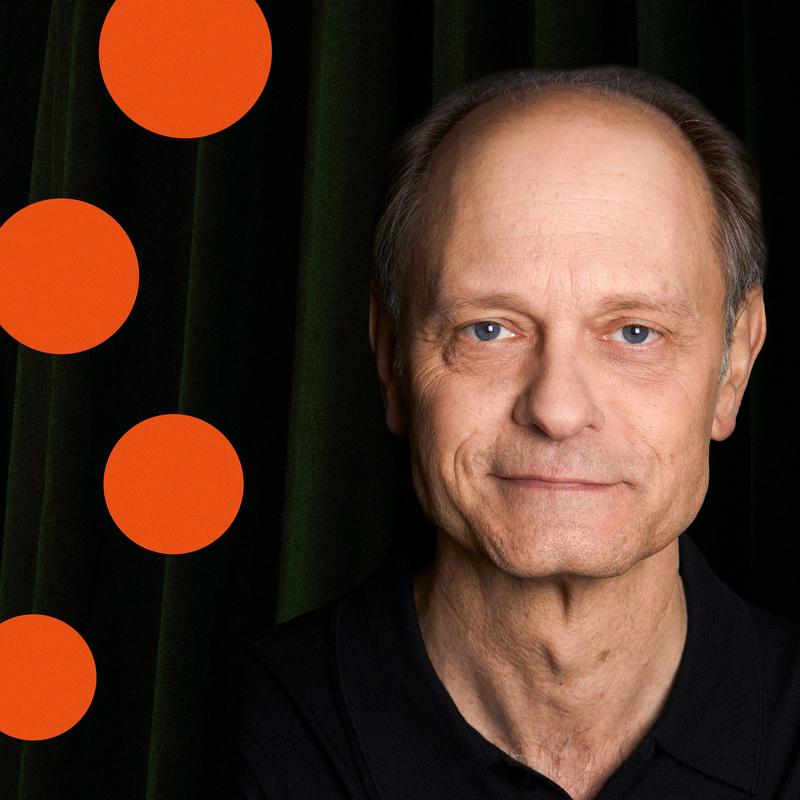
David Hyde Pierce - a.k.a. Niles Crane
David Hyde Pierce: There was one wonderful exchange between me and Frasier where I think Frasier says, "Remember when we thought the 1812 Overture was good music? Niles says, "Were we ever that young?"
[laughter]
Manny Ax: From WQXR and Carnegie Hall, this is Classical Music Happy Hour hosted by me, pianist Manny Ax. Each episode, we'll speak with a special guest about their lives, listen to some of their favorite musical gems, play music inspired games and answer questions from you, our listeners. My guest today is the actor David Hyde Pierce. You may know him for his many television, movie and stage appearances, including the character of Niles Crane from the sitcom Frasier, where he played Frasier's fastidious but lovable brother.
In that role, he won an Emmy for Best Supporting Actor four times. In recent years, he's been very active in musical theater, performing in of Hello, Dolly!, The Pirates of Penzance, and the very last musical that Stephen Sondheim wrote, Here We Are. David, welcome to the show.
David Hyde Pierce: Thanks, Manny. It's so good to be here.
Manny Ax: I know that we met quite a while ago. I doubt that you remember. I played at a private house, a sort of benefit for an organization in LA, and you happened to be there. I was starstruck immediately because I'd seen you on the show. Since then, we've done a few things. We've played together.
David Hyde Pierce: We did.
Manny Ax: How did you get started playing the piano at all? Was that something that you thought you might do for the rest of your life?
David Hyde Pierce: No, my parents made me. It became something I thought I might do for the rest of my life. As it turns out, I have just not so people can hear me. I was born in 1959, and when I was about eight, I started-- My brother and sisters, all older, had all taken piano lessons and they'd taken from this woman. Her name was Edith Stonequist. She was French, and her mother had taught at the Paris Conservatory. She told stories about how as a little girl, she would sit under the stairs at their home and listen to Alfred Cortot play the piano.
Manny Ax: Who was one of the great French pianists from before the Second World War, in fact.
David Hyde Pierce: That's right, yes. For about a year, my parents made me keep taking lessons. I didn't like It. I didn't like it. After a year, the thing that happened was I started to discover that I could sight read pretty well. Then I started to become voracious and just want to play things. What I loved about Mrs. Stonequist, she taught the love of the music. I had watched, on PBS, The Phantom of the Opera, the silent movie with Lon Chaney. The underscoring was different classical pieces.
Manny Ax: Yes.
David Hyde Pierce: The second subject of the first movement of the Appassionata, that was in that movie. I heard that, and I came to my next lesson and I said, "What is this?" I hummed it to her. She said, "It's this." She handed me the music and showed it to me. She said, "Go ahead, take a look at it." She didn't ever say, "Don't even come near this for 50 years." I just developed a love for it. I aimed to be a professional because I was having a lot of success. My high school senior, whatever project, I guess, was the Choral Fantasy.
[music]
Manny Ax: Oh, wow.
David Hyde Pierce: The guy who taught the chorus in my high school, his name was Jeffrey Vredenburg. I was cutting gym one day because I hated gym. They had this great Mason & Hamlin grand piano in a practice room. I was there playing, and he came by and spotted me, and said, "How would you like to play for the junior high school chorus?" Instead of saying, "Go to the principal's office." I did, and I started playing for them. I ended up playing with the orchestra, accompanying instrumentalists for competitions and stuff like that, playing the organ at church and doing all these things. I realized a culmination of all of that would be this Beethoven piece where there's a piano and an orchestra and a choir and soloists, and so I did it.
Manny Ax: In fact, it's a very funny piece because you see the stage and there's about 100 people in the chorus behind the orchestra. There's a big orchestra. Then this one guy comes out, there's a piano in front, and proceeds to play for five minutes on his own. If I were hearing this for the first time, I'd say, "What is everybody else doing there? Why is this guy annoyingly not letting anybody else do anything?" Eventually everybody comes in. It's kind of a trial piece for the end of the ninth Symphony.
David Hyde Pierce: Sure. That's right. That theme is very similar. God bless them, we had some wonderful musicians in my high school, but also high school string Players. This was not a music school. This was a public high school. That piece, as you said, there's like five minutes of piano solo. I am by no means God's gift to playing the piano, but the piano is an instrument that's in tune and if there's a wrong note, it's because I hit it. You get to the end--
Manny Ax: Unfortunately, I know.
David Hyde Pierce: You get to the end of that whole piano intro and then the strings come delicately in.
[music]
David Hyde Pierce: With the high school little completely out of tune, squeaky violins, you've been misled by this piano introduction. It's like, "Oh, okay." Then you have to adjust.
Manny Ax: Except in my case, I missed so many notes in that opening that nobody noticed, but it was fine. That was fine.
David Hyde Pierce: I'm glad to hear that.
Manny Ax: People who watched you on the show realized you loved classical music. Did you want to emphasize that side of things during the show, in the script and so forth? Did you have input in that?
David Hyde Pierce: No. I loved it anytime something like that came around. One of the creators of the show, David Leigh, is also very knowledgeable and into classical music as well, as were some of the other writers. On that show, I could say almost pretty much throughout, the actors didn't need to contribute any jokes or any lines because the writers were so good. There was one wonderful exchange between me and Frasier where I think Frasier says, "Remember when we thought the 1812 Overture was good music?" Niles says, "Were we ever that young?"
[laughter]
Manny Ax: Which is quite a put down of a wonderful piece.
David Hyde Pierce: It's a really good piece. I think it was more about the snobbery of these two guys, I think, than it was about Tchaikovsky's shortcomings.
[music]
Manny Ax: I'm hoping you can help me answer some questions about classical music from our listeners. We've invited them to submit their questions and we're going to do our best to answer them. If I can't answer, I'll make up an answer.
David Hyde Pierce: Oh, that's good.
Manny Ax: Or I'll get someone to look it up in the OED.
David Hyde Pierce: Oh, wow.
Manny Ax: Shall we go to Maggie from New York? She's got a question about where violinists stand.
Maggie: Whenever I see violinists performing with the pianist, the violinist is always standing in front of the pianist rather than in the crook where you often see a vocalist stand. I wonder why is that? Because it seems like it's difficult for the violinist to make eye contact with the pianist. There must be a reason. If you have an answer, I'd love to hear it.
Manny Ax: Okay. First of all, I feel that the best position for the violinist is offstage. Given that they want to be on stage and play, I think the best eye contact is actually if they do stand in front and to the right. Because then I see them very well. I like it, because being fat, it's nice to have someone cover the view of the audience to the piano. I'm fine with that. The crook is usually a place for the singer because the singer wants to feel a lot of support from the piano. The singers that I've worked with usually have enormous voices.
In fact, the human voice is much more powerful than a violin. If you do something with Joyce DiDonato or Renée Fleming or Susan Graham, any of these people, it's a huge voice, not to mention the guys. You actually need to support them quite a bit. They like having that feeling of the piano supporting them. When I play with Yo-Yo, the cello, he also sits in the position where you were talking about the violin being rather than the crook, because he's more comfortable not being assaulted by the piano noise. That's really the reason.
David Hyde Pierce: If you're playing a trio, does he sit there, and the violinist?
Manny Ax: If you're playing a trio, there's really no choice. We find a middle line. That's where we put the keyboard of the piano. Then the violin sits on one side, the cello on the other. They're usually a little farther to the front, so it's not overwhelming in any way.
David Hyde Pierce: Do they advance and retreat during the performance, like as they're trying to claim territory, or do they're pretty much--
[music]
Manny Ax: We're going to listen and talk maybe about a piece of music that we're both besotted by, which is the third movement of the Beethoven Trio, called the Archduke Trio.
David Hyde Pierce: There's a pattern. It goes back to the Bach Goldberg Variations. You have a theme and you hear it, and it has a certain beauty to it or whatever. Then you go on this journey, and at the end of the journey, the theme comes back and everything has changed. The theme has changed, you've changed. To me, this movement is such an exquisite version of that.
Manny Ax: It's a piece that I've known most of my life, have played very little, actually, but recently have played a lot with my buddies, Leonidas and Yo-Yo. Every time we play it, [music] we go into a little bit of a trance. [music] You can't help it. There's just something about this particular movement that just does it. [music] We're either in church or in a synagogue or in a mosque.
[music]
David Hyde Pierce: There's a kind of heartbreak and longing too, that it's also-- There might be something of that as well.
Manny Ax: It's also very human, of course. Yes. I have to admit, music is my religion, so that's--
David Hyde Pierce: That's a good one.
[music]
David Hyde Pierce: Where was he in his hearing life when he wrote this?
Manny Ax: I think he was probably near the end. The thing about his general ability to have things work even though he couldn't hear, I don't know where that's--
David Hyde Pierce: Especially things like this that have not been written before. This is not, forgive me, a Haydn or something where it's a much more structured. This, imaginatively, is so out there.
Manny Ax: Generally, the stuff that he did when he was almost not being able to hear. He heard noises and things. It all seems to work so incredibly well. This is the amazing part. You don't have to change anything with the Beethoven symphony if you just play it correctly. Everything seems to work in terms of balance and projection and so forth. That's true of very, very few composers, even the great ones who had perfect hearing and could experiment. For someone who spent most of his life saying, "What?" It's pretty--
David Hyde Pierce: His answer to the question, what? Is pretty profound.
Manny Ax: Yes.
[music]
Manny Ax: I'm Manny Ax. This is Classical Music Happy Hour. We'll return in just a moment. This is Classical Music Happy Hour. I'm Manny Ax. Let's hear a little more from our talk with David Hyde Pierce. What is your favorite drink after a long day?
David Hyde Pierce: Ooh, either a non alcoholic beer or a vodka martini.
Manny Ax: Amazing combination.
David Hyde Pierce: It depends on the day.
Manny Ax: Do you ever pour the two together?
David Hyde Pierce: Not intentionally.
Manny Ax: Okay. [laughs] What's the best book you've ever read about music?
David Hyde Pierce: Oh, gosh. The Rest is Noise is a fantastic book.
Manny Ax: By Alex Ross.
David Hyde Pierce: Yes, that's the first one that comes to mind because it explains the inexplicable.
Manny Ax: first album that you bought with your own money.
David Hyde Pierce: That's a long time ago, and they were made of stone. [laughter] Can I answer a different question?
Manny Ax: Yes.
David Hyde Pierce: It's close enough. I didn't pay for this because it wasn't mine. When I was in elementary school, our music teacher-- It was a public school and we had music teachers. That's worth mentioning. She asked us to bring in a record of something that we liked. I looked through my parents records and they had something called the Pastoral Symphony of Beethoven. Never heard of it. Never heard it. I thought, "Oh, I bet nobody else will bring anything like this in." I brought that in, and she said, "Oh, how wonderful." She said, "It's a little long. We'll just play part. What's your favorite movement?" I said, "Oh, just play anything." She put it on, and it changed my life because I'd never heard that music. As soon as it started, I was on another planet.
Manny Ax: Who is your musical hero?
David Hyde Pierce: My piano teacher. Her name was Edith Stonequist. She was this wonderful old French woman. She instilled in me a deep love of playing the piano. Not a great skill, but a deep love of playing the piano. She was a huge fan of the New York Mets. When you would have lessons in the summer, it was fantastic because she would have the TV on in the other room and she'd sit there with her Mets hat on watching the television while you played. You could do anything and she wouldn't notice.
Manny Ax: You do a lot of TV and you do a lot of theater and musical theater. How big are your gestures, your voice, your attitude? How much does that change between television and stage?
David Hyde Pierce: I guess it's kind of a balance issue. My fundamental belief is that it's all the same, and it also really depends on the space. I've worked a couple times, at least twice, at the Shubert Theater in New York. The Shubert is probably the greatest Broadway house, because the way the seating is set up and the way the acoustic is in the place, you can virtually do nothing on stage. They get it. It translates. Like when we were doing Spamalot, which is quite a farce and broad comedy, but the way it works really is for people to play it straight. That's what makes it funny. That was my first time at the Shubert and I realized that you could transmit. It's like, oh, my God, Joyce DiDonato.
Manny Ax: The singer who does a lot at the Met.
David Hyde Pierce: Yes, she's extraordinary.
Manny Ax: She does Handel and various--
David Hyde Pierce: Everything.
Manny Ax: Everything. She does everything. She made pizza the other day. She does a lot.
David Hyde Pierce: She does a lot. There was-- Oh, gosh, I won't remember the opera. I think it was Donizetti. She was in the middle of a huge ensemble, and they were singing, and she sang pianissimo.
Manny Ax: Which means soft, soft, soft, soft.
David Hyde Pierce: Oh, no. Yes, that's what I meant. [laughter] This sound just came to you through the Metropolitan Opera, which is not a small space. It's just spectacular. People handle this differently. In general, I feel like when a performer or an actor or whoever has been doing it long enough, your instincts take over. Now, there's a famous story about the Muny Theater in St. Louis, which is so gigantic, it's like 400 billion seats. Famously, when you make an entrance, you have to gesture wildly with your hand when you speak so people in the house know who the hell's talking.
Manny Ax: I was asking, because I know for myself there's a difference between recording and being on stage. Very often, when you have played a piece for a while and then go into the studio and try and record it, you really have to change the dynamic range and the gestures because of the mic being close. I was wondering, when you have closeups on television, whatever you do is maybe less broad than what you do on stage. Or for you, that's just instinctive.
David Hyde Pierce: No, first of all, I'll answer that, I think, that I'm completely in shock to hear that about recording. It never occurred to me that you would have to adjust in that way.
Manny Ax: You don't adjust a priori, but what happens is you play something for the first time after having played it in concert, and then you listen back, and you realize that everything is maybe exaggerated.
David Hyde Pierce: Oh, it's interesting.
Manny Ax: It's too loud.
David Hyde Pierce: Of course.
Manny Ax: Too loud. Maybe too fast. There are differences, and you make a instinctive adjustment because of what you've just heard.
David Hyde Pierce: It's like being in a very live space. I know from my church work that some churches are so resonant that you either have to slow things down or be more articulate or both.
Manny Ax: That kind of adjustment. I was wondering if the same thing holds true when the camera is in your face.
David Hyde Pierce: When I was doing Frasier all those years, one of the great things about that show was we did it for a live audience. As someone coming from the theater, even though there were cameras, they were never up in your face like if you're doing a feature film. For me, it was the best of both worlds. I was working with theater actors, with Kelsey and John Mahoney and Jane and Perry.
I got used to having cameras and not being self conscious about it, and didn't have to modulate that much because there was a live audience there to play to. They weren't a million miles away. I think the balance was right. My experience in doing film is finding the freedom to not shut down and mute everything because you're so aware that there's a camera up your nose. I would be afraid of that if I were a musician.
Manny Ax: That's the thing with recording. One of the things that's happened now that I'm very old, the young generation, they never do anything wrong. They never miss any notes. They actually can record live concerts. I don't think I could ever have recorded a live concert without doing some inserts. Then you're in the studio, so it's a different experience. I think now any number of these young people can just do a record of a recital and have it come out and it's perfect.
[music]
Manny Ax: Janet from Short Hills in New Jersey has a question about memory.
Janet: How on earth do you keep all that music in your head? It really seems to be quite daunting.
Manny Ax: First of all, what I do is I write all the music on my left sleeve and look down there and nobody can see because I'm facing the other way.
David Hyde Pierce: Right. Smart.
Manny Ax: If I don't have enough room on the sleeve, for me, I practice a lot because I'm very slow at learning. I have to practice over and over and over. I find by the time I'm done practicing and am actually able to play the piece, it seems to stick in my head. I don't actually plan to memorize anything. I just memorize it. Of course, if it's a piece that's not familiar, like if it's a new concerto that was just written for me, I'll just go ahead and use music because I can't remember. That's one type of memory, is just repetition, repetition, repetition.
The great conductor Lorin Maazel, he had something that he called photographic memory, which was that he was able to actually visualize the music that he studied. I saw him do a rehearsal with no music. He was able to say to the orchestra, "Three bars before letter B, I would like this." He actually saw the thing in front. Other people have a combination of the two. I think for you, it's probably infinitely harder. I can imagine memorizing music. I can't imagine memorizing a script.
David Hyde Pierce: Right back at you. Seriously. Famously, actors always get asked, "How do you memorize all those lines?" As someone who plays and loves music, I am fascinated by memory. I could never play from memory. Even now if I'm playing something in a television show or something, it's very rare. It's interesting the thing about the photographic memory because I also feel like that's not a hearing the music thing. I'm sure, obviously he could do that as well.
Manny Ax: Yes, sure.
David Hyde Pierce: Literally, it's a visual thing.
Manny Ax: It's a visual thing. He actually could somehow visualize the score as it goes by. I will add one more thing. I think memory today should be a non-issue. I think if you can't memorize, just use the music. There's no reason why not. I just don't think it should be an issue and it certainly shouldn't make anyone nervous about playing something or learning something. That's my answer.
[music]
Manny Ax: Is Gilbert and Sullivan an opera or is it a musical?
David Hyde Pierce: Yes.
Manny Ax: Excellent.
[laughter]
David Hyde Pierce: Gilbert and Sullivan. I have a lot of G&S in my background. When I went to summer camp as a young boy, I went to a camp up in New Hampshire that had been founded in the early part of the 1900s. They had early part of the 1900s tradition of doing a Gilbert and Sullivan operetta every summer. Through the course of my however many years I was there, I got to either listen to, be in, and ultimately direct a lot of their shows. When I went to college, Yale had a Gilbert and Sullivan Society. They probably still do. now with The Pirates of Penzance, it's like coming back full circle.
Manny Ax: Thank you for that non answer. That's excellent.
David Hyde Pierce: Well, all right. Is it opera? You know what? It depends on the part. Sometimes I feel like it's opera. I know it's not great opera, but it has its moments. Sullivan was a--
Manny Ax: I love the music. I was just wondering how you visualize it.
David Hyde Pierce: I don't think of it as opera, but I feel like there are big choral-- Oh, like in Pirates, there's this huge second act mashup of all these different vocal lines. The cops are singing one thing and the pirates are singing another thing and the girls are singing something else.
Manny Ax: Like a Mozart Ensemble.
David Hyde Pierce: It's hard to say it's like Mozart, but it's Mozartian-esque-ish.
Manny Ax: Okay. When you're on stage in a non-musical, in a drama, do you feel that you have to collaborate the way an orchestral musician would have to collaborate? What I mean is, do you listen when they're talking to you, or do you concentrate on what you're going to do?
David Hyde Pierce: There were other people on stage. [laughter] No, I'll tell you, I love that question. That's a great question. It taps into something which is, I would say, from the first day of rehearsal and it never stops, that connection. Just recently, a dear friend who's a director asked me to do a one-person show. I said, "I don't wanna be out there, just me." The joy of it for me is that chamber music-ness of it. I'm drawn to it.
I work with the Orchestra of St. Luke's. I'm on the board of the Orchestra of St. Luke's, and that is a group, the core of which has been together for so long, 50 years. Then the aesthetic there is so collaborative and so sensitive and nuanced, and the privilege of sitting in on a rehearsal and watching them put a piece together. My introduction to the St. Matthew Passion, I'd never heard it before and I heard it in rehearsal. Bernard Labadie is our principal conductor, and it was life changing. That piece would probably change your life if you're open to it anyway. To hear it in that way and hear how people were shaping it and bringing things out teaches you so much about the piece of.
Manny Ax: Are there times when you don't know people, I won't say dislike them, but you don't know them very well and you're on stage with them, interacting?
David Hyde Pierce: Yes. Although it's a little bit different because by the time you're on stage in a production, you all know each other very well. It's very different. Like if you're playing a concerto, especially if you're doing it with a conductor or an orchestra you aren't familiar with, you don't have a lot of time to discover what they're like. Is that fair to say?
Manny Ax: Probably. I think it also depends on the individual person. Some people make friends very quickly and very easily and some need more time, maybe. Once in a while, there are even people who don't necessarily get along but still manage to.
David Hyde Pierce: Yes. Awful people.
Manny Ax: Exactly. Still manage to play together.
David Hyde Pierce: I have such romantic feeling about classical music and seeing great performances and things. I can imagine it can also be a little bit competitive in like a sporting event. There's famous stories of, I think, when Horowitz played the Rock three or something with Toscanini, or the Tchaikovsky. It was one of the first times he was out. It was like a race to the end about who was going to survive.
Manny Ax: Finish first.
David Hyde Pierce: I think so. I hope I don't have that story wrong. Anyway, the idea that I love the collaboration as opposed to the competition. You should have both. There should be a healthy competition.
Manny Ax: I think sometimes the music itself is a kind of competition.
David Hyde Pierce: Sure.
Manny Ax: Where you have the concerto principle, where you have the one against the many. Sometimes it's collaborative and sometimes you're fighting.
David Hyde Pierce: Yes, that's right.
Manny Ax: That's what you're supposed to be.
David Hyde Pierce: You're supposed to be.
Manny Ax: Of course, it's nice if you collaborate on the fight.
David Hyde Pierce: I remember as a young man listening to the Emperor concerto and really I'm getting-- Actually, my neck is tingling now as I'm talking about it. I used to get so excited about this in the last movement, when the orchestra and the piano would trade parts of the themes.
[music]
David Hyde Pierce: I just thought that was so cool that they'd each had it to themselves and they said, "We can do this together." I love that.
Manny Ax: It's a nice part of the piece. The rest of it, phooey.
[music]
Manny Ax: There is a game that comes from our producing partner, Carnegie Hall.
David Hyde Pierce: Oh, I love that.
Manny Ax: Who has a fabulous educational program with a lot of online resources. If you go to kids.carnegiehall.org, there are a lot of games and quizzes for kids and adults who are looking for a way to pass the time.
David Hyde Pierce: That's us.
Manny Ax: Yes. This game is called Animal or Instrument. I have not played this. I don't know what it's going to be like. I think the idea behind the game is what you hear. Is this an animal or is it an instrument? We're going to get David who's going to give us the answers, the other David, to introduce himself.
David Norville: This is David Norville, game key master.
Manny Ax: Okay. Thank you, David.
David Hyde Pierce: We're in good hands.
Manny Ax: Shall we try and have a go?
David Hyde Pierce: Sure.
Manny Ax: We're ready.
[animal sound]
Manny Ax: It's got to be a bird.
David Hyde Pierce: All right, I'll go with that. It sounds like a bird.
Manny Ax: Are you willing to go with it?
David Hyde Pierce: No, I'll support that. Yes.
David Norville: That was an animal, but the animal indeed was a leopard.
Manny Ax: What?
David Hyde Pierce: A leopard playing a bird. [laughter] How did it make that? What was it doing?
David Norville: I guess it's none of our business.
Manny Ax: But it's very scary. What if you have a bird bath outside your house? You walk out, you get--
David Hyde Pierce: There's a leopard in it.
Manny Ax: Not good at all.
David Hyde Pierce: It's probably how it learned. It learned when it made leopard noises that people would go the other way. If it makes little bird noises, then. Anyway.
Manny Ax: All right, next.
[instrument sound]
[laughter]
Manny Ax: I'm going to guess right off the bat. I'm going to say it's a trombone.
David Hyde Pierce: Oh.
Manny Ax: What do you think?
David Hyde Pierce: I was thinking it was an instrumentalist in the restroom, [laughter] but I could be wrong.
Manny Ax: Or a trumpet mouthpiece. We say it's an instrument.
David Norville: It is an instrument. The instrument is a trumpet.
Manny Ax: Okay. Correct. You nailed it.
David Hyde Pierce: All right.
Manny Ax: Fabulous.
David Hyde Pierce: Played in a restroom.
Manny Ax: Certainly.
Manny Ax: Next.
[instrument sound]
David Hyde Pierce: Oh, wow, that's interesting.
Manny Ax: I'm going to guess an instrument and it's like a slowly going wind machine. What do you think?
David Hyde Pierce: I think it's an instrument too, but I'm thinking of it more as a semi percussion instrument. I don't know.
David Norville: It's an instrument, but once again, it's a trumpet.
David Hyde Pierce: Oh, come on.
Manny Ax: It's a buzzing tech.
David Hyde Pierce: Oh, a buzzing tech.
Manny Ax: A buzzing tech. It certainly did buzz.
David Hyde Pierce: Yes, absolutely. Next.
Manny Ax: Okay. Do we have more?
David Norville: Yes.
Manny Ax: Okay.
[animal sound]
[laughter]
David Hyde Pierce: That sounds like a cat meeting a leopard.
Manny Ax: Yes, that's got to be me trying to play the coda of the Schumann Fantasie and getting unbelievably annoyed every time.
David Norville: That's great. That's the part we never get to hear.
David Hyde Pierce: It sounded like a cat to me, but I think it's supposed to sound like a cat and foolish. I say a cat.
Manny Ax: A cat.
David Hyde Pierce: That's what I say.
Manny Ax: I'm going to guess an animal also, but they all sound like birds to me. I think it's another kind of bird.
David Hyde Pierce: It's very messianic of you.
Manny Ax: Yes. Thank you.
David Norville: It is an animal this time. The animal is an armadillo.
Manny Ax: Oh, okay. I was close. [laughs]
David Hyde Pierce: I think these are from an animal comedy club where they're all doing impressions.
[music]
Manny Ax: I can't thank you enough for spending time with me.
David Hyde Pierce: It is always a joy for me to do this.
Manny Ax: You're the best.
David Hyde Pierce: This was so much fun
Manny Ax: Thank you. I'm Manny Ax. This is Classical Music Happy Hour. Classical Music Happy Hour is supported in part by the Robert and Mercedes Eichholz foundation and by Linda Nelson. Our production team includes Lauren Purcell-Joiner, Eileen Delahunty, Laura Boyman, Elizabeth Nonamaker, David Norville, Christine Herskovits and Ed Yim. Our engineering team includes George Wellington, Irene Trudel, and Chase Culpon. Classical Music Happy Hour is produced by WQXR in partnership with Carnegie Hall.
[music]
Copyright © 2026 New York Public Radio. All rights reserved. Visit our website terms of use at www.wnyc.org for further information.
New York Public Radio transcripts are created on a rush deadline, often by contractors. This text may not be in its final form and may be updated or revised in the future. Accuracy and availability may vary. The authoritative record of New York Public Radio’s programming is the audio record.